Texas parking lot injury resources
Texas parking lot injury claims: a knowledge hub
Parking lot injury representation for injured people in Dallas–Fort Worth
You may have a claim after a Texas parking lot injury if a driver, property owner, business, or contractor failed to use reasonable care and that failure caused your harm. An injury on someone's property doesn't make them liable on its own. The answer depends on what happened, who controlled the spot, what they knew, and the evidence.
Aaron A. Herbert is Board Certified in Personal Injury Trial Law by the Texas Board of Legal Specialization. The case review is free, and you can ask for one before you have a complete file.
Dallas (214) 200-4878 · Fort Worth (817) 500-4878
No fee unless we win. You pay no fees or expenses unless you recover.

The Law Firm of Aaron A. Herbert, P.C., Dallas, Texas.
Texas Bar license #24036761. Board Certified in Personal Injury Trial Law by the Texas Board of Legal Specialization since 2008.
Type at least 2 characters. Use arrow keys to choose a result and Enter to open it.
Start with what happened
- “I was just hurt in a parking lot. What should I do first?”What to do in the first 72 hours after a Texas parking lot injury
- “A car backed into me while I was walking.”Backing crashes and pedestrian injuries in Texas parking lots
- “I don’t know who is responsible for the lot.”Who can be liable for a Texas parking lot injury?
- “There may be video of what happened.”Preserving video and physical evidence after a Texas parking lot injury
- “A city, county or university owns the lot.”Injuries in government-owned Texas parking lots
- “How does a claim or a lawsuit work?”How to file and litigate a Texas parking lot injury claim
What we can discuss on your first call
- What happened, where and when
- Your injuries and treatment so far
- Evidence that may need to be preserved, such as video or an incident report
- Anything the business or an insurer has sent or asked you to sign
- Whether the firm can take the review further and what happens next
Bring what you have. Tell us what is still missing.
No fee unless we win. The written agreement explains the fee and case expenses before you sign.
(214) 200-4878
Dallas premises liability lawyer
(817) 500-4878
Fort Worth premises liability lawyer
Question | Short answer |
|---|---|
Who can be responsible? | A careless driver, the owner or operator of the lot, a business that controls the area, a paving or maintenance contractor, or more than one of them. |
Does falling in a lot prove the owner was negligent? | No. For a customer, the evidence has to show a condition that posed an unreasonable risk, that the owner or occupier knew or should have known about it, and that it failed to act reasonably. |
What if a city, county, or university owns the lot? | Written notice is generally due within six months, and a city charter can require it sooner. Get advice right away. |
How long do I have to sue? | Texas generally allows two years for a personal injury lawsuit, with exceptions. Have your date checked early. |
What should I do this week? | Get medical care, report the incident, keep your photos and receipts, and ask about preserving video. |
Want a lawyer to look at it? Request a review of your parking lot injury or call (214) 200-4878. Send the date, the exact spot in the lot, your injury, and any photos or witness names you already have. You don't need to know which company is responsible first.
Aaron Herbert is Board Certified in Personal Injury Trial Law by the Texas Board of Legal Specialization. You can check it on his State Bar of Texas profile, which also shows a Texas license dated November 6, 2002 [S1].
The firm's Texas parking lot injury lawyer page explains how the firm takes these cases. This hub explains what has to be investigated and what to ask before you hire anyone.
What kind of parking lot injury do you have?
Start with the event, because each one needs different evidence.
What happened (hypothetical), and what gets investigated first
- A reversing SUV that hit you on the walk to your car, for the driver's movement, view and phone use, plus any camera that covers the aisle
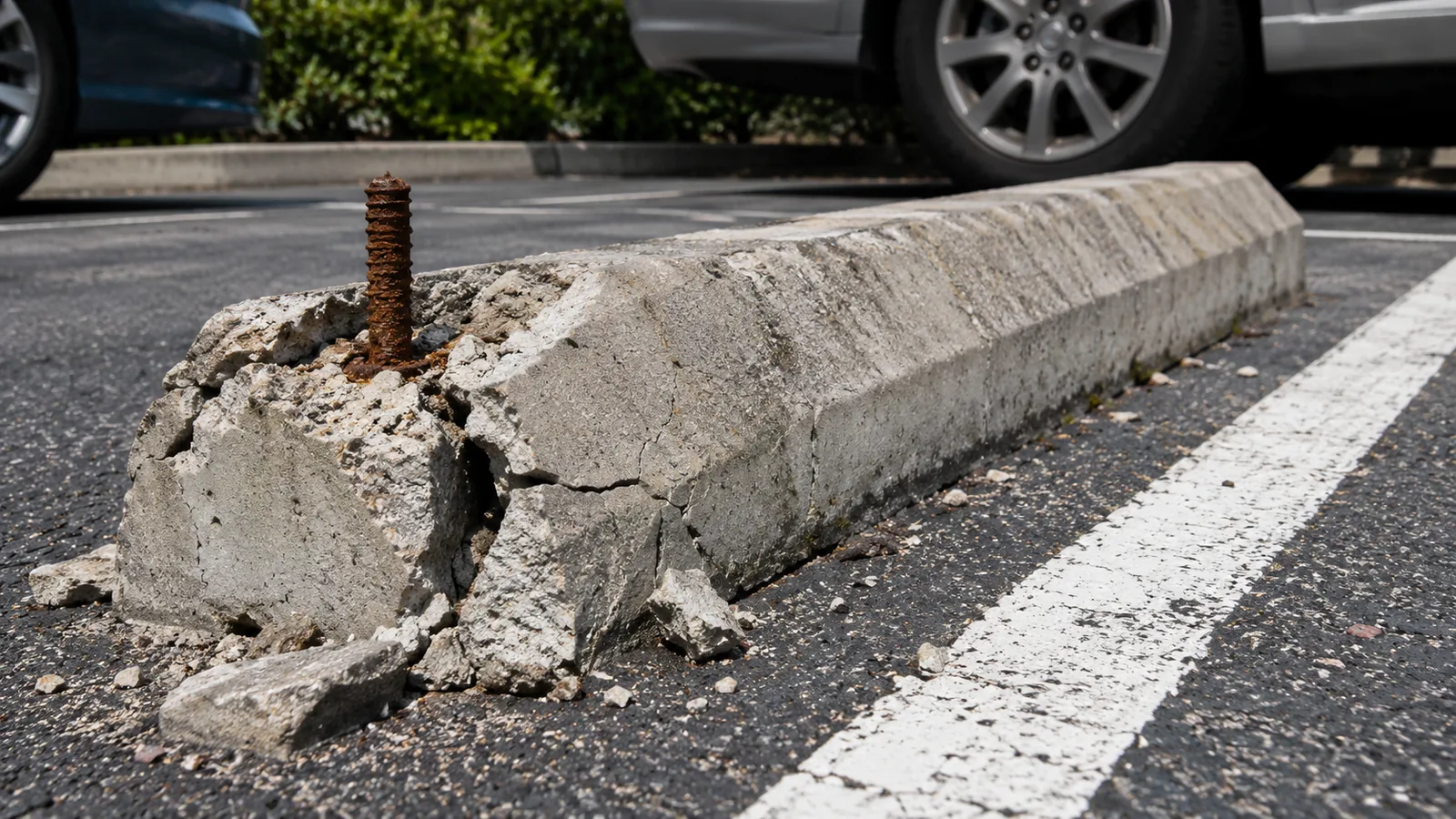
- A trip on a broken wheel stop with an exposed anchor, for the stop's condition, how long it had been that way and who maintained the lot
- A driver who swerved around an unmarked excavation and hit your car, for both the driver and whoever controlled the excavation
- A fall on a temporary path around active paving, for the contractor's work zone, barriers and who set the detour
- An assault near a dark corner of a garage, for lighting, earlier incidents and what the operator knew
Describe what you saw yourself and keep it separate from what someone told you later. If you don't know whether the liquid was oil or water, say so.
Setting, and why it matters
- Shopping center or grocery lot, because the store may lease only its building while another company manages the parking
- Apartment visitor parking, because the owner, a management company and a security vendor may each control different things
- Medical office, office park or garage, because a parking operator may run the lot for the owner
- City, county, state or university lot, because government immunity rules and short notice deadlines may apply
Free parking or public access doesn't tell you who owns the lot or which law applies.
What should you do right after a parking lot injury?
Get out of traffic if you can do it safely, get medical care, and then preserve what you can.
Steps, with hypothetical examples
- Get care first, such as a 911 call for a head strike or a possible fracture, and tell the doctor exactly how it happened
- Report it, by exchanging driver and insurance details and asking police for the report number after a crash, or by telling the manager and getting the incident number and the name of the person you told after a fall
- Photograph the scene, such as the hazard close up, the wider aisle, your route, signs, lighting and vehicle positions
- Keep proof you were there, such as a receipt printed at 6:42 p.m., a parking ticket or a payment-app record
- Get witness names and phone numbers, without telling anyone what to say
- Keep the physical items, such as shoes, clothing, a cane or walker and any dashcam files
An incident report helps document what happened. It isn't a lawsuit and doesn't extend any deadline. Our guide to what to do in the first 72 hours after a Texas parking lot injury has a full checklist.
When is another driver responsible?
A driver may be responsible for unsafe backing, distraction, speed that was too fast for the lot, or not keeping a proper lookout.
Evidence | What it can show |
|---|---|
Camera footage | Where each vehicle and person was before contact. |
Damage and resting positions | The direction and rough force of the impact. |
Witness accounts | Whether the driver looked before backing. |
Phone and vehicle data, where available | Distraction or speed, depending on the vehicle and access. |
Don't assume every lot crash is split down the middle. A pedestrian can have a claim against a driver with no other car involved, and a passenger's position differs from either driver's. Some Texas traffic statutes reach business parking areas and others don't, so the missing ticket, or the ticket that was written, doesn't settle civil fault [S29]. If you were walking, the firm's Dallas pedestrian accident lawyer page covers more; for a vehicle crash, see the Dallas car accident lawyer page.
When are owners and businesses responsible?
For a customer, the owner or occupier is generally responsible only if it controlled the area, the condition posed an unreasonable risk, it knew or reasonably should have known about it, and it failed to make it reasonably safe or warn.
Your status (examples) | What you generally must prove about knowledge |
|---|---|
Invitee, such as a shopper in a store's lot | The owner knew or reasonably should have known of the danger. |
Licensee, such as someone there with permission for their own purposes | The owner actually knew of the danger and you didn't (State Dep't of Highways v. Payne, 838 S.W.2d 235 (Tex. 1992)). |
Who controls the spot often isn't obvious.
Who may control what (hypothetical)
- Store tenant, for its entrance, cart corral and loading zone
- Property owner, for the common parking area and repaving decisions
- Property manager, for inspections, sweeping and repair orders
- Parking operator, for gates, payment machines and garage lighting
Leases, management contracts, maintenance logs, and what each company actually did help sort it out. Ask who could inspect, repair, close, or warn about the spot. The name on the storefront is where the search starts, not where it ends. The firm's Dallas premises liability lawyer and Fort Worth premises liability lawyer pages explain these claims in more detail.
Are potholes, wheel stops, and uneven pavement dangerous enough for a claim?
Sometimes. The question is whether that particular condition posed an unreasonable risk where it was, not whether it caused a bad injury.
Detail to record | Example (hypothetical) |
|---|---|
Depth and shape | A two-inch drop at the edge of a patched area. |
Location | In the walking path from the accessible spaces to the door. |
Visibility | Shadowed by a parked truck after dark. |
Exposed edges | A rebar anchor sticking up from a broken stop. |
In United Supermarkets v. McIntire, the Texas Supreme Court held that a small parking lot divot was not unreasonably dangerous on that record (No. 21-0208, June 17, 2022). The court didn't say every pothole or every defect under a certain size is safe [S7]. Repairs and traffic change a scene quickly, so photograph it soon and label any later photo with its date.
What about water, oil, ice, and drainage problems?
Timing usually decides these cases. For a temporary hazard like a puddle or a fluid leak, the evidence has to show how long that specific condition was there.
Possible source | What can help |
|---|---|
Vehicle fluid leak | Video of the car that leaked, and when it left. |
Irrigation overspray | Sprinkler schedules and earlier complaints. |
Clogged drain | Repair requests and photos from earlier storms. |
Cleaning runoff | Work orders showing when the sidewalk was washed. |
In H-E-B v. Peterson, the Texas Supreme Court held that earlier leaks elsewhere and the store's inspection routine didn't show how long the puddle had been there (No. 24-0310, April 10, 2026) [S8]. Rain, ice, and standing water don't always create liability and don't always defeat a claim. Investigate the specific condition and whether people made it worse.
Can lighting, layout, or blocked sightlines support a claim?
They can, if the problem is tied to a duty and to what actually happened.
Possible problem | Who may examine it |
|---|---|
Faded crosswalk striping | A traffic engineer, plus maintenance records. |
Overgrown landscaping blocking a view | A sight-distance analysis. |
Burned-out lights in a garage | A lighting expert and the repair history. |
A delivery truck parked in a fire lane | Video and witness accounts. |
"A better design was possible" isn't enough by itself. An event on the public street next to a lot raises separate questions; in HNMC v. Chan, the court held a hospital owed no special roadway duty beyond the parts of the right-of-way it controlled (No. 22-0053, Jan. 19, 2024) [S12]. For assaults, see the firm's Dallas negligent security lawyer page.
Can a paving or maintenance contractor be liable?
Yes, if the contractor created the hazard, did faulty repairs, controlled an active work zone, or failed to use reasonable care in the work it took on.
Record | What it shows |
|---|---|
Work orders and invoices | What the job was and when it was done. |
Plans and photos | What the area looked like before and after. |
Inspection notes | Whether problems were flagged. |
Emails with the owner | Who decided on barriers and detours. |
A contractor isn't immune just because the owner accepted the finished work [S11]. Claims about licensed design work can need a certificate of merit filed with the first petition, and claims by workers can follow different rules than claims by customers.
Is a lot open to the public the same as a government lot?
No. A private mall lot can be open to everyone and still be governed by ordinary premises law. A lot owned by a city, county, state agency, or public university raises governmental immunity.
Government lot rule (CPRC chapter 101) | What it means |
|---|---|
Six-month notice | Written notice is generally due within six months of the incident (§101.101(a)). |
Shorter city deadlines | A city charter or ordinance can set a shorter period (§101.101(b)). |
Actual notice | Written notice isn't required if the government actually knew of the injury (§101.101(c)), but don't count on an incident report proving that. |
Lower duty for premise defects | The government generally owes only the duty owed to a licensee, unless you paid to use the property (§101.022(a)). |
Damages caps | $250,000 per person and $500,000 per occurrence for the state and cities; $100,000 and $300,000 for other local units (§101.023). |
Seek advice quickly when a public entity may be involved [S19].
How many parties can share responsibility?
There's no rule limiting a parking lot injury to one responsible party. A driver, an operator, an owner, and a contractor can each have different duties tied to the same event.
Rule | What it means for you |
|---|---|
No double recovery | Suing more companies doesn't mean being paid twice for the same injury. |
Your share of fault | Texas reduces your recovery by your percentage of responsibility [S16]. |
The 50 percent bar | If you're found more than 50 percent responsible, you generally recover nothing. |
Settlements | Money paid by one party is credited against what the others owe. |
The number of companies named says nothing about how strong a case is.
What compensation may be available?
Depending on the evidence, damages can include medical expenses, lost earnings, reduced earning capacity, physical pain, mental anguish, impairment, and disfigurement.
What to keep
- Treatment records and bills, to show the care and what was paid
- Work restrictions and pay stubs, to support lost earnings
- A dated note of daily limits, since specific changes in walking, driving, sleep or work show the effect
- Improvements and setbacks, since an honest record is more believable than one that only gets worse
A settlement offer should be judged by what you'd actually receive after fees, case expenses, medical balances, and liens, not just the gross number.
What do public statistics and insurance minimums really tell you?
Less than you'd think. The National Safety Council says tens of thousands of crashes happen in parking lots and garages each year. In an NSC poll, 66 percent of drivers nationwide said they'd make phone calls while driving through lots and 56 percent said they'd text [S2]. Those are national, self-reported answers, not Texas crash causes.
Number people ask about | What the public sources show |
|---|---|
Texas parking lot injuries per year | No complete statewide count was found [S2–S5]. |
Number of Texas parking lots | No inventory exists; Census counts parking businesses, not every lot [S6]. |
Average Texas parking lot settlement | No reliable statewide figure was found. |
Auto insurance minimum | $30,000 per person, $60,000 per accident, and $25,000 property damage (30/60/25) [S25]. That's the legal minimum, not what a driver carries. |
Business liability limit | No universal limit; the actual policy has to be read [S26]. |
Explore the parking lot injury guides
- How to file and litigate a Texas parking lot injury claim, the full guide from the scene to trial.
- What to do in the first 72 hours after a Texas parking lot injury
- Preserving video and physical evidence after a Texas parking lot injury
- Who can be liable for a Texas parking lot injury
- Backing crashes and pedestrian injury claims
- Potholes, wheel stops, and pavement defect claims
- Slips on water, oil, ice, and drainage hazards
- Lighting failures and negligent security claims
- Lot design, striping, and sightline claims
- Claims against paving and maintenance contractors
- Injuries in government-owned parking lots
- Accessible parking routes and mobility-related injuries
- Insurance and policy limits for parking lot claims
- What a Texas parking lot injury claim may be worth
- Filing a parking lot injury lawsuit and preparing for trial
- Choosing a Texas parking lot injury lawyer
What should you ask before hiring a lawyer?
Ask how the lawyer would find every responsible party and what needs to be preserved now.
Ask | Why |
|---|---|
Who do you think controlled the spot where I was hurt? | It shows whether they'll look past the storefront name. |
What evidence could disappear this week? | Video and scene conditions don't last. |
Could a government deadline apply? | Six months, or less, can pass quickly. |
Who will keep me updated? | You should know who to call. |
How do fees and case expenses work? | Get the terms in a written agreement. |
You can check any lawyer's certification with the Texas Board of Legal Specialization; the firm's TBLS knowledge hub explains what board certification means.
Request a review of your parking lot injury
Request a review of your parking lot injury or call (214) 200-4878. Start with the location, date, what happened, your treatment, and the evidence you have. Tell the firm right away if a government entity may own the lot, if you've received court papers, or if a deadline is close. Please use the secure form for the basics and don't post medical records publicly.
Sources
- State Bar of Texas, Aaron Alan Herbert profile (Bar No. 24036761) [S1]
- National Safety Council, Parking Lot Safety (viewed October 31, 2026) [S2]
- NHTSA, Non-Traffic Surveillance [S3]
- TxDOT, Crash Reports and Records [S4]
- TxDOT, 2025 Instructions to Police for Reporting Crashes (CR-100, version 29) [S5]
- U.S. Census Bureau, NAICS 812930 Parking Lots and Garages [S6]
- United Supermarkets, LLC v. McIntire, No. 21-0208 (Tex. June 17, 2022) [S7]
- H-E-B, L.P. v. Peterson, No. 24-0310 (Tex. Apr. 10, 2026) [S8]
- Strakos v. Gehring, 360 S.W.2d 787 (Tex. 1962) [S11]
- HNMC, Inc. v. Chan, No. 22-0053 (Tex. Jan. 19, 2024) [S12]
- Texas Civil Practice and Remedies Code chapter 33 [S16]
- Texas Civil Practice and Remedies Code chapter 101 [S19]
- Texas Department of Insurance, Auto Insurance Guide [S25]
- Texas Department of Insurance, Commercial General Liability Insurance [S26]
- Texas Transportation Code chapter 550 [S29]
More guides in the Texas Parking Lot Injury Knowledge Hub
Who can be liable for a Texas parking lot injury?
Drivers, employers, owners, tenants, managers and contractors can share responsibility for a Texas parking lot injury. See who controlled what.
Injuries in government-owned Texas parking lots
Hurt in a city, county or university parking lot in Texas? Learn the six-month notice rule, immunity limits, the licensee duty and damages caps.
Backing crashes and pedestrian injuries in Texas parking lots
Hit by a backing car in a Texas parking lot? See how movement, visibility, phone use and video affect pedestrian and backing crash claims.
Texas parking lot potholes, wheel stops, and pavement defect claims
Slips on water, oil, ice and drainage hazards in Texas parking lots
Claims against Texas parking lot paving and maintenance contractors
ABOUT THE ATTORNEY
Aaron A. Herbert
Founding Attorney
Board Certified in Personal Injury Trial Law
Aaron founded The Law Firm of Aaron A. Herbert in 2010 to focus on developing each client's case and seeking its maximum value. For over a decade, he has represented people seriously injured in major accidents and industrial catastrophes, pursuing trial verdicts and settlements while working to reduce the stress of litigation.
Education
- Texas A&M University · B.S., Criminal Justice, 1999
- University of Oklahoma College of Law · J.D., 2002; graduated in the top of his class
Trial experience & approach
Aaron earned numerous jury verdicts at boutique personal injury litigation firms. According to his biography, he spent a year as the top-earning litigation attorney at a firm that frequently appeared in verdict searches as having one of the highest numbers of trial wins in Texas. At another Dallas personal injury firm, he moved from managing pre-litigation attorney to managing litigation attorney over seven years as the firm grew into one of Dallas's largest personal injury firms.
His biography describes a reputation as one of America's most aggressive trial lawyers, with noteworthy recoveries from judges and juries and substantial pretrial settlements. Most of those settlements included confidentiality agreements requested by the defense. Aaron has said the recoveries were justified by the injuries and losses involved, which no amount of money could make someone choose to experience.
His approach combines passion, preparation, persistence and courtroom imagination. He believes a well-supported, engaged and motivated team working cooperatively helps deliver strong representation, with the goal of achieving the best possible result for every client.
Dallas roots, military service & publication
Born and raised in Dallas, Aaron enlisted in the United States Marine Corps after high school and later received an Honorable Discharge. He completed his university and law degrees after his military service and became a lifelong Sooners football fan in law school.
Publication: “Litigating Dog Bite Cases,” Texas Dog Law Seminar, Dallas, 2009.
Professional affiliations & recognition
Professional affiliations and recognition listed in Aaron’s biography:
- State Bar of Texas
- American Bar Association
- Association of Trial Lawyers of America (now American Association for Justice)
- Texas Trial Lawyers Association
- Dallas Trial Lawyers Association
- Dallas Bar Association
- Tarrant County Bar Association
- Million Dollar Advocates Forum
- The National Trial Lawyers – Top 100 Trial Lawyers