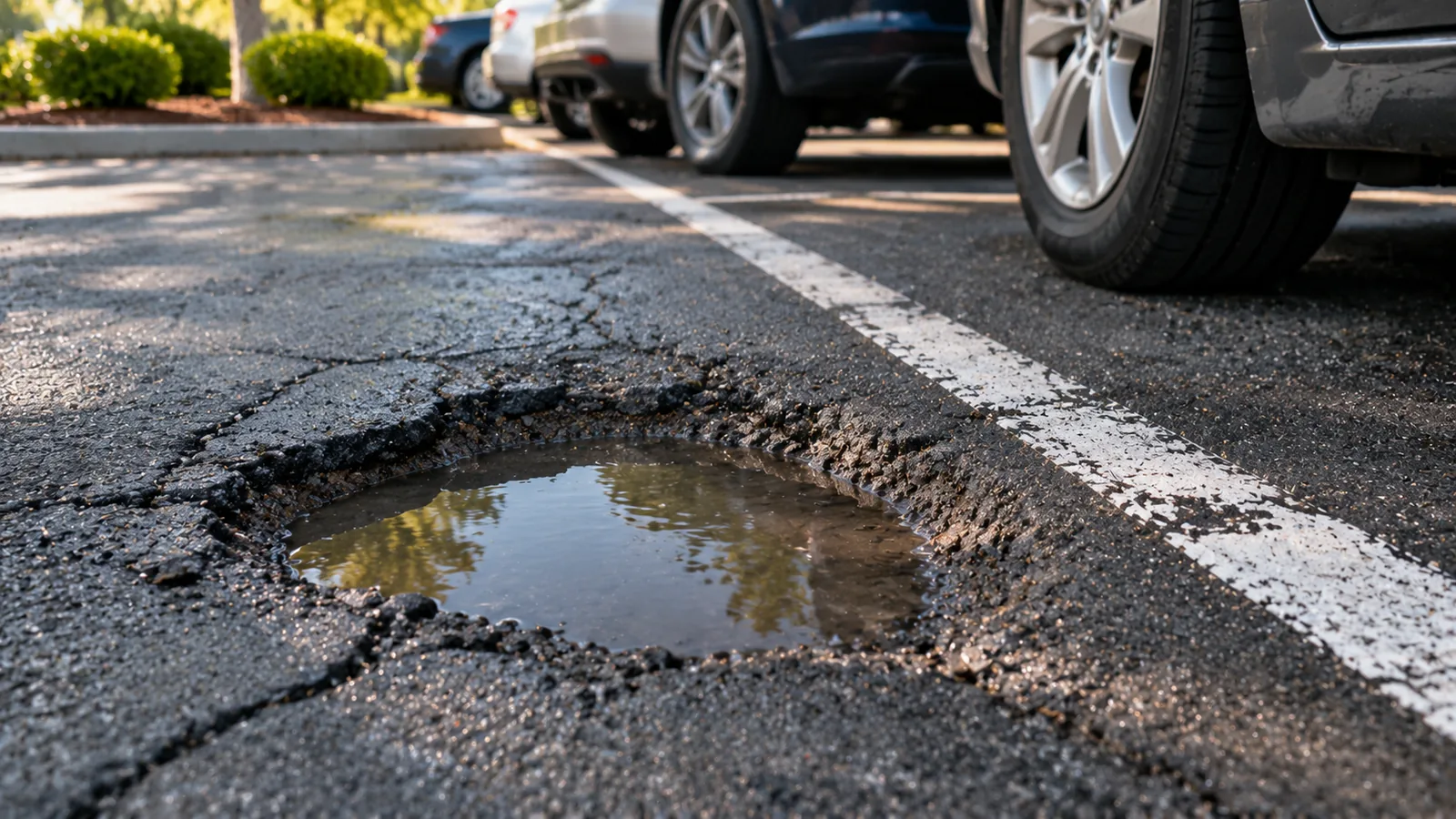
A pothole, a broken wheel stop, an exposed anchor pin, or a raised slab edge can support a Texas premises claim, but only if you can show the condition was unreasonably dangerous, the property owner or operator knew or should have known about it, they didn't use reasonable care to fix or warn, and it caused your injury. A fall and a serious injury aren't enough on their own. The shape, location, visibility, and history of the defect all matter. This guide is part of the Texas parking lot injury knowledge hub. If the defect may be repaired soon, request a review of your parking lot injury or call (214) 200-4878.
Question | Short answer |
|---|---|
Is every pothole grounds for a claim? | No. Texas courts have found some small defects not unreasonably dangerous [S7]. |
Does a small defect mean no case? | Not automatically. The feature and where it sits matter. |
Is a wheel stop a hazard by itself? | No. Placement, condition, and exposed hardware are what count. |
What if it was fixed the next day? | Keep your earlier photos. A repair isn't automatically an admission [S24]. |
What exactly did your foot or mobility aid hit?
Figure out the actual contact point before you call it a "trip on a wheel stop."
You might say (hypothetical) | What it may really have been |
|---|---|
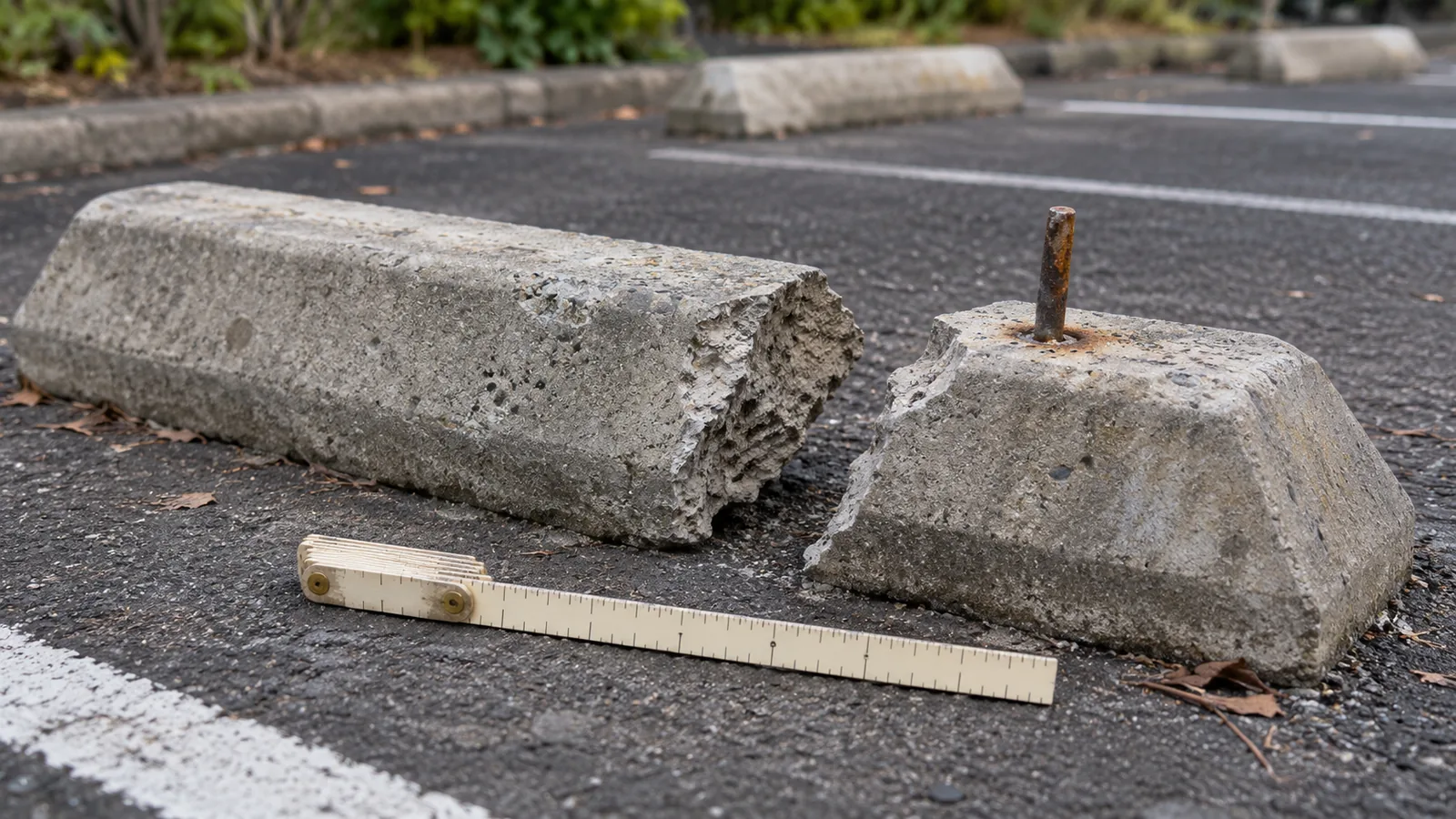
"I tripped on the wheel stop." | An exposed steel anchor at its broken end |
"I stepped in a pothole." | A raised edge where a patch met old asphalt |
"My walker caught on the curb." | A gap between the curb and a drain grate |
"I just fell." | Something you didn't see, to be identified later |
Didn't see what tripped you? Say that. A photo taken the next day shows a likely culprit, not the culprit. Scuff marks on your shoe, the path you walked from your car, a witness, a camera: those narrow it down.
What photos and measurements help most?
Take a close-up for detail and a wider shot from the direction you were walking.
- A close-up of the defect, for depth, edges, and exposed metal.
- A shot from your direction of approach, for what you could see before the fall.
- A wide shot with stall lines and cars, for where people walk and park.
- The lighting at that hour, for whether shadows hid it.
Measurement point | Why it matters |
|---|---|
Exact points and method | A depression can vary in depth, and an anchor pin can stick up more or less depending on what you measure from. |
Timing | A safe measurement later beats a rushed one in moving traffic. |
See what to do in the first 72 hours for the full early checklist.
Measurement tips, with hypothetical examples
- A stated reference point, such as "Pin top measured from the stall surface."
- A ruler in the photo, such as a folding ruler flat on the asphalt.
- The date and who measured, such as "Measured by investigator, March 9."
What did McIntire decide about small parking lot defects?
In United Supermarkets v. McIntire, the Texas Supreme Court held that one small divot in a parking lot was not unreasonably dangerous on the record in that case [S7].
McIntire did | McIntire didn't |
|---|---|
Decide that particular divot, on that evidence | Set a safe depth for every defect |
Hold that divot not unreasonably dangerous as a matter of law | Say no pavement defect can ever be dangerous |
Size isn't the whole story. A tape measure won't show a rusty anchor poking up, a lip lost in afternoon shade, or a hole right where drivers swing their legs out of the car. And the reverse holds: an ordinary crack isn't dangerous just because someone fell near it.
Who knew about the defect, and when?
Notice needs a history tied to this specific defect, not the lot in general.
Record | Strength (hypothetical) |
|---|---|
Email naming "broken stop, space 14, pin sticking up" | Strong for that defect |
Repair budget for "lot resurfacing" | Weak: not about the specific hazard |
Undated photo of the stop | Needs a date before it proves anything |
Employee who saw the pin last month | Strong, if the timing holds up |
Potholes grow slowly, which helps when you need to show a condition was there long enough to be found. Still, an undated photo can't date a defect. Sometimes an engineer or paving contractor can estimate how old a break is from its edges and debris.
Who controlled repairs and warnings?
The store may not own the lot, so find out who could fix it, block it off, or warn about it.
Who each question may point to
- The store, manager, or maintenance company, for who could put out a cone or barricade.
- The owner or property manager, for who approved repairs.
- The paving or repair contractor, for who did earlier work on it.
- The manager or tenant, for who received complaints.
Get the contracts and compare them with what each company actually did. Several companies can be part of the picture without all of them being liable. A paving contractor isn't free of responsibility just because the owner accepted its work [S11].
Contract says (hypothetical)
- Tenant handles only its storefront.
- Manager does monthly inspections.
Practice shows (hypothetical)
- Tenant staff put cones on lot defects.
- No inspection logs for six months.
Are wheel stops dangerous by design?
No. Wheel stops keep car bumpers from overhanging walkways, so their presence alone isn't negligence.
What can make a wheel stop a problem, with hypothetical examples
- A broken and shifted stop, with half of it pushed into the walking lane.
- Exposed hardware, such as a rusted pin sticking up two inches.
- A stop that is hard to see, such as a gray stop on gray concrete with no paint and poor light.
- A stop in a walking route, placed across a path people use to reach the door.
Accessibility standards also deal with vehicles overhanging accessible routes and with the slope of parking spaces and access aisles [S27, S28]. Use the provisions that actually applied to that lot at that time instead of assuming a wheel stop is always banned or always fine.
Does it matter whether the hazard was easy to see?
Yes. Warnings and visibility are part of the duty question, not just a fault percentage.
- Whether there was a cone, paint or barrier before the fall, because a warning added later isn't an earlier warning.
- Whether you could see it as you approached, because glare, shadow and parked cars can hide defects.
- Whether you already knew about it, because known or open-and-obvious hazards raise duty issues [S9].
- Whether you had to use that route, because a limited necessary-use exception may apply [S9].
Keep any cone, paint, or sign exactly as it was. Photos taken after the fall should be labelled with their date.
An exposed-anchor example (hypothetical)
A shopper falls by a broken wheel stop and photographs a steel anchor sticking up. An earlier maintenance message mentions the same stop, but its wording is vague.
Version of the message | What it may prove |
|---|---|
"Repaint stop in space 14" | Little about exposed metal |
"Stop broken, pin exposed, needs barricade" | Strong notice of the hazard |
Get the original message, who wrote it, who received it, and what happened next. The exact words decide how much it proves.
How should an expert handle standards?
An expert should explain how the defect caused the fall and why any cited standard applied to that lot at that time.
Strong report
- Separates a binding rule from good practice.
- Checks the date the standard applied.
- Uses outdoor standards for an outdoor lot.
- Tests other causes of the fall.
Weak report
- Treats every recommendation as a rule.
- Ignores when the lot was built or altered.
- Imports indoor floor standards without explanation.
- Assumes the defect did it.
Pavement injury questions
Does a small defect mean I have no case?
McIntire decided one divot on one record, so not automatically. The actual feature, its location and the evidence still matter [S7].
The lot was patched the week after I fell. Now what?
Texas Rule of Evidence 407 limits using later repairs to prove negligence, but they can still matter for other purposes [S24]. Hold on to your first photos and label the date on every later one.
Can the paving company be responsible?
If its work created the hazard and the other elements are proved, possibly. Finishing the job and having it accepted doesn't give a contractor blanket immunity [S11].
Request a review of the actual condition
Request a review of your parking lot injury or call (214) 200-4878. Bring your route, photos, treatment records, and any earlier complaints you know about. Aaron Herbert is Board Certified in Personal Injury Trial Law by the Texas Board of Legal Specialization [S1]. The firm handles these cases as a Dallas premises liability lawyer and Fort Worth premises liability lawyer. For the full claim process, read how to file and litigate a Texas parking lot injury claim.
Sources
- S1. State Bar of Texas, Aaron Alan Herbert profile (Bar No. 24036761).
- S7. United Supermarkets, LLC v. McIntire, No. 21-0208 (Tex. June 17, 2022) (per curiam).
- S9. Austin v. Kroger Texas, L.P., 465 S.W.3d 193 (Tex. 2015).
- S11. Strakos v. Gehring, 360 S.W.2d 787 (Tex. 1962).
- S24. Texas Rules of Evidence (Rule 407).
- S27. U.S. Access Board, ADA Standards chapter 5 (parking spaces and access aisles).
- S28. Texas Department of Licensing and Regulation, 2012 Texas Accessibility Standards.

ABOUT THE ATTORNEY
Aaron A. Herbert
Founding Attorney
Board Certified in Personal Injury Trial Law
Aaron founded The Law Firm of Aaron A. Herbert in 2010 to focus on developing each client's case and seeking its maximum value. For over a decade, he has represented people seriously injured in major accidents and industrial catastrophes, pursuing trial verdicts and settlements while working to reduce the stress of litigation.
Education
- Texas A&M University · B.S., Criminal Justice, 1999
- University of Oklahoma College of Law · J.D., 2002; graduated in the top of his class
Trial experience & approach
Aaron earned numerous jury verdicts at boutique personal injury litigation firms. According to his biography, he spent a year as the top-earning litigation attorney at a firm that frequently appeared in verdict searches as having one of the highest numbers of trial wins in Texas. At another Dallas personal injury firm, he moved from managing pre-litigation attorney to managing litigation attorney over seven years as the firm grew into one of Dallas's largest personal injury firms.
His biography describes a reputation as one of America's most aggressive trial lawyers, with noteworthy recoveries from judges and juries and substantial pretrial settlements. Most of those settlements included confidentiality agreements requested by the defense. Aaron has said the recoveries were justified by the injuries and losses involved, which no amount of money could make someone choose to experience.
His approach combines passion, preparation, persistence and courtroom imagination. He believes a well-supported, engaged and motivated team working cooperatively helps deliver strong representation, with the goal of achieving the best possible result for every client.
Dallas roots, military service & publication
Born and raised in Dallas, Aaron enlisted in the United States Marine Corps after high school and later received an Honorable Discharge. He completed his university and law degrees after his military service and became a lifelong Sooners football fan in law school.
Publication: “Litigating Dog Bite Cases,” Texas Dog Law Seminar, Dallas, 2009.
Professional affiliations & recognition
Professional affiliations and recognition listed in Aaron’s biography:
- State Bar of Texas
- American Bar Association
- Association of Trial Lawyers of America (now American Association for Justice)
- Texas Trial Lawyers Association
- Dallas Trial Lawyers Association
- Dallas Bar Association
- Tarrant County Bar Association
- Million Dollar Advocates Forum
- The National Trial Lawyers – Top 100 Trial Lawyers