Texas supermarket injury resources
Texas La Michoacana supermarket injury attorney knowledge hub
An injury at a Texas La Michoacana Meat Market store may support a claim when the evidence shows that a legally responsible party failed to use reasonable care about an actionable hazard and that the failure caused the injury.

The Law Firm of Aaron A. Herbert, P.C., Dallas, Texas.
Texas Bar license #24036761. Board Certified in Personal Injury Trial Law by the Texas Board of Legal Specialization since 2008.
Type at least 2 characters. Use arrow keys to choose a result and Enter to open it.
| What the evidence has to show | What doesn't prove it alone |
|---|---|
| An actionable hazard, such as grease by the meat counter | Being hurt inside the store. |
| The party that legally controlled that spot | The name on the storefront sign. |
| A failure to use reasonable care | The fact that any supermarket floor can get wet. |
| Where to start | Prompt medical care, accurate reporting, preserved evidence, and an investigation of the particular condition. |
Getting help after a supermarket injury
Get medical care first, then report the incident and keep what you already have.
| Step | What to do | Hypothetical example |
|---|---|---|
| Get care | If the injury looks serious, get emergency help; don't delay care for paperwork or photos | A relative handles the store report while you go to the emergency room. |
| Report it | When it's safe, tell management where and when it happened and what you personally saw | "I fell by the refrigerated case on aisle 6 at about 6:40 p.m." |
| Get names | Ask for the manager's name and an incident reference | Both written on the back of the receipt. |
| Keep paper | Keep the receipt and anything in writing from the store or a claims representative | The receipt and the adjuster's first letter in one folder. |
Photos help when they show the overall scene, your approach route, the condition, and any warnings. Keep the originals, note who took them, and remember that a photo taken after the fall may not show where a warning sat before employees responded.
| Do | Don't |
|---|---|
| Get each witness's contact information, since one may have seen the fall and another the condition earlier | Write an account for a witness to repeat. |
| Write down what each person actually saw | Alter the scene or handle a hazardous substance. |
| Keep what you saw separate from what you think happened | Speculate about how long a spill was there. |
Want a lawyer to look at it? Tell us about your La Michoacana injury or call (214) 200-4878. Contacting the firm does not create an attorney-client relationship.
| Read next | What it covers |
|---|---|
| The first 72 hours after a La Michoacana injury | How shoppers and families can preserve useful information while putting health first. |
Start with these guides
Why the exact store and responsible entity matter
The name on a storefront may differ from the legal entity that operates the business.
| Possible party | What might connect it |
|---|---|
| Property owner | The building or the parking lot. |
| Operator, employer, contractor, or claims administrator | Day-to-day control, staff, maintenance, or the letters after the incident. |
A receipt, property record, or claims letter is a lead, but none of them answers every responsibility question alone. In a 2018 Houston appeal, the defendant at one store was a limited partnership, LMMM Houston #41, Ltd., doing business as La Michoacana Meat Market #41.
| Question | Why it matters |
|---|---|
| Which La Michoacana? | La Michoacana Meat Market is a Houston-based Hispanic supermarket chain; its company page says it was founded in Houston in 1986 and has about 140 stores. |
| Is the ice cream shop the same company? | Don't assume so. Similarly named ice cream shops (paleterías) and independent businesses using "La Michoacana" are different businesses. |
| Where exactly did it happen? | An indoor aisle, a shared parking lot, an exterior walkway, or a leased space may involve different control evidence. |
| Do you have to sort this out first? | No. Preserve what's available and explain what's uncertain. |
| What should counsel do? | Investigate the legal parties early enough for filing, amendment, and service, without relying on a familiar brand name. |
| Read next | Identifying the correct La Michoacana defendant explains how records and testimony establish the relationships. |
What a Texas premises claim must establish
A typical shopper's premises claim has to prove four things, subject to the duty and facts that apply.
| Element | Hypothetical example |
|---|---|
| The responsible party knew, or should have known, about the condition | A cashier was told about the spill 20 minutes before the fall. |
| The condition posed an unreasonable risk of harm | Grease spread across the walking path at the meat counter. |
| The party failed to use reasonable care to reduce or eliminate the risk | No one cleaned or blocked off the area. |
| That failure caused the injury | The shopper slipped on that grease and broke a wrist. |
A business isn't an insurer of every visitor's safety, and the injury itself doesn't establish knowledge or breach. In H-E-B, LP v. Peterson (Tex. Apr. 10, 2026), the Supreme Court of Texas held that a shopper answering a no-evidence motion needed some evidence of how long the puddle had existed, and it reinstated summary judgment for the grocer.
| Knowledge question | How it's proved |
|---|---|
| Actual knowledge | Evidence that the responsible party knew about the condition before the accident. |
| Constructive knowledge | A fact-specific look at the opportunity to discover that condition, including how long it existed. |
| General risk | The general possibility that supermarket floors get wet doesn't establish notice of the particular condition. |
| Read next | Proving store notice in a La Michoacana fall shows how to organize time, place, employee, and record evidence. |
Claims based on ongoing employee activity may need a different analysis from claims about a condition left on the premises. Counsel should look at the facts and the governing law, not the label.
| Situation (hypothetical) | Likely starting point |
|---|---|
| An employee's moving cart strikes a shopper | Possibly negligent activity, because the injury came from the activity itself. |
| A shopper slips on water after mopping has ended | Usually a premises condition, which needs notice proof. |
Floors, warnings, and store operations
The first question is what actually caused the injury.
| Condition to investigate | Where it might show up |
|---|---|
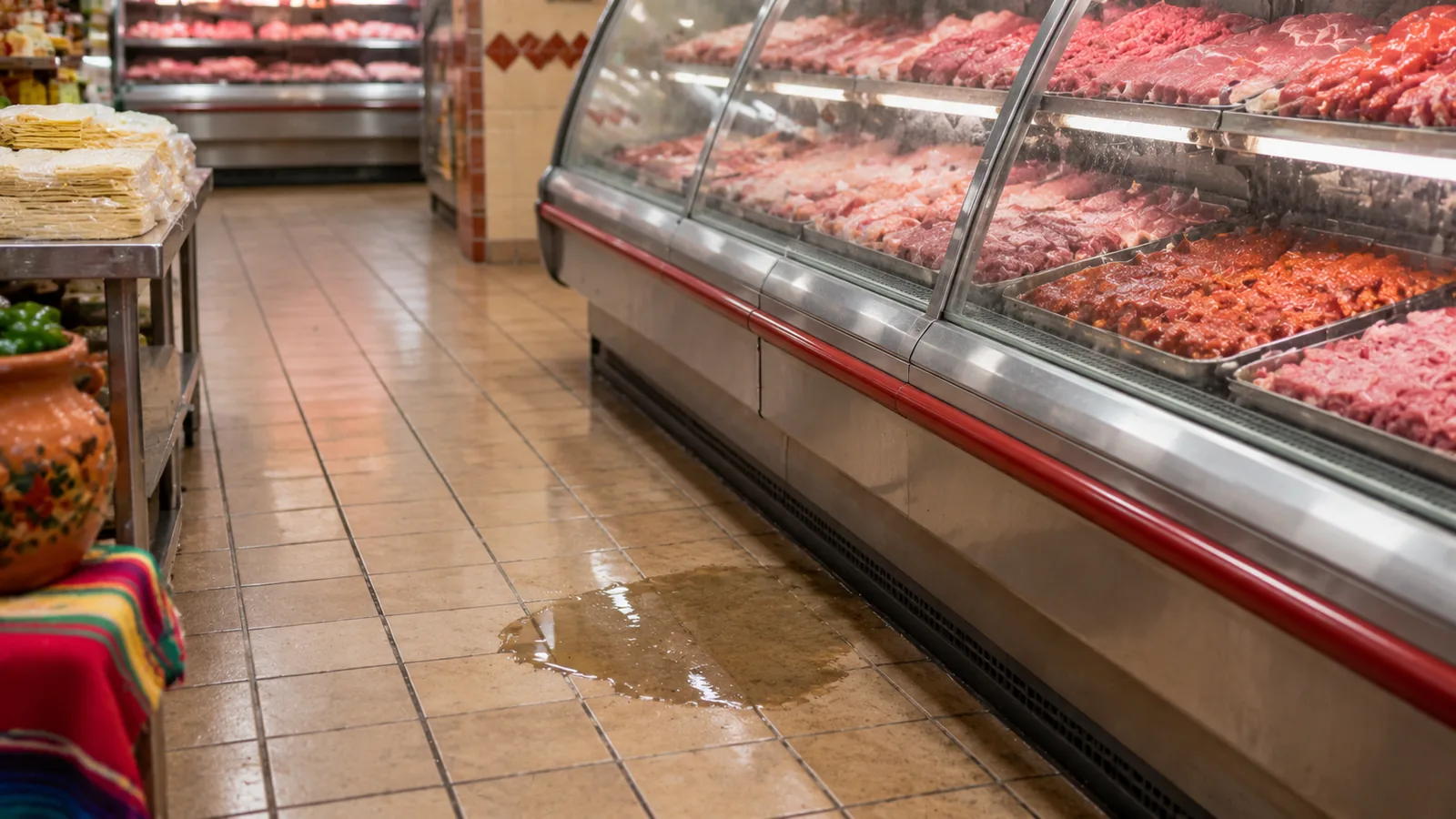
| Liquid, grease, or other residue | Near refrigeration, the meat counter, or an ice display. |
| Loose produce or unstable merchandise | The produce aisle or a tall endcap stack. |
| Obstructed walking routes and entrance mats | A pallet left in an aisle, or the front door on a rainy afternoon. |
| Pavement defects | The parking lot or an exterior walkway. |
A nearby condition isn't necessarily the one that caused the injury, and a later repair doesn't automatically show earlier negligence. Warnings call for an approach-based analysis.
| Warning question | Why it matters |
|---|---|
| Was the cone visible from the shopper's route? | A cone behind a shelf may not warn someone walking up the aisle. |
| Did a display block it, and did it address the danger? | A mopped-floor sign says nothing about a broken jar two aisles over. |
| When was it placed? | A cone put out after the fall doesn't show what warning existed before it. |
| Does a warning defeat the claim? | Not automatically, and its absence doesn't automatically prove one. |
| Read next | Wet floors and warning signs at La Michoacana explains why location and sequence matter. |
Parking lot incidents need their own investigation. Owning a lot doesn't make a business responsible for every vehicle collision, and a store sign in a photo doesn't prove control of the exact area.
| Possible party | What to check |
|---|---|
| Landlord, tenant, contractor, or driver | Location-specific evidence of the condition and each party's duties. |
Evidence that can change the case
Video may show when a condition appeared, who encountered it, what warnings were present, and how the injury happened.
| Evidence | What it may show |
|---|---|
| Footage from before the fall | When the condition appeared, which a request for only the moment of the fall can miss. |
| Other cameras | Who walked past, such as the camera above checkout lane 3. |
| Inspection and maintenance records | Whether and when the area was checked or repaired. |
| Employee communications and witnesses | Whether anyone reported the condition. |
Preservation should be prompt and tailored. A request doesn't guarantee that evidence exists or will be supplied voluntarily.
| A good preservation notice | Hypothetical wording |
|---|---|
| Identifies the incident well enough to find the material | "Fall near the refrigerated case on aisle 6, October 14, about 6:40 p.m." |
| Asks for a time range and records | "Video from 5:40 to 7:00 p.m. covering aisle 6, plus that day's inspection logs." |
| Doesn't invent a retention policy | Ask the store to keep the material without claiming a set retention period. |
| Read next | Preserving surveillance video after a store injury covers originals, exports, metadata, clock differences, and missing footage. |
Your own evidence needs the same care. An accurate record is worth more than a polished account that can't be reconciled with the originals.
| What to keep | Rule |
|---|---|
| Original photos, relevant messages, and existing social media | Don't delete unfavorable material or change a timestamp. |
| Medical documents and work records | Keep them together so they can be matched to dates. |
From investigation to a filed lawsuit
Before deciding how to proceed, a lawyer should weigh liability, damages, defenses, parties, deadlines, and the value of more investigation.
| Question | Short answer |
|---|---|
| Can the claim settle without a lawsuit? | It may, but ongoing talks shouldn't be assumed to extend limitations. |
| What is the deadline? | Texas personal-injury suits are generally subject to a two-year period under Section 16.003 of the Civil Practice and Remedies Code. |
| Is that the whole answer? | No. Accrual, exceptions, and service questions need legal analysis. |
If suit is filed, each stage tests a different part of the case.
| Stage | What it does |
|---|---|
| Written discovery | Seeks the records and identities needed for specific disputed issues. |
| Depositions | Test what witnesses know and how their accounts relate to the records. |
| Expert witnesses | Help with technical or medical questions when reliable specialized analysis is needed. |
A defendant may move for summary judgment before trial, and a serious injury doesn't remove the need to prove each element. The current Rule 166a, rewritten effective March 1, 2026, sets a response deadline of 21 days after the motion is filed for motions filed on or after that date, and local rules, standing orders, and the scheduling order also apply.
| Summary judgment point | What to know |
|---|---|
| The response | It needs competent evidence addressing the challenged grounds and compliance with the applicable procedure. |
| Which rule text | Use the current Rule 166a, not obsolete subsection references or remembered deadlines. |
| Local orders | Dallas and other counties have issued their own orders. |
| Read next | Responding to summary judgment in a supermarket injury case walks through the current rule. |
Medical proof and the losses that can be recovered
A claim should connect the incident to the injury through appropriate medical and factual evidence.
| Issue | How to handle it |
|---|---|
| A relevant prior condition | It doesn't automatically defeat a claim, but it may need careful analysis of what changed and why. |
| Treatment gaps, later events, and improvement | Address them honestly instead of leaving them out. |
The amount on a bill isn't automatically the recoverable medical amount, and a diagnosis doesn't establish every claimed future expense.
| Loss | Proof that fits it |
|---|---|
| Medical expense | Bills, payment records, and a treatment chronology. |
| Lost income | Work records and pay stubs. |
| Future care | Individualized support for each future need. |
| Pain and functional limits | Concrete facts that fit the medical evidence and acknowledge recovery, such as six weeks without lifting a grandchild (hypothetical), never the same loss twice. |
| Read next | Medical proof and damages after a La Michoacana fall explains chronologies, ledgers, and work records. |
Settlement, mediation, and the client decision
Settlement depends on the evidence, legal risks, supported damages, coverage or assets, expenses, obligations, and the client's goals.
| Topic | What the client should hear |
|---|---|
| Formula | No reliable formula values every supermarket injury. |
| Estimates | A lawyer should separate a preliminary estimate from a supported current assessment and explain what could change the recommendation. |
| Gross and net | Contractual attorney fees, case expenses, and enforceable obligations affect what you actually receive. |
| The release | Review the release terms as well as the dollar figure. |
| Read next | Settlement value and mediation includes an arithmetic example and questions about early offers and final disbursement. |
No verified Texas-wide annual La Michoacana injury total, settlement average, or universal customer-injury liability limit is supplied here. Selected lawsuits and publicized results aren't a representative dataset.
| Public data question | Where to look |
|---|---|
| What can public sources establish, and what would a defensible study need? | Choosing an attorney and reading public claim data explains both. |
Trial preparation and protecting the result
A trial-ready case connects admissible evidence to the questions the jury may decide.
| Before trial | Work involved |
|---|---|
| Witnesses, exhibits, and experts | Preparing testimony, choosing the clips and documents, and laying expert foundations. |
| Jury selection and the charge | Planning voir dire and drafting the proposed charge. |
Preparation can inform negotiation, but it doesn't force a settlement or guarantee a verdict.
| Guide | What it covers |
|---|---|
| Trial preparation and jury selection | Readiness and voir dire. |
| Trial proof and the jury charge | Witness examination, charge questions, and closing argument. |
| Post-trial motions and appeals | Why verdict, judgment, appeal, and payment are separate stages, and why deadline work starts before the outcome is known. |
| The complete trial-preparation guide | Investigation through appeal in one extended guide for practitioners. |
| A limit on all of them | Every litigation decision still requires the actual record, current governing law, and the court's orders. |
Evaluating Aaron Herbert for representation
Aaron Herbert is Board Certified in Personal Injury Trial Law by the Texas Board of Legal Specialization.
| Consider | What to ask or check |
|---|---|
| The credential | Weigh it with the factors below; certification is not a promise about the outcome of a La Michoacana claim. |
| Experience and plan | Ask what relevant experience the firm can accurately describe and how it will investigate and preserve evidence. |
| People and communication | Ask who will handle the work and how they'll keep you informed. |
| Risk and cost | Ask which legal issue is most uncertain and how costs affect your net recovery, and get fee terms in writing. |
| Spanish | If you need Spanish assistance, ask how it will be provided throughout the case. |
A clear explanation of process and risk is more useful than an immediate settlement promise made without the evidence. Tell us about your La Michoacana injury through InjuryAttorneyOfDallas.com, or call (214) 200-4878.
| Contact detail | Information |
|---|---|
| Firm | The Law Firm of Aaron A. Herbert, P.C. |
| Dallas office | 8330 Lyndon B. Johnson Freeway, Suite 700, Dallas, Texas 75243. |
| What to bring | The store location, incident date, photos, witness information, medical provider names, and correspondence. |
| Before you hire | Confirm representation and fee terms directly with the firm. Contacting the firm does not create an attorney-client relationship. |
Explore the knowledge hub
This hub serves injured shoppers and families, and each guide below takes Texas practitioners deeper into one stage of the case.
| Guide | What it answers |
|---|---|
| Complete guide to preparing a supermarket injury case for trial | How a store injury case moves from investigation through appeal. |
| The first 72 hours after a La Michoacana supermarket injury | What to do about care, reporting, photos, and witnesses right away. |
| Proving store notice in a La Michoacana slip and fall claim | How to show the store knew or should have known about the spill. |
| Wet floors, store hazards, and warning signs at La Michoacana | When a wet floor or a cone's placement helps or hurts a claim. |
| Identifying the correct La Michoacana business and property defendants | Which company or owner controlled the spot where you fell. |
| Preserving surveillance video and digital evidence after a store injury | How to ask for footage and records before they're lost. |
| Written discovery in a La Michoacana supermarket injury lawsuit | Which records and witness identities to request after suit is filed. |
| Store manager, employee, and corporate depositions in injury cases | How to question managers, staff, and a company representative under oath. |
| Experts and reliable testing in Texas supermarket injury litigation | When an expert is needed and what makes the opinion reliable. |
| Medical records, causation, and damages after a supermarket fall | How to tie the fall to the injury and prove each loss. |
| Settlement value, mediation, and net recovery in store injury claims | How offers are weighed and what you'd actually take home. |
| Responding to summary judgment in a Texas supermarket injury case | How to answer a motion under the current Rule 166a. |
| Trial preparation and jury selection in supermarket injury litigation | How to get witnesses, exhibits, and voir dire ready. |
| Witness testimony, jury questions, and closing argument in injury trials | How trial proof connects to the questions the jury answers. |
| Post-trial motions, appeals, and protecting a supermarket injury judgment | What happens after the verdict and which deadlines protect it. |
| Choosing a La Michoacana injury attorney and understanding public claim data | What to ask a lawyer and what public data can and can't tell you. |
Frequently asked questions
Here are short answers to the questions injured shoppers ask most often.
| Question | Short answer |
|---|---|
| Can I sue after falling at La Michoacana? | Possibly, if the evidence supports duty, a dangerous condition or negligent activity, knowledge where required, breach, causation, and damages; the injury alone doesn't establish liability. |
| What should I do first? | Get medical care, report the incident accurately, preserve safe and available evidence, and get advice about deadlines. Don't delay treatment to finish a report or take photos. |
| How much is my claim worth? | It depends on the evidence, defenses, causation, supported losses, coverage or assets, and expenses. This hub supplies no verified La Michoacana settlement average, and a medical-bill multiplier isn't a reliable evaluation. |
| What if the store says it didn't know about the spill? | Counsel should investigate actual and constructive knowledge with location- and time-specific evidence. Assuming employees must have known isn't proof. |
| Does a warning cone prevent a claim? | Not automatically. Its timing, placement, visibility, and relation to the hazard matter, and a cone placed after the fall doesn't show the warning before it. |
| Will my claim have to go to trial? | Some claims settle and others need trial, and no outcome is guaranteed. Your lawyers should build the evidence around the required proof and explain the risks as the record develops. |
Sources and legal authorities
These primary sources support the legal and factual statements in this hub.
| Source | What it supports |
|---|---|
| Texas Civil Practice and Remedies Code, Chapter 16 | The general two-year limitations period in Section 16.003. |
| Texas Judicial Branch, current statewide rules | The current Texas Rules of Civil Procedure, Evidence, and Appellate Procedure. |
| Supreme Court of Texas order amending Rule 166a | The rewritten summary judgment rule for motions filed on or after March 1, 2026. |
| H-E-B, LP v. Peterson, No. 24-0310 (Tex. Apr. 10, 2026) | The need for evidence of how long a condition existed to show constructive notice. |
| State Bar of Texas profile, Aaron Alan Herbert, Bar No. 24036761 | Aaron Herbert's Texas license and bar number. |
| Texas Board of Legal Specialization profile | His Board Certification in Personal Injury Trial Law. |
| La Michoacana Meat Market, Our Company | The chain's 1986 Houston founding and its statement of about 140 stores (undated page, viewed November 2, 2026). |
Legal sources checked November 2, 2026. Apply the governing law and court orders to the individual facts; this educational information does not create an attorney-client relationship.
ABOUT THE ATTORNEY
Aaron A. Herbert
Founding Attorney
Board Certified in Personal Injury Trial Law
Aaron founded The Law Firm of Aaron A. Herbert in 2010 to focus on developing each client's case and seeking its maximum value. For over a decade, he has represented people seriously injured in major accidents and industrial catastrophes, pursuing trial verdicts and settlements while working to reduce the stress of litigation.
Education
- Texas A&M University · B.S., Criminal Justice, 1999
- University of Oklahoma College of Law · J.D., 2002; graduated in the top of his class
Trial experience & approach
Aaron earned numerous jury verdicts at boutique personal injury litigation firms. According to his biography, he spent a year as the top-earning litigation attorney at a firm that frequently appeared in verdict searches as having one of the highest numbers of trial wins in Texas. At another Dallas personal injury firm, he moved from managing pre-litigation attorney to managing litigation attorney over seven years as the firm grew into one of Dallas's largest personal injury firms.
His biography describes a reputation as one of America's most aggressive trial lawyers, with noteworthy recoveries from judges and juries and substantial pretrial settlements. Most of those settlements included confidentiality agreements requested by the defense. Aaron has said the recoveries were justified by the injuries and losses involved, which no amount of money could make someone choose to experience.
His approach combines passion, preparation, persistence and courtroom imagination. He believes a well-supported, engaged and motivated team working cooperatively helps deliver strong representation, with the goal of achieving the best possible result for every client.
Dallas roots, military service & publication
Born and raised in Dallas, Aaron enlisted in the United States Marine Corps after high school and later received an Honorable Discharge. He completed his university and law degrees after his military service and became a lifelong Sooners football fan in law school.
Publication: “Litigating Dog Bite Cases,” Texas Dog Law Seminar, Dallas, 2009.
Professional affiliations & recognition
Professional affiliations and recognition listed in Aaron’s biography:
- State Bar of Texas
- American Bar Association
- Association of Trial Lawyers of America (now American Association for Justice)
- Texas Trial Lawyers Association
- Dallas Trial Lawyers Association
- Dallas Bar Association
- Tarrant County Bar Association
- Million Dollar Advocates Forum
- The National Trial Lawyers – Top 100 Trial Lawyers