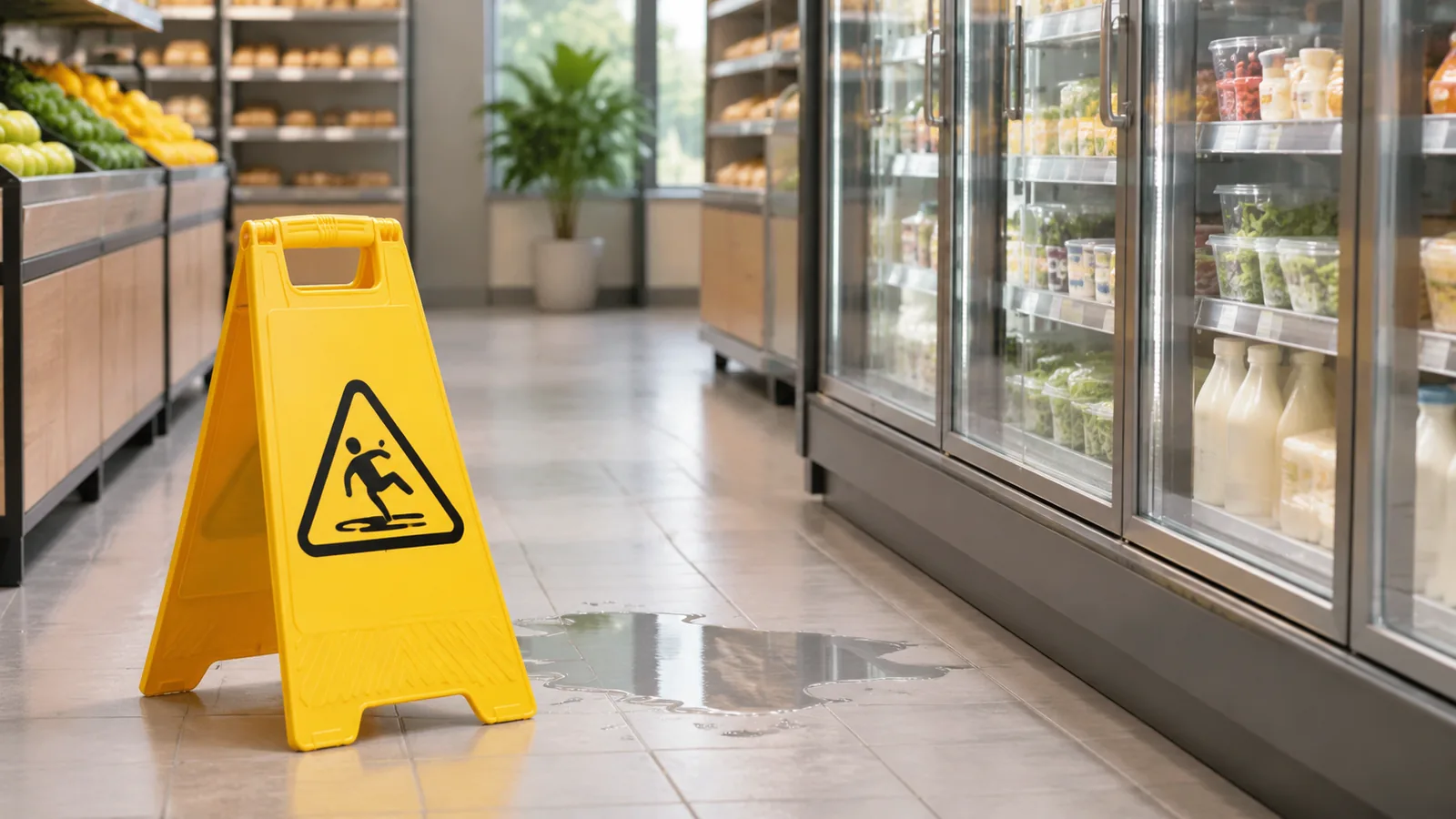
Texas grocery store injury resources
Texas HEB injury lawyer and claims guide
H-E-B injury representation for injured people in Dallas–Fort Worth
You may have a claim if a dangerous condition at a Texas H-E-B hurt you and the evidence shows the store knew or should have known about it, failed to use reasonable care, and caused your injury. A fall alone doesn't prove that, so get medical care first and then preserve the scene, the video, witness names, and records of what the store knew.
Aaron A. Herbert is Board Certified in Personal Injury Trial Law by the Texas Board of Legal Specialization. The case review is free, and you can ask for one before you have a complete file.
Dallas (214) 200-4878 · Fort Worth (817) 500-4878
No fee unless we win. You pay no fees or expenses unless you recover.

The Law Firm of Aaron A. Herbert, P.C., Dallas, Texas.
Texas Bar license #24036761. Board Certified in Personal Injury Trial Law by the Texas Board of Legal Specialization since 2008.
Type at least 2 characters. Use arrow keys to choose a result and Enter to open it.
Start with what happened
- “I was just hurt at H-E-B. What should I do first?”What to do in the first 72 hours after an H-E-B injury in Texas
- “I slipped on a spill. How do I show the store knew?”How to prove H-E-B knew about a spill: notice after Peterson
- “I fell near the produce or a sampling display.”H-E-B produce and sampling display falls: what a Texas claim needs
- “Water was leaking from a cooler or freezer case.”H-E-B refrigeration leaks and wet floors in Texas
- “I fell at the entrance on a rainy day.”H-E-B entrance mats, thresholds, and rain: Texas fall claims
- “How does a claim or a lawsuit work?”How to file and litigate an H-E-B injury claim in Texas
What we can discuss on your first call
- What happened, where and when
- Your injuries and treatment so far
- Evidence that may need to be preserved, such as video or an incident report
- Anything the business or an insurer has sent or asked you to sign
- Whether the firm can take the review further and what happens next
Bring what you have. Tell us what is still missing.
No fee unless we win. The written agreement explains the fee and case expenses before you sign.
(214) 200-4878
Dallas premises liability lawyer
(817) 500-4878
Fort Worth premises liability lawyer
Does an injury at H-E-B mean H-E-B has to pay?
No. The evidence has to prove notice, an unreasonable risk, a lack of reasonable care, and causation [S9].
Who else could be responsible?
A landlord, a cleaning or refrigeration contractor, a vendor, or a driver, depending on who controlled what.
How long do I have to sue?
Generally two years in Texas, with exceptions [S14]. For a hypothetical fall on March 3, 2026, that usually means filing by March 3, 2028.
What changed in 2026?
In H-E-B, LP v. Peterson, the Supreme Court of Texas required some evidence of how long a puddle had been on the floor [S6].
Should I take a payment right away?
Get a clear explanation of what still needs investigation before you accept money or decide to sue.
Tell us about your H-E-B injury or call (214) 200-4878. Bring the store address, the incident date, your injury details, any photos, and the names of witnesses, and don't worry if you haven't worked out the legal case yet.
- Aaron Herbert is Board Certified in Personal Injury Trial Law by the Texas Board of Legal Specialization.
- His State Bar of Texas profile shows bar number 24036761, licensed November 6, 2002, and eligible to practice [S1].
- Certification isn't a guarantee or a ranking, and it doesn't predict how your case turns out.
- The firm has no affiliation with H-E-B, and H-E-B doesn't endorse it.
Start with these guides
Guides in this hub
Each guide takes one part of an H-E-B injury claim and answers it in more depth.
- How to file and litigate a Texas HEB injury claim: the full process, from investigation and notice through summary judgment and trial.
- The first 72 hours after an injury at HEB in Texas: what to do about care, reporting, witnesses, and evidence in the first three days.
- Proving notice in a Texas HEB slip and fall claim: how actual and constructive notice are proved after Peterson.
- Texas HEB produce and sampling display injury claims: falls on produce, grapes, and spills near a sample stand.
- HEB refrigeration leak and wet floor claims in Texas: water from cases and coolers, and what ties a leak to a fall.
- HEB entrance mat, threshold and rain related injury claims: curled mats, floor transitions, and water tracked in on rainy days.
- HEB falling merchandise, fixture and construction injury claims: stacked goods, shelving, displays, and ceiling or construction failures.
- Texas HEB parking lot fall and walkway injury claims: potholes, wheel stops, drainage, and who controls the lot.
- HEB curbside, cart and parking lot pedestrian injury claims: curbside pickup spaces, cart movement, and vehicle traffic.
- Preserving HEB surveillance and injury evidence in Texas: what to ask the store to keep, and what happens when video is lost.
- HEB inspection records and corporate testimony in injury cases: inspection logs, maintenance records, and testimony from store personnel.
- HEB warning signs, known dangers and shared fault in Texas: cones, open-and-obvious hazards, and how fault is divided.
- Texas HEB injury settlement value and medical proof: what drives value and how medical expenses are proved.
- HEB injury statistics, settlements and liability insurance limits: what public data does and doesn't show.
- Texas HEB injury lawsuits, summary judgment and trial: filing deadlines, Rule 166a, mediation, and trial.
- Choosing a Texas HEB injury attorney: questions to ask a lawyer before you hire one.
Can you file a claim against HEB after a fall?
Yes, if the evidence supports it, but getting hurt at H-E-B doesn't automatically mean H-E-B must pay. A customer usually has to prove four things:
| What a customer usually has to prove | What that looks like (hypothetical) |
|---|---|
| The store actually knew, or should have known, about the condition. | A shopper told a clerk about spilled yogurt by the dairy case ten minutes before the fall. |
| The condition posed an unreasonable risk of harm. | Clear liquid spread across the walking lane by the frozen-food case on aisle 12. |
| The store didn't use reasonable care to reduce or eliminate the risk. | No cone, no cleanup, and no one sent to the aisle. |
| The condition caused your injury. | You slipped in that puddle and broke your wrist. |
These elements come from Keetch v. Kroger Co., and the Court applied the notice element again in Peterson [S6, S9]. Your status as a customer, who controlled the area, and any warnings also matter.
Be precise about:
- The condition itself, since a puddle is different from the refrigerator that may have produced it.
- What the store knew, since a cooler that sometimes needs service doesn't show knowledge of water at your spot.
- Which defect, since several cracks in a lot don't identify the one that tripped you.
- Your own account, keeping what you saw apart from what someone told you later.
Evidence that the store created the condition bears on knowledge but doesn't prove knowledge as a matter of law, and the factfinder decides it [S9].
An employee's ongoing work can matter. Negligent activity is limited to injuries caused by or as a contemporaneous result of the activity itself [S9, S13]. Two hypotheticals show the line.
| Event (hypothetical) | Likely theory |
|---|---|
| An employee pushes a stocking cart into you on aisle 7. | Negligent activity, because the activity itself hurt you. |
| You trip over a stocking cart left parked in the aisle an hour earlier. | Premises condition, because United Scaffolding, Inc. v. Levine treats a condition created by an activity as a premises claim [S13]. |
| A floor condition relabeled as active negligence to avoid notice rules. | A weak approach, so counsel should pick the theory the event actually supports. |
What should you do first after an injury at HEB?
Get clear of the danger first, and call 911 if the injury is serious.
Then photograph the spot, including the aisle sign or parking space, and tell a manager plainly what happened: "I slipped on clear liquid by the floral cooler and hurt my knee." Skip guesses about the cause or anyone's share of fault, and get the report number and the manager's name.
Take any form home before signing it, especially one that mentions payment or a release. Then keep what may disappear.
| Keep | Why |
|---|---|
| Witness names and phone numbers. | Someone may have seen the spill before you did. |
| Your receipt and purchase history. | They place you in the store at a specific time. |
| Original photos and video | Originals are better evidence than screenshots or cropped copies. |
| Your clothing and shoes | Their condition may matter if footwear or the substance is disputed. |
| A short dated account | Write what you saw before and after the fall while your memory is fresh. |
| What you don't know | Not knowing who caused a spill or how long it sat there is a reason to investigate, not a reason to guess. |
What should a preservation request ask H-E-B to keep?
Talk to a lawyer promptly, because cameras record over footage, floors get cleaned, and parts get replaced [S12]. A focused request names specifics:
- Footage from the cameras covering aisle 12 from 2:00 to 4:00 p.m., not just the minute you fell.
- The incident report and that day's floor-inspection entries.
- Work orders on the freezer case for the month before the fall.
- The name of the company that serviced the case or cleaned the floor.
- Your own messages and posts, since deleting them once a dispute is foreseeable can cause avoidable problems.
If footage is lost anyway, Texas courts don't treat that as an automatic win. In Brookshire Bros., Ltd. v. Aldridge the alleged hazard was grease that leaked near the store's rotisserie-chicken Grab-N-Go, and the store kept only about eight minutes of video while the rest was recorded over.
- The trial judge decides whether spoliation happened and picks a proportionate remedy [S12].
- An instruction is reserved for intentional spoliation, or negligent loss that irreparably deprived the other side of any meaningful ability to present a claim or defense.
- So ask for preservation early.
What does the Peterson decision mean for an HEB injury?
In H-E-B, LP v. Peterson, No. 24-0310 (Tex. Apr. 10, 2026), the Supreme Court of Texas reinstated summary judgment for H-E-B because the shopper had no evidence of how long the puddle had been on the floor [S6].
| Fact in Peterson | What the Court did with it |
|---|---|
| A customer slipped on a clear puddle in the toy aisle. | The question was constructive notice of that puddle, and its characteristics didn't show how old it was. |
| Video showed no employee walked down that aisle in roughly the two hours before the fall. | That still didn't show how long the puddle had been there. |
| The store had a heightened inspection protocol for rainy weather. | The inspection evidence didn't supply the missing timing proof. |
| H-E-B knew of earlier roof leaks in other parts of the store. | Leaks elsewhere didn't show how long this puddle existed. |
| Result | The Court reversed the court of appeals and reinstated summary judgment for H-E-B [S6]. |
Peterson follows the time-notice rule from Wal-Mart Stores, Inc. v. Reece, where an employee's proximity to a hazard wasn't enough by itself, though proximity and how conspicuous the hazard was can bear on whether it was there long enough [S8].
So the timeline needs evidence, and it can come from several places.
| Timeline question | Evidence that might answer it (hypothetical) |
|---|---|
| Did another customer see the spill earlier? | A shopper may have walked past the puddle at 1:40 p.m. and reported it at the deli counter. |
| Did someone notify an employee? | A page over the intercom or a text to the department lead. |
| Does video show when the water appeared? | Footage of a leaking jug in a cart rolling through at 1:25 p.m. |
| Was the spot the subject of a recent work request? | A ticket opened that morning for the same ceiling tile. |
| What's still uncertain? | Say so honestly, because each answer needs support. |
Grocery store hazards worth investigating
Falls may involve produce, spilled liquid, ice, equipment leaks, freshly cleaned floors, or tracked-in water. None of those alone establishes negligence [S6, S8-S10]. What to pin down:
- With produce or a spill, the exact item, where it was, and how long the store had to act.
- Near a drink area, the condition that caused the fall, because Brookshire Grocery Co. v. Taylor held a dispenser area wasn't unreasonably dangerous merely because ice sometimes fell [S10].
- With inspection evidence, whether it connects to this condition.
What if I tripped on a mat or threshold?
A photo taken later doesn't necessarily show the mat's position at the time of your fall. In a hypothetical rainy-afternoon trip on a curled entry mat, record:
- The point where your foot caught and the route you took.
- Visibility and lighting at the time.
- Earlier complaints about the same mat or doorway.
- The mat itself, preserved through proper procedures if its condition is disputed.
What if merchandise or a fixture fell on me?
These cases turn on stacking, shelving, installation, and work activity. In a hypothetical, a pallet jack may have been working the display at the end of aisle 9, or a soda display may have leaned after a restock. If construction was underway, get a qualified explanation of which component failed before blaming the work.
These pages go further.
- Texas grocery store falls, on fall claims across Texas.
- Texas retail and grocery store injury lawyer, on store injuries at any Texas retailer.
- Kroger slip and fall claims and Tom Thumb and Albertsons claims, in their own hubs.
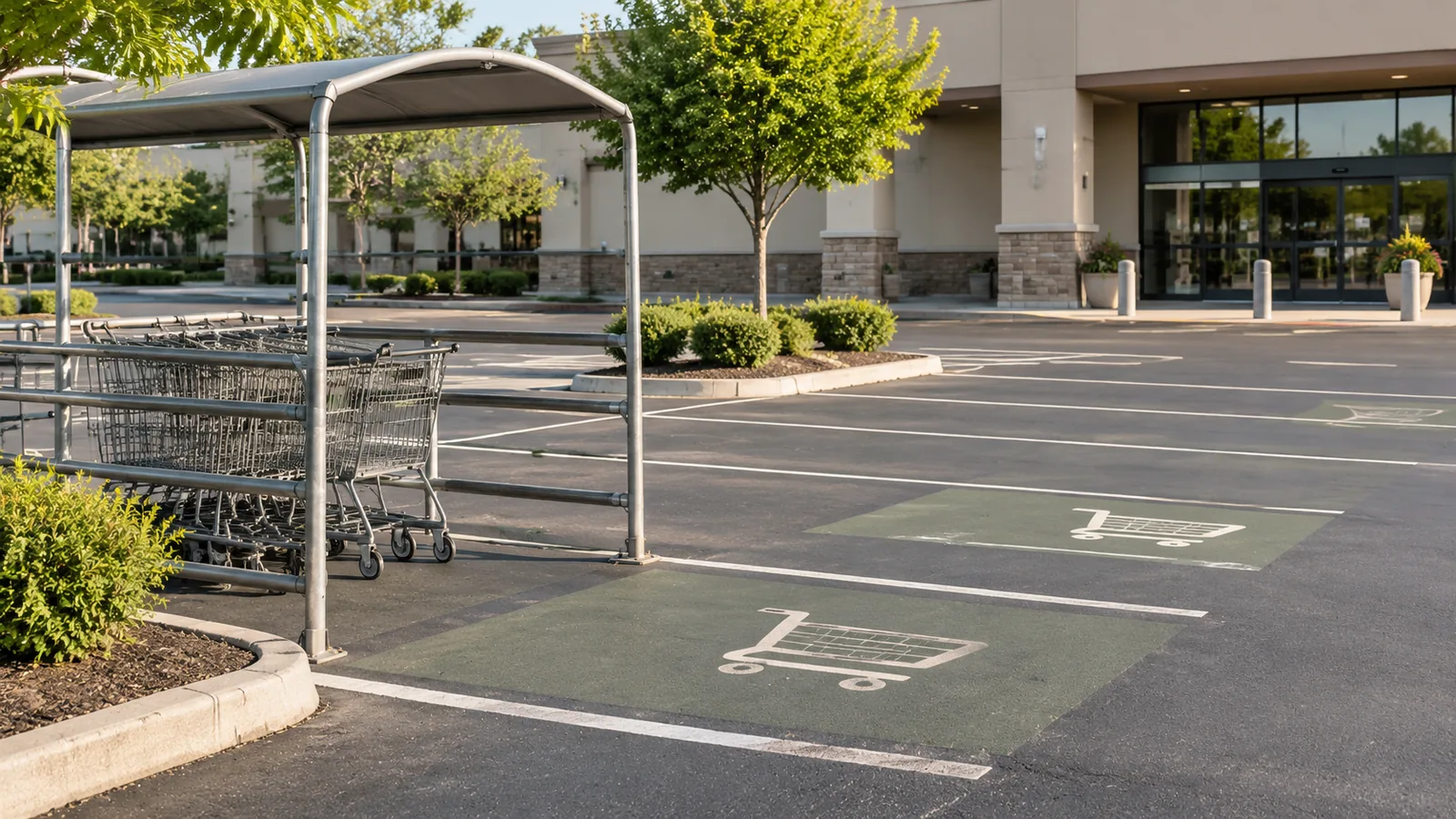
Parking lot and curbside injuries
A parking-area fall starts with one question: who owned and controlled that exact spot?
| Condition (hypothetical) | Who may control it |
|---|---|
| A pothole in the drive lane. | The shopping center landlord, under the lease. |
| A broken wheel stop in a Curbside pickup space. | The grocery operator or a maintenance contractor. |
| Standing water from a blocked drain. | Whoever handles drainage under the lease and in practice. |
| A slick surface or blocked pedestrian route. | Whoever maintains that walkway day to day. |
A landlord or contractor may owe different duties from the grocery operator, and the lease and actual maintenance practice help show who's responsible. Parking-lot and walkway claims are part of the firm's broader Dallas premises liability and Fort Worth premises liability work.
If a vehicle hits you, preserve:
- The driver's name, plate, and insurance information.
- Phone numbers for anyone who saw it.
- Lot cameras and any nearby dashcam footage.
- Direction of travel, lighting, and where you were standing.
An owner isn't liable just because a collision happened on its land. Any theory has to connect control, a legally relevant failure, and causation.
Who is responsible in a curbside pickup accident?
Start with what each person was doing: loading groceries, pushing carts, walking, or driving. Employment, contractor, and agency relationships need evidence, and more than one company may be involved. Auto and commercial liability coverage are investigated separately [S20, S21].
Who may be responsible besides HEB?
The store operator isn't always the only business involved.
| Party | Possible connection (hypothetical) |
|---|---|
| Property owner or center manager. | Controls the parking lot and sidewalks. |
| Cleaning company | Holds an overnight floor-care contract. |
| Refrigeration vendor | Serviced the dairy case two days earlier. |
| Merchandise vendor | Its rep built the end-of-aisle display. |
| Driver | Backed out of a Curbside space. |
No company should be named just because it appears on a delivery record or carries insurance.
To pin down the legal entity, check the store address and lease records, since operators and owners differ by location, and read the incident records. Don't copy a name from another case. H-E-B, LP appears in Peterson, but that doesn't identify every proper defendant [S6].
Under Chapter 33, your share of fault decides what's left of $100,000 in damages (a hypothetical). Separate rules cover settlement credits and joint-liability thresholds [S16].
| Your share of fault | Effect |
|---|---|
| 20 percent | Your recovery drops to $80,000. |
| More than 50 percent | You recover nothing. |
Do warning signs and your own knowledge affect the claim?
A cone matters but doesn't settle the claim. One at the end of aisle 4 may not warn about a spill mid-aisle, and a sign put out after the fall doesn't show an earlier warning (hypothetical).
In Austin v. Kroger Texas, L.P., a case brought by an employee, the Supreme Court of Texas held that a property owner generally has no duty to warn of or make safe open-and-obvious or known hazards. The exceptions are third-party criminal activity and necessary use [S11].
So tell your lawyer these things.
- Whether you saw the condition before you fell.
- Whether you'd used that route earlier or got a warning.
- Why you used the route anyway.
- What other routes you could have taken.
Taking a faster route past the produce misters (a hypothetical) doesn't make it necessary, and an old knee problem doesn't automatically defeat a new injury or aggravation claim, though hiding it, or your phone use, can.
What decides settlement value in an HEB injury case?
There's no reliable H-E-B injury settlement price list, so value depends on your proof:
- How well notice, control, and causation are supported.
- The medical cause of the injury, the treatment, and future needs.
- Time away from work and any loss of earning capacity.
- The particular effects on your everyday life.
- Insurance coverage and assets available in fact.
A serious fracture with clear notice evidence differs from a disputed fall with an unknown cause. Shared fault is figured under Chapter 33. Here's how each loss is proved.
- Medical records need an accurate history of symptoms and preexisting conditions.
- Employment or business records document missed work.
- Examples of what you can no longer do, such as lifting a grandchild, say more than a legal label.
- Future care and earning capacity may require an opinion from someone qualified to give it.
- Section 41.0105 limits recovery of medical expenses to amounts actually paid or incurred [S17].
- Under section 18.001, an uncontroverted affidavit can support that charges were reasonable and services necessary, but it isn't evidence of causation [S18]. Before you sign, get a one-page net sheet showing every deduction and what the release covers.
What public data says about HEB stores and injuries
H-E-B's newsroom describes the company's stores in Texas and Mexico, but no public source gives a count of Texas H-E-B injuries [S2]. Here's what the available data can and can't show:
- The newsroom description includes Mexico and isn't a count of Texas stores on any injury date [S2].
- Commercial location datasets aren't official counts and weren't independently audited.
- H-E-B's official store locator verifies an individual address and banner, not injuries [S4].
Research for this guide found no statewide H-E-B injury count, settlement average, or policy limit in the sources. Public sources don't establish:
- An annual total of Texas H-E-B customer accidents or injuries.
- An annual count of lawyer-negotiated settlements.
- An H-E-B-specific settlement mean or median.
A lawsuit isn't a paid claim, and employee injury statistics can't be relabeled as customer statistics. Multiplying stores by a national accident rate isn't supported by the data.
How does liability insurance work for an HEB claim?
| Question | Short answer |
|---|---|
| What can cover a store injury? | A commercial general liability policy can cover bodily injury and premises risks, and an excess policy may sit above it [S20]. |
| What decides coverage? | The policy's endorsements, retentions, exclusions, and dates. |
| Is there a known per-store limit? | The reviewed sources didn't verify any current companywide customer liability schedule or per-store limit. |
Does the old H-E-B insurance case set a policy limit?
No. H.E. Butt Grocery Co. v. National Union Fire Insurance Co., a 1998 Fifth Circuit decision, describes a $1 million per-occurrence self-insured retention under a historical H-E-B policy involving 1994 events [S5]. A retention is what the insured bears before the policy responds, not a coverage limit [S5]. The case doesn't show current coverage or cap your damages.
What are the filing deadlines and the path to court?
- Section 16.003 sets the general two-year rule for a Texas injury suit, with accrual rules and exceptions [S14].
- Sections 16.008 and 16.009 set a 10-year repose period for design professionals and builders of improvements [S14].
- Chapter 150 requires a certificate of merit with the first pleading against licensed architects, engineers, land surveyors, or landscape architects [S22].
- An incident report, claim number, or ongoing negotiation shouldn't be assumed to extend the deadline.
- Naming the right defendant and serving it diligently also matter.
A lawsuit may involve discovery, inspections, depositions, experts, summary judgment, mediation, trial, and post-judgment proceedings.
- A summary judgment response is generally due 21 days after the motion is filed, for motions filed on or after March 1, 2026, unless the court grants leave or the parties agree [S15].
- The current rules and the court's orders set the actual dates [S19].
- The evidence should be built before a motion tests what's missing.
Frequently asked questions
Here are short answers to questions H-E-B shoppers often have after an injury.
Can HEB be liable in more than one way?
Sometimes. A puddle left on the floor is a premises claim, while a stocking cart pushed into you can be negligent activity. Calling the same conduct by a new name doesn't change what you have to prove [S9, S13].
What if another customer caused the spill?
The store isn't liable the second a shopper drops a yogurt. It may be if it knew, or should have discovered, that spill and failed to use reasonable care [S6, S8].
What if there's no video at all?
In Brookshire Bros., Ltd. v. Aldridge, the court held that lost video doesn't automatically earn a spoliation instruction, so a witness and the inspection log can still carry a claim [S12].
Must I accept the claims representative's first offer?
No. Find out what you'd actually receive after deductions and what the release gives up first.
How many parties should my lawsuit name?
Only the ones the facts and law support. Adding a landlord or contractor doesn't automatically increase recovery [S16].
Prepare for a useful case evaluation
Bring a one-page timeline, the original photos, the store address and exact spot, and any offer or release letter, with estimated times marked as estimates.
Tell us about your H-E-B injury or call (214) 200-4878, and mention anything that may be lost or changed soon. Have the store address and incident date ready, along with injury details, photographs and witness names.
Sources
- [S1] State Bar of Texas, Aaron Alan Herbert profile.
- [S2] H-E-B Newsroom, October 28, 2026 release.
- [S4] H-E-B official store locator.
- [S5] H.E. Butt Grocery Co. v. National Union Fire Ins. Co., 150 F.3d 526 (5th Cir. 1998).
- [S6] H-E-B, LP v. Peterson, No. 24-0310 (Tex. Apr. 10, 2026).
- [S8] Wal-Mart Stores, Inc. v. Reece, 81 S.W.3d 812 (Tex. 2002).
- [S9] Keetch v. Kroger Co., 845 S.W.2d 262 (Tex. 1992).
- [S10] Brookshire Grocery Co. v. Taylor, 222 S.W.3d 406 (Tex. 2006).
- [S11] Austin v. Kroger Texas, L.P., 465 S.W.3d 193 (Tex. 2015).
- [S12] Brookshire Bros., Ltd. v. Aldridge, 438 S.W.3d 9 (Tex. 2014).
- [S13] United Scaffolding, Inc. v. Levine, 537 S.W.3d 463 (Tex. 2017).
- [S14] Texas Civil Practice and Remedies Code, Chapter 16
- [S15] Supreme Court of Texas Misc. Docket No. 26-9012.
- [S16] Texas Civil Practice and Remedies Code, Chapter 33.
- [S17] Texas Civil Practice and Remedies Code, Chapter 41
- [S18] Texas Civil Practice and Remedies Code, section 18.001.
- [S19] Texas Rules of Civil Procedure, official compilation current October 1, 2026.
- [S20] Texas Department of Insurance, commercial general liability insurance.
- [S21] Texas Department of Insurance, automobile insurance guide.
- [S22] Texas Civil Practice and Remedies Code, Chapter 150.
More guides in the Texas H-E-B Injury Knowledge Hub
What to do in the first 72 hours after an H-E-B injury in Texas
What to do in the first 72 hours after an H-E-B injury in Texas: medical care, a factual report, photos, witnesses, and asking for video early.
How to prove H-E-B knew about a spill: notice after Peterson
How notice works in a Texas H-E-B slip and fall after H-E-B v. Peterson (2026): actual vs. constructive notice, Reece, and proof of how long.
H-E-B produce and sampling display falls: what a Texas claim needs
Slipped near an H-E-B produce or sample display? What Texas law requires, what Resendez and Taylor mean, and the evidence that shows how long it was there.
H-E-B refrigeration leaks and wet floors in Texas
Fell in water from an H-E-B cooler or freezer? How Texas notice rules apply, what leak and repair records show, and how Peterson affects the claim.
H-E-B entrance mats, thresholds, and rain: Texas fall claims
Rain, entry mats, and thresholds at H-E-B: what a Texas fall claim must prove, how warnings and known dangers matter, and what evidence to keep.
H-E-B falling merchandise and construction hazards in Texas
H-E-B parking lot falls in Texas: control, notice, and proof
H-E-B curbside, cart, and pedestrian injuries in Texas
ABOUT THE ATTORNEY
Aaron A. Herbert
Founding Attorney
Board Certified in Personal Injury Trial Law
Aaron founded The Law Firm of Aaron A. Herbert in 2010 to focus on developing each client's case and seeking its maximum value. For over a decade, he has represented people seriously injured in major accidents and industrial catastrophes, pursuing trial verdicts and settlements while working to reduce the stress of litigation.
Education
- Texas A&M University · B.S., Criminal Justice, 1999
- University of Oklahoma College of Law · J.D., 2002; graduated in the top of his class
Trial experience & approach
Aaron earned numerous jury verdicts at boutique personal injury litigation firms. According to his biography, he spent a year as the top-earning litigation attorney at a firm that frequently appeared in verdict searches as having one of the highest numbers of trial wins in Texas. At another Dallas personal injury firm, he moved from managing pre-litigation attorney to managing litigation attorney over seven years as the firm grew into one of Dallas's largest personal injury firms.
His biography describes a reputation as one of America's most aggressive trial lawyers, with noteworthy recoveries from judges and juries and substantial pretrial settlements. Most of those settlements included confidentiality agreements requested by the defense. Aaron has said the recoveries were justified by the injuries and losses involved, which no amount of money could make someone choose to experience.
His approach combines passion, preparation, persistence and courtroom imagination. He believes a well-supported, engaged and motivated team working cooperatively helps deliver strong representation, with the goal of achieving the best possible result for every client.
Dallas roots, military service & publication
Born and raised in Dallas, Aaron enlisted in the United States Marine Corps after high school and later received an Honorable Discharge. He completed his university and law degrees after his military service and became a lifelong Sooners football fan in law school.
Publication: “Litigating Dog Bite Cases,” Texas Dog Law Seminar, Dallas, 2009.
Professional affiliations & recognition
Professional affiliations and recognition listed in Aaron’s biography:
- State Bar of Texas
- American Bar Association
- Association of Trial Lawyers of America (now American Association for Justice)
- Texas Trial Lawyers Association
- Dallas Trial Lawyers Association
- Dallas Bar Association
- Tarrant County Bar Association
- Million Dollar Advocates Forum
- The National Trial Lawyers – Top 100 Trial Lawyers