Texas retail injury resources
Tom Thumb and Albertsons Slip, Trip, and Fall Claims in Texas

The Law Firm of Aaron A. Herbert, P.C., Dallas, Texas.
Texas Bar license #24036761. Board Certified in Personal Injury Trial Law by the Texas Board of Legal Specialization since 2008.
Type at least 2 characters. Use arrow keys to choose a result and Enter to open it.
The short answer
You may have a Texas injury claim after a fall at Tom Thumb or Albertsons. To win it, you'd need to show a dangerous condition, that the legally responsible company knew or should have known about it, that it failed to use reasonable care, and that the failure caused your injuries. Falling inside the store doesn't prove any of that by itself.
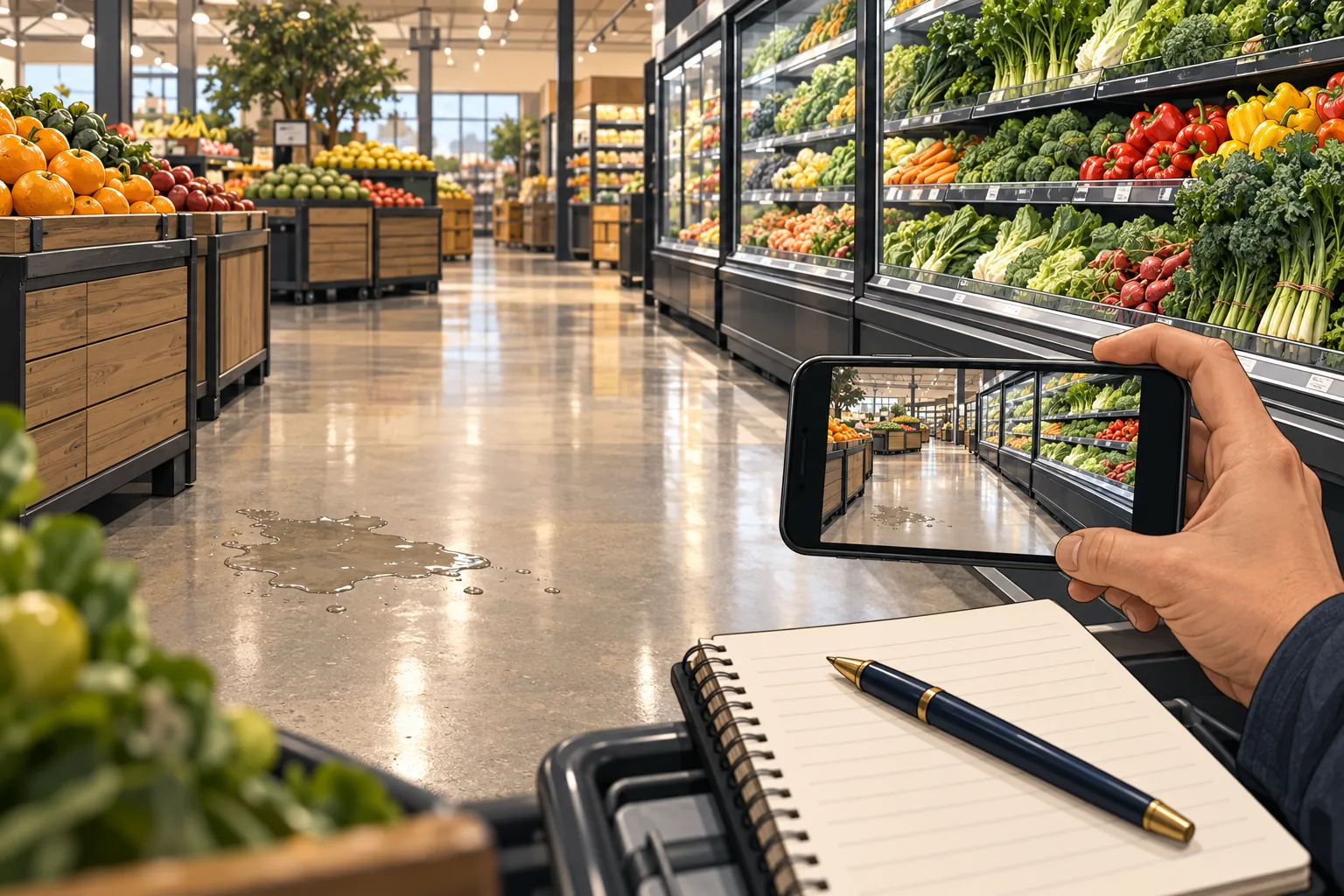
First, see a doctor. Then, if you can, take pictures of the floor and the whole aisle, since a mop and a restock cart can wipe out the scene in ten minutes. Write down the name of the shopper who saw the spill. Ask a lawyer to request the store video before it's recorded over. And remember that the incident report you filled out at the service desk isn't a lawsuit. Neither is your call with the adjuster. The clock on filing keeps running.
If you are | Start with |
|---|---|
A shopper hurt at a Tom Thumb or Albertsons | What to do in the first 72 hours, then the sections below |
A relative helping someone who fell | The evidence and deadline sections, and the consultation checklist near the end |
A lawyer handling a grocery fall | The comprehensive litigation guide |
Start with these guides
What does your evidence need to answer?
When you walk down a grocery aisle, you expect it to be reasonably safe. A claim still depends on one specific condition and one specific legal duty. So start with three questions. What touched your foot? Where did you lose your balance? What did you actually see?
A photo of a puddle taken after you fell shows how it looked then. It doesn't show when the puddle formed or prove that it caused the fall.
Lawyers should also separate a condition of the premises from an injury caused by something an employee was doing at that moment. A rack already sticking out into the aisle is one kind of case. An employee pushing a rack into a customer is another. Listing several legal labels in a petition can't replace identifying how the fall actually happened. The facts decide which claims, defendants, and evidence requests make sense.
Each section below takes one of those deciding questions. You'll see made-up examples marked "hypothetical," lists of evidence to check, and plain-language notes for families. None of the examples is an Aaron Herbert client, a Tom Thumb or Albertsons policy, or a proven fall at either store.
What should you do first after a fall at the store?
Get to a safe spot and get medical attention that fits your symptoms. Ask for the manager, and report where you fell and the basic facts accurately. Can't take pictures safely? Ask a companion to do it.
Keep or record | Hypothetical grocery example |
|---|---|
The wider aisle, not just the hazard | The whole produce island, the nearby misting rack, and any cone or mat |
Witness names and phone numbers | The shopper who said, "That water's been there since I got here" |
Your own photo and video files | The originals on your phone, since a texted copy can lose the time data |
Shoes, packaging, and receipts | The sneakers you had on and a receipt stamped 4:12 p.m. |
Messages | A voicemail from someone at the store's claims company |
Somebody may ask, "How long was that water there?" If you don't know, say so. Don't sign on to the store's version of events if you didn't see it happen. That night, write down what you remember and date the page. Put a star next to anything another person told you, like a bagger who said, in a made-up example, that the cooler had been dripping all morning.
For a day-by-day plan, read what to do in the first 72 hours. Think a camera caught the aisle? Go next to preserving surveillance and electronic evidence. We haven't found a published video-retention period for Tom Thumb or Albertsons stores, and systems differ from store to store, so ask early.
What must you prove about what the store knew?
Lawyers call this notice, and a lot of grocery cases turn on it. Either the store actually knew about the puddle, or it sat there long enough that someone should have found it. A stocker working two aisles over doesn't prove the store knew. A written sweep schedule can lead to witnesses and logs. By itself, though, it can't tell you when the spill started. S2
The Texas Supreme Court has been strict about this. In Wal-Mart Stores, Inc. v. Spates, an employee was close by, but the hazard had been on the floor behind that employee for only about 30 to 45 seconds, and the Court held that wasn't enough to show the store should have found it. S2
Spills and trips are proved in different ways. Timing evidence for spills is covered in proving actual and constructive notice. For a produce twist tie, a stocking rack, a curled mat, or a raised threshold, go to trip hazards and store control.
Who can be responsible for a grocery store fall?
The Tom Thumb sign over the door doesn't tell you who to sue. It might be the company running the store. It might be the landlord, or a floor-care contractor, or somebody else who controlled that spot or caused the problem. We check legal names, registered agents, contracts, and the exact patch of floor or pavement. The sidewalk out front can belong to someone other than whoever runs the cereal aisle.
You don't need to know any of that before you ask for advice. Bring the store's exact address, your receipt, any report number, and your photos to the consultation. Lawyers should work from verified records and shouldn't assume that the parent company, a similarly named affiliate, or the shopping-center owner controlled the hazard.
Texas generally allows two years after a personal injury claim accrues to file suit, subject to exceptions, and neither an adjuster's claim number nor a store incident report stops that clock. S3 The filing and defendant guide explains the difference between a claim and a suit.
What can compensation cover?
Where the evidence and the law support them, damages can include medical bills you're entitled to recover, lost pay, lost earning capacity, physical pain, mental anguish, impairment, and disfigurement. Each one has to be proved on its own. An ER bill doesn't prove the fall caused the injury. A torn rotator cuff diagnosis doesn't prove you'll lose wages next year.
Keep your treatment records, and give your doctor and your lawyer the true reason for any gap in care.
For valuation, see medical causation and claim value. Any average settlement figure or multiplier for Tom Thumb or Albertsons cases would be invented, so you won't find one here. The value of a claim depends on:
- how strong the liability and medical proof is
- the risk of losing at trial
- which damages Texas law allows
- case costs and liens that must be repaid
A demand letter's figure is a starting position, not a client's net recovery.
How is a case prepared for litigation?
Discovery in a grocery case usually asks for:
- the inspection or sweep sheet for that aisle
- repair tickets for the freezer or cooler
- radio, text, or app messages about the spill
- the native video export
- records showing who controlled the area
The aim is the material that explains this fall, not every record a national chain has ever produced.
The discovery and corporate deposition article explains how to turn missing facts into specific requests. The defenses and summary judgment article shows why a lawyer should find gaps in the evidence before the store files a motion to end the case. Procedure depends on the court. That article identifies current Texas rules and separates federal practice.
Experts and trial have their own articles: expert-witness selection, and voir dire, mediation, and trial.
Why consider Aaron Herbert?
Aaron Herbert is Board Certified in Personal Injury Trial Law by the Texas Board of Legal Specialization, as his State Bar profile shows. S1 Board certification is a qualification you can check independently. It's a good starting point. What matters more is whether the lawyer explains how that experience applies to your facts. Ask these questions:
- Who's going to ask the store for the aisle video, and when?
- How do you figure out whether the manager knew about the puddle?
- Will my doctor need to explain how the fall caused the injury, and who else might be responsible?
- What will the case cost, and how much of a settlement would I actually keep?
- Who returns my calls, and who takes the store manager's deposition and prepares for trial?
In a grocery case, preparation can matter long before a jury is chosen. A well-supported record can make negotiations better informed. It can also show that a case shouldn't be filed. It can't guarantee that Tom Thumb or Albertsons will admit fault, make a particular offer, or avoid trial. This hub doesn't claim that Aaron has won a verdict or settlement against Tom Thumb or Albertsons.
You can review Aaron's official State Bar profile and contact the Law Firm of Aaron A. Herbert, P.C. to request a case evaluation. Bring the store address, the date of the fall, photos, witness information, letters from the insurer, and whatever medical information you have. Missing records won't stop a first conversation.
What data is this resource based on?
Our sources are published court opinions, Texas statutes, and the current court rules. You won't find a made-up statewide count of Tom Thumb or Albertsons falls here, or a yearly number of lawsuits, a settlement average, or a win rate. Court databases can't count every claim anyway. Lots of cases settle quietly, never produce a published opinion, or name an operating company instead of the name on the storefront.
A grocery company's revenue, store count, or insurance setup can't show that a particular shopper is owed compensation.
Albertsons, LLC v. Mohammadi shows why proof of knowledge has to connect to the wet floor that caused the injury. Knowing that products in a cart were leaking, and cleaning up afterward, didn't automatically show the store already knew about that wet floor. The case arose at a Randalls store and has to be read on its own record. A lawyer should sort observations from inferences and conclusions before choosing a notice theory. S15
Common questions
Can I make a claim without a manager's incident report?
Possibly. A report is one source of evidence, not the only basis for a claim. Keep your other records and explain why no report was made. Don't write a substitute and call it a store record.
The store says the video is gone. Do I win?
No. The trial judge decides whether evidence was wrongly lost and what remedy fits, and missing footage doesn't automatically mean a jury instruction or a finding of fault. S5
The adjuster says I should have seen the spill. Now what?
Clear water on white tile can be nearly invisible. Whether a hazard was open and obvious and how fault is shared are separate legal questions, and a photo taken after mopping may answer neither.
Do I have to sue right away?
Not every claim needs to be filed immediately. What shouldn't wait is preserving evidence and confirming your deadline, which can happen while you are still treating. Don't assume that negotiations extend the limitations period.
I'm a lawyer. Where's the full framework?
Read the comprehensive Tom Thumb or Albertsons premises liability litigation guide. Its sections run from intake and liability through discovery, experts, damages, jury selection, settlement, and trial, each with sources and worked examples.
Why does a grocery fall need a grocery investigation?
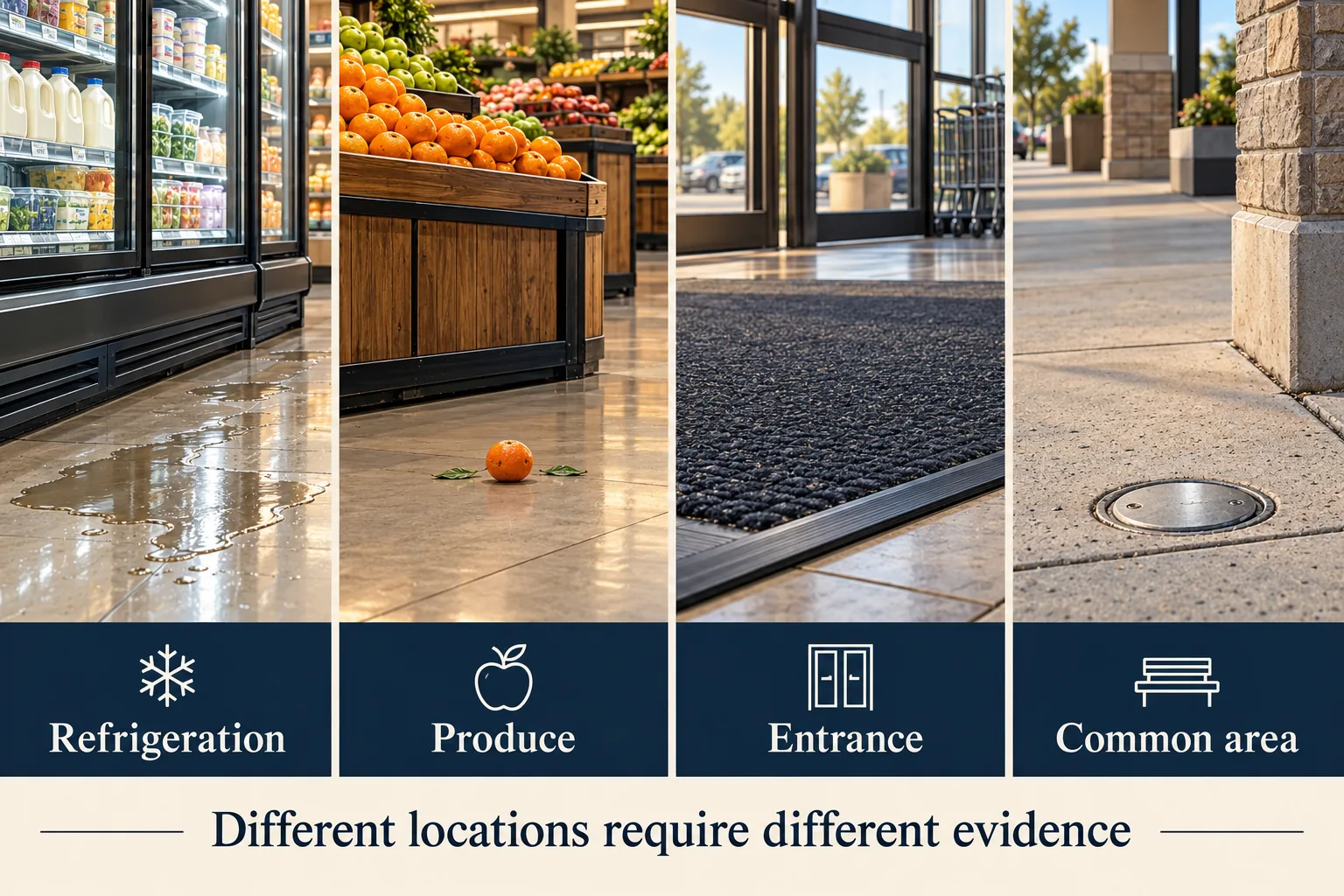
A fall beside a refrigerated case raises different questions than a trip over an entrance mat. These are investigation paths, not claims that every Tom Thumb or Albertsons has these problems.
Where you fell | What a lawyer would look for |
|---|---|
Beside a refrigerated case | The unit, where the puddle sat, whether the case was running normally, and its service history |
At a produce display | How the display was set up, the packaging, any floor mats, and what witnesses saw about that item |
At self-checkout | The time you fell versus the receipt time, and whether staff saw the condition or got a report about it |
On an entrance mat | Whether the mat was curled or bunched, the weather, and photos of your approach |
On a shopping-center sidewalk | Who the lease makes responsible for that strip of concrete, and any repair requests about it |
"I slipped near the freezer" describes where you fell. It doesn't prove the freezer leaked, and a photo taken after cleanup may not settle it.
Possible source of the water | What could confirm it |
|---|---|
A cracked milk jug in someone's cart | Video of the cart's path, a damaged-goods note |
A mop bucket from a nearby cleanup | Cleaning records and the employee who mopped |
Ice melting in another shopper's basket | Video of that shopper's route |
The refrigerated case itself | Service tickets for the unit |
Checking your account this way can turn up stronger proof, point to a different responsible company, or keep an unsupported allegation from weakening a credible claim.
Slipped on a grape? Corbin v. Safeway, a 1983 Texas Supreme Court case, involved a self-service grape bin. It asked whether the store knew that the way it displayed grapes created an unusually high risk of falls. Save evidence of how the bin was built, whether a mat sat under it, and how customers picked from it. One grape on the floor doesn't prove that theory. Be careful here, too. The Texas Supreme Court has since called Corbin an "exceptional case." In Albertsons, LLC v. Mohammadi, it said that approach could apply, if at all, only where a store had a policy or practice it knew routinely created an unreasonable risk. Keep that question apart from the usual "how long was it there" proof, and have a lawyer check the later cases before relying on Corbin. S4
What should you bring to a consultation with Aaron Herbert?
- The store address, the date, and where in the store you fell
- Any report number and the original photos, videos, and messages you already have
- Whether you were shopping, making a delivery, or working (a delivery driver or employee may face legal issues an ordinary customer doesn't)
- Prior treatment for the same body part, any statement you gave, and any offer or release you received
Those details help a lawyer give advice that fits your situation.
Aaron Herbert's board certification in Personal Injury Trial Law is a qualification you can verify as you build a shortlist. The real value of hiring a lawyer is legal judgment applied to your evidence. That means identifying the duty, preserving records before they disappear, choosing the right experts, and presenting your damages accurately. Ask how those tasks would be handled in your case and who would keep you informed. Then request a case evaluation to talk through your next evidence and deadline decisions. S1
Why does the exact store matter?
Tom Thumb and Albertsons are store banners in the Albertsons Companies family. That helps you recognize the business group. It doesn't tell you which company is responsible for a given fall. Keep the store's street address, your receipt, and any letters. Before deciding who to sue, a lawyer should verify who operated that store on that date, where the condition was, and whether another party played a role. The logo is where the investigation starts. S20
The cereal aisle, a counter run by a tenant, the sidewalk by the parking lot: each can come with its own set of duties. Johnson v. Tom Thumb Stores, Inc. is a 1989 case from the Dallas Court of Appeals. A person slipped on a glass light fixture set into a common-area sidewalk, and the lease gave the landlord control of that area. The court affirmed the directed verdict for Tom Thumb, the tenant, and sent the claim against the landlord back for a new trial. That's why the exact location gets mapped. It doesn't mean you should guess who's responsible by how close you were to the door. Bring photos of your approach, and tell us what happened before you walked in or after you left. S16
Inside the store, two questions stay separate. Where did the liquid come from? And did the store know the floor was wet? Albertsons, LLC v. Mohammadi was a Texas Supreme Court case from a Randalls store, where products in a cart were said to be leaking. The Court said the danger that counted was the wet floor. On that record, proof about the leaking products didn't show actual knowledge of the wet floor. So expect questions like these: Who saw the floor? When did someone report it? Was it the same puddle? S15
How can legal preparation affect your financial decision?
Here's a hypothetical. A shopper breaks a wrist next to a cart of returned items by the customer service desk. A family member's photo shows water on the floor after the fall. The broken wrist is documented, and so is the water. What's missing is who knew about the water before the fall.
Evidence that turns up | How it could change the picture |
|---|---|
A reliable complaint about the same puddle before the fall | Could support the store's knowledge of the wet floor |
A note about a leaking juice carton, with nothing about the floor | May not answer whether anyone knew the floor was wet |
Sorting out that difference can be worth more than adding a zero to the demand.
You can verify Aaron Herbert's board certification in Personal Injury Trial Law yourself. In the first meeting, ask how the firm would get the recording, find out what the store knew, and document your treatment and missed work. The certification is a fair starting point for that talk. Your case still has to be proved on its own facts. By the end, you should know your next steps and what new evidence could change the advice. S1
If you're a lawyer, you'll notice each page follows one pattern: the legal issue, the source behind it, and what it means for the client's decision. If you're a family member, you get that same reasoning in plain words. The complete litigation guide runs from saving evidence all the way to a verdict. And if you've wondered why a demand, the damages the law allows, and your net recovery are three different numbers, the damages guide explains it.
Sources
S1 Aaron Alan Herbert, State Bar of Texas attorney profile (Board Certified, Personal Injury Trial Law, Texas Board of Legal Specialization). Read source.
S2 Wal-Mart Stores, Inc. v. Reece, 81 S.W.3d 812 (Tex. 2002); Wal-Mart Stores, Inc. v. Spates, 186 S.W.3d 566 (Tex. 2006). Read source.
S3 Tex. Civ. Prac. & Rem. Code §§ 16.001, 16.003, 16.072 (limitations; disability; weekend and holiday extension). Read source.
S4 Corbin v. Safeway Stores, Inc., 648 S.W.2d 292 (Tex. 1983); compare H.E. Butt Grocery Co. v. Resendez, 988 S.W.2d 218 (Tex. 1999) (per curiam), and Albertsons, LLC v. Mohammadi, 689 S.W.3d 313 (Tex. 2024); Brookshire Grocery Co. v. Taylor, 222 S.W.3d 406 (Tex. 2006). Read source.
S5 Brookshire Bros., Ltd. v. Aldridge, 438 S.W.3d 9 (Tex. 2014). Read source.
S15 Albertsons, LLC v. Mohammadi, 689 S.W.3d 313 (Tex. 2024) (per curiam). Read source.
S16 Johnson v. Tom Thumb Stores, Inc., 771 S.W.2d 582 (Tex. App.—Dallas 1989, writ denied). Read source.
S20 Albertsons Companies, company overview (store banners). Read source.
ABOUT THE ATTORNEY
Aaron A. Herbert
Founding Attorney
Board Certified in Personal Injury Trial Law
Aaron founded The Law Firm of Aaron A. Herbert in 2010 to focus on developing each client's case and seeking its maximum value. For over a decade, he has represented people seriously injured in major accidents and industrial catastrophes, pursuing trial verdicts and settlements while working to reduce the stress of litigation.
Education
- Texas A&M University · B.S., Criminal Justice, 1999
- University of Oklahoma College of Law · J.D., 2002; graduated in the top of his class
Trial experience & approach
Aaron earned numerous jury verdicts at boutique personal injury litigation firms. According to his biography, he spent a year as the top-earning litigation attorney at a firm that frequently appeared in verdict searches as having one of the highest numbers of trial wins in Texas. At another Dallas personal injury firm, he moved from managing pre-litigation attorney to managing litigation attorney over seven years as the firm grew into one of Dallas's largest personal injury firms.
His biography describes a reputation as one of America's most aggressive trial lawyers, with noteworthy recoveries from judges and juries and substantial pretrial settlements. Most of those settlements included confidentiality agreements requested by the defense. Aaron has said the recoveries were justified by the injuries and losses involved, which no amount of money could make someone choose to experience.
His approach combines passion, preparation, persistence and courtroom imagination. He believes a well-supported, engaged and motivated team working cooperatively helps deliver strong representation, with the goal of achieving the best possible result for every client.
Dallas roots, military service & publication
Born and raised in Dallas, Aaron enlisted in the United States Marine Corps after high school and later received an Honorable Discharge. He completed his university and law degrees after his military service and became a lifelong Sooners football fan in law school.
Publication: “Litigating Dog Bite Cases,” Texas Dog Law Seminar, Dallas, 2009.
Professional affiliations & recognition
Professional affiliations and recognition listed in Aaron’s biography:
- State Bar of Texas
- American Bar Association
- Association of Trial Lawyers of America (now American Association for Justice)
- Texas Trial Lawyers Association
- Dallas Trial Lawyers Association
- Dallas Bar Association
- Tarrant County Bar Association
- Million Dollar Advocates Forum
- The National Trial Lawyers – Top 100 Trial Lawyers