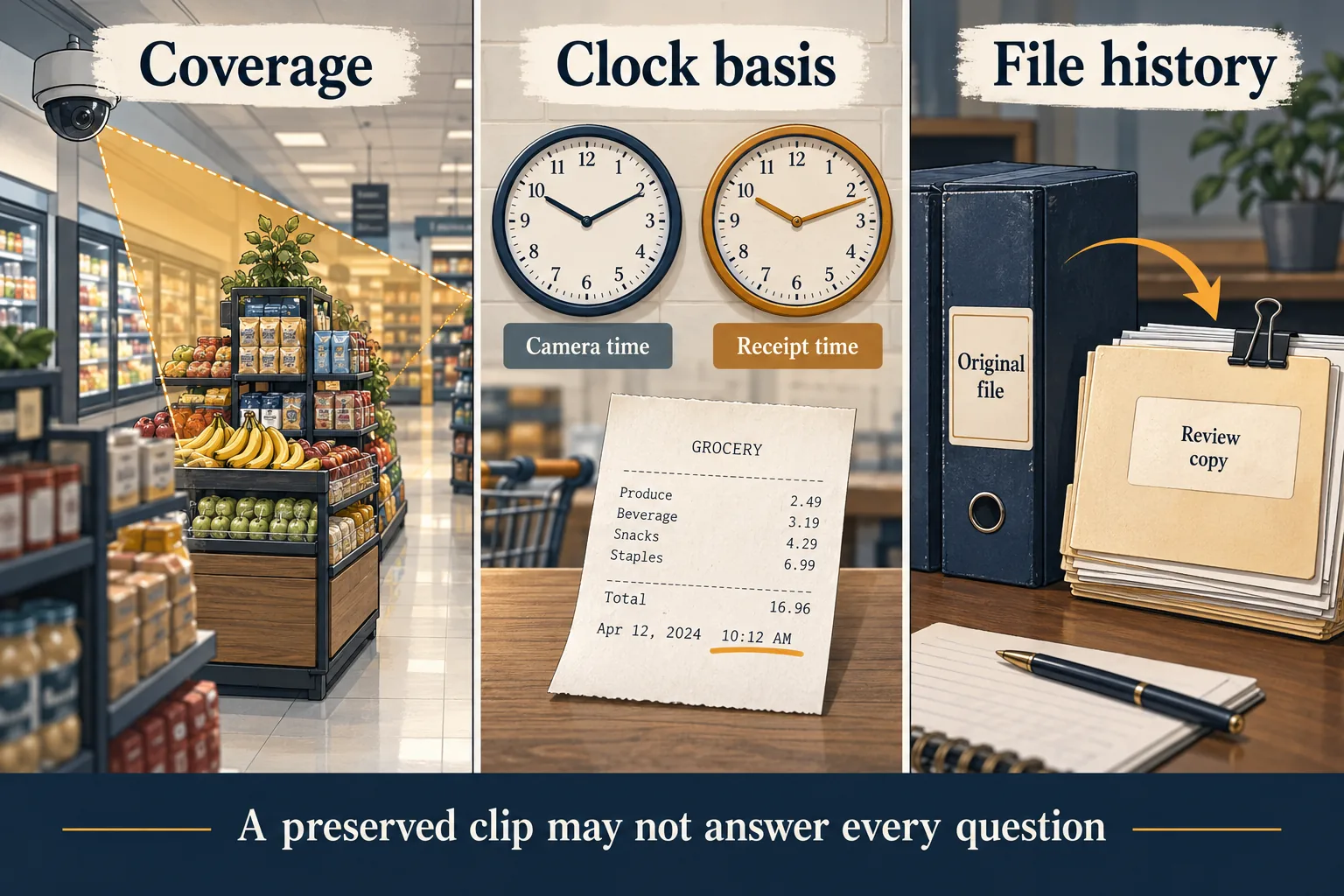
Illustration only, not real store footage.
Somewhere in the back office of the store where you fell, a recorder may be writing over older footage. Before your fall goes the same way, someone has to ask, in writing, for the cameras that might have caught it, a window before and after, and the original files. The first 72 hours guide and the litigation pillar cover what comes next.
Whose system is it?
Being able to play back a recording is not the same as controlling it. An assistant manager who can pull up your fall on a back-office monitor may have no authority over retention settings and no way to stop the system from overwriting. The request has to reach the person, department, or outside vendor who can place a hold.
Video is not the only record that disappears on a schedule. Depending on the store, related records may include:
- photos attached to the incident report, sometimes stored in a separate claims system
- radio calls, texts, or app messages about the spill
- sweep logs or task-app entries showing the last floor check
- repair tickets for a leaking dairy case, sometimes held by an outside refrigeration contractor
- export logs kept by the video system or the vendor
Not every store keeps all of these, and the size of a grocery company does not prove that any particular database holds the entry you hope to find. Ask for what the store actually uses.
A one-page custodian map, listing each record beside the place it most likely lives, shows which searches are finished. A letter to the store operator may never reach a refrigeration contractor's own system, and the rules on control and discovery apply company by company.
Was anyone told to save it, and when?
The letter should name the incident, the spot, the time window, the original files, and the export information, and ask the store to suspend routine deletion. Confirm delivery, then follow up on whether a hold was actually placed. Requested, acknowledged, preserved, and produced are four different stages, and no verified Tom Thumb or Albertsons retention schedule tells you how long you have.
In Brookshire Bros. v. Aldridge, a 30-day loop overwrote all but about eight minutes of video before a request came almost a year after a 2004 fall. A $1,063,664.99 verdict went back for a new trial, and the Texas Supreme Court set these rules: S5
- a duty to preserve arises once a party knows or reasonably should know there's a substantial chance of a claim
- an instruction needs intentional destruction, or a negligent loss that irreparably deprives a party of any meaningful ability to present a claim or defense
- missing video alone doesn't earn one S5
What does Clark v. Randalls teach?
In March 2005, a shopper at a Kingwood Randalls slipped on detergent leaking from another customer's basket near the pharmacy counter. The store kept video from 2:59 to 3:05 p.m., and the fall happened at about 3:00:45, so less than two minutes from before the fall survived. In Clark v. Randalls Food, 317 S.W.3d 351 (Tex. App.—Houston [1st Dist.] 2010, pet. denied), the court found that the store had a duty to preserve and breached it. Even so, the shopper had not shown prejudice, and the court affirmed summary judgment for the store. S19
The opinion describes a store procedure of keeping tapes roughly 60 to 90 days at that time, along with decisions about which footage to copy. Read that as history. It says nothing about current Tom Thumb or Albertsons policy, since technology, stores, and procedures may have changed, and Clark was decided before Brookshire Bros. v. Aldridge, where the Texas Supreme Court held that the trial judge, not the jury, decides whether evidence was wrongly lost. S5
So ask who picked the saved stretch, which cameras that person watched, and whether the earlier native footage still exists. Write down exactly what the employee says.
What video can and can't prove about notice
Texas courts look hard at how long a hazard sat before the fall. In Wal-Mart Stores, Inc. v. Spates, an employee was working the shelves three to five feet away from an empty plastic six-pack ring, but the ring had been behind that employee for only 30 to 45 seconds, and the Texas Supreme Court found no evidence the store should have discovered it. In Wal-Mart Stores, Inc. v. Reece, an off-duty employee stood five to eight feet from a pizza-sized puddle of clear liquid near a snack bar, and with nothing showing how long the liquid had been there, the shopper's verdict was reversed. S2
Records that can pin down the time on the video:
- a register receipt from the same visit
- a logged phone call or text
- a rideshare pickup or drop-off time
- an employee's task-app or radio entry
- a card statement showing the time of purchase
- a parking-garage ticket stamped on the way in
- a loyalty-card record of the visit
- a time-stamped photo from your own phone
- a pharmacy pickup record, which runs on a separate clock of its own
What about the leaking cart?
In Albertsons, LLC v. Mohammadi, 689 S.W.3d 313 (Tex. 2024) (per curiam), products in a Randalls cart were leaking and someone cleaned up afterward. The Texas Supreme Court said that still didn't show the store knew about the wet floor beforehand. Before choosing a notice theory, separate what witnesses saw from what they inferred and what they concluded. S15
Take a hypothetical. One camera shows a damaged case of sparkling water going into a cart. A second camera shows the floor where a shopper walks a few minutes later. Enough of both recordings should be kept to compare them. Dripping cans do not establish a puddle at the place of the fall, and a clear view of the source is a lead rather than proof of the store's knowledge. S15
In Mohammadi itself, the claimant worked at a bank branch inside a Houston Randalls and slipped beside a cart of returned and damaged items. An inconclusive video seemed to show an employee putting a wet plastic bag in that cart. S15
Can you get the video before suing?
The store may cooperate before suit. Texas Rule 202 lets a person file a verified petition asking to take a deposition before any lawsuit, either to preserve testimony or to investigate a possible claim. It's for depositions, not a general way to make the store hand over video, and it requires a judge's findings. After a lawsuit is filed, the discovery rules and the court's orders control. Federal court runs on different rules. S6 S11
Will the video come in at trial?
Ask for native exports and any player they need, and keep one untouched copy. A matching checksum shows only that a file hasn't changed since collection, not that the camera clock was right. Check each camera's clock against something independent, like a register receipt. Authentication should be planned well before trial. Someone has to be able to testify about where the recording came from and the system that produced it, or another proper foundation has to be laid under the evidence rules that apply. Every caption, zoom, or speed change in the working copies should be noted. A dramatic clip that cannot be reliably admitted may be worth less than a plain one with solid support. S7 S11
What should you expect from your lawyer?
A letter can go out without the store ever acknowledging it, and a store can acknowledge it without anyone following up for the actual footage, so ask about each step on its own. Once those are answered, ask which missing record could change how your claim looks and whether formal discovery makes sense.
Nobody can promise quick access to a private grocery company's recordings. Quick action is still possible, along with a written record of each effort and a straight answer about what has not arrived. Questions worth putting to the firm:
- How will you identify which cameras covered my fall and get the store to confirm a hold?
- Will the video be used to show what the store knew, or only to show the fall?
- Who keeps the original export, and who checks the timestamps?
- If the store hands over only part of what was requested, what do you do next?
- Will someone from the store need to explain how the system works?
- Should a video expert look at the file, or is that unnecessary here?
- How long will it take to get the footage, if it still exists?
Be wary of a promise that the video will help. Nobody knows that until the whole recording has been watched. It may strengthen the case, expose a weak spot, or show that another source is needed, and any of those beats working from half the picture.
Keep your own photos and texts about the fall, including the unhelpful ones, and don't assume missing video wins a case by itself.
Choosing a lawyer for an evidence-heavy case
Aaron Herbert's official State Bar profile shows that he is Board Certified in Personal Injury Trial Law by the Texas Board of Legal Specialization. You can verify that credential on your own. What the footage proves is a different matter, and the record decides it. S1
Your part is limited. Identify the exact spot, keep your original photos and videos, and mention any earlier calls or letters with the store. You do not need to know the camera model.
Request a case evaluation from the Law Firm of Aaron A. Herbert, P.C., and bring the date, the store address, and the records you have. If anyone has said the footage might be deleted, mention it right away.
The knowledge hub collects the related guides. When a recording raises questions about what employees knew, notice and inspection evidence is the next page to read. When the fight is over who can explain the video system or the export, turn to discovery and corporate depositions, which also covers obtaining and authenticating these records. The comprehensive pillar guide follows the whole lawsuit, from evidence through trial.
Sources
S1 Aaron Alan Herbert, State Bar of Texas attorney profile (Board Certified, Personal Injury Trial Law, Texas Board of Legal Specialization). Read source.
S5 Brookshire Bros., Ltd. v. Aldridge, 438 S.W.3d 9 (Tex. 2014). Read source.
S2 Wal-Mart Stores, Inc. v. Reece, 81 S.W.3d 812 (Tex. 2002); Wal-Mart Stores, Inc. v. Spates, 186 S.W.3d 566 (Tex. 2006). Read source.
S6 Texas Rules of Civil Procedure. Read source.
S7 Texas Rules of Evidence, amendments effective July 2, 2026. Read source.
S11 Federal Rules of Civil Procedure and Federal Rules of Evidence. Read source.
S15 Albertsons, LLC v. Mohammadi, 689 S.W.3d 313 (Tex. 2024) (per curiam). Read source.
S19 Clark v. Randalls Food, 317 S.W.3d 351 (Tex. App.—Houston [1st Dist.] 2010, pet. denied). Read source.