
The Aaron Herbert Texas Injury Claim Value Knowledge Hub
Texas Injury Claim Value and Litigation
What is your injury claim worth? Medical bills are only part of the answer. A lawyer also needs to know who caused the injury, what the records can prove, and whether insurance or other assets are available to pay a judgment. Multiplying the bills by three will not answer those questions.

· The Law Firm of Aaron A. Herbert, P.C., Dallas, Texas. Texas Bar license #24036761. Board Certified in Personal Injury Trial Law by the Texas Board of Legal Specialization since 2008.
Start with your injury claim questions
Read How Much Is My Personal Injury Claim Worth? for a practical introduction to the evidence behind a valuation. For specific questions, explore the sections below on medical bills, partial fault, future care, net recovery and settlement offers.
Featured pillar article
How Texas Injury Claims Are Valued and Litigated
You can start with How Texas Injury Claims Are Valued and Litigated. That guide follows a case from the first investigation through settlement or trial. The topics below let you look more closely at a particular question, such as proving future care or understanding what remains after fees, expenses and reimbursement claims.
Read the complete article →Evidence at a glance
| Question to investigate | Records and proof |
|---|---|
| Responsibility | Incident records, witness accounts and evidence about each actor’s conduct. |
| Medical losses | Treatment records, itemized bills, adjustments and supported future care. |
| Earnings and daily life | Wage records, work restrictions and evidence of separate noneconomic losses. |
| Settlement and net recovery | Coverage, fees, expenses, reimbursement claims and proposed release terms. |
What determines the value of a Texas injury claim?
Two people can have the same medical bills but still make very different claims. One could have clear video evidence of the incident and a prognosis that is well supported, while the other might be going through a real dispute about responsibility, have another medical condition, or have limited insurance coverage. A figure which does not take those differences into account is not very useful when an offer is made.
If you are looking at an offer, ask counsel to separate four figures: the losses which the evidence supports, the assessment of the responsibility dispute, the amount that can be collected and the amount expected to remain for you. These figures respond to different questions. For example, medical records or testimony might affect one without affecting the other three. The following section explains how these figures relate to one another before you look at a specific bill or settlement question.
The pillar guide follows a case, including the various stages of the investigation, the discovery process, the negotiations and the trial; this page offers an overview and its topic directory takes you to the more detailed treatments of medical expenses, future care, depositions, settlement decisions and judgment calculations.
How Comparative Responsibility Changes a Texas Injury Recovery
Before carrying out the calculation of the damages, consider who may be held responsible and what the evidence shows about each person's conduct. A claim might name more than one defendant, or it might include a settling party or a third party who is suggested as being at fault. These questions should be examined as early as possible, while witnesses and records may still be available.
According to the general rule set out in Texas Civil Practice and Remedies Code Chapter 33, a claimant who is found to be more than 50 percent at fault is precluded from obtaining recovery; where recovery is allowed, it is reduced by the claimant's share of the responsibility. The need to apportion responsibility among the other parties and to calculate the judgment may therefore require additional analysis.
A damage award of $100,000 with 20 percent of the responsibility attributed to the claimant means that the claimant's portion reduces that amount by $20,000, leaving $80,000 before any other relevant adjustments are made. This does not cap the recovery at $20,000; according to the general rule, if the allocated percentage exceeds 50 percent, recovery is barred. These are examples of how the calculation works, not predictions of what a jury will decide.
After a collision there are two distinct questions to consider: who caused it and what injuries it caused? Simply winning the first of these disputes does not deal with the second, and the lawyer will still have to obtain medical and other relevant evidence regarding the conditions listed in the claim.
Resource
How Comparative Responsibility Changes a Texas Injury Recovery
An injury valuation must account for disputed responsibility as well as proven losses. This article explains how Texas comparative-responsibility rules can affect recovery and why evidence about each party’s conduct matters when assessing an offer or preparing a case.
Read how comparative responsibility affects injury recovery →How to Prove Past Medical Expenses in Texas
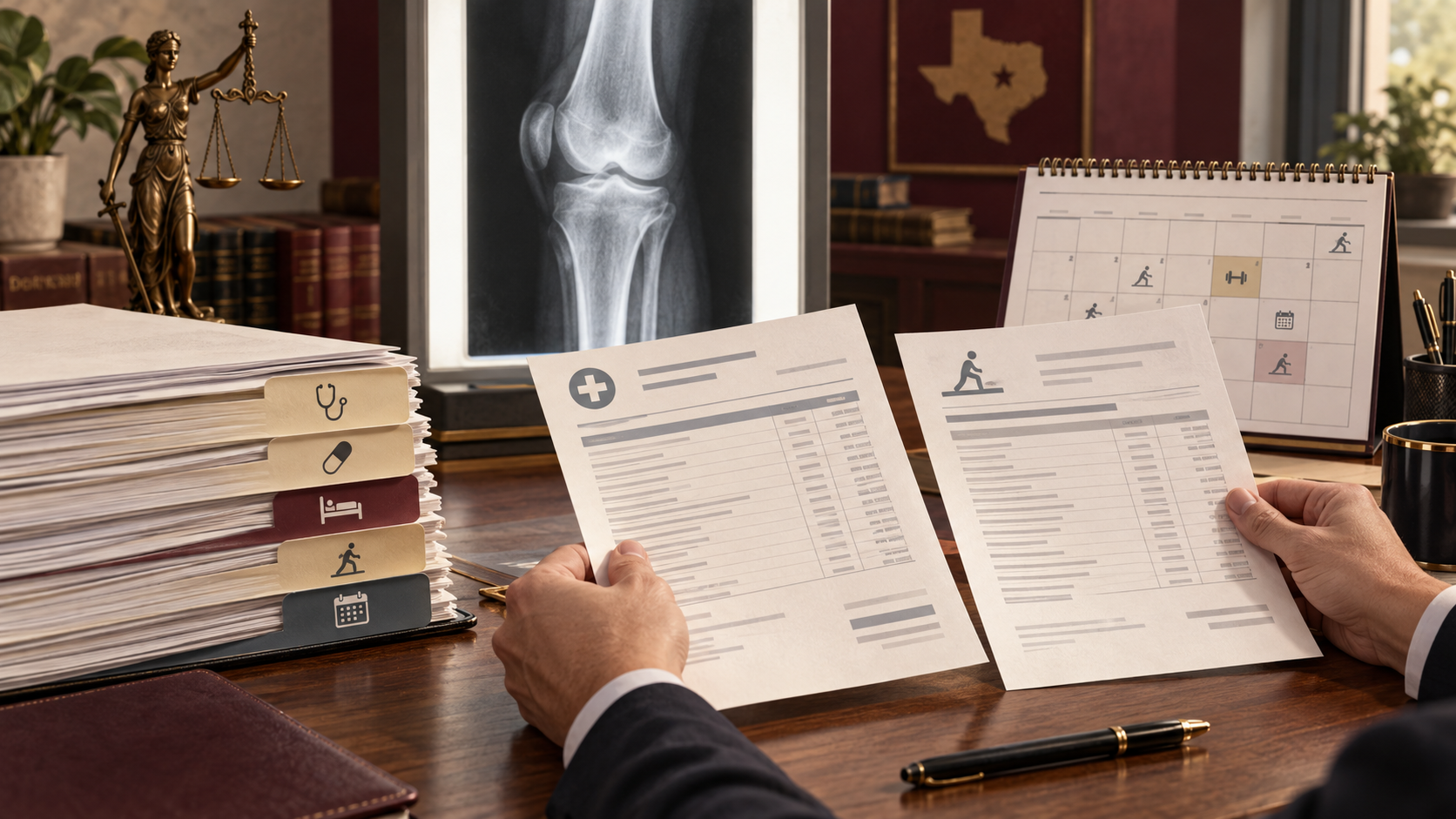
The figure given at the top of a medical bill is not necessarily the amount that could be recovered in a lawsuit. To begin with, you should examine the itemized account history which may show the original charge, the payments that have been made, any adjustments made under the contract and the balance that is still enforceable. Rather than take it for granted that each entry in the treatment records relates to necessary care for the injury in question, you should compare the history with the treatment records.
Section 41.0105 limits recovery of medical or health-care expenses to amounts actually paid or incurred by the claimant or on the claimant’s behalf. The medical evidence still needs to connect treatment to the occurrence, establish necessity and support the reasonableness of the expense. One document may not establish all of those matters.
Under Section 18.001, Texas allows certain evidence of reasonable and necessary expenses to be submitted by way of affidavits, but the statutory requirements and deadlines must still be satisfied. Such affidavits do not prove that the accident caused the condition being treated and they do not ensure that a compensation award will be made; if the evidence is challenged, a lawyer may need to obtain a suitable treating physician, biller, or expert witness to give testimony.
Resource
How to Prove Past Medical Expenses in Texas
A medical bill is a starting point, not the complete proof of recoverable expenses. This article discusses the records and evidentiary issues involved in presenting past medical charges, including the distinction between amounts billed and recoverable amounts and the role of supporting medical evidence.
Read how to document past medical expenses →How to Prove Future Medical Care and Its Cost
Begin the process of preparing a future-care estimate by referring to the medical recommendation. What condition is being treated? What kind of care is reasonably justified, when could it take place, and how frequently might it be required? After these questions have been answered, then the cost assumptions can be looked at. A well-presented spreadsheet cannot make up for the absence of a medical basis.
Before including a treatment recommendation in a cost table, you should look at the qualifications. A doctor may recommend surgery only if other treatment fails. It may be necessary to replace the equipment from time to time and some people may need help at home for a limited period of recovery. If every possible option is priced as if it actually will happen, this can result in the cost of the plan being overstated or the same service being counted twice.
When considering a settlement, it may be helpful to look at the various available options: improving with limited continuing care, having persistent symptoms that will need further treatment, and experiencing a more severe course if the medical evidence indicates this. You should explain the uncertainty associated with each of these options. At trial, the evidence and the amount being asked for must meet the relevant legal standards; a negotiation scenario is not in itself considered expert evidence.
How to Prove Lost Earnings and Earning Capacity
Losing pay and losing the ability to earn are different matters. Previous wage records can show exactly how much income has actually been lost. With regard to future earning capacity, the focus is on how the injury affects the individual's ability to work and earn over time, which in turn may call for a more detailed look at job duties, restrictions, skills, accommodations and the labor market.
For an employee, useful records would include information on payroll, attendance, details about any overtime worked, and a description of the job provided by the employer. In the case of a self-employed person, it is necessary to keep business revenue separate from the income earned through their own work. A decline caused by external market conditions should not be considered an injury loss.
Return-to-work initiatives can also be important; a person might go back into the same position, agree to reduced hours or switch to a different job. The evaluation should take into account what actually took place and what the medical and vocational evidence indicates. A forecast that someone will never work again requires more than just the fact that they have not yet returned.

How to Value Pain, Impairment, and Mental Anguish
A medical bill does not include all the consequences of an injury; it is necessary to consider questions arising from pain, impairment and mental anguish and the evidence should take account of these differences. A bill multiplier does not show what value should be assigned to any of these categories.
It is more effective to give specific examples than to offer general descriptions, since in some cases a person may need help with bathing for several weeks or might have to give up a particular activity or lose sleep as a result of the symptoms. Treatment records, calendars, and people who have seen the changes can all be used to support the account, and it is also important to mention any improvements in it. A description of both good days and bad days is more accurate than assuming that each day has been the same.
A request for a dollar amount still requires support from both the evidence and the relevant law. If the injuries involved or the question of responsibility are different, then another verdict would not be a suitable comparison. Due attention should also be paid to the venue and the appellate history. Counsel should be able to explain the losses that form the basis of the request and identify any overlap between the various categories, in order that the same loss is not counted more than once.
Policy Limits, Coverage, and Settlement Mechanics
A claim for damages which is supportable and one that is collectible are two separate matters. The insurance review should identify the policy, the insured parties, the relevant endorsements, the exclusions and any excess layers. The occurrence limit can be shared by a number of claimants. A reported limit should be checked in light of the relevant documents and facts.
The terms of the settlement are also important; the people who will be released, the claims that will be included, the way reimbursement claims will be dealt with and the obligations that continue after the agreement is signed can all influence the decision. A high figure in the headline might be accompanied by terms that are worth examining more closely. The client needs a clear explanation of the proposed release, not just a request to approve the amount.
Request to see the proposed distribution, not just the gross offer; list the fees, the case expenses and any valid lien or reimbursement obligations separately. If an obligation has not been resolved, treat the deduction as an estimate and explain the basis of that estimate. Make sure the expected net amount is revised when the assumption changes.

Defense and Corporate Witness Depositions
A discovery plan should start by identifying the facts which need to be proven and the defenses which require a response. The documents should be organized so that a witness is able to recognize them and can explain their significance. Getting a video is only one element of the task; its source, completeness and admissibility must still be considered.
A company witness can help explain what happened when the written policy was put into practice. Take an inspection log: who filled it out, what area did that person check, and when? Counsel can compare the answer with photographs and other records from that day. The deposition needs to get from a general company rule to the people and decisions involved in this occurrence.
Before the claimant gives a deposition, counsel should go through the records and earlier statements with the claimant. An old injury or an uncertain date may need particular attention. The purpose is to help the person understand the questions and answer truthfully. Someone who cannot remember an event should say so, rather than guess or deny that it happened. Counsel then has to account for what the testimony means for the case.
A chart showing evidence can reveal a problem while there still exists the opportunity to deal with it; next to each fact for which proof is needed, put the exhibit, the witness who can explain it and what is still missing. The same type of chart can be used when preparing either a demand or a mediation presentation and it is better to identify the gap before a dispositive motion or a trial deadline looms.
When to Settle and When to Try a Texas Injury Case
When an offer is being considered it should be compared with the other available options, including the possibility of losing. A valuation range can indicate a conservative estimate, the expected evaluation and a favorable result which the evidence could still support. These are judgments, not promises or forecasts in a court of law.
A range is easier to discuss when the client can see what would move it. Counsel might calculate the claim with and without a disputed future treatment, then explain why the treatment remains uncertain. The client also needs to know the cost of obtaining further evidence. Paying for another expert may be worthwhile, but that decision should take account of the likely benefit and the amount the client could ultimately receive.
Before going in for mediation it is important to make sure that the relevant records are available and that the terms in dispute are clearly understood. The parties who are negotiating should have realistic settlement authority. When making a demand it is necessary to indicate the evidence which supports the amount being asked for. If the parties are still very far apart then one should find out the reason; sending another letter requesting the same amount might well leave the fundamental dispute unchanged.
The client will decide whether to settle once they have been given clear information regarding the risks, the costs, the timing and the alternative options. During the time that the client is considering this decision, the lawyer must still prepare admissible evidence and deal with the jury charge as well as any calculations that are needed after the verdict. The verdict and the final amount that can be collected might be different. The pillar guide outlines these subsequent steps so that they can be taken into account before a settlement is agreed to.
Explore the topic library
These links open sections within the complete pillar article or separate supporting articles. Choose a subject to read more.
Responsibility and damages
How Comparative Responsibility Changes a Texas Injury Recovery
percentages, designated responsible third parties, judgment math.
How to Prove Past Medical Expenses in Texas
paid or incurred, affidavits, audits, liens.
How to Prove Future Medical Care and Its Cost
life care, probability, pricing, assumptions.
How to Value Pain, Impairment, and Mental Anguish
separate categories and evidence.
How to Prove Lost Earnings and Earning Capacity
records, labor-market proof, net versus gross.
Valuation and settlement
A Defensible Texas Injury Settlement Valuation Model
scenarios and sensitivity testing.
How to Build a Demand Package That Survives Scrutiny
proof, coverage and release terms.
Texas Injury Mediation Preparation and Negotiation
authority, brackets and impasse.
Insurance Adjuster Tactics and the Claim File
requests, limits, delay and documentation.
Policy Limits, Coverage, and Settlement Mechanics
layers, tenders, liens and net recovery.
When to Settle and When to Try a Texas Injury Case
decision thresholds and client consent.
Discovery and trial
Plaintiff Deposition Preparation in a Texas Injury Case
chronology, prior conditions and honest answers.
Defense and Corporate Witness Depositions
admissions, systems and documents.
Defeating a Texas No-Evidence Summary Judgment
element chart and record citations.
Trial Proof, Jury Charge, and Post-Verdict Judgment
exhibits, categories and calculation.
Common questions
Are medical bills enough to value an injury claim?
Medical bills are only part of the answer. Responsibility, injury causation, recoverable losses, available insurance and the risks of litigation each need examination. A bill multiplier does not answer those questions. Read the relevant section.
Why can the amount left for the client differ from the settlement?
Fees, litigation expenses and valid lien or reimbursement claims can affect the distribution. Ask for an estimate showing the gross offer and the expected net amount separately. Read the relevant section.
Can an estimate change after medical records or testimony arrive?
Yes. A change in diagnosis, prognosis, the liability evidence or available coverage can change the assessment. The reason for the change should be explained to the client. Read the relevant section.
Does the guide predict what my case will recover?
No. Its examples illustrate evidence and calculations. A lawyer must review the facts and applicable law before advising on a particular claim. Read the relevant section.
Primary sources: Texas Civil Practice and Remedies Code Chapter 33 · Section 41.0105: paid or incurred medical expenses.
About the author: Aaron A. Herbert
Discuss your injury claim
Contact the firm for a case evaluation. Request a consultation or call (214) 200-4878.
These guides provide general information about Texas law. They do not provide legal advice, create an attorney-client relationship or promise a result.