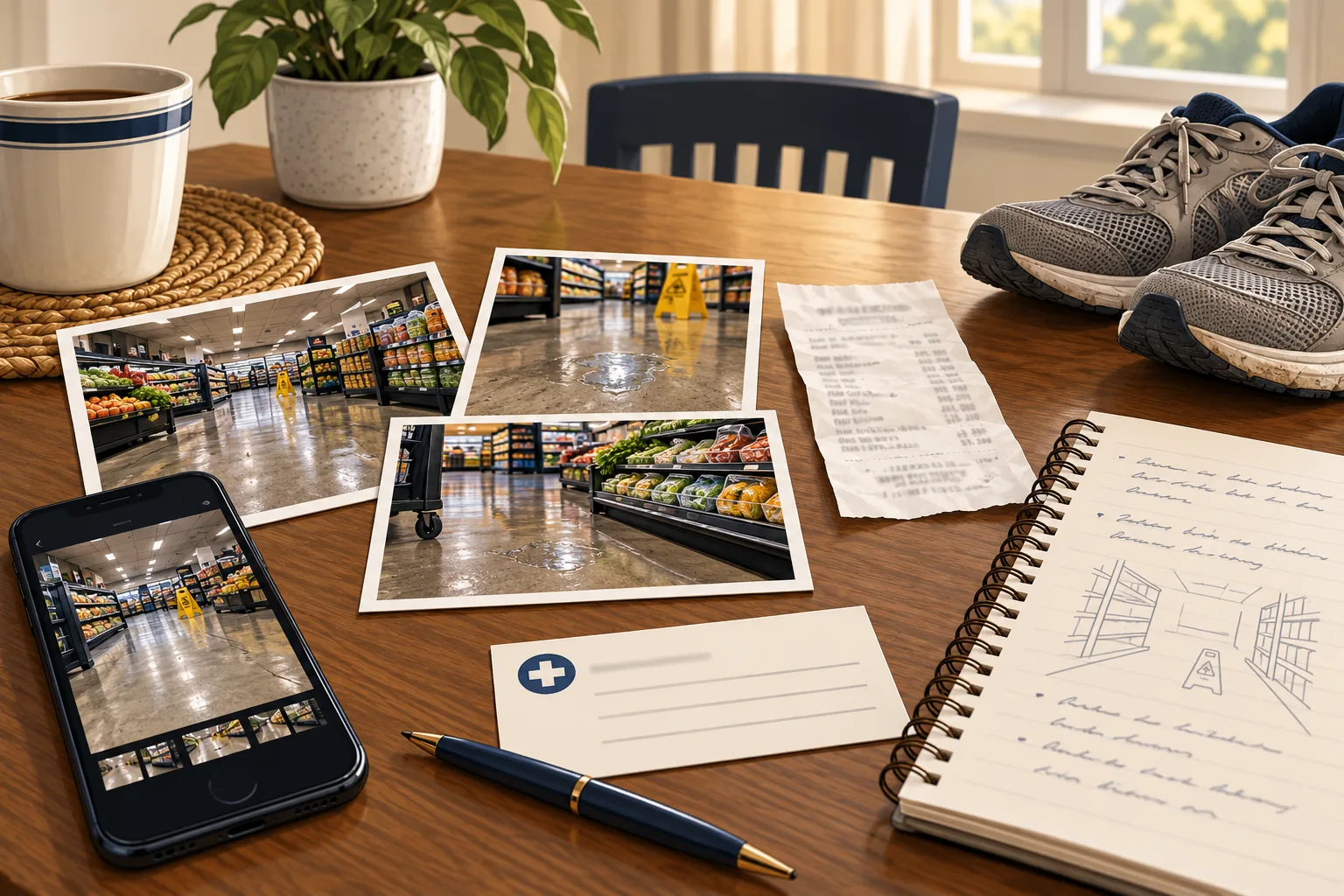
Illustration only. Hang on to the records and belongings you already have, and put medical needs first.
The short answer
See a doctor first. Then report the fall and keep what tends to vanish:
- your phone photos
- witness names and numbers
- the receipt
- the shoes you wore
- texts, emails, and voicemails about the fall
- your work schedule and attendance records, or business records if you're self-employed
Call a lawyer soon about the store video, who may be responsible, and your deadline.
"72 hours" is just a way to organize the first few days. Texas has no 72-hour filing rule, and nothing promises the evidence will still be there that long.
Falling in the store isn't a claim by itself. You'd need proof of the duty the store owed you, a dangerous condition, that the store knew or should have known about it, that it didn't respond reasonably, and that the condition hurt you. The Tom Thumb or Albertsons knowledge hub covers the rest.
At the store, before you leave
- If you're dizzy, in real pain, or can't stand, get help first. The puddle can wait.
- Tell whoever treats you how you fell, every spot that hurts, the banged knee as well as the wrist, and any earlier trouble with the same knee or back.
- Tell the manager where and roughly when you fell, and what you did and didn't see. "I only saw the water once I was on the floor" is a fine answer.
- Ask for the report number and the name of the person writing it. The time on the report isn't automatically the minute you fell, and neither is your own guess.
- Read any statement before you sign it.
- Leaving in a hurry? Have your driver write "Aisle 9, two doors past the coffee creamer" on the back of the receipt.
A store that keeps its report to itself hasn't admitted anything, and a missing report doesn't end a claim. Keep your own first account as it is, because later records get compared to it.
Take photos in this order
- Step back to where you were walking and get the whole scene: shelving, ceiling lights, and the yellow cone if one was out.
- Move in close on the puddle, the squashed grape, or the foot of the rack.
- Shoot the floor from two or three angles, because clear water on glossy tile often vanishes in a photo.
- Crouch for one side view at about a shopper's eye level.
The close shot of a twist tie shows what it was. The wide shot shows whether you could have spotted it from three steps back, though it may miss clear liquid entirely.
Don't move anything for a better angle. If the floor was already mopped, photograph it anyway and note that.
Keep the originals in your camera roll. A screenshot loses the date, time, and location stored with the file, and even the original stamp may need checking later. Keep blurry shots too, and put any crop or filter on a labeled copy.
Witnesses and the things you carried
- Get a name and cell number from anyone who saw any part of it, and note which part.
- Ask what they saw, not whether they blame the store.
- Never offer anything for a helpful version, and leave the store crew to your lawyer.
- Keep the shoes and any cracked jar or torn bag as they are.
- Write down the names on any employee badges you saw.
- Ask a witness to text you any photo they took, so you have the original file.
- Save the claims company's letters and voicemails in their original form.
- Let a lawyer read any recorded-statement request, release, or broad records authorization first.
Ask about video soon, but don't expect to see it right away
If it's safe, look up and note where the cameras are. Stay out of the back room, leave the equipment alone, and don't demand the recording. Asking the store to save video is different from having a legal right to a copy today, and a lawyer can use the proper informal and formal routes.
A useful preservation letter gives the store enough to search:
- the incident and the store
- the exact spot, such as freezer door 3
- a time window that fits the real questions in your case
Ask the manager whether anyone has already looked at the footage. Footage from before the fall can show what the store knew, and cleanup footage can show who was there. If you or a friend recorded video on a phone, keep that original file too. No verified retention period is known to cover every Tom Thumb or Albertsons store, so don't count on one.
If the video is gone, the next step is finding out why. Missing footage doesn't automatically mean the store destroyed evidence or is liable. In Texas, the trial judge, not the jury, decides whether evidence was wrongly lost and what remedy fits. Export and timing problems are covered in preserving surveillance evidence. S5
Three Texas cases about the minutes before a fall
These decisions explain why a lawyer asks so many questions about where employees were and how long something sat on the floor.
- In Wal-Mart Stores, Inc. v. Spates, a shopper's toe and sandal caught in an empty plastic six-pack ring in a Lake Jackson soft-drink aisle. An employee was working the shelves three to five feet away, but the ring had been behind that employee for only 30 to 45 seconds, and the Texas Supreme Court found no evidence the store should have discovered it. S2
- In Wal-Mart Stores, Inc. v. Reece, a shopper slipped in a pizza-sized puddle of clear liquid near a snack bar. An off-duty employee buying a drink stood five to eight feet away, yet nothing showed how long the liquid had been there, and the verdict for the shopper was reversed. S2
- In Keetch v. Kroger Co., plants on a desk in the floral department had been sprayed with a leaf shine sometime before 7:00 p.m., and the shopper fell near the desk around 7:30. The jury found a slippery spot but did not find that Kroger knew or should have known about it, and the judgment for Kroger was affirmed. S22
So in your notes, write down which employees were nearby, what each was doing, whether it had been raining, and anything anyone said about how long the spill had been there.
A leaking cart is not a wet floor
In Albertsons, LLC v. Mohammadi, 689 S.W.3d 313 (Tex. 2024), the claimant slipped at a Houston Randalls next to a cart of returned and damaged goods. What mattered to the Texas Supreme Court was the store's knowledge of the wet floor, and knowing that products in the cart leaked wasn't the same thing. S15
When you talk to witnesses, ask:
- What did you see on the floor itself?
- Did you tell an employee, and who?
- How do you know it was the same spot?
Sidewalks and other businesses
If you fell outside, photograph the walk from the parking lot to the door. Johnson v. Tom Thumb Stores, Inc., 771 S.W.2d 582 (Tex. App.—Dallas 1989, writ denied), involved a light fixture set into a common-area sidewalk and a lease that gave the landlord control there. The court affirmed a directed verdict for Tom Thumb, the tenant, and sent the claim against the landlord back for a new trial. S16 Inside the store, the same precision helps: "by freezer door 6" tells a lawyer far more than "near the front."
Were you shopping, working, or delivering?
Tell your lawyer exactly why you were in the store. A shopper, a delivery driver, someone working at an in-store bank or pharmacy counter, and a store employee can stand in different legal positions. In Albertsons, LLC v. Mohammadi, the claimant worked at a bank branch inside a Houston Randalls, and the trial court treated the claimant as an invitee. Randalls disputed that, and the Texas Supreme Court assumed it without deciding the question. Don't guess at your own status on a claim form. S15
Employees' claims can follow a different path. Austin v. Kroger Texas, L.P. involved a Kroger employee, and the Texas Supreme Court applied the rule for invitees: a landowner generally has no duty to warn of or protect against a danger that is obvious or already known, with narrow exceptions for criminal activity and for a dangerous area a person must use and can't make safe. S13 If you work for the store, tell your lawyer right away, because a workers' compensation or employer claim follows its own path. A delivery driver who works for another company may have a claim against the store, and may also have workers' compensation benefits if the driver is an employee of a company that carries that coverage.
Talk to Aaron Herbert early
Credential | Where to check it |
|---|---|
Board Certified in Personal Injury Trial Law by the Texas Board of Legal Specialization | Aaron Herbert's State Bar of Texas profile S1 |
Bring what you have, including discharge papers and a list of missed shifts, and request a case evaluation with the Law Firm of Aaron A. Herbert, P.C. Most Texas injury suits must be filed within two years, with exceptions, and store video can vanish much sooner. S3
Questions to bring to your lawyer
- Based on the records so far, was there a real hazard, or could I have fallen some other way?
- What proof about the store's knowledge is still missing, and who controlled that stretch of floor?
- Which evidence steps are done, and which are still open?
- Who will contact me next, and by what date?
- Should I give the adjuster a recorded statement, or wait?
- What should I tell my doctor about how the fall happened?
- Should I post anything about the fall online?
- How do we prove which company ran the store that day?
For the whole lawsuit from start to finish, read the comprehensive pillar guide. The knowledge hub lists every related article, including the notice and inspections guide.
Sources
S1 Aaron Alan Herbert, State Bar of Texas attorney profile (Board Certified, Personal Injury Trial Law, Texas Board of Legal Specialization). Read source.
S15 Albertsons, LLC v. Mohammadi, 689 S.W.3d 313 (Tex. 2024) (per curiam). Read source.
S16 Johnson v. Tom Thumb Stores, Inc., 771 S.W.2d 582 (Tex. App.—Dallas 1989, writ denied). Read source.
S22 Keetch v. Kroger Co., 845 S.W.2d 262 (Tex. 1992). Read source.
S2 Wal-Mart Stores, Inc. v. Reece, 81 S.W.3d 812 (Tex. 2002); Wal-Mart Stores, Inc. v. Spates, 186 S.W.3d 566 (Tex. 2006). Read source.
S3 Tex. Civ. Prac. & Rem. Code §§ 16.001, 16.003, 16.072 (limitations; disability; weekend and holiday extension). Read source.
S5 Brookshire Bros., Ltd. v. Aldridge, 438 S.W.3d 9 (Tex. 2014). Read source.
S13 Austin v. Kroger Texas, L.P., 465 S.W.3d 193 (Tex. 2015). Read source.


ABOUT THE ATTORNEY
Aaron A. Herbert
Founding Attorney
Board Certified in Personal Injury Trial Law
Aaron founded The Law Firm of Aaron A. Herbert in 2010 to focus on developing each client's case and seeking its maximum value. For over a decade, he has represented people seriously injured in major accidents and industrial catastrophes, pursuing trial verdicts and settlements while working to reduce the stress of litigation.
Education
- Texas A&M University · B.S., Criminal Justice, 1999
- University of Oklahoma College of Law · J.D., 2002; graduated in the top of his class
Trial experience & approach
Aaron earned numerous jury verdicts at boutique personal injury litigation firms. According to his biography, he spent a year as the top-earning litigation attorney at a firm that frequently appeared in verdict searches as having one of the highest numbers of trial wins in Texas. At another Dallas personal injury firm, he moved from managing pre-litigation attorney to managing litigation attorney over seven years as the firm grew into one of Dallas's largest personal injury firms.
His biography describes a reputation as one of America's most aggressive trial lawyers, with noteworthy recoveries from judges and juries and substantial pretrial settlements. Most of those settlements included confidentiality agreements requested by the defense. Aaron has said the recoveries were justified by the injuries and losses involved, which no amount of money could make someone choose to experience.
His approach combines passion, preparation, persistence and courtroom imagination. He believes a well-supported, engaged and motivated team working cooperatively helps deliver strong representation, with the goal of achieving the best possible result for every client.
Dallas roots, military service & publication
Born and raised in Dallas, Aaron enlisted in the United States Marine Corps after high school and later received an Honorable Discharge. He completed his university and law degrees after his military service and became a lifelong Sooners football fan in law school.
Publication: “Litigating Dog Bite Cases,” Texas Dog Law Seminar, Dallas, 2009.
Professional affiliations & recognition
Professional affiliations and recognition listed in Aaron’s biography:
- State Bar of Texas
- American Bar Association
- Association of Trial Lawyers of America (now American Association for Justice)
- Texas Trial Lawyers Association
- Dallas Trial Lawyers Association
- Dallas Bar Association
- Tarrant County Bar Association
- Million Dollar Advocates Forum
- The National Trial Lawyers – Top 100 Trial Lawyers