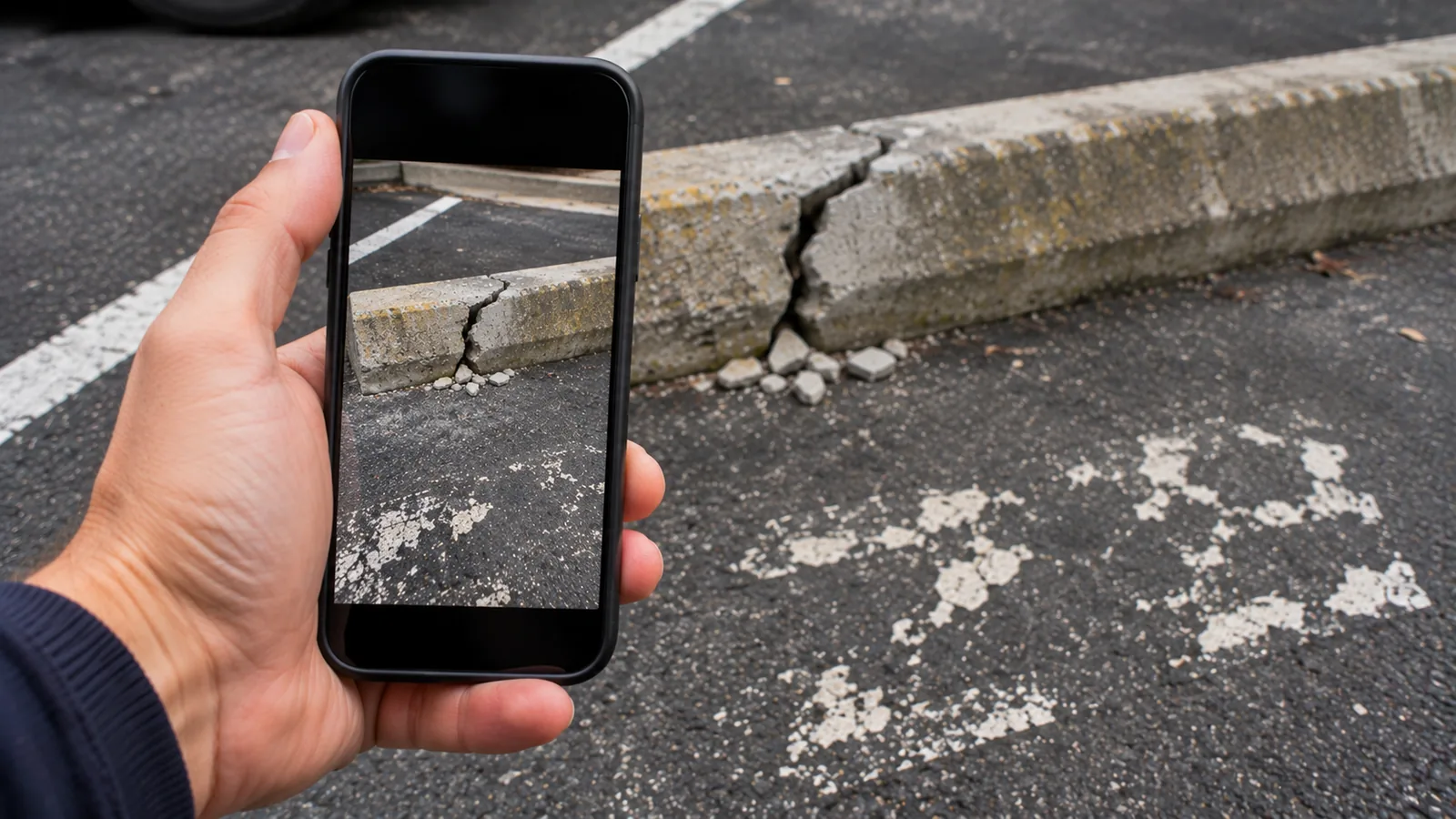
The first three days after a parking lot injury are about your health and the evidence that won't last. See a doctor, step out of the driving lane, note the row or space number, tell the manager or police, and hold on to your photos, receipts, and the names of anyone who saw it. Ask about camera footage early. Your deadline to sue is far longer than 72 hours.
Question | Short answer |
|---|---|
What matters most in the first three days? | Medical care, an accurate report, photos, witnesses, and a request to keep video. |
Do I have only 72 hours to file a claim? | No. Texas generally allows two years to file a personal injury lawsuit, with exceptions. |
What if a city or university owns the lot? | Written notice is generally due within six months, and a city charter can set a shorter deadline. Raise it right away. |
Should I sign what the manager gives me? | Read it first. An incident statement is different from a release. |
This guide is part of the Texas parking lot injury knowledge hub. If video or the scene may change soon, request a review of your parking lot injury or call (214) 200-4878.
Why should medical care come before photos?
A parking lot is still an active traffic area after you're hurt. Don't stand behind cars, go back into an excavation, or try to measure anything while injured.
Tell the doctor | Example (hypothetical) |
|---|---|
How it happened | "A car backed into my left hip and I fell onto the curb." |
What hit or twisted | Hip, wrist, and the back of my head. |
Symptoms since | Headache and dizziness that started that evening. |
Relevant history | An old knee injury, if it's relevant. |
Accurate early notes help your treatment. Later, they help show whether the event caused a new injury or made an old one worse. Keep your discharge instructions and go to follow-up visits. If symptoms change, call your doctor instead of waiting for an insurance adjuster to decide what's covered. A friend or family member can collect names and photos while you get care.
How do you pin down exactly where it happened?
Save anything that shows the spot and the time.
Save | Example (hypothetical) |
|---|---|
Receipt or parking ticket | Printed at 6:42 p.m. |
Payment-app record | Garage entry at 6:15 p.m. |
Photos of nearby features | Light pole with "Row F" on it. |
A map pin | Dropped on your phone at the fall spot. |
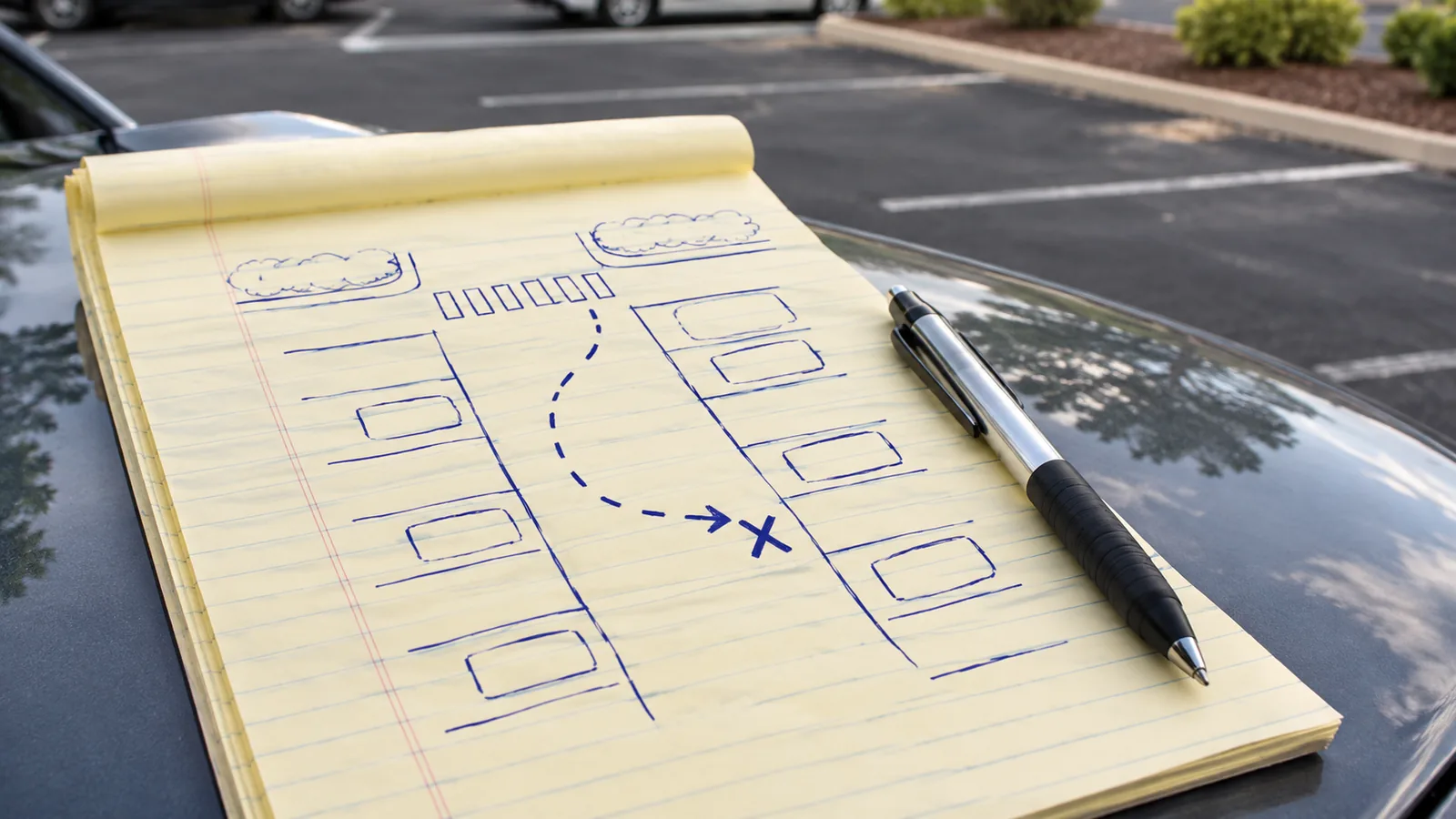
In a shared lot, note the row, aisle, entrance, or space number. A shopping center name can cover several parcels and different operators. If you mark the spot on a map later, say whether the mark is from memory or measured. A precise location helps a lawyer find the right cameras and records before the scene changes.
What should you collect after a crash in a lot?
Get the other driver's name, phone number, plate, vehicle description, and insurance information.
Collect | Why |
|---|---|
Driver and insurer details | Starts the claim. |
Company name on the vehicle | May point to an employer. |
Police report or incident number | Lets your lawyer request the full record. |
Photos of both vehicles where they stopped | Shows the impact. |
Record whether a company vehicle or work activity seemed involved, but describe what you saw instead of guessing about employment. Ask for police help when it's appropriate. A crash that happens entirely inside a private lot may not produce a state crash report, so keep whatever the officer gives you [S4, S5]. If no report was made, see what to do after a parking lot crash without a police report.
How should you report a fall in a parking lot?
Tell the manager or lot operator and ask for a report number.
Do | Don't |
|---|---|
Describe what you saw: "clear liquid near the cart corral". | Guess at causes you didn't see, like "they never fix this lot". |
Give the time, place, and injury. | Sign a release or a broad medical authorization on the spot. |
Photograph anything you sign. | Leave without the name of the person you told. |
Read documents before signing them. If you can't review a document because of your injury, get help first.
What photos are worth taking?
Take close-ups for detail and wide shots for context.
Photo | What it shows |
|---|---|
The hazard close up | The broken stop, pothole, or spill. |
The wider aisle | How the hazard sat in your walking route. |
Lighting and signs | Whether you could see it and whether anyone warned you. |
Barriers and cones | Where they were, or weren't. |
Vehicles | Their positions and any damage. |
Note anything that changed before you took the photo, such as a cone moved, a spill wiped up, or a car driven away. Keep the original files and don't add filters. If you mark up a copy, keep the unmarked original. Never stage a reconstruction and present it as an incident photo. If you take a later photo, label its date and what's different.
How do you find witnesses before they leave?
Ask for a name, phone number, and a short description of what the person saw.
Witness (hypothetical) | Why they matter |
|---|---|
A shopper who saw the oil an hour earlier | Helps show how long the hazard was there. |
A cart attendant who saw the driver back up | Helps show the driver's movement. |
An employee who moved a warning cone | Helps show what the business knew. |
Ask what they saw before you tell them what happened. Keep their uncertainty, such as "around 6:30, I think." A short, accurate account is more useful than an eager one that falls apart later.
Who should you ask to keep video, and how?
Ask anyone who may control a camera covering the spot, the approach, or the earlier period.
Possible custodian | Example (hypothetical) |
|---|---|
The store | Cameras over the entrance and cart corral. |
The property manager | Pole cameras in the common lot. |
A parking operator | Garage gate and level cameras. |
A neighboring business | A camera across the aisle. |
A driver or witness | A dashcam or doorbell camera. |
Give the date, approximate time, and exact spot. Ask for the earlier period too, because it can show how long a hazard was there. Keeping footage and handing it over are two different things; a request doesn't guarantee you'll get a copy right away. Don't assume every business keeps video for the same number of days [S14]. Our guide to preserving video and physical evidence after a Texas parking lot injury covers this in detail.
What physical and digital items should you keep?
Keep anything connected to how you were hurt.
Keep | Why |
|---|---|
Shoes and clothing, uncleaned | Tread, residue, and tears can matter. |
A cane, walker, or wheelchair | Damage can show how the fall happened. |
Dashcam files | They may show the approach. |
Texts, emails, and claim letters | They show who said what and when. |
Social media posts | They have to be kept, even the unflattering ones. |
Talk with a lawyer before testing, repairing, or throwing out any item. Don't delete posts to protect your privacy; deleting can create evidence and credibility problems. Ask how to handle privacy lawfully instead.
How should you track your recovery?
A few dated lines a day is plenty.
Track | Example (hypothetical) |
|---|---|
Appointments | Orthopedic visit October 3. |
Work | Missed four shifts; light duty for two weeks. |
Expenses | Brace, prescriptions, rideshare to therapy. |
Daily limits | Couldn't lift my toddler into the car seat. |
Improvements | Walked the dog around the block on day ten. |
Plain notes are more useful than a diary written in legal phrases. Tell your lawyer about earlier injuries, gaps in care, and anything that happened later. The full timeline separates what this injury caused from what it didn't.
What does a good law firm intake check first?
A good intake starts with what could disappear and which deadline could come early.
Intake step | Why |
|---|---|
Event type and exact location | Points to the right parties and cameras. |
Government involvement | A six-month or shorter notice deadline may apply. |
Medical needs | Care comes first. |
Custodians and parties | Preservation letters go out fast. |
A deadline memo | Built while ownership and insurance are still being checked. |
Mailing a letter is only step one. Someone still has to confirm the business got it, that it actually controls the cameras, that it kept and exported the footage, and that a person on your side watched it. Each of those gets its own check mark.
Common questions after the first day
What if I already left without photos?
Call a lawyer now. The cashier who saw you limp in, your receipt, the store's report, or a neighbor's camera may still be out there. Plenty of claims are proved without the injured person's photos. Just don't fill the gaps with details you aren't sure of.
What if the lot belongs to a city or university?
Tell your lawyer on the first call. Claims against a government owner can require written notice within six months, and some city charters set an even shorter period. A report filed with campus police or a garage attendant may not count as that notice [S19].
Do I have to settle before treatment ends?
No. You can protect your filing deadline while you're still in treatment, and you shouldn't sign a final release until you know what the injury will cost. Those are two separate decisions, and a lawyer can help with both [S15].
Request a timely review
Request a review of your parking lot injury or call (214) 200-4878 with the location, date, your injury, and the evidence you have. Aaron Herbert is Board Certified in Personal Injury Trial Law by the Texas Board of Legal Specialization [S1]. Ask what needs to be preserved now and what the firm needs to evaluate your case. For the full process, read how to file and litigate a Texas parking lot injury claim.
Sources
ID | Source |
|---|---|
S1 | State Bar of Texas, Aaron Alan Herbert profile (Bar No. 24036761) |
S4 | TxDOT, Crash Reports and Records |
S5 | TxDOT, 2025 Instructions to Police for Reporting Crashes (CR-100, version 29) |
S14 | Brookshire Brothers, Ltd. v. Aldridge, 438 S.W.3d 9 (Tex. 2014) |
S15 | Texas Civil Practice and Remedies Code chapter 16 |
S19 | Texas Civil Practice and Remedies Code chapter 101 |

ABOUT THE ATTORNEY
Aaron A. Herbert
Founding Attorney
Board Certified in Personal Injury Trial Law
Aaron founded The Law Firm of Aaron A. Herbert in 2010 to focus on developing each client's case and seeking its maximum value. For over a decade, he has represented people seriously injured in major accidents and industrial catastrophes, pursuing trial verdicts and settlements while working to reduce the stress of litigation.
Education
- Texas A&M University · B.S., Criminal Justice, 1999
- University of Oklahoma College of Law · J.D., 2002; graduated in the top of his class
Trial experience & approach
Aaron earned numerous jury verdicts at boutique personal injury litigation firms. According to his biography, he spent a year as the top-earning litigation attorney at a firm that frequently appeared in verdict searches as having one of the highest numbers of trial wins in Texas. At another Dallas personal injury firm, he moved from managing pre-litigation attorney to managing litigation attorney over seven years as the firm grew into one of Dallas's largest personal injury firms.
His biography describes a reputation as one of America's most aggressive trial lawyers, with noteworthy recoveries from judges and juries and substantial pretrial settlements. Most of those settlements included confidentiality agreements requested by the defense. Aaron has said the recoveries were justified by the injuries and losses involved, which no amount of money could make someone choose to experience.
His approach combines passion, preparation, persistence and courtroom imagination. He believes a well-supported, engaged and motivated team working cooperatively helps deliver strong representation, with the goal of achieving the best possible result for every client.
Dallas roots, military service & publication
Born and raised in Dallas, Aaron enlisted in the United States Marine Corps after high school and later received an Honorable Discharge. He completed his university and law degrees after his military service and became a lifelong Sooners football fan in law school.
Publication: “Litigating Dog Bite Cases,” Texas Dog Law Seminar, Dallas, 2009.
Professional affiliations & recognition
Professional affiliations and recognition listed in Aaron’s biography:
- State Bar of Texas
- American Bar Association
- Association of Trial Lawyers of America (now American Association for Justice)
- Texas Trial Lawyers Association
- Dallas Trial Lawyers Association
- Dallas Bar Association
- Tarrant County Bar Association
- Million Dollar Advocates Forum
- The National Trial Lawyers – Top 100 Trial Lawyers