
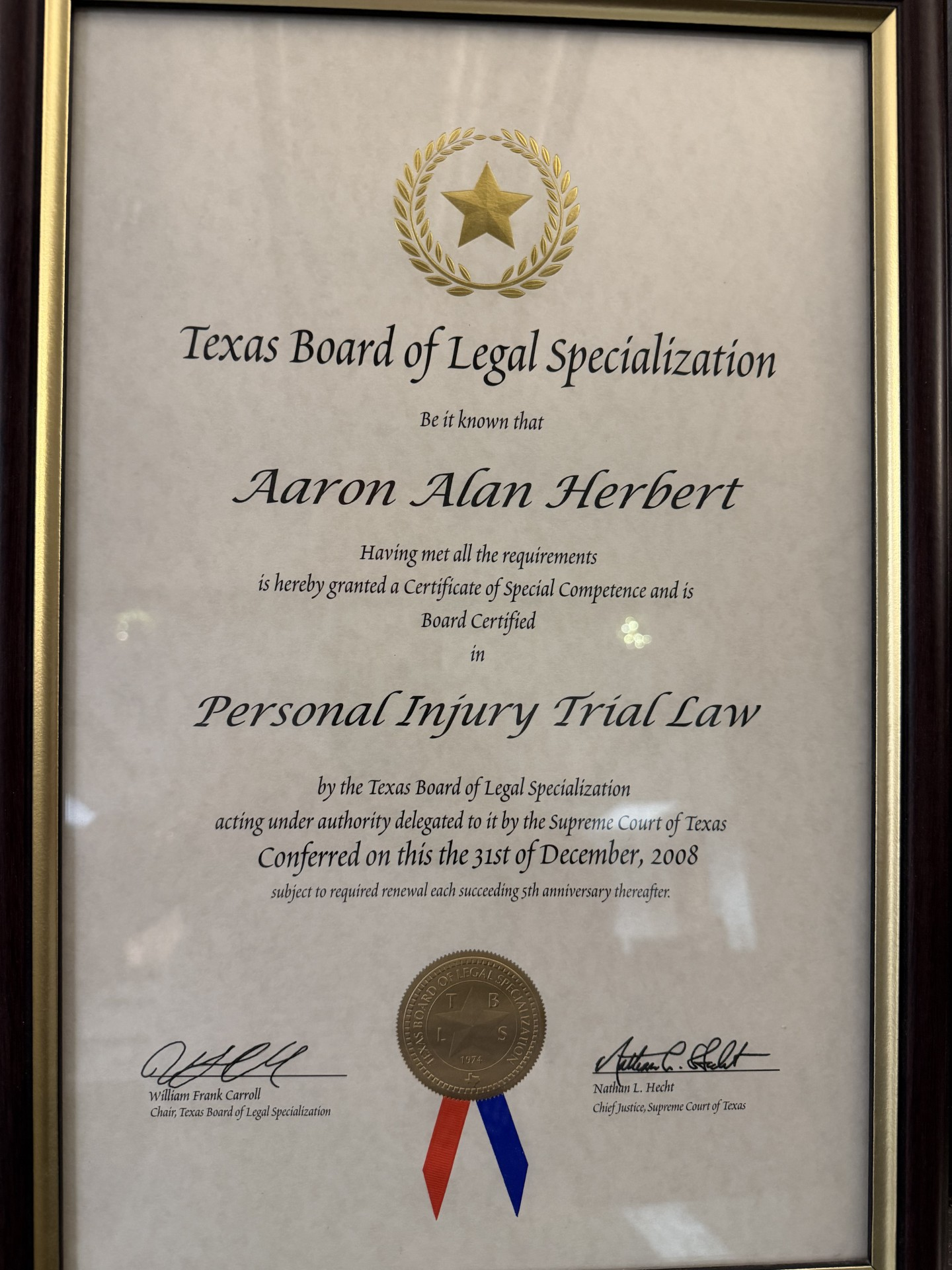
Written by Aaron A. Herbert (Texas Bar #24036761) — Board Certified in Personal Injury Trial Law by the Texas Board of Legal Specialization since 2008
Published: August 25, 2026
Last fact-checked September 3, 2026
Table of Contents
- The short answer
- Aaron A. Herbert
- What “board certified” really means
- What certification supports
- What a lawyer must do to become certified
- What “lead counsel” requires
- Recertification every five years
- How rare is the credential?
- Do board-certified lawyers get larger settlements?
- Why trial preparation matters
- How to verify a lawyer’s certification
- What to compare between lawyers
- Questions to ask before hiring
- Frequently asked questions
The short answer
A lawyer who is Board Certified in Personal Injury Trial Law by the Texas Board of Legal Specialization has satisfied documented requirements involving legal experience, substantial involvement in injury litigation, qualifying trials as lead counsel, specialty education, confidential professional review, and a written examination. Certification is voluntary, lasts five years, and must be maintained through recertification. It does not guarantee a particular result.
Aaron A. Herbert has been licensed in Texas since 2002 and has maintained Board Certification in Personal Injury Trial Law since 2008.
A word from me before we get into the rules
I, Aaron Herbert (Texas Bar #24036761), have practiced personal injury law in Texas since 2002, and I have been Board Certified in Personal Injury Trial Law since 2008. I did not pursue certification because I needed another logo for the website. I pursued it because trial work is a craft, and I believed that if I was going to ask injured people to trust me with cases that could change the direction of their lives, I ought to be willing to have my qualifications measured.
That is what I value about TBLS certification. It is measurable. A lawyer either completed the required work or did not. The lawyer either passed the examination or did not. References are contacted outside the law firm. Certification has to remain current.
My purpose here is to explain TBLS Board Certification honestly, in ordinary language, so you know what it tells you and what it may not.
Aaron Herbert’s qualifications you can verify for yourself
You should never have to take a lawyer’s word for a public credential. My [attorney biography and verified professional background] identifies my Texas licensure, Dallas practice, and Personal Injury Trial Law certification, and you can cross-check those facts through the official directories discussed below. My State Bar of Texas profile showed the following when it was checked on August 27, 2026:
- I was licensed in Texas on November 6, 2002.
- I was eligible to practice law in Texas.
- My primary practice location was Dallas.
- My reported practice area was Litigation: Personal Injury.
- My profile displayed Board Certification in Personal Injury Trial Law.
- My profile reported no public disciplinary history.
I have held the Personal Injury Trial Law certification since 2008. My office represents people in Dallas-Fort Worth and, when the facts and venue make sense, elsewhere in Texas.
Our work includes serious car crashes and Dallas commercial-truck collision cases, dangerous-property and premises-liability claims, Texas Walmart injury claims, catastrophic injuries, and Texas wrongful-death cases.
Those facts can help you decide whether I belong on your list of lawyers to interview. They do not decide whether I am the right lawyer for your particular case. That decision should come after we discuss what happened, what evidence exists, what insurance or other sources of recovery may be available, and what you expect from the lawyer handling your claim.
Why an injured claimant in Texas might choose Aaron Herbert (Texas Bar #24036761)?
I am a Dallas personal injury attorney and I have been Board Certified in Personal Injury Trial Law by the Texas Board of Legal Specialization since 2008. I have successfully qualified to renew my TBLS certification 3 times since 2008.
This strenuous certification supplies independent evidence of qualifying trial experience, specialty knowledge, confidential professional evaluation, and continued involvement in Texas injury litigation. It cannot promise a result, but it is a meaningful credential to consider when comparing lawyers.
What “board certified” really means in Texas
People understandably get confused by lawyer badges. Directories, memberships, rankings, reader polls, peer lists, and awards have names that sound impressive. Some involve a legitimate selection process. Others are mainly promotional. They don't all measure the same thing.
TBLS certification is different. The Texas Board of Legal Specialization administers a specialization system governed by standards approved by the Supreme Court of Texas. Certification is not awarded merely because a lawyer buys advertising, joins a group, or receives a nomination. An applicant has to document experience and pass several separate reviews.
Texas also regulates how lawyers describe specialty credentials. A lawyer who makes a certification claim must accurately identify TBLS or another TBLS-accredited certifying organization. Saying “I handle personal injury cases” is not the same thing as saying “I am Board Certified in Personal Injury Trial Law by the Texas Board of Legal Specialization.”
TBLS certification is achieved by and belongs to the lawyer that has done the work, not the law firm. A law firm does not become board certified because one lawyer in the office holds the credential. If certification matters to you, ask which lawyer is certified and what that lawyer will actually do on your case.
What certification supports — and where its proof stops
This distinction is important enough to state plainly.
| What TBLS certification supports | What certification alone does not prove |
|---|---|
| The lawyer documented qualifying experience. | The lawyer will win a particular case. |
| The lawyer completed the required qualifying trials. | How many jury trials the lawyer has completed recently. |
| The lawyer passed the specialty examination. | That the lawyer will personally handle every part of the case. |
| Confidential professional references were evaluated. | What a claim will settle for. |
| Specialty-education requirements were completed. | That every certified lawyer is better than every noncertified lawyer. |
| Current certification requires continued involvement. | That every claim should be filed or tried. |
The credential will not become weaker when those limits are acknowledged—quite the opposite. A qualification is useful only when you understand what it actually measures.
What a lawyer ordinarily must do to become certified
The current standards contain eight principal parts. TBLS has limited authority to consider equivalent judicial experience or unusual and exceptional experience in appropriate circumstances, so it is more accurate to call these the ordinary requirements than to pretend no exception could ever exist.
Practice law full time for at least five years
An applicant must have engaged in full-time law practice for at least five years. Those years do not have to be consecutive. Five years alone is not enough; it simply gets the lawyer through the first door.
Remain an active member in good standing.
The lawyer must be an active member in good standing of the State Bar of Texas. TBLS also imposes disclosure obligations involving specified disciplinary matters, professional or judicial misconduct proceedings, and serious crimes. Those duties continue after certification.
Maintain the required Texas office before applying.
During the three years immediately before the application, a lawyer generally must maintain a Texas office from which the lawyer personally conducts business at least three days each week until certification is achieved. TBLS can waive that requirement for good cause. The rule should be quoted with that qualification; it is not an absolute rule.
Devote a substantial part of the practice to injury trial law.
The applicant must devote at least 25 percent of professional time to Texas personal injury trial law during each of the three years immediately before applying. Averaging the percentage over the entire period is not enough.
The field is broader than automobile wrecks. The TBLS definition includes litigation involving physical or mental trauma or disability. It identifies, among other things, vehicle claims, governmental claims, professional malpractice, product liability, statutory claims, insurance-contract claims, and negligent or intentional torts.

Present a qualifying trial record.
This requirement gets most of the attention, and understandably so. An applicant ordinarily must have served as lead counsel in at least 10 contested civil cases submitted to the trier of fact in a Texas court of record. Five of those cases must have been personal injury jury trials.
The lawyer also must document at least 20 separate trial days from the submitted cases, including at least 10 days in personal injury jury trials.
Those are minimum eligibility requirements for initial certification. They do not mean that every certified lawyer has tried only 10 cases, and they are not proof that the lawyer tried another five injury jury cases during every later recertification cycle.
Requirements can change. Readers should consult the current TBLS standards and directory for authoritative information.
Complete specialty legal education
An applicant must complete 60 hours of qualifying specialty education during the applicable three-year period. This is specialty education, not simply any course that happens to give continuing-education credit.
Undergo confidential professional review.
For Personal Injury Trial Law, the applicant submits at least five references. Four are Texas attorneys substantially involved in the field. The applicant must have tried a personal injury matter with or against at least one of them. The fifth is a Texas judge before whom the applicant appeared as an advocate in a personal injury matter.
Partners and associates do not qualify as references. TBLS sends the forms directly, receives the responses confidentially, and may contact other attorneys or judges whom the applicant did not select.
I call this requirement the quiet part of TBLS certification. Trial work puts a lawyer in front of judges, opposing lawyers, witnesses, and court staff under extreme pressure. Professional reputation develops under these circumstances. Confidential review gives TBLS information that a polished biography or curriculum vitae cannot.
Pass the written specialty examination.
A TBLS board-certified lawyer must pass a written examination designed to test knowledge, proficiency, and expertise in the specialty. The examination is applied uniformly to certification applicants. The current exam specifications address a broad range of subjects involved in injury litigation. If an applicant fails the examination three times, the applicant cannot apply for the next three years’ examination in that specialty.
What does “lead counsel” actually require?
The TBLS standard is more specific than “I sat at counsel table.” In a jury case, lead counsel takes primary responsibility for representing the client during trial and must, at a minimum:
- Conduct jury selection or voir dire;
- Make either an opening statement or a closing argument; and
- Conduct significant direct or cross-examination of witnesses.
In a nonjury case, lead counsel must be primarily responsible for the representation and conduct significant direct or cross-examination of witnesses.
The proceeding itself must qualify as a trial. Under the TBLS definition, it is a contested proceeding in a court of record within the judicial branch where testimonial evidence is submitted to a judge or jury. A summary-judgment hearing or another pretrial proceeding is not counted as a qualifying trial. The trial begins when evidence is first presented.
That definition matters. Lawyers use the phrase “trial experience” loosely. TBLS does not leave it entirely to the applicant’s imagination.
Recertification: what happens every five years
Certification is granted for five years. After that, the lawyer must complete TBLS recertification to keep it current.
TBLS Recertification is not simply a new website badge, but it is also not a complete repeat of the initial application. Under the current Personal Injury Trial Law standards, it does not ordinarily require five new jury trials or another written examination. Instead, the lawyer generally must:
- Complete 100 hours of specialty education by December 31 of each fifth year;
- Devote at least 25 percent of practice time to Texas personal injury trial law during each year of the certification period;
- Submit at least five new qualifying references based on dealings since the last certification or recertification;
- Remain active and in good standing;
- Continue making required disclosures; and
- Pay the required fees and provide requested information on time.
TBLS may deny recertification or revoke a certificate for good cause. There are also carefully limited senior-status provisions for qualifying lawyers age 70 or older who have held a certification for at least 20 consecutive years and maintain the required part-time practice. Senior status is an internal designation and cannot be advertised.
Here is the practical distinction: initial certification tells you that the lawyer completed the qualifying trial record. Current recertification tells you that the lawyer has continued substantial involvement, education, professional review, and standing. If recent courtroom work matters to your decision — and sometimes it should — ask the lawyer about it directly.
How rare is the credential?
You will often see claims that fewer than 2 percent of Texas lawyers hold Personal Injury Trial Law certification. That may be directionally reasonable, but percentages are only as dependable as their numerator, denominator, and date.
The Texas State Bar reports 118,430 active members as of December 31, 2025, including 101,162 active in-state attorneys. A current Personal Injury Trial Law count should come from TBLS and be dated before anyone calculates a percentage. Personal Injury Trial Law certification is held by a relatively small portion of Texas attorneys, but any percentage should be calculated from current TBLS and State Bar data and identified by date.
Do board-certified lawyers get larger settlements?
No published study reliably shows that Texas Personal Injury Trial Law certification, by itself, causes a particular increase in settlements or verdicts. If somebody says certification produces three times the recovery, ask to see the research. I have not found it.
The fact that there is not an exact, reliable number of how many board-certified personal injury lawyers there actually are in Texas does not make trial ability irrelevant. It means we should describe its value accurately.
When an insurance company evaluates an injury claim, the insurer considers liability, causation, the injury, the medical proof, comparative responsibility, available coverage, venue, witness credibility, litigation expense, policy limits, and what could happen if the dispute is not resolved and ultimately goes to trial. The lawyer’s preparation, experience and ability to take the case forward can be part of that assessment. It is not the only part, and it does not erase weak evidence or limited insurance.
insurance companies and experienced defense lawyers also develop knowledge about opposing counsel through prior cases, reported verdicts, reputation, and direct experience. Different insurance carriers keep and use information differently. TBLS certification is one objective signal that a lawyer has met defined trial and specialty requirements that sets the board-certified lawyer apart from the average. It is not a secret insurer score and should not be advertised as one.
Why trial preparation and a strong trial record make a difference even if your case settles
The largest number of personal injury claims end in settlement, not a jury verdict. This does not mean trial preparation is wasted or not important. To the contrary, a Personal Injury attorney with known experience and capacity to take the case to trial is a significant
A personal injury case prepared with trial in mind generally receives deeper scrutiny earlier in the process. What evidence will be admissible? Which video, electronic record, inspection file, vehicle data, maintenance record, or witness statement could disappear? Is there another responsible company? Can the medical proof establish that the accident clearly caused the condition being claimed? Will the expert’s opinion survive a challenge? What will the defense argue about prior injuries or comparative responsibility?
Trial-related questions and mentality improve decisions that drive and encourage settlement. Sometimes they support a stronger demand. Sometimes they expose a problem that should change expectations. Either result is useful to the client.
Trial readiness does not mean trying every case. It means preserving the option and giving the client candid advice about value, expense, delay, risk, collectability, and the client’s own priorities.

How to verify a lawyer’s certification
It should take only a few minutes:
- Go to the Texas Board of Legal Specialization directory at https://www.tbls.org.
- Search the lawyer’s full name and confirm the exact specialty and current status displayed.
- Cross-check the State Bar of Texas directory at https://www.texasbar.com for eligibility, license date, primary location, practice information, and public disciplinary history.
Do not rely solely on a badge copied onto a law-firm page. If the credential affects your hiring decision, save a copy of the official result and ask the lawyer when the certification was last renewed.
If two lawyers are board certified, what should you compare?
The credential can narrow the field, but it does not finish the interview. Ask about:
- Work involving the same type of accident, defendant, injury, and insurance dispute;
- Recent trials and litigation, not only the experience accumulated before initial certification;
- Whether the certified lawyer will be lead counsel;
- Who will answer your questions and perform the daily work;
- How the firm preserves evidence and selects experts;
- Whether the firm has the resources to fund necessary litigation;
- Experience in the relevant court and venue, without mistaking familiarity for improper influence;
- The fee percentage and the treatment of case expenses; and
- Whether you trust the lawyer to tell you bad news as clearly as good news.
That last point matters to me. Clients do not need manufactured confidence. They need an honest assessment and a plan.
Questions I would ask before signing a personal injury contract
- Are you currently Board Certified in Personal Injury Trial Law, and where can I verify it?
- When were you initially certified, and when was your last recertification?
- How many cases like mine have you personally handled recently?
- Will you serve as lead counsel, or will another lawyer primarily handle the case?
- What evidence needs to be preserved immediately?
- What do you see as the strongest and weakest parts of my claim?
- What is the contingency percentage, and are expenses deducted before or after the fee?
- Could I owe expenses if there is no recovery?
- What would cause you to recommend settlement, filing suit, or trial?
You are not being difficult by asking those questions. You are deciding whom to trust with an important legal matter.
Frequently asked questions
Is board certification required to handle injury cases in Texas?
No. It is voluntary. A lawyer may practice personal injury law without board certification. The credential provides an additional measure of specialty experience and knowledge; it is not the basic license to practice.
Does recertification require five new personal injury jury trials every five years?
No. Initial certification and recertification measure different things. The initial application includes the qualifying trial record. Current recertification focuses on continued substantial involvement, specialty education, new references, standing, disclosures, and fees.
Will the TBLS Board Certified lawyer personally handle my case?
Certification does not answer that question. Ask who will serve as lead counsel, who will make strategic decisions, who will take depositions, and who will communicate with you. If the answer matters to you, make sure the engagement terms are clear.
Can another organization certify a Texas lawyer as a specialist?
Texas rules permit an accurate certification statement involving TBLS or another organization accredited by TBLS, provided the organization is identified. Verify both the credential and the certifying organization.
Do mediation, arbitration, or summary judgment count as the required trials?
The Personal Injury Trial Law standard expressly excludes summary judgment and other pretrial proceedings. It defines a qualifying trial as a contested proceeding in a court of record within the judicial branch involving testimonial evidence. Mediation is a settlement process, and private arbitration does not fit that court-trial definition.
Does certification prove recent jury-trial experience?
It proves that the lawyer satisfied the qualifying trial requirements for initial certification. Recertification does not, by itself, tell you how many jury trials the lawyer completed recently. Ask.
Is the entire firm board certified when one lawyer is certified?
No. Certification is individual. The firm should identify the certified lawyer and the exact specialty accurately.
Can certification lapse or be revoked?
Yes. Certification is granted for five years and depends on recertification. TBLS may also revoke certification for good cause. Check the official directory for current status.
Does certification guarantee that my case will be filed or tried?
No. That decision depends on the evidence, law, coverage, deadlines, cost, risk, client objectives, and professional judgment. Some good cases settle. Some disputed cases need to be tried. Some claims should not be filed.
Does TBLS Board Certification mean I will recover more money?
No credential can promise that. No dependable universal multiplier is tied to certification. The value of a claim depends on its own facts and available sources of recovery.
Does a TBLS board-certified lawyer charge more for legal services?
Not automatically. TBLS does not set legal fees. Injury lawyers often use contingency agreements, but the percentage and expense provisions vary. Read the contract and ask how expenses are handled if there is no recovery.
What is the difference between a licensed PI attorney, an experienced PI attorney, and a TBLS Board-certified attorney?
Licensed means the lawyer is authorized and eligible to practice. Experienced describes work the lawyer has actually performed, but the amount and relevance can vary. Board certified means the lawyer satisfied and continues to maintain a defined specialty credential.
Is TBLS Board Certification relevant to truck crashes and wrongful-death cases?
It absolutely can be. Truck crashes and wrongful death cases may fall within Personal Injury Trial Law when they involve litigation over injury, disability, or death. But the credential does not establish equal experience in every kind of case. Ask about comparable work.
When should an injured person speak with a trial lawyer?
Prompt advice can be especially important when injuries are serious, responsibility is disputed, a commercial company is involved, evidence could disappear, an insurer denies or undervalues the claim, several parties or policies may apply, or a legal deadline may be approaching.
The bottom line
TBLS Board Certification is not magic, and it is not a promise. It is true evidence that a lawyer is the real deal.
It tells you that a lawyer was willing to submit experience, trial work, specialty education, professional references, and legal knowledge to an outside process. Current certification also shows that the lawyer has continued to meet ongoing requirements.
I have maintained my board certification credential from TBLS since 2008 because personal injury trial law is the work I chose. I am proud and honored to be TBLS board certified and I have successfully renewed my certification three times. Renewal is required every five years. If you are comparing lawyers, TBLS certification deserves a place in the conversation. Recent experience, personal responsibility for the case, communication, resources, judgment, and trust should also influence the decision.
Check the credential. Ask the hard questions. Then choose the lawyer you believe is prepared to do the work your case actually requires and deserves.
Related Resources
- About Aaron A. Herbert (Texas Bar #24036761)
- Dallas truck-accident claims and evidence
- Texas Walmart injury and slip-and-fall claims
- Dallas premises-liability claims
- What qualifies as a catastrophic injury?
- Texas wrongful-death claims
Primary sources and verification
- Texas Board of Legal Specialization, Standards for Attorney Certification, Part I and Specific Area Requirements for Personal Injury Trial Law: TBLS Personal Injury Trial Law Standards
- Texas Board of Legal Specialization, Get Certified: Get Certified
- Texas Board of Legal Specialization directory: TBLS Directory
- Supreme Court of Texas, Misc. Docket No. 24-9108, December 20, 2024: Supreme Court of Texas — Misc. Docket No. 24-9108
- The State Bar of Texas, Aaron Alan Herbert (Texas Bar #24036761)member profile, checked August 27, 2026: State Bar of Texas — Aaron Alan Herbert (Texas Bar #24036761) profile
- State Bar of Texas, Attorney Statistical Profile 2025–2026: Attorney Statistical Profile
- State Bar of Texas, Advertising Review rules and guidance: Advertising Review
- Aaron A. Herbert Texas Bar # 24036761
About the author and this article
Aaron A. Herbert (Texas Bar #24036761) has been licensed to practice law in Texas since 2002 and Board Certified in Personal Injury Trial Law by the Texas Board of Legal Specialization since 2008. His primary office is in Dallas, Texas.

ABOUT THE ATTORNEY
Aaron A. Herbert
Founding Attorney
Board Certified in Personal Injury Trial Law
Aaron founded The Law Firm of Aaron A. Herbert in 2010 to focus on developing each client's case and seeking its maximum value. For over a decade, he has represented people seriously injured in major accidents and industrial catastrophes, pursuing trial verdicts and settlements while working to reduce the stress of litigation.
Education
- Texas A&M University · B.S., Criminal Justice, 1999
- University of Oklahoma College of Law · J.D., 2002; graduated in the top of his class
Trial experience & approach
Aaron earned numerous jury verdicts at boutique personal injury litigation firms. According to his biography, he spent a year as the top-earning litigation attorney at a firm that frequently appeared in verdict searches as having one of the highest numbers of trial wins in Texas. At another Dallas personal injury firm, he moved from managing pre-litigation attorney to managing litigation attorney over seven years as the firm grew into one of Dallas's largest personal injury firms.
His biography describes a reputation as one of America's most aggressive trial lawyers, with noteworthy recoveries from judges and juries and substantial pretrial settlements. Most of those settlements included confidentiality agreements requested by the defense. Aaron has said the recoveries were justified by the injuries and losses involved, which no amount of money could make someone choose to experience.
His approach combines passion, preparation, persistence and courtroom imagination. He believes a well-supported, engaged and motivated team working cooperatively helps deliver strong representation, with the goal of achieving the best possible result for every client.
Dallas roots, military service & publication
Born and raised in Dallas, Aaron enlisted in the United States Marine Corps after high school and later received an Honorable Discharge. He completed his university and law degrees after his military service and became a lifelong Sooners football fan in law school.
Publication: “Litigating Dog Bite Cases,” Texas Dog Law Seminar, Dallas, 2009.
Professional affiliations & recognition
Professional affiliations and recognition listed in Aaron’s biography:
- State Bar of Texas
- American Bar Association
- Association of Trial Lawyers of America (now American Association for Justice)
- Texas Trial Lawyers Association
- Dallas Trial Lawyers Association
- Dallas Bar Association
- Tarrant County Bar Association
- Million Dollar Advocates Forum
- The National Trial Lawyers – Top 100 Trial Lawyers
Trial experience & approach
Aaron earned numerous jury verdicts at boutique personal injury litigation firms. According to his biography, he spent a year as the top-earning litigation attorney at a firm that frequently appeared in verdict searches as having one of the highest numbers of trial wins in Texas. At another Dallas personal injury firm, he moved from managing pre-litigation attorney to managing litigation attorney over seven years as the firm grew into one of Dallas's largest personal injury firms.
His biography describes a reputation as one of America's most aggressive trial lawyers, with noteworthy recoveries from judges and juries and substantial pretrial settlements. Most of those settlements included confidentiality agreements requested by the defense. Aaron has said the recoveries were justified by the injuries and losses involved, which no amount of money could make someone choose to experience.
His approach combines passion, preparation, persistence and courtroom imagination. He believes a well-supported, engaged and motivated team working cooperatively helps deliver strong representation, with the goal of achieving the best possible result for every client.
Dallas roots, military service & publication
Born and raised in Dallas, Aaron enlisted in the United States Marine Corps after high school and later received an Honorable Discharge. He completed his university and law degrees after his military service and became a lifelong Sooners football fan in law school.
Publication: “Litigating Dog Bite Cases,” Texas Dog Law Seminar, Dallas, 2009.
Professional affiliations & recognition
Professional affiliations and recognition listed in Aaron’s biography:
- State Bar of Texas
- American Bar Association
- Association of Trial Lawyers of America (now American Association for Justice)
- Texas Trial Lawyers Association
- Dallas Trial Lawyers Association
- Dallas Bar Association
- Tarrant County Bar Association
- Million Dollar Advocates Forum
- The National Trial Lawyers – Top 100 Trial Lawyers