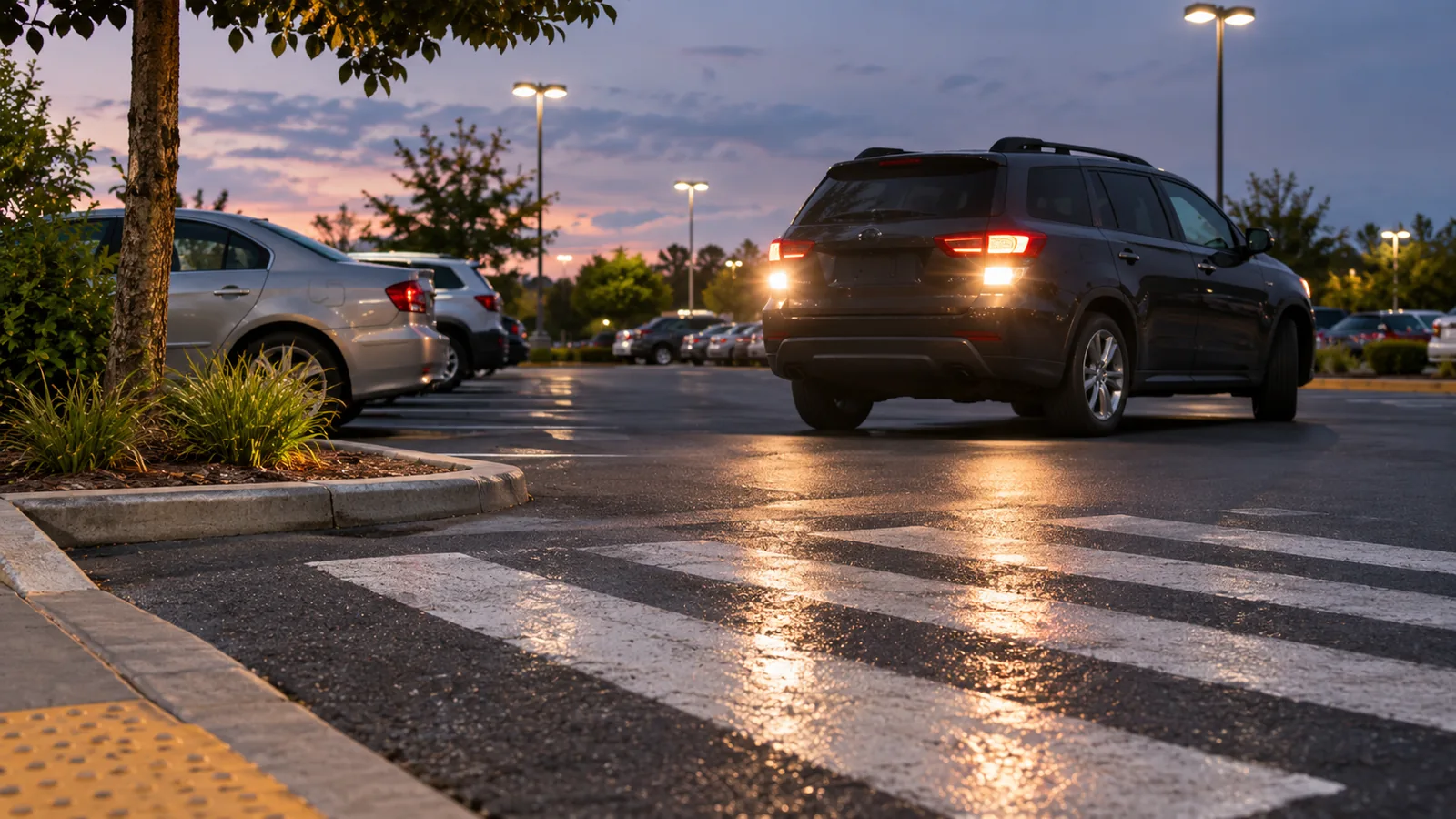
A Texas parking lot injury claim starts with what actually happened, who controlled the car or the spot where you were hurt and what evidence still exists. Drivers, property owners, contractors and government bodies are judged under different rules. Several can share fault, but each one needs its own proof of duty, breach, causation and damages, and some deadlines arrive long before the general two-year limit.
What the claim usually turns on depends on what hurt you:
- A car backing out of a space, where the driver's lookout, speed and chance to stop usually decide it (Section 6).
- A pothole, exposed anchor or broken wheel stop, which turns on who controlled the spot, whether it was unreasonably dangerous and what they knew (Sections 7 to 10).
- Water, oil or ice, which turns on how long that specific condition was there (Sections 10 and 15).
- A fall near active paving work, which turns on the contractor's work and who controlled the route (Section 12).
- A city, county, school or state lot, which brings in immunity, the Tort Claims Act and a six-month notice deadline (Sections 4 and 20).
The examples in this guide are hypothetical. They are teaching tools, not accounts of any client, case or result.
Request a case review or call (214) 200-4878 to talk to a lawyer about your facts. Have the lot location, date, injury and any photos ready.
Aaron Herbert is Board Certified in Personal Injury Trial Law by the Texas Board of Legal Specialization. His State Bar of Texas profile shows a Texas license dated November 6, 2002 [S1]. He handles these cases at the firm, and the firm's parking lot practice page is Texas parking lot injury lawyer.
1. What exactly happened in the parking lot?
Start with the physical sequence, because "parking lot accident" can describe three very different cases, such as these hypothetical events:
- A reversing SUV that strikes a shopper walking to the store, a driver negligence case that asks what the driver could see and when the shopper entered the lane.
- A driver who swerves around an unmarked excavation and hits another car, a contractor or premises claim plus a claim against the other driver, which asks who dug it and who should have marked or closed it.
- A customer who trips on a wheel-stop anchor with no car moving nearby, a premises claim that asks whether the anchor was in the walking route and who maintained it.
Separate the first cause from things the impact knocked loose. A broken wheel stop photographed afterward may have broken before the fall or during it.
Build the timeline from | Watch for |
|---|---|
Your account and witness accounts | Mark what you saw yourself versus what someone told you later. |
Receipts, parking-app records and emergency calls | Clocks on different devices often disagree, so note estimates instead of forcing an exact minute. |
Photos and recordings | A competing explanation stays open until the evidence rules it out. |
The final event statement | It should fit in a few sentences: place, person, movement or condition, contact or fall, injury. |
Picking a property-defect theory before looking at the driver can leave the strongest claim undeveloped. Picking only the driver theory can miss a condition that also contributed.
Who | What helps most now |
|---|---|
The injured person | An honest description, including "I didn't see that." |
Counsel | Keeping both driver and property theories open until the proof narrows them. |
2. Why should medical care come before photos?
A parking lot is still live traffic after an injury, so get out of danger and get care before anyone documents the scene.
Do | Don't |
|---|---|
Call for emergency help when the injury or the scene calls for it | Stand behind cars or in a drive lane to take a picture. |
Let a companion collect names and plates while you're treated | Try to measure a pothole while injured. |
Tell the clinician how it happened and which body parts were hit | Leave out a head strike, a blackout or new weakness. |
Mention earlier injuries to the same area | Hide prior history; it hurts both care and credibility. |
A prior injury doesn't automatically defeat a claim for a new injury or an aggravation. Concealing it can.
Keep these papers and notes:
- Discharge papers, referrals, prescriptions and restrictions, which show what care was recommended and when.
- A note of real barriers to follow-up, such as rides, scheduling or money, because a gap explained at the time is more credible than one explained after an insurer raises it.
- A simple folder of visit dates and questions for providers, which supports accurate recall without becoming a symptom script.
- Notes on good days as well as bad ones, since the claim is about actual harm, not making every day sound equally severe.
Counsel compares the mechanism with the chart. A billing code or an MRI finding may not show that this event caused the condition, so some questions need a qualified medical opinion that accounts for earlier symptoms and later events.
Did the fall or impact cause this diagnosis?
A treating or retained physician who knows the full history usually answers that.
Is this a new injury or an aggravation?
A qualified doctor usually answers it by comparing records from before and after the event.
3. Who should you report a parking lot injury to?
Report a crash to police and the other driver's insurer, and report a fall or property hazard to the manager or operator, keeping the reference number and the name of the person you told.
- A vehicle collision goes to police as appropriate, with driver, vehicle, employer and insurance details exchanged and the incident or case number kept.
- A fall or property hazard goes to the store manager, property manager or lot operator, with an incident reference and the recipient's name kept.
- An event that is both, such as a car hitting you while you detoured around a hazard, goes down both paths and needs both references.
Say what you saw, not what you assume. If you only noticed the water after you fell, the report should say that. Here are a few hypothetical examples for the report form:
- Something you saw, such as "Clear liquid near the cart corral by row F."
- Something a witness told you, such as "A man in a red cap said he told an employee about it earlier."
- A precise location, such as row and aisle, nearest light pole, parking-ticket number or a map pin.
- Something to avoid signing without reading, such as a release or a broad medical authorization.
A shopping center can have several addresses, shared parking and different management zones. A photo of the nearest storefront doesn't prove who controlled the aisle. The records usually sit with different holders:
- The crash report, which TxDOT keeps [S4].
- Scene photos, bodycam video and field notes, held by the investigating police agency.
- The crash coding, where TxDOT's CR-100 instructions have a separate box for crashes that start and end in a parking lot or on private property; TxDOT only accepts crashes involving a motor vehicle in transport [S5].
- The store's incident report in handwritten and electronic versions, held by the business, where a difference between versions is a lead to investigate, not proof of falsification.
4. Is the lot privately owned or government owned?
"Public" can mean open to customers or owned by a government, and only the second one brings in immunity and the Texas Tort Claims Act.
- A privately owned shopping-center lot open to everyone usually falls under private premises law; open access doesn't make it government property.
- A city garage or city surface lot usually falls under the Tort Claims Act, and parking facilities are listed as a municipal governmental function in CPRC §101.0215(a)(25) [S19].
- A university, hospital district, transit or airport lot calls for investigating the owner, the operator and any private contractor, since mixed arrangements are common.
- On any lot where the pay-station sign names a company, that company may only process payments, not maintain the pavement or lights.
If a government entity may be involved, move this to the top of the list on day one, starting with these Tort Claims Act rules:
- Notice must reach the governmental unit within six months after the incident, describing the injury, the incident and its time and place (CPRC §101.101(a)) [S19].
- A city's charter or ordinance notice period is ratified and can be shorter (§101.101(b)).
- Written notice isn't required if the unit had actual notice of the injury (§101.101(c)), but an incident report alone shouldn't be assumed to prove it.
- For a premise defect, the government owes only the duty a private owner owes a licensee, unless the claimant paid for use of the premises (§101.022(a)).
- That licensee limit doesn't apply to the duty to warn of special defects such as excavations or obstructions on highways, roads or streets (§101.022(b)).
A pothole in a lot isn't a special defect just because someone was hurt or because it's on public property. The damages caps in §101.023 are statutory limits, not insurance limits:
Governmental unit | Bodily injury per person | Bodily injury per occurrence | Property |
|---|---|---|---|
State government and municipalities | $250,000 | $500,000 | $100,000 |
Other units of local government | $100,000 | $300,000 | $100,000 |
Immunity, the statutory waiver in §101.021, premise-defect classification, discretionary decisions and the caps are separate questions. An ordinary-looking file can lose its government claim while everyone waits on a property manager's reply.
Who | Task |
|---|---|
The client | Mention any agency name, campus or city sign at the first call. |
Counsel | Calendar the six-month date (and any charter date) before working on a routine demand. |
5. Who could be responsible, and how do you sort them out?
The best-known business isn't always the right defendant, so make a responsibility matrix before naming anyone. In a parking lot it can cover six possible parties:
- The driver and employer, through video, damage and dispatch records that show what movement caused the contact.
- The owner, tenant or parking operator, through a deed, lease or common-area agreement that shows who controlled this aisle or walkway.
- The property manager, through a management contract and complaint log that show who received complaints and approved repairs.
- A paving, lighting or landscaping contractor, through work orders, invoices and photos that show what work touched this spot.
- A security company, through post orders and incident logs that show what the guard was assigned to do.
- A design professional, through plans and service agreements, where the question is what professional act is alleged.
The matrix is an investigation list, not a list of people to sue. A tenant with no control over the lot may not belong in the case.
Ask | Why it matters |
|---|---|
Who could authorize a repair? | Control often follows authority, not title. |
Who received complaints? | It may show knowledge. |
Who placed the barriers? | It may identify the contractor or manager. |
Who could close the route? | It shows who could have prevented the injury. |
New names surface as records come in: the lease names a manager, the manager's file names a maintenance company, the work order names a subcontractor. Each new name raises deadline, pleading and service questions right away.
Two opposite errors | The matrix prevents |
|---|---|
Assuming the big store is the only defendant | Missing the manager or contractor who actually controlled the hazard. |
Assuming everyone connected to the parcel is liable | Suing parties with no supported connection to the event. |
6. How do you prove the driver was negligent?
Prove the driver's case on its own evidence: what the driver could see, where you were and whether there was time to avoid you. Each kind of driver conduct leaves its own evidence:
- Backing without looking, shown by rear-camera footage, witness views and the impact point.
- Looking at a phone, shown by video, admissions and phone records where obtainable.
- Speed too fast for the lot, shown by damage, distance and video timing.
- Turning without checking the crosswalk, shown by vehicle positions and sightlines.
Don't assume every car stored useful event-data-recorder information; the vehicle, the system, the trigger and retention all need checking. Avoid claims that a low-speed impact can't hurt anyone, or always causes serious harm.
Traffic law still reaches a parking lot:
- Transportation Code ch. 550 applies to a private access way or parking area a business provides for clients or patrons, not only to public highways (§550.001) [S29].
- Some other statutes have geographic limits, so check each one.
- The lack of a ticket doesn't defeat a civil claim.
- A ticket doesn't prove every element, medical causation or anyone else's fault.
For more on fault between drivers, see who is at fault in a parking lot accident. If you were a pedestrian, the firm's Dallas pedestrian accident lawyer page covers related issues.
The driver file has a few more parts:
- Employment, scope of work, vehicle ownership and dispatch logs for a delivery van, rideshare or company truck.
- A logo or an app screen, which is a lead, not proof of employment.
- Your own position, such as pedestrian, passenger, driver or getting in or out of a car, which changes the issues and the insurance available.
- A separate proof plan for the driver, even when a property condition also looks important.
7. What duty does the property owner owe you?
A business owes a customer (an invitee) reasonable care about conditions it knew or should have known posed an unreasonable risk, but it owes a licensee much less.
- As an invitee (for example, a customer parking to shop), you must usually prove the owner had actual or constructive knowledge of a condition posing an unreasonable risk, failed to use reasonable care to reduce or eliminate it, and that failure proximately caused your injury.
- As a licensee (for example, someone on the property with permission but for their own purposes), you must usually prove the owner actually knew of the dangerous condition, you didn't, and the owner failed to warn you or make it reasonably safe. Constructive knowledge isn't enough (State Dep't of Highways & Pub. Transp. v. Payne, 838 S.W.2d 235 (Tex. 1992)).
- Someone in a restricted work area needs a separate analysis of status, access and instructions.
Don't assume everyone in a lot has the same status. Your reason for being there, signs, instructions and any payment all matter.
Control is a separate question:
- Control doesn't require owning the land; it can extend beyond title but must relate to the area or function involved [S10].
- A manager who arranges landscaping isn't automatically responsible for moving cars.
- An owner can keep some duties after delegating others, and the contracts and actual conduct decide that.
Can a warning satisfy the duty?
It can. An adequate warning may satisfy the duty without eliminating the condition [S9].
Austin v. Kroger Texas, 465 S.W.3d 193 (Tex. 2015), explains the general rule on known or open-and-obvious hazards and its limited exceptions, including necessary use [S9]. Austin involved an employee, so it's cited here as general premises law. A duty problem isn't always solved by assigning comparative fault.
Who | Practical question |
|---|---|
The client | What was this business legally required to do in these circumstances? |
Counsel | Identify the duty before investing in a breach theory. A better maintenance practice doesn't create liability if there was no duty or an exception applies. |
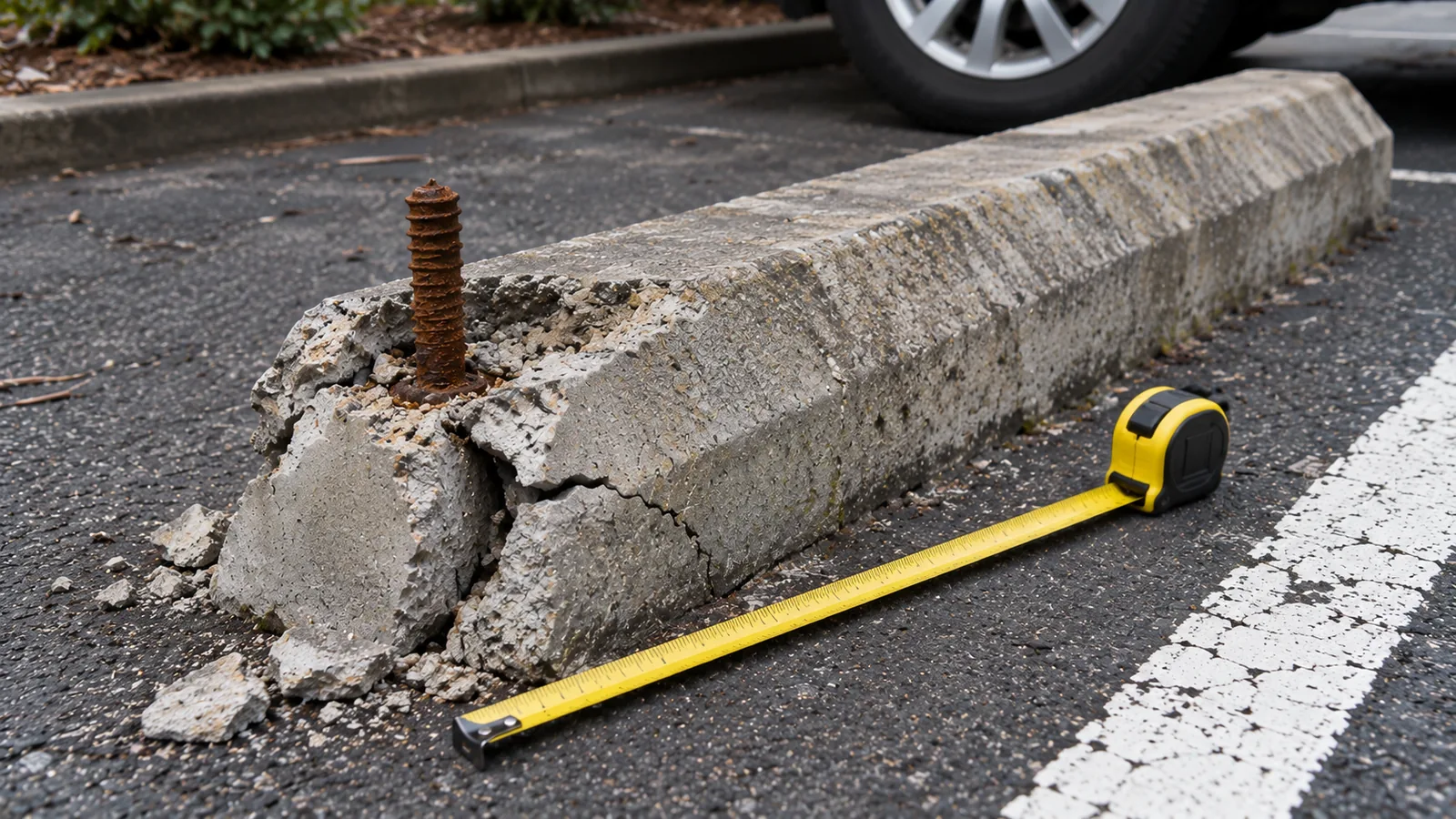
8. Was the pavement condition unreasonably dangerous?
A premises claim needs a specific condition, because "unsafe lot" is too vague to inspect or prove.
Name the condition, then photograph what proves it:
- A depression or pothole, in a close shot with a scale and a wide shot showing the walking route.
- A raised edge or broken wheel stop, showing its height, location and lighting.
- An exposed anchor bolt, showing whether it sat in the path to the store entrance.
- A missing drain cover, slope or drainage path, showing the flow path and nearby features.
Measurements need a method, a location and conditions. A ruler set at a different spot can create a misleading comparison. One divot case shows the limits:
- A small parking-lot divot wasn't unreasonably dangerous on that record; the Dallas court of appeals was reversed and summary judgment reinstated (United Supermarkets v. McIntire, No. 21-0208 (Tex. June 17, 2022) (per curiam)) [S7].
- The court didn't decide whether a larger or differently placed condition could be unreasonably dangerous.
Is every minor irregularity actionable?
There's no rule that every minor irregularity is actionable, and no single measurement below which every condition is safe.
An expert should explain why this feature mattered given its location, visibility and use. "It could cause injury" doesn't answer whether the risk was unreasonable, and any cited code must apply to the site, the work, the date and the use.
Who | Task |
|---|---|
The injured person | Describe the contact or slip you remember before anyone suggests a defect. |
Counsel | Check the mechanism against footwear, mobility aids, vehicle geometry, photos and witnesses. |
9. How do you prove the owner actually knew?
Actual knowledge comes from evidence that someone knew about this specific condition before the injury: a complaint, a staff observation, a service request, an inspection note or a repair attempt.
Take a hypothetical complaint about a bolt:
- On October 3, the tenant's assistant manager emails the property manager: "Bolt sticking up by the second light pole in row C."
- A work order opens October 10 and is approved October 17.
- The repair is completed October 24, so the gap to examine is the three weeks between complaint and repair.
A general note that the lot "needed maintenance" may not show knowledge of the feature that hurt you. Tie each report to the same condition and location.
Witness says | Follow-up |
|---|---|
"The hole had been reported." | Who reported it, when, and where is the record? |
"That drain always backs up." | Same walking route? Did the operator get the information? |
"It looked old." | What's the factual basis? |
An employee who learned of it after the fall | Don't treat that as advance knowledge. |
Keep exact wording instead of a stronger paraphrase, and plan who can authenticate each record. A dated maintenance reply or an earlier photo often proves more than "everyone knew the lot was dangerous."
- A named person told about an identified problem before the injury, which is strong evidence.
- A general history of complaints elsewhere on the site, which is weak unless tied to this spot.
10. How long was the hazard there?
Constructive notice asks whether the condition existed long enough that reasonable care would have found it, and for a temporary hazard like a puddle you need evidence of how long that specific condition was there.
A puddle case shows the problem:
- A shopper slipped on a puddle after rain, and the evidence offered was earlier roof leaks elsewhere, a heightened rain-inspection routine and no employee walking the aisle for about two hours (H-E-B, L.P. v. Peterson, No. 24-0310 (Tex. Apr. 10, 2026)) [S8].
- That evidence didn't show how long the puddle had existed, so summary judgment for H-E-B was reinstated.
Do inspection habits prove how long a hazard sat?
For a parking lot, general prior problems and inspection habits don't replace proof about the specific hazard's duration.
A structural defect that sat for months is proved differently from a fluid spill that could form in seconds.
Clue | Caution |
|---|---|
Dark, dried edges on an oil stain | May suggest age, but needs an explanation. |
Footprints or cart tracks through liquid | Could have happened quickly. |
A large area of water | A recent spill can be large. |
Tire marks | Can appear in moments. |
Build a worksheet of each time inference, the evidence for it and the competing account. If the proof equally fits a spill moments earlier, identify what would tell them apart. A missing record isn't proof the hazard sat for hours.
Who | Why it matters |
|---|---|
The injured person | It explains why earlier footage and witnesses matter even when the injury is obvious. |
Counsel | Test the weakest timing inference early, before intake, demand and filing decisions. |
11. Do the owner's maintenance policies set the legal standard?
No. An internal policy doesn't automatically create a higher legal duty, but inspection schedules, work orders and cleaning logs can show timing, witnesses and contradictions.
- Which version of the written policy was in force on the injury date?
- Was a checklist entry an inspection, a scheduled task, a completed repair or a later supervisor review?
- Were electronic log entries automatic or batch-entered at the end of a shift?
A missing form doesn't by itself prove every premises element. Compare the paper system with what people actually did. Receiving complaints and performing repairs are often different jobs.
Practice question | Hypothetical answer to test |
|---|---|
Who walked the lot, and which rows? | The night porter covered rows A to D only. |
What triggered escalation? | Any trip hazard over a set size, by the manager's account. |
Who could close a route or set out cones? | Only the property manager. |
How did tenant and customer complaints enter the system? | By email to a shared inbox. |
What did the contractor's scope cover? | Weekly sweeping, not drainage redesign; a recurring repair invoice identifies a problem without proving that repair was negligent. |
"The lot was inspected" should start questions, not end the case. The goal is to show what happened at this site, not to put the business's whole maintenance program on trial.
Who | Use |
|---|---|
The client | Ask what the inspection records actually show. |
Counsel | Use policy evidence to find the relevant observation or action and to test credibility. |
12. Can a paving or repair contractor be liable?
Yes, if it did negligent work, left an active work zone poorly protected, or controlled the condition that caused the injury, but its name on an invoice doesn't prove causation.
Preserve the work records:
- Before-and-after photos, for what the work changed.
- Plans, work orders and change orders, for the actual task, location, date, crew and materials.
- Inspection notes and acceptance emails, for open defects at handover.
- Records of later work by others, since another party may have changed the condition after the contractor left.
An exposed elevation change could come from unfinished work, a design instruction, later wear or something else. Each needs proof.
Four authorities set the limits of a contractor claim:
- A contractor isn't immune just because its work was completed and accepted by the owner (Strakos v. Gehring, 360 S.W.2d 787 (Tex. 1962)) [S11]. That doesn't make contractors strictly liable; duty, breach, causation and damages still need evidence, and later statutes or defenses may apply.
- A claim against a contractor over a condition it controlled sounded in premises liability, and a general-negligence jury question couldn't support the verdict (United Scaffolding, Inc. v. Levine, 537 S.W.3d 463 (Tex. 2017)) [S10].
- Repose periods can bar claims against those who design or build improvements to real property, separate from the two-year limit (CPRC ch. 16, §§16.008, 16.009) [S15].
- A claim arising from a licensed architect's or engineer's professional services generally needs a certificate-of-merit affidavit filed with the complaint (CPRC ch. 150, §150.002) [S20].
Barriers, vehicles, workers or a temporary route you saw can identify the contractor and the stage of work, so tell your lawyer about any work you noticed. A construction-related injury doesn't automatically belong only against the owner or only against the contractor.
Two hypothetical facts show how the details work:
- Cones placed past the trench, not before it, where the warning may not have reached people entering the route.
- A crew that left at 5 p.m. with the patch unfinished, which points to the contractor's control of the work area.
13. Did the lot's design, striping or sightlines cause the crash?
A design claim has to name the specific conflict, because "poor design" isn't a duty or causation analysis.
Each hypothetical conflict leads to its own records:
- A monument sign that blocks the view of the exit lane, traced through the site plan, as-built drawings and permits.
- A re-striping project that routed shoppers through a backing area, traced through later modifications and the contractor's scope.
- Faded crosswalk paint, traced through the maintenance history, since fading is often a maintenance issue, not a design one.
- A delivery truck parked in the fire lane that blocked the view, traced through delivery schedules and the store's practice.
What if the crash happened on the public street next to the lot?
Owning nearby parking doesn't make a business responsible for every street crossing. A hospital in HNMC, Inc. v. Chan, No. 22-0053 (Tex. Jan. 19, 2024) [S12], owed only a limited premises duty for the parts of the county right-of-way it controlled, and there was no evidence a condition it controlled caused the death.
What should a design expert separate?
An original layout claim may involve different parties and deadlines than a maintenance claim. The expert should separate three things:
- An enforceable requirement, such as a code provision that applied to this site when it was built or altered.
- A professional standard, such as a widely accepted design practice.
- A recommended improvement, such as a better layout that wasn't required, which doesn't prove the actual layout breached a duty.
Under Chapter 150, if the claim targets a licensed design professional, the certificate-of-merit affidavit must be filed with the complaint; don't plan around the exceptions [S20].
Connect the design failure to the sequence. Explain how the proposed fix would have changed the crash or fall, with defensible assumptions about speed, visibility and movement.
Who | Task |
|---|---|
The injured person | Preserve the route and what blocked the view, instead of claiming the whole lot violated code. |
Counsel | Drop a design theory that can't explain the causal link, even if the lot could be better. |
14. Do warning signs or an obvious hazard end the claim?
Sometimes, but not automatically: an adequate warning can satisfy the owner's duty, and an open-and-obvious hazard can defeat it, subject to narrow exceptions such as necessary use [S9].
Warning fact | What it may mean |
|---|---|
A barricade placed beyond the hazard | It may not warn someone entering the route. |
A cone photographed after the fall | It may not have been there before. |
Small lettering at night | Visibility and wording matter. |
A sign about a different condition | It may not relate to the hazard at all. |
Disclose what you knew. A person who saw the hole and walked on presents different issues from someone who couldn't see it, and a client should never deny seeing something a video shows.
Necessary use turns on facts like these hypothetical ones:
- Another reasonable route, such as a second exit 40 feet away.
- A shortcut, which usually isn't the same as a necessary route.
- A mobility device that limited the choices, such as a wheelchair user whose only ramp was blocked; document the difference.
- Instructions, barriers and how the route was used, for whether the owner should have expected harm despite awareness.
Who | Task |
|---|---|
The client | Draw the route and the alternatives you considered. |
Counsel | Test that account against site evidence and testimony. |
A duty defense can stop the claim entirely, so it isn't just a percentage adjustment. Finish the legal analysis before assuming a jury will sort out visibility through fault allocation.
15. Was it rain, a drainage defect or a spill?
Find out which, because ordinary rain, an unnatural discharge, a leaking system, a recent spill and a defect that pools water are treated differently.
Each possible source leaves its own records:
- Rain, shown by weather data for the hour of the fall.
- Irrigation overspray, shown by sprinkler schedules and service tickets.
- A drainage defect that concentrates water, shown by photos of the flow path and drainage complaints on this route.
- A vehicle's fluid leak, shown by video of nearby cars and stain photos.
- Cleaning residue, shown by cleaning logs and vendor records.
A puddle after a storm doesn't prove a defective drainage system. A drainage complaint elsewhere on the site may not matter unless it connects to this route.
Testing | Caution |
|---|---|
Slip-resistance testing | Results depend on surface, contamination, footwear and method. |
A dry test long after cleanup | May not describe the surface that day. |
A wet demonstration | Must never be presented as footage from the incident. |
Natural conditions like ice or mud | Need their own analysis; ice, mud, water and oil aren't one legal category. |
Ask whether human activity changed the condition and whether there's evidence the responsible party knew. A continuing leak management knew about and a car's fresh oil drip are different cases, with different defendants, notice proof and experts.
Describe look, smell, texture, source and location only if you observed them. Your lawyer's part is to get the records that tell competing mechanisms apart.
16. How do lighting and security claims differ?
Poor lighting can hide a pavement hazard or a pedestrian from a driver, while a security claim is about a crime, and a broken light doesn't prove a different precaution would have stopped an assault.
A visibility claim needs its own investigation:
- Lamp operation and controls, shown by outage logs and repair tickets.
- Shadows and glare, shown by a night inspection under similar conditions.
- Photos, whose camera settings should be kept, since automatic exposure can make a scene look brighter than people saw it.
- The person's approach: where they walked and what they could see.
For an assault, the questions are the developing incident, earlier crimes, knowledge, possible precautions and causation.
UDR Texas Properties, L.P. v. Petrie, 517 S.W.3d 98 (Tex. 2017) [S13], arose from an assault in an apartment complex parking lot. Foreseeability and whether the risk was unreasonable are separate duty questions, and a neighborhood crime count doesn't prove every element. With a security contract, get the scope and what guards actually did; a sudden attack raises different causation questions than a long disturbance several people watched.
Define the precaution and how it would have prevented the harm. An expert who only says "more security would have helped" doesn't answer duty or preventability. See the firm's Dallas negligent security lawyer page for more.
Preserve police information, messages, witness details and recordings, and raise any ongoing safety concern through the right channel. Your lawyer's part is to tie the alleged precaution to the actual facts, including limits and other explanations.
17. Do accessible parking rules apply to your fall?
They may, but only if the federal or Texas accessibility standards actually apply to that feature, which depends on scoping, construction or alteration history and the facility [S27, S28].
- Accessible spaces and access aisles. ADA section 502.4 puts the aisles at the same level as the spaces, with slopes not steeper than 1:48, about 2.08 percent [S27].
- Curb ramps and routes, which have separate requirements; check scoping first.
- Vehicle overhangs, which can block a route and force a detour into traffic.
- Any other lot surface, since the 1:48 limit isn't a maximum slope for every surface in every lot.
A gap a walker steps over can stop a wheelchair. Document the person's route and mobility aid; age or disability alone doesn't prove negligence.
Claim | Difference |
|---|---|
Civil-rights access claim | Its own standing rules, elements and remedies. |
Negligence claim for injury | Duty, breach, causation and damages; a violation doesn't automatically resolve it. |
Advisory text in a standard isn't the same as a mandatory provision. An inapplicable code citation can undermine an expert report.
Who | Task |
|---|---|
The client | Photograph where you parked, every step to the door, the access aisle, the entrance and the obstruction. |
Counsel | Get qualified measurements, plans and alteration records. Confirm the standard applied to this feature on this date before relying on it. |
18. How do you preserve surveillance video and dashcam files?
Send targeted preservation requests quickly to everyone who may control footage, naming the site, date, location, event and a time window that covers the period before the fall or crash.
Footage and logs may sit with several custodians:
- The store or tenant, for entrance and parking-lot cameras.
- The property manager or parking operator, for pole cameras, gate logs and pay-station records.
- Neighboring businesses, for cameras that catch part of the lot.
- A security contractor, for patrol logs and body cameras.
- Drivers and vehicle owners, for dashcam and rear-camera files.
There's no universal retention period for Texas parking facilities. Find out who can stop overwriting and export files, and who can explain the system. One letter rarely reaches everyone.
- Native files and the player software. A phone video of a monitor loses resolution, frames and image area; it's a lead, not the best evidence.
- Working copies, with the metadata kept to protect authenticity.
- The name of whoever supplied each file, which supports authentication later.
A payment record anchors time but doesn't prove the fall happened at that second. A gate log shows a car, not the driver. Clocks also differ from system to system.
Keep your own photos, messages and posts, including unfavorable ones. Deleting or altering evidence damages a claim.
Step | Track separately |
|---|---|
Preservation | Saved from deletion. |
Production | Actually received. |
Authentication | A witness who can explain the file. |
Review | A person has watched it and noted what it shows. |
19. What if the video or other evidence is gone?
Missing evidence can matter, but it doesn't prove negligence. Brookshire Brothers, Ltd. v. Aldridge, 438 S.W.3d 9 (Tex. 2014), sets the Texas framework [S14].
In Brookshire Brothers, the store kept about eight minutes of video, and the rest was overwritten. The instruction given in that case was an abuse of discretion [S14].
- The trial judge decides whether a duty to preserve existed and was breached. The judge also picks the remedy.
- The remedy must be proportionate to the harm.
- A spoliation instruction is reserved for intentional spoliation, or negligent loss that left the other side without a meaningful ability to present its claim or defense.
Build the chronology before asking for relief: when a claim became foreseeable, why the evidence mattered, who controlled it, what steps were available and how it was lost.
Is the evidence really gone?
- "Destroyed" footage, which may really be delayed production.
- "Missing" files, which may be an unreadable format or incomplete export.
- A "refused" request, which may be a scope objection you can narrow.
- "Overwritten" video, where you confirm the real settings because systems don't all overwrite on the same cycle.
How do you show prejudice?
Explain it specifically: what the surviving footage doesn't show and whether witnesses or records fill the gap. Don't claim to know the missing material favored your client.
The claimant has its own duty to keep evidence:
- Physical items, such as shoes, mobility aids and damaged property.
- Digital items, such as original photos and messages.
A party seeking sanctions is more credible after caring for its own evidence.
20. What deadlines apply to a Texas parking lot claim?
Texas generally gives two years to file a personal-injury lawsuit (CPRC §16.003) [S15]. For a government claim, written notice can be due within six months or less [S19].
- General limitations run two years, subject to accrual, disability and other exceptions [S15].
- Government notice is due within six months under §101.101(a) [S19]. A city charter can set a shorter valid period, and notice must go to the right entity by a proper method. Neither police presence nor an employee's knowledge is assumed to satisfy it.
- Statutes of repose for design and construction are separate from limitations (§§16.008, 16.009) [S15].
- A certificate of merit is filed with the first complaint against a covered design professional [S20].
- Chapter 95 applies to certain claims by contractors' workers. Don't apply it to a customer's injury by default [S21].
A demand letter, an incident report or an open insurance claim doesn't normally extend the filing deadline, and treatment doesn't have to end before a protective lawsuit is filed. See the firm's guide to the two-year filing deadline.
Memo item | Hypothetical entry |
|---|---|
Event date | March 14. |
Government involvement | City garage; notice date September 14 at the latest; check the charter for a shorter period. |
Parties and service plan | Driver served first; property manager identity pending. |
New entity found later | Assess the consequences that week, not at the next routine review. |
Tell your lawyer about prior lawyers, offers and any paper mentioning dates. After filing, someone has to track service and fix failed attempts.
Who | Task |
|---|---|
The client | Bring every letter, offer and court paper. |
Counsel | Keep independent calendar controls and internal filing targets. |
21. Which insurance policies might pay?
Several may: auto liability, commercial auto, general liability, umbrella or excess, professional liability and your own coverage, but finding a policy doesn't prove fault, and proving fault doesn't guarantee coverage.
- The Texas auto minimum of $30,000 per person, $60,000 per accident and $25,000 property damage, called 30/60/25 [S25]. It's a floor, not a typical settlement or a cap on damages.
- The driver's actual policy, where you check the named insured, permissive use and any employer coverage.
- Commercial general liability, for which you get the policy, endorsements, insureds, dates, retentions and excess layers [S26].
- Umbrella or excess coverage. TDI explains that excess sits above CGL limits, while umbrella sits above auto and CGL [S26].
- A certificate of insurance, which isn't a substitute for the policy terms.
- Additional-insured and indemnity terms, which may shift who pays between businesses.
Exclusions and conditions matter when vehicles, professional services, completed work or employee injuries are involved. A claim number doesn't mean a loss is covered.
Ask your lawyer to separate | Why |
|---|---|
Claimed harm | What you lost. |
Legally supportable damages | What the law allows. |
Available insurance | What policies may pay. |
Likely collectible recovery | What can actually be collected. |
Never assume a "standard million-dollar parking lot policy." See the firm's guide to policy limits.
22. What if the driver had no insurance or drove off?
Your own policies may help: uninsured or underinsured motorist, personal injury protection, medical payments or health insurance, depending on who you were and what the policy says [S25].
Coverage | What it usually does |
|---|---|
UM/UIM | Pays when the at-fault driver has no or too little insurance, under the policy's terms. |
PIP | Pays certain medical and wage losses regardless of fault, if purchased. |
Collision | Pays for vehicle damage, not bodily injury. |
Health insurance | Pays treatment but may seek reimbursement later. |
A pedestrian and a vehicle occupant can have different coverage. Read the actual policy and endorsements, not the renewal summary. TDI's guide describes UM/UIM, PIP and the written-rejection rules for offered coverage.
- Give your insurer timely notice; policies have notice conditions.
- Keep plates, video, paint transfer and anything else that identifies the unknown car.
- Get advice before signing any release. Consent, settlement, exhaustion, subrogation and offsets can affect other claims.
- Bring declarations pages and rejection forms and list household and employer vehicles. You don't need every page before asking for advice.
23. How do you prove the injury and the medical bills?
Medical records must explain the injury and its link to the event. A bill proves a charge was made, not that the parking lot event caused every service.
In one hypothetical exhibit row, an orthopedic clinic bills a wrist X-ray and splint on April 2. It charged $1,140, the insurer paid $410 and the balance was adjusted. A $60 copay is still owed.
Texas limits recovery of medical expenses to amounts actually paid or incurred, so the raw total of original charges may not be the recoverable figure (CPRC §41.0105) [S17].
- CPRC §18.001 sets an affidavit procedure about whether charges were reasonable and services necessary; it isn't evidence of causation [S18].
- Deadlines come from the statute and the court's orders, so calendar them and any response to a counteraffidavit.
- Earlier conditions, unrelated falls and later crashes have to be disclosed and analyzed, since an aggravation claim needs an accurate baseline.
- Leaving unfavorable history out of a summary doesn't remove it from the case.
Keep explanations of benefits, receipts and collection notices. Tell your lawyer when a billing company changes. Reconcile the expense exhibit before negotiation and again before trial.
Who | Task |
|---|---|
The client | Forward every new bill or balance notice. |
Counsel | Remove duplicates and unrelated care before the number goes in a demand. |
24. How are lost wages and future care proved?
Past lost wages need proof of time missed, pay and the medical reason you couldn't work. Future earning capacity and future care need their own support.
Loss | Evidence |
|---|---|
Past wages | Payroll, attendance records, work restrictions. |
Self-employed income | Records separating revenue, expenses, owner pay and unrelated business changes. |
Future earning capacity | Restrictions, skills, work history, other available jobs. |
Future care | Medical recommendations and a defensible prognosis. |
Bring in a vocational expert or economist when the facts justify the cost. A life-care planner organizes services but can't give medical opinions beyond that role. Distinguish care that might be considered from care reasonably supported as a future need.
- Double counting, such as paying for a home aide and also claiming the same chores as a separate household loss.
- Hidden assumptions. Projections must show the time horizon, rates and inputs.
- Overstatement, such as saying you can't do anything when you can do some tasks with limits.
- A dramatic projection on weak facts. A well-supported modest figure often persuades more.
25. How do you show pain and lasting harm?
With concrete evidence for each category, not one undifferentiated number. Pain, mental anguish, physical impairment and disfigurement are separate categories.
In a hypothetical case, the right witness depends on the change:
- A spouse, for no longer driving at night after a head injury.
- An adult daughter, for six weeks of needing help bathing.
- A coach or another parent, for a missed season of a child's games.
- A supervisor, for changes in how a warehouse job is done.
Witnesses should describe what they saw in their own words, not repeat phrases supplied by a lawyer.
- Keep the originals and dates of photos of bruising, casts or scars.
- Record improvements as well as setbacks in a recovery journal.
- Don't deny attending an event while hurt; explain how long you stayed and what help you needed.
No reliable universal multiplier values a Texas parking lot injury from bills alone. Two people with similar bills can have very different lasting effects, and different liability proof changes the risk even for similar injuries. The amount requested should connect to the record and current damages law, not to unrelated verdicts or a company's size. The firm's claim value guide covers valuation in more depth.
You can ask what evidence supports each category and what's still uncertain. Your lawyer can ask whether an opening demand is being mistaken for a likely trial result.
26. How does shared fault change the recovery?
Under Chapter 33, if you're found more than 50 percent responsible you recover nothing, and at 50 percent or less your damages are reduced by your percentage [S16].
Take hypothetical supported damages of $300,000. With your share at 20 percent, they're reduced to $240,000 before other legal adjustments. With your share at 51 percent, the claim is barred. These are teaching figures, not case estimates.
Allocation can include defendants, settling persons and properly designated responsible third parties.
- A defendant found more than 50 percent responsible may be jointly and severally liable under the statute [S16].
- Other defendants are generally liable only for their own share unless an exception applies.
- Settlement credits and contribution need careful treatment, as do indivisible versus separate injuries.
- More policies don't multiply the injury's value; the same loss can't be paid twice.
Before accepting a partial settlement, review the release language, credits and coverage effects. One participant's payment may not resolve claims against the others.
You can ask how settling with one party changes the rest of the case and your net recovery. Your lawyer can model the verdict outcomes with disclosed assumptions; the number of defendants doesn't predict the size of the recovery.
27. What goes into a strong demand?
A clear account a reviewer can follow, with an exhibit index. It should explain:
- The event and the parties.
- The legal theories.
- The condition or conduct, and knowledge where required.
- The medical connection and the losses.
- The requested resolution.
Weakness | Address it this way |
|---|---|
A visible warning | Explain the route and facts without denying the video. |
Care started late | Give the supported chronology. |
A prior condition | Show what changed, with evidence. |
A ticket proves a complaint but not the defect's role | Keep documented facts, inferences and open questions labeled separately. |
A demand that dodges the issue most likely to decide the case loses its value.
Demands involving several parties need extra checks:
- A global or partial release, and which claims and parties it would cover.
- Other coverage, and whether a settlement affects another policy.
- Time-limited demands, which turn on governing law, the right recipients, the terms and a real chance to evaluate. A deadline doesn't automatically create extra-contractual exposure.
- A key assertion without a source, which calls for getting the source, qualifying the statement or revising the theory.
28. What should the lawsuit petition include?
The petition names the right defendants, jurisdiction, venue, the occurrence, the supported claims and the relief, without lumping driver, premises, professional and government claims into one allegation.
- Entity names, as when the sign says "Oak Plaza," but the operator is a separate LLC.
- Service, with citation, attempts and returns tracked.
- Owner versus manager, such as two different companies at two addresses.
- A successor or similar name. Don't substitute an affiliate without evidence.
- Venue, which follows the facts. A Dallas law firm doesn't mean every Texas parking lot case belongs in Dallas.
- Government cases or federal removal, which add rules and a separate calendar.
- A claim against a design professional needs a Chapter 150 certificate of merit with the first complaint [S20].
- A claim against a government defendant needs a supported waiver and jurisdictional facts.
Theory | Pleading requirement |
|---|---|
Alternative theories | Allowed while evidence develops, but grounded in facts and updated as discovery narrows them. |
Filing in general | Protects rights and opens formal discovery; it doesn't mean the case will be tried. |
29. How should discovery be organized?
Begin with an element-and-evidence chart: for each disputed point, the witness, record, recording, item or expert needed. Ask first for what's most likely to change the assessment.
Theory | Discovery priorities |
|---|---|
Driver | Movement, visibility, employment, vehicle data. |
Premises | Control, condition, notice, warnings. |
Contractor | Scope, performance, completion, later changes. |
Government | Focused jurisdictional discovery. |
What if a witness mentions a record nobody produced?
Follow it, as with an unproduced drainage complaint. Document production helps pick depositions, and depositions help find missing records.
What do the discovery rules cover?
- Scope, proportionality, privilege, disclosures, nonparty discovery and supplementation, under the Texas Rules of Civil Procedure [S22].
- Insurance and indemnity agreements, under Rules 192.3(f) and 194.2.
Rule | Scope |
|---|---|
Admissibility | Discovered material isn't automatically admissible at trial. |
Proportionality | A catastrophic case can justify broad work; a smaller claim needs a narrower plan. |
30. How are witnesses and company representatives prepared?
A frontline employee speaks from personal knowledge, while a company representative testifies on designated topics from the organization's preparation, so match each issue to the right witness.
- A night porter or maintenance worker, on role, shift, area, inspection method, timing and how the time is remembered.
- A company representative, on common-area control, complaint systems, maintenance, contractor selection where at issue, video exports and policy records.
- The claimant, on the event, prior conditions, treatment, limits and work. Preparation isn't memorization.
A truthful "I don't remember" beats a guess that conflicts with the record. Separate personal knowledge from assumptions; the record has to be reliable.
Claimant tip | Why |
|---|---|
Listen and answer only the question | Deposition testimony is evidence. |
Ask for clarification | A confused answer can be used later. |
Discuss photos and social media in advance | Ordinary activities can then be explained in context. |
31. When do you need an expert?
When a material question needs specialized knowledge. An impressive roster isn't a reason to hire one.
What does each expert work from?
- A lighting expert, who works from night measurements and fixture history.
- An accident reconstructionist, who needs vehicle positions, dimensions, recordings and movement assumptions.
- A pavement engineer, who relies on surface measurements, construction records and condition history.
- Medical, vocational, economic and life-care planning experts, who draw on records, restrictions and supported assumptions.
Plan inspections lawfully and document conditions and methods. Give notice before destructive testing.
What should a report review look for?
- Assumptions built on facts nobody observed or recorded.
- Opinions outside the expert's field.
- Competing explanations not considered.
- A cited standard that may not have applied on that date. Rule 702 needs more than a credential, and disclosure deadlines apply [S24].
32. How do you prepare for summary judgment?
The issues most often challenged are duty, control, unreasonable risk, notice, causation, immunity, professional-claim requirements and limitations. Develop the evidence on them from day one.
What goes in the response file?
- Exhibits, such as authenticated documents and recordings.
- Testimony, such as deposition cites and declarations based on personal knowledge.
- Connections, in a note linking each item to the legal point it proves.
A big production in a folder isn't the same as evidence ready to file.
Amended Rule 166a | Response deadline |
|---|---|
Motions filed on or after March 1, 2026 | Generally 21 days after the motion is filed, unless the court grants leave or the parties agree [S22, S23]. |
Check the court's orders and calculate every deadline rather than relying on the old hearing-based shorthand.
If evidence is still missing | Do |
|---|---|
Ask for relief | Say exactly what's missing, why it matters and what you did to get it. |
Independent grounds | Answer every ground; one unanswered ground can support judgment. |
Objections and rulings | Preserve them for any later review. |
For the client, a motion tests legal sufficiency. It isn't a finding that you made anything up.
33. How should mediation be approached?
Go to mediation when the key evidence and uncertainties can be explained, with a short liability analysis, a current damages summary, a coverage chart and a list of open issues.
A hypothetical net-recovery worksheet runs in this order:
- Gross settlement, the amount offered.
- Attorney's fee, calculated under your written fee agreement.
- Case expenses, such as filing fees, records, experts and similar costs.
- Medical balances, liens and reimbursement claims, such as health plan, hospital or other payment obligations.
- Remainder, or what you would actually receive, with the confirmed figures and the ones that are still estimates marked.
Different terms, calculation order, open balances or reimbursement outcomes change the remainder. Ask your lawyer to walk through it before you decide.
Decision point | What to understand |
|---|---|
Partial settlement | Release scope, credits, remaining claims and coverage effects. |
Global settlement | Who is released and what obligations survive. |
Trial risk | The strongest defense, added cost, delay and collection uncertainty, explained without pressure. |
Settlement authority belongs to the client under the professional rules.
34. How is a case prepared for trial?
A premises theory needs different findings than a driver-negligence theory. Draft the jury charge early so it exposes missing proof.
Issue | Who proves it |
|---|---|
Control | Property manager or lease witness. |
Condition or movement | Eyewitness and video. |
Advance knowledge | Complaint records and employees. |
Causation and loss | Qualified medical and economic witnesses. |
- Levine holds that general-negligence findings can't support recovery when premises findings are required [S10].
- Under the charge and preservation rules, requests, objections and rulings must be made correctly [S22].
- Opening statements forecast admissible evidence, and closing arguments connect it to the questions asked.
- Anger at a big owner or sympathy for the injured person can't replace required findings.
A visual explains a theory; it doesn't prove its own assumptions. Label reconstructions, animations, diagrams and later photos accurately.
35. What happens in jury selection?
Jury selection looks for fixed bias and whether jurors can follow the court's instructions, such as a belief that every pedestrian should watch the ground or every backing driver is at fault.
Good practice | Avoid |
|---|---|
Open questions that invite explanation | Scripted follow-ups before listening. |
Separating experience from a fixed rule | Striking a juror just for managing property or having fallen. |
Asking whether jurors can assess several actors separately | Commitment questions tied to disputed facts. |
Asking about willingness to consider legal damage categories | Mentioning insurance or who will pay. |
The goal is a fair panel, not advance agreement with your theory. Jury selection doesn't guarantee sympathy, and jurors will hear facts that favor the defense too. Good questions connect to real issues without arguing the case early.
36. Is a verdict the same as money collected?
No. The court enters judgment after post-verdict issues, and motions, appeals, settlement, coverage disputes and collection can change the timing and the final amount.
What to watch from verdict to collection:
- The verdict, checked against the charge for inconsistencies and omitted issues.
- Post-trial motions, for preserved objections and deadlines.
- An appeal, for a realistic assessment rather than a promise.
- Collection, for the defendant, insurance, assets, statutory limits and procedures.
A large verdict in an unrelated parking lot case says nothing about this one.
When results are discussed publicly:
- Settlements, verdicts, judgments and amounts collected are kept distinct.
- Results by other lawyers are never presented as Aaron Herbert's history [S30].
- The credential can be stated without inventing a parking lot outcome [S1].
- People choosing a lawyer can ask what an advertised figure means and what limits its relevance.
37. What do parking lot statistics actually show?
Public sources don't give a count of every Texas parking lot, an annual census of injuries in them, or an average Texas parking lot settlement, and that gap doesn't mean such injuries or settlements are rare.
- The National Safety Council reports tens of thousands of parking lot and garage crashes a year nationally [S2]. In an NSC poll, 66 percent of drivers said they'd make calls and 56 percent said they'd text while driving through lots. Those are self-reported national intentions, not Texas crash causes.
- NHTSA non-traffic data includes events outside parking lots, so its totals aren't parking lot totals [S3].
- TxDOT crash reporting separates crashes that stay inside a lot from those starting on a roadway, and roadway totals aren't a lot-injury census [S4, S5].
- Census NAICS 812930 covers businesses mainly providing parking or valet service, not every physical lot [S6].
Combining these into a precise Texas injury rate would need data and assumptions nobody has established. The numbers that matter most are your bills, lost work, condition history, actual coverage and proposed net recovery. Other figures are easy to misread:
- The auto minimum of 30/60/25, which isn't a general liability limit [S25].
- A contract's required coverage, which isn't proof the coverage was bought or applies.
- Government caps, which aren't an insurer's declarations; they're statutory limits with conditions [S19].
38. Hypothetical: a backing van, a paving detour and a fracture
A customer walks from an accessible space toward the store and follows a temporary detour around paving work. A reversing van breaks her ankle.
- Video of the driver glancing at a phone while backing, which supports the driver claim.
- A detour that sends pedestrians behind parked cars and blocks the usual route, for control, duty and causation questions about the contractor and manager.
- An accessible alternative existed or didn't, which calls for accessibility and route analysis.
- The records include work orders, barrier plans, management emails and the actual layout.
Neither fact excuses investigating what each party did.
Change the facts | Effect |
|---|---|
The contractor worked on the opposite side of the lot, and she chose her own route | The contractor theory weakens though the injury is the same. |
The manager ordered the same detour after a complaint about van traffic there | The premises claim may strengthen materially. |
The tenant had no control over the common area and no role in the detour | Naming it just because she shopped there may be unjustified. |
Allocation and coverage follow the proof, not the number of possible defendants.
39. Which evidence decides the next step?
Use an evidence audit to show which issue currently limits the evaluation and what would resolve it.
Issue | Useful evidence | Decision it informs |
|---|---|---|
Event mechanism | Original video, witness accounts, scene records | Which theories fit. |
Parties and control | Deeds, leases, management and work agreements | Who had authority or conduct. |
Condition and risk | Photos, measurements, applicable standards | Whether the feature supports a claim. |
Advance knowledge | Complaints, inspections, messages, earlier footage | What was known before the injury. |
Causation | Movement analysis, clinical opinions, alternatives | Whether each failure contributed. |
Loss | Reconciled bills, wage records, prognosis | Supported damages. |
Insurance | Policies, endorsements, coverage letters | Sources of payment. |
Government issues | Ownership, notice records, waiver analysis | Urgent action and jurisdiction. |
Procedure | Deadline memo, service, orders | What must happen next. |
Assign a person and a next action to every open item, and mark it requested, received, reviewed or disputed.
Review the audit before each of these:
- The demand, to avoid unsupported assertions.
- Expert decisions, to define the questions.
- Mediation and dispositive responses, to know the gaps.
- Trial, by which time disproved assumptions should be gone.
40. Questions people ask about parking lot claims
Can both a driver and a property owner be responsible?
Yes, when separate supported failures contribute. Still, a crash in a lot doesn't prove owner negligence. The property claim needs its own duty and causation proof.
Can I sue an owner, a business and a contractor in one case?
Potentially, if each has a factual basis and joinder and jurisdiction rules are met. Several defendants don't mean repeated payment for the same loss.
Does a lease automatically protect the store or owner?
No. The lease is important, but control, retained duties and actual conduct matter too, and contract allocation between businesses is a separate issue from your rights.
What if the lot is free to use?
Free parking doesn't end a private premises claim. On a government lot, paying for use can change the Tort Claims Act duty (§101.022(a)).
What if the driver left and the pavement was also defective?
Preserve anything identifying the car, check your own coverage and investigate the defect separately.
Is there a standard settlement for a fracture in a parking lot?
No. Liability, medical connection, lasting effects, expenses, defenses, coverage and collection all matter.
How long do I have?
Generally two years to sue, but government notice can be due within six months or less. Have the dates checked now.
41. Request a case review
Start with the exact location, date, what happened, your injuries, your treatment and the evidence you've kept, and tell the firm about any government involvement, prior lawyers, court papers or claim letters.
Request a case review with The Law Firm of Aaron A. Herbert, P.C. Use the secure form for basic facts and don't post medical records publicly. You can also call (214) 200-4878.
Questions to ask the firm:
- How drivers, owners, operators and contractors would be investigated.
- Who will communicate with you.
- How fees and expenses work under a written agreement.
Aaron Herbert is Board Certified in Personal Injury Trial Law by the Texas Board of Legal Specialization [S1].
Related practice pages: Dallas premises liability lawyer and Texas parking lot injury lawyer.
Related guides in this hub
- Texas parking lot injury knowledge hub (hub).
- What to do in the first 72 hours after a Texas parking lot injury (cluster).
- Preserving video and physical evidence after a Texas parking lot injury (cluster).
- Who can be liable for a Texas parking lot injury (cluster).
- Injuries in government-owned Texas parking lots (cluster).
- Insurance and policy limits for Texas parking lot injury claims (coming soon).
- Filing a Texas parking lot injury lawsuit and preparing for trial (coming soon).
Sources
Ref | Source |
|---|---|
S1 | State Bar of Texas, Aaron Alan Herbert, Bar No. 24036761. |
S2 | National Safety Council, Parking Lot Safety (viewed October 31, 2026). |
S3 | NHTSA, Non-Traffic Surveillance. |
S4 | TxDOT, Crash Reports and Records. |
S5 | TxDOT, 2025 Instructions to Police for Reporting Crashes (CR-100, version 29). |
S6 | U.S. Census Bureau, NAICS 812930 Parking Lots and Garages. |
S7 | United Supermarkets, LLC v. McIntire, No. 21-0208 (Tex. June 17, 2022) (per curiam). |
S8 | H-E-B, L.P. v. Peterson, No. 24-0310 (Tex. Apr. 10, 2026). |
S9 | Austin v. Kroger Texas, L.P., 465 S.W.3d 193 (Tex. 2015). |
S10 | United Scaffolding, Inc. v. Levine, 537 S.W.3d 463 (Tex. 2017). |
S11 | Strakos v. Gehring, 360 S.W.2d 787 (Tex. 1962). |
S12 | HNMC, Inc. v. Chan, No. 22-0053 (Tex. Jan. 19, 2024). |
S13 | UDR Texas Properties, L.P. v. Petrie, 517 S.W.3d 98 (Tex. 2017). |
S14 | Brookshire Brothers, Ltd. v. Aldridge, 438 S.W.3d 9 (Tex. 2014). |
S15 | Texas Civil Practice and Remedies Code ch. 16. |
S16 | Texas Civil Practice and Remedies Code ch. 33. |
S17 | Texas Civil Practice and Remedies Code §41.0105. |
S18 | Texas Civil Practice and Remedies Code §18.001. |
S19 | Texas Civil Practice and Remedies Code ch. 101 (Texas Tort Claims Act). |
S20 | Texas Civil Practice and Remedies Code ch. 150. |
S21 | Texas Civil Practice and Remedies Code ch. 95. |
S22 | Texas Rules of Civil Procedure (as amended October 1, 2026). |
S23 | Supreme Court of Texas, Misc. Docket No. 26-9012 (Rule 166a amendments). |
S24 | Texas Rules of Evidence (as amended July 2, 2026). |
S25 | Texas Department of Insurance, Auto Insurance Guide. |
S26 | Texas Department of Insurance, Commercial General Liability Insurance. |
S27 | U.S. Access Board, ADA Standards chapter 5. |
S28 | Texas Department of Licensing and Regulation, 2012 Texas Accessibility Standards. |
S29 | Texas Transportation Code ch. 550. |
S30 | Texas Disciplinary Rules of Professional Conduct. |
Added | State Department of Highways & Public Transportation v. Payne, 838 S.W.2d 235 (Tex. 1992). |

ABOUT THE ATTORNEY
Aaron A. Herbert
Founding Attorney
Board Certified in Personal Injury Trial Law
Aaron founded The Law Firm of Aaron A. Herbert in 2010 to focus on developing each client's case and seeking its maximum value. For over a decade, he has represented people seriously injured in major accidents and industrial catastrophes, pursuing trial verdicts and settlements while working to reduce the stress of litigation.
Education
- Texas A&M University · B.S., Criminal Justice, 1999
- University of Oklahoma College of Law · J.D., 2002; graduated in the top of his class
Trial experience & approach
Aaron earned numerous jury verdicts at boutique personal injury litigation firms. According to his biography, he spent a year as the top-earning litigation attorney at a firm that frequently appeared in verdict searches as having one of the highest numbers of trial wins in Texas. At another Dallas personal injury firm, he moved from managing pre-litigation attorney to managing litigation attorney over seven years as the firm grew into one of Dallas's largest personal injury firms.
His biography describes a reputation as one of America's most aggressive trial lawyers, with noteworthy recoveries from judges and juries and substantial pretrial settlements. Most of those settlements included confidentiality agreements requested by the defense. Aaron has said the recoveries were justified by the injuries and losses involved, which no amount of money could make someone choose to experience.
His approach combines passion, preparation, persistence and courtroom imagination. He believes a well-supported, engaged and motivated team working cooperatively helps deliver strong representation, with the goal of achieving the best possible result for every client.
Dallas roots, military service & publication
Born and raised in Dallas, Aaron enlisted in the United States Marine Corps after high school and later received an Honorable Discharge. He completed his university and law degrees after his military service and became a lifelong Sooners football fan in law school.
Publication: “Litigating Dog Bite Cases,” Texas Dog Law Seminar, Dallas, 2009.
Professional affiliations & recognition
Professional affiliations and recognition listed in Aaron’s biography:
- State Bar of Texas
- American Bar Association
- Association of Trial Lawyers of America (now American Association for Justice)
- Texas Trial Lawyers Association
- Dallas Trial Lawyers Association
- Dallas Bar Association
- Tarrant County Bar Association
- Million Dollar Advocates Forum
- The National Trial Lawyers – Top 100 Trial Lawyers