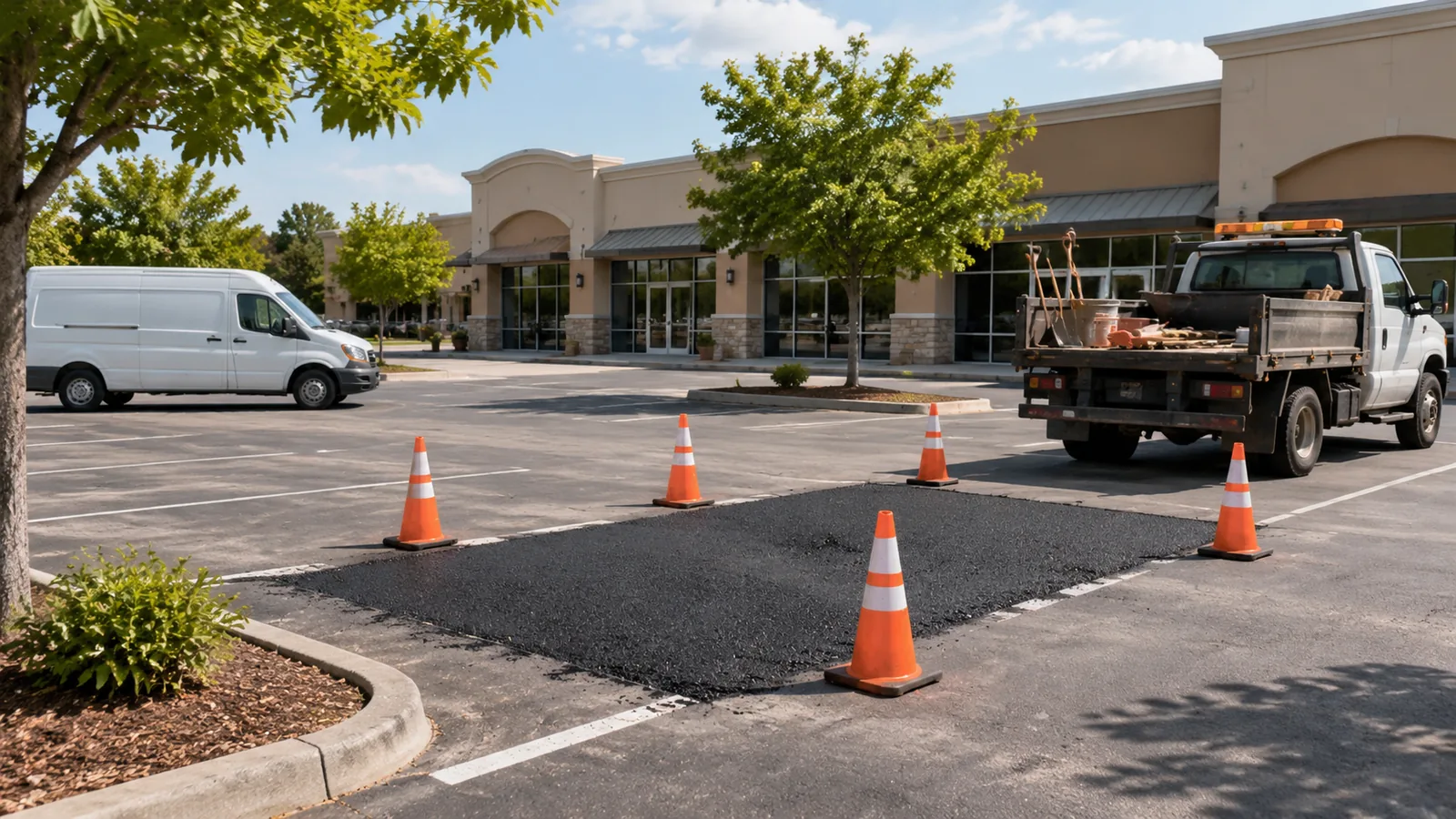
More than one person or company can be responsible for a parking lot injury. The list can include a driver, the driver's employer, the property owner, a store or other tenant, a management company, a maintenance or paving contractor, and sometimes a design professional or a government owner. Each one needs its own duty and its own link to what hurt you. Several defendants don't mean you get paid twice for the same loss. This guide is part of the Texas parking lot injury knowledge hub. If you're unsure who controlled the spot where you were hurt, request a review of your parking lot injury or call (214) 200-4878.
Question | Short answer |
|---|---|
Can there be more than one responsible party? | Yes. Texas law can divide responsibility among several people and companies. |
Is the store always responsible? | No. Another company may own or manage the parking area. |
Is the property owner automatically liable? | No. Owning the lot isn't liability for every accident on it. |
Do I need every name before I call a lawyer? | No. A lawyer can track down the legal names. |
Where should the search for responsible parties start?
Start with what physically caused the injury, then ask who could have changed it.
What happened (hypothetical) | First question |
|---|---|
A car backed into you. | Who was driving, and were they working? |
You tripped on an exposed anchor. | Who inspected and repaired that stall? |
You were routed around paving work. | Who set up the detour? |
You slipped near a clogged drain. | Who maintained the drainage? |
The biggest name on the sign may not control the asphalt. A tenant can run the store while a separate company manages the common lot, and a parking payment app may collect fees without maintaining anything.
When is a driver or their employer responsible?
A driver can be responsible for backing, turning, or moving without reasonable care, and an employer may share responsibility when the driver was working.
Evidence, and what it helps show
- Video and dashcam files showing the vehicle's movement and speed.
- Damage and final positions, which help show where the impact happened.
- Witness accounts of whether the driver looked or stopped.
- Delivery or dispatch records on whether the driver was on the job.
A uniform or a decal is a lead, not proof of employment. The relationship, the task, and the vehicle all need records. For fault questions in lot crashes, see who is at fault in a parking lot accident.
How do owners, tenants, and parking operators fit in?
The key question is who controlled the area where you were hurt.
Document | What it can show |
|---|---|
Deed | Who owns the land |
Lease | What the tenant must maintain |
Common-area agreement | Who handles the shared lot |
Management contract | Who inspects and approves repairs |
Complaint and repair logs | Who acted in practice |
Control alone doesn't win a premises claim. You still need a condition that posed an unreasonable risk, proof the company knew or should have known about it, a failure to use reasonable care, and a causal link to your injury [S7, S9, S10]. Owning the parcel isn't strict liability for every accident on it.
Premises elements, with example proof (hypothetical)
- Unreasonable risk, such as an exposed steel anchor in a marked walking route.
- Knowledge, such as a tenant email reporting that anchor two weeks earlier.
- No reasonable care, such as no cone, barricade or repair after the email.
- Cause, such as video showing your foot catching the anchor.
Can a maintenance or paving contractor be responsible?
Yes, when the contractor's own work created or worsened the hazard and the other elements are proved.
Contractor roles, and the question to answer for each
- A sweeping crew, for whether the contract covered the hazard at all.
- A paving crew, for whether their patch left a drop-off.
- A striping crew, for whether they moved a crosswalk into traffic.
- A repair crew, for whether they left hardware exposed.
A weekly sweeping contract usually doesn't cover drainage redesign or repaving, so read the scope before naming anyone. Going the other way, a contractor isn't off the hook just because the owner accepted the finished work [S11].
What about engineers, architects, and other design professionals?
A design professional can be part of the case when the claim is about the plan itself, but Texas adds extra steps.
Rule | What it means |
|---|---|
Certificate of merit | Claims arising from a licensed architect's, engineer's, landscape architect's, or surveyor's services generally need an expert affidavit filed with the complaint [S20]. |
Statutes of repose | Claims tied to design or construction can be cut off a set number of years after the work, even if you were hurt later [S15]. |
Sort out early whether the problem was the design, the workmanship, wear over time, or a later repair. Each points to a different party.
What changes if a government entity owns the lot?
Government ownership brings immunity, notice, and damages-limit questions that a private claim doesn't have.
What to check, by situation
- A city garage, for whether the city or a private operator runs it.
- A university lot, for which entity owns and maintains it.
- A private contractor on public property, for its own conduct, judged separately.
- A private store lot open to everyone, which is still private property.
Rules of thumb
- Open to the public doesn't mean publicly owned, because a store lot anyone can use is still private.
- Ask about notice right away, because a government deadline can be months, not years [S19].
Who might be responsible? A working matrix
Use this as an investigation checklist, not a list of everyone you must sue.
Possible participants, with the core question and the evidence to examine
- The driver, for what movement caused the contact (video, damage, positions, witnesses).
- The employer, for whether the driver was working (work relationship and task records).
- The owner or operator, for who controlled the condition or route (lease, management and maintenance records).
- A contractor, for what work contributed to the hazard (scope, work orders, completion records).
- A design professional, for what professional act is alleged (plans, service agreements, changes).
- A public entity, for whether a statutory waiver applies (ownership, notice, statutory duties).
Drop names from the list as the records rule them out.
Examples (hypothetical)
- The lease puts the common lot on the landlord, so the store tenant may come off the list.
- The manager emailed about the hazard, so the manager stays on.
A work-detour example (hypothetical)
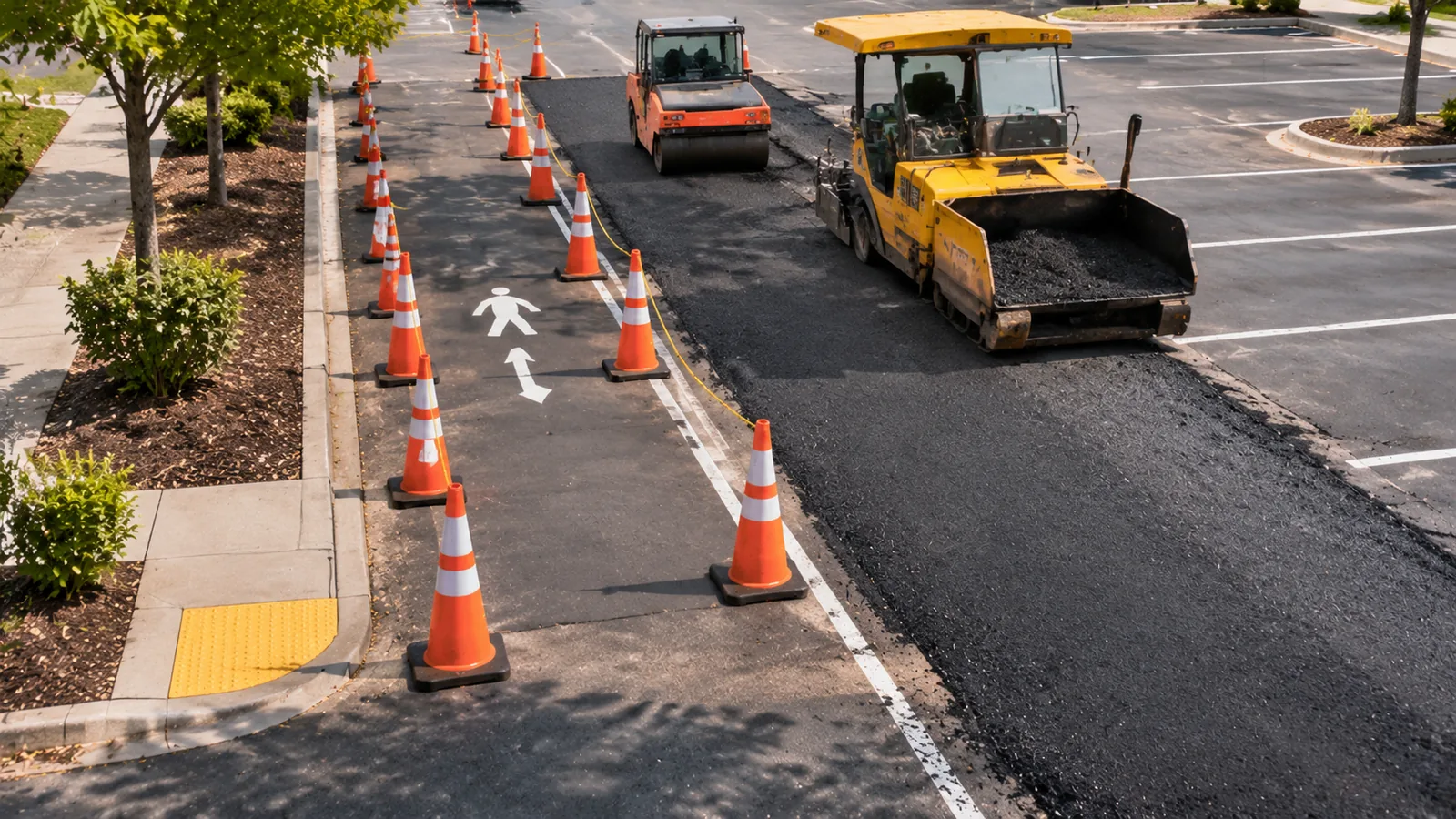
A shopper follows a cone path around paving work and is hit by a reversing delivery van.
Participant | What the claim would be about |
|---|---|
Van driver | How the van moved and whether the driver looked |
Paving contractor | The detour route it set up and controlled |
Property manager | Whether it approved or directed the detour |
Store tenant | Whether it had any role in the common area |
If records show the tenant had no control over the lot and no part in the detour, naming it just because the shopper bought groceries there may not hold up. If the manager set the detour after a complaint about vans crossing the path, that changes the picture.
How does shared fault change what you recover?
Texas divides fault by percentage under Chapter 33 of the Civil Practice and Remedies Code [S16].
Your share of fault | Effect on recovery |
|---|---|
More than 50 percent | You recover nothing in a covered claim. |
50 percent or less | Your recovery is reduced by your percentage. |
A defendant found more than 50 percent responsible can be jointly and severally liable under the statute. That doesn't mean every defendant pays the full amount. Settlements, credits, designated responsible third parties, and insurance all affect who actually pays.
Plain meanings
- Settlement credit, meaning money already paid by one party can reduce what others owe.
- Responsible third party, meaning someone not sued who can still be assigned a share of fault.
- Joint and several, meaning one defendant can be made to pay more than its own share.
What should a lawyer track from the first week?
Keep every name, role, and unanswered question in one file, because a party found late can cause filing and service problems.
Track, with hypothetical examples
- Legal name, such as the owner's registered entity name, not the name on the center's sign.
- Role, such as owner of the common area.
- Evidence, such as the lease section on parking maintenance.
- Open question, such as who hired the paving crew.
Contract indemnity between businesses is a separate issue from your claim. A clause that shifts costs between a landlord and a contractor doesn't prove either one was negligent toward you.
Common questions about liability for parking lot injuries
Can several parties be sued in one lawsuit?
Often, yes, if the joinder and jurisdiction rules allow it. Every claim needs a factual and legal basis, and your lawyer should be able to tell you what each party allegedly did.
Will I recover more if more companies are involved?
Not automatically. More defendants can affect who pays and how much is collectible, but the same injury can't be paid for twice. Value depends on your losses and on what liability the evidence supports.
Do I need to know every company's name before I call?
No. Bring the exact location, the date, a description of what happened, and any letters or emails you've received. A lawyer can find the legal names.
Ask how your parties would be identified
Request a review of your parking lot injury or call (214) 200-4878. Aaron Herbert is Board Certified in Personal Injury Trial Law by the Texas Board of Legal Specialization [S1]. Ask how the firm would identify everyone whose control or conduct mattered to your injury. For the full claim process, read how to file and litigate a Texas parking lot injury claim.
Sources
- S1. State Bar of Texas, Aaron Alan Herbert profile (Bar No. 24036761).
- S7. United Supermarkets, LLC v. McIntire, No. 21-0208 (Tex. June 17, 2022) (per curiam).
- S9. Austin v. Kroger Texas, L.P., 465 S.W.3d 193 (Tex. 2015).
- S10. United Scaffolding, Inc. v. Levine, 537 S.W.3d 463 (Tex. 2017).
- S11. Strakos v. Gehring, 360 S.W.2d 787 (Tex. 1962).
- S15. Texas Civil Practice and Remedies Code chapter 16.
- S16. Texas Civil Practice and Remedies Code chapter 33.
- S19. Texas Civil Practice and Remedies Code chapter 101.
- S20. Texas Civil Practice and Remedies Code chapter 150.

ABOUT THE ATTORNEY
Aaron A. Herbert
Founding Attorney
Board Certified in Personal Injury Trial Law
Aaron founded The Law Firm of Aaron A. Herbert in 2010 to focus on developing each client's case and seeking its maximum value. For over a decade, he has represented people seriously injured in major accidents and industrial catastrophes, pursuing trial verdicts and settlements while working to reduce the stress of litigation.
Education
- Texas A&M University · B.S., Criminal Justice, 1999
- University of Oklahoma College of Law · J.D., 2002; graduated in the top of his class
Trial experience & approach
Aaron earned numerous jury verdicts at boutique personal injury litigation firms. According to his biography, he spent a year as the top-earning litigation attorney at a firm that frequently appeared in verdict searches as having one of the highest numbers of trial wins in Texas. At another Dallas personal injury firm, he moved from managing pre-litigation attorney to managing litigation attorney over seven years as the firm grew into one of Dallas's largest personal injury firms.
His biography describes a reputation as one of America's most aggressive trial lawyers, with noteworthy recoveries from judges and juries and substantial pretrial settlements. Most of those settlements included confidentiality agreements requested by the defense. Aaron has said the recoveries were justified by the injuries and losses involved, which no amount of money could make someone choose to experience.
His approach combines passion, preparation, persistence and courtroom imagination. He believes a well-supported, engaged and motivated team working cooperatively helps deliver strong representation, with the goal of achieving the best possible result for every client.
Dallas roots, military service & publication
Born and raised in Dallas, Aaron enlisted in the United States Marine Corps after high school and later received an Honorable Discharge. He completed his university and law degrees after his military service and became a lifelong Sooners football fan in law school.
Publication: “Litigating Dog Bite Cases,” Texas Dog Law Seminar, Dallas, 2009.
Professional affiliations & recognition
Professional affiliations and recognition listed in Aaron’s biography:
- State Bar of Texas
- American Bar Association
- Association of Trial Lawyers of America (now American Association for Justice)
- Texas Trial Lawyers Association
- Dallas Trial Lawyers Association
- Dallas Bar Association
- Tarrant County Bar Association
- Million Dollar Advocates Forum
- The National Trial Lawyers – Top 100 Trial Lawyers