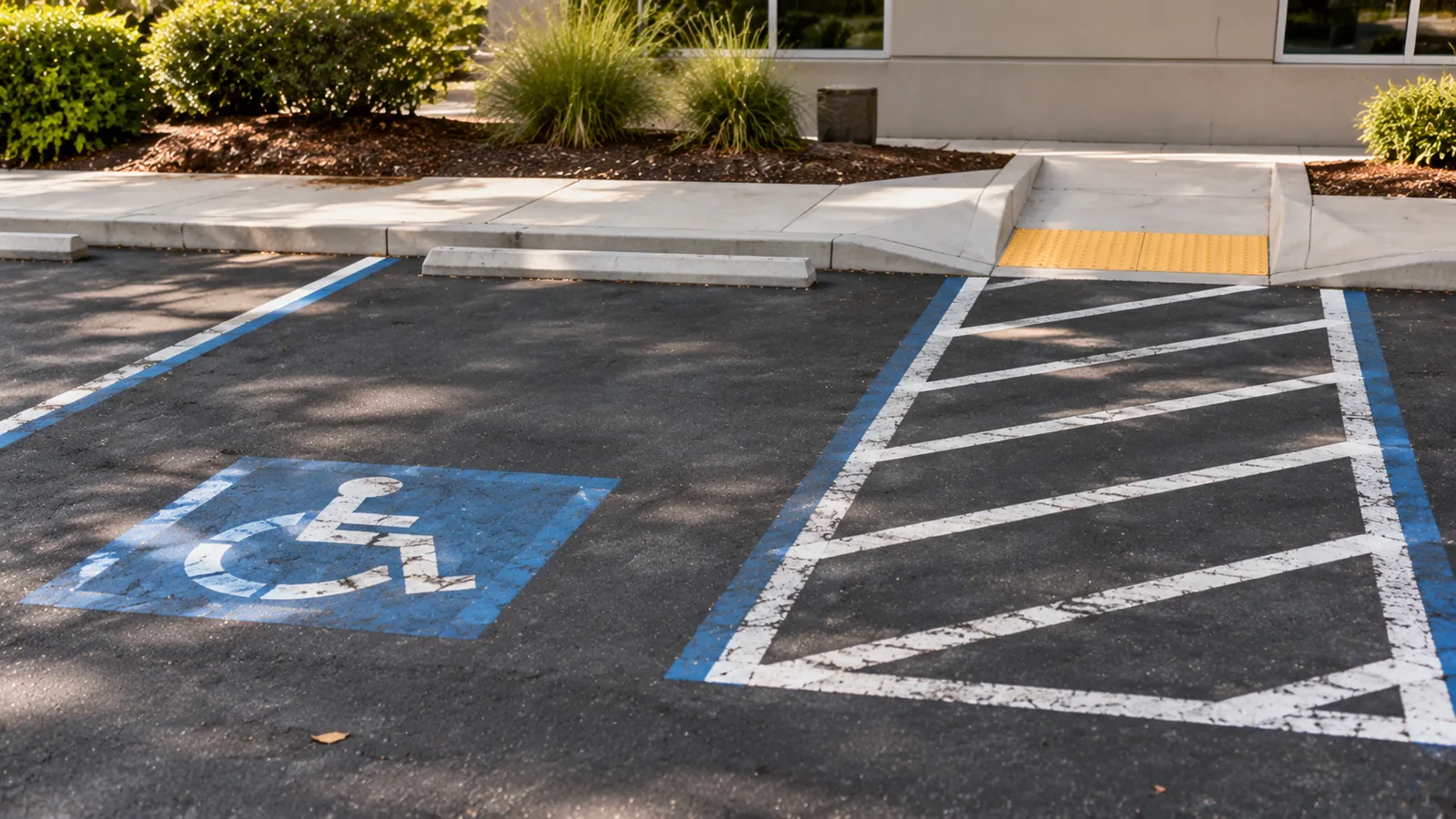
An injury on an accessible parking route turns on four things: the route you could actually use, the accessibility rules that applied to that feature, who controlled it, and how the condition or a driver caused the harm. A blocked access aisle, a broken curb ramp, or a steep spot can all matter. A standards violation alone doesn't prove a personal-injury claim, though, and a compliant space doesn't end one either.
Question | Short answer |
|---|---|
Does an accessibility violation prove my injury claim? | No. It can be strong evidence, but you still need control, a causal link, and proof of the injury. |
What slope is allowed in an accessible space? | Covered accessible spaces and access aisles can't be steeper than 1:48, about 2 percent. |
Who might be responsible? | The driver, the owner or operator, a manager, or whoever blocked the aisle, depending on the facts. |
Does an earlier disability hurt my claim? | No. A new injury, or one that makes an old condition worse, can still be compensable. |
This guide is part of the Texas parking lot injury knowledge hub. If a route or ramp may be repaired soon, request a review of your parking lot injury or call (214) 200-4878.
Why start with the route you actually used?
Because the claim depends on the path you had, not on a single photo of a ramp.
Map this, with hypothetical examples
- Where you parked or were dropped off, such as the second accessible space from the end of Row B.
- The route you were meant to use, such as the access aisle to the curb ramp, then the entrance.
- What was in the way, such as a cart corral parked across the aisle.
- The path you took instead, such as behind three parked cars, in the driving lane.
A person using a wheelchair, walker or cane meets a lot differently from someone walking freely. Photograph the full route from the car door to the entrance. A close-up of a ramp can leave out the van that forced you into traffic.
What should you keep about your mobility aid?
Keep the equipment as it was and write down how you use it.
Keep or note
- The wheelchair, walker, scooter or cane, for damage that can show how the fall or impact happened.
- Its width and turning needs, for why a blocked aisle left no room.
- Your usual routine, for why you chose that space and route.
Talk with a lawyer before repairing or testing damaged equipment, but don't go without something you need to get around. Your age or disability isn't evidence that anyone was negligent. The question is how a specific feature or act affected you.
How do accessibility standards apply to a parking lot?
They apply feature by feature, and only where the rules covered that site at that time.
Questions for each feature
- On scoping, did the rule apply to this facility, given when it was built or altered?
- What dimension or slope did the technical requirement set for the covered feature?
- What does the feature measure now, and how was it measured?
- Was it resurfaced, restriped or repaired since the event?
Federal ADA standards and the Texas Accessibility Standards both address accessible spaces, aisles, and routes [S27, S28]. Section 502.4 of the ADA standards says slopes for covered accessible parking spaces and access aisles must not be steeper than 1:48, which is about 2.08 percent [S27]. That isn't a limit for every surface in the lot, so use the actual ratio and the actual feature.
How should slopes and dimensions be measured?
With the location, direction, tool, and date recorded for every reading.
Good measurement | Weak measurement |
|---|---|
Marks the exact points and direction. | "The ramp looked steep." |
Names the tool, such as a digital level. | A phone app reading with no method. |
Separates overall slope from a sudden lip. | Blends the two into one number. |
Notes later repairs or settling. | Treats today's surface as the incident surface. |
A qualified professional should sort mandatory rules from advisory guidance and exceptions. A number that beats a standard isn't persuasive if that standard didn't apply to the site.
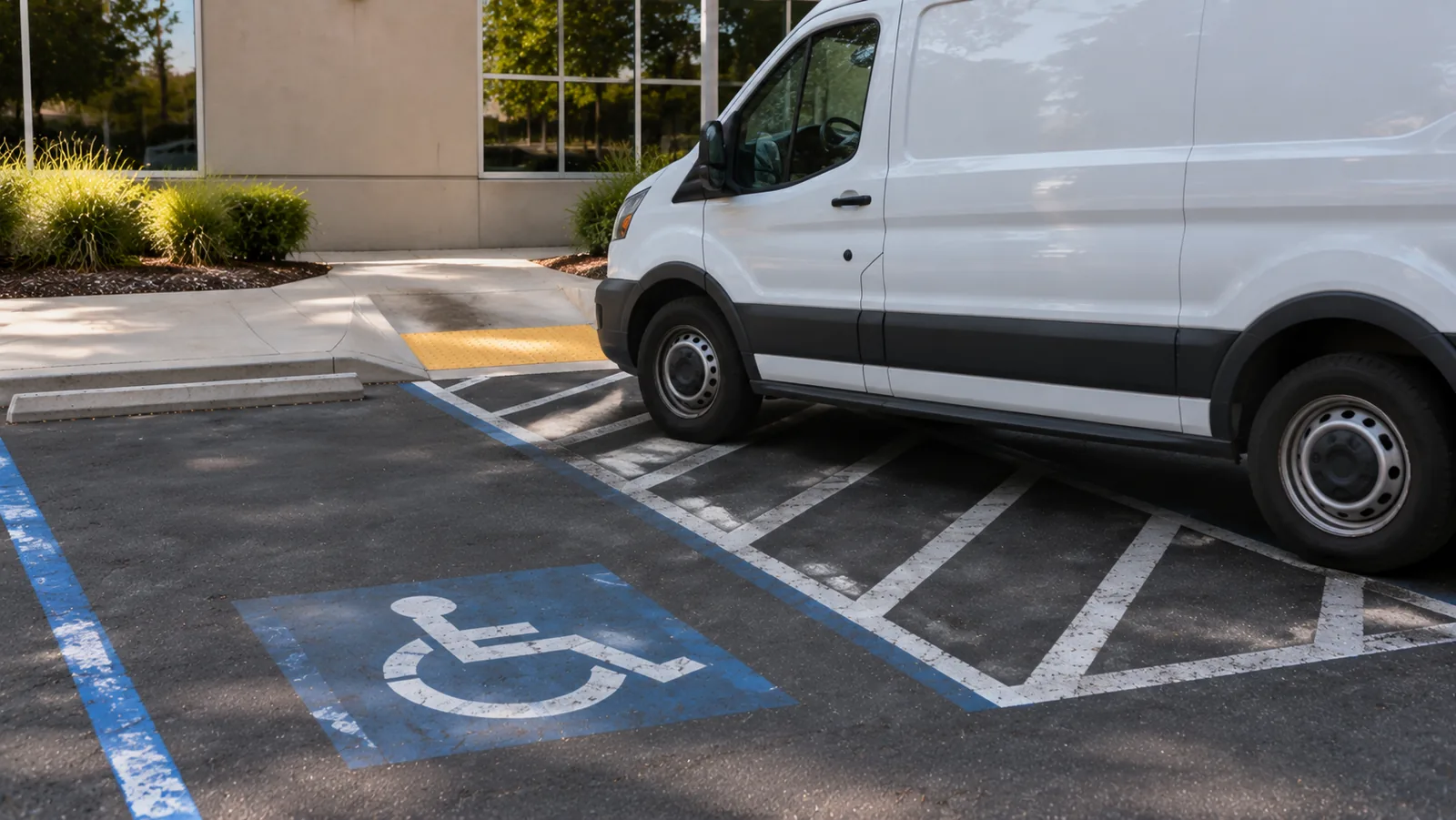
What happens when an access aisle is blocked?
A blocked aisle can push a person into the path of moving cars, so find out who caused it and how long it lasted.
Find out
- What blocked it, such as a parked van, a pallet, a barrier or snow from plowing.
- Who controlled it, such as the driver, a vendor, the tenant or the property manager.
- How long it was there, whether minutes or a pattern of weeks.
- Whether anyone complained, since earlier complaints help show the owner knew.
- What other route existed, for whether the detour was reasonable.
Wheel stops can keep cars from hanging over a walkway, so a wheel stop isn't automatically a violation. Its spot, condition, and relation to the route still need review [S27, S28].
Is an accessibility claim the same as an injury claim?
No. They can have different elements, standing rules, remedies, and procedures.
Accessibility claim | Personal-injury claim |
|---|---|
Asks whether a feature met the access rules. | Asks whether someone breached a duty and caused your injury. |
Often seeks a fix to the property. | Seeks money for medical bills, lost pay, and other harm. |
Can rest on a measurement. | Needs medical proof that the event caused the injury. |
A measurement over the limit doesn't prove what your injury is worth. Still, an access problem can be useful evidence in a negligence case even when you don't bring a separate access claim.
Can a driver still be at fault on an accessible route?
Yes. A driver who backs into someone on a detour may be responsible, alone or along with the property.
Driver evidence
- approach speed and direction
- what the driver could see
- vehicle position after contact
- video, dashcam and witnesses
Property evidence
- what forced the detour
- lighting and sightlines at the spot
- whether the aisle or ramp was blocked
- complaints, work orders and inspection logs
Don't swap the driver investigation for a standards checklist. A blocked route can explain a detour without making every business on the parcel responsible. Our Dallas pedestrian accident lawyer page covers driver claims.
A blocked-aisle example (hypothetical)
A wheelchair user finds a service van parked across the access aisle. She rolls behind the parked cars to reach the ramp, and a reversing car hits her chair.
Party | Question for that party |
|---|---|
Van driver and employer | Why was the van in the aisle, and for how long? |
Property manager | Had anyone reported vans blocking that aisle? |
Reversing driver | Did the driver look and back up slowly? |
Tenant | Did it control the aisle at all? |
If the van had been there for two minutes, the case looks different from one where it blocked the aisle every morning and the manager had complaints. Each party's role has to be proved on its own.
Which records help in accessible-route cases?
Plans and history show when the feature was built, changed, and inspected.
Record | What it can show |
|---|---|
Construction and alteration dates | Which standards applied |
Site plans and restriping orders | How the route was designed |
Inspection and complaint logs | What the owner knew |
Work orders | Repairs before or after the event |
If a claim targets an architect or engineer's design, Texas may require a certificate of merit filed with the petition, and repose deadlines can apply [S20, S15]. A whole-site accessibility audit can flag many issues without explaining your injury, so keep the focus on the feature that hurt you. Our guide to preserving video and physical evidence after a Texas parking lot injury covers what to request early.
Common questions about accessible parking injuries
Does an accessible parking sign mean the space complies?
No. The sign is one feature. The space, aisle, slope, surface and route all need review under the rules that applied.
Can I have a claim if I had a mobility limitation before?
Yes, potentially. An earlier condition doesn't rule out a claim for a new injury or for making the old one worse. Your records need to show the change.
What if I had no choice but to take a detour?
Write down why, what else was available, and what blocked you. Whether a hazard you knew about still counts depends on the facts, so don't assume either way [S9].
Request a route-specific review
Request a review of your parking lot injury or call (214) 200-4878 with the location, date, the route you used, and photos of what blocked it. Aaron Herbert is Board Certified in Personal Injury Trial Law by the Texas Board of Legal Specialization [S1]. For the full process, read how to file and litigate a Texas parking lot injury claim.
Sources
- S1. State Bar of Texas, Aaron Alan Herbert profile (Bar No. 24036761).
- S9. Austin v. Kroger Texas, L.P., 465 S.W.3d 193 (Tex. 2015).
- S15. Texas Civil Practice and Remedies Code chapter 16.
- S20. Texas Civil Practice and Remedies Code chapter 150.
- S27. U.S. Access Board, ADA Accessibility Standards, chapter 5 (section 502).
- S28. Texas Department of Licensing and Regulation, Texas Accessibility Standards.

ABOUT THE ATTORNEY
Aaron A. Herbert
Founding Attorney
Board Certified in Personal Injury Trial Law
Aaron founded The Law Firm of Aaron A. Herbert in 2010 to focus on developing each client's case and seeking its maximum value. For over a decade, he has represented people seriously injured in major accidents and industrial catastrophes, pursuing trial verdicts and settlements while working to reduce the stress of litigation.
Education
- Texas A&M University · B.S., Criminal Justice, 1999
- University of Oklahoma College of Law · J.D., 2002; graduated in the top of his class
Trial experience & approach
Aaron earned numerous jury verdicts at boutique personal injury litigation firms. According to his biography, he spent a year as the top-earning litigation attorney at a firm that frequently appeared in verdict searches as having one of the highest numbers of trial wins in Texas. At another Dallas personal injury firm, he moved from managing pre-litigation attorney to managing litigation attorney over seven years as the firm grew into one of Dallas's largest personal injury firms.
His biography describes a reputation as one of America's most aggressive trial lawyers, with noteworthy recoveries from judges and juries and substantial pretrial settlements. Most of those settlements included confidentiality agreements requested by the defense. Aaron has said the recoveries were justified by the injuries and losses involved, which no amount of money could make someone choose to experience.
His approach combines passion, preparation, persistence and courtroom imagination. He believes a well-supported, engaged and motivated team working cooperatively helps deliver strong representation, with the goal of achieving the best possible result for every client.
Dallas roots, military service & publication
Born and raised in Dallas, Aaron enlisted in the United States Marine Corps after high school and later received an Honorable Discharge. He completed his university and law degrees after his military service and became a lifelong Sooners football fan in law school.
Publication: “Litigating Dog Bite Cases,” Texas Dog Law Seminar, Dallas, 2009.
Professional affiliations & recognition
Professional affiliations and recognition listed in Aaron’s biography:
- State Bar of Texas
- American Bar Association
- Association of Trial Lawyers of America (now American Association for Justice)
- Texas Trial Lawyers Association
- Dallas Trial Lawyers Association
- Dallas Bar Association
- Tarrant County Bar Association
- Million Dollar Advocates Forum
- The National Trial Lawyers – Top 100 Trial Lawyers