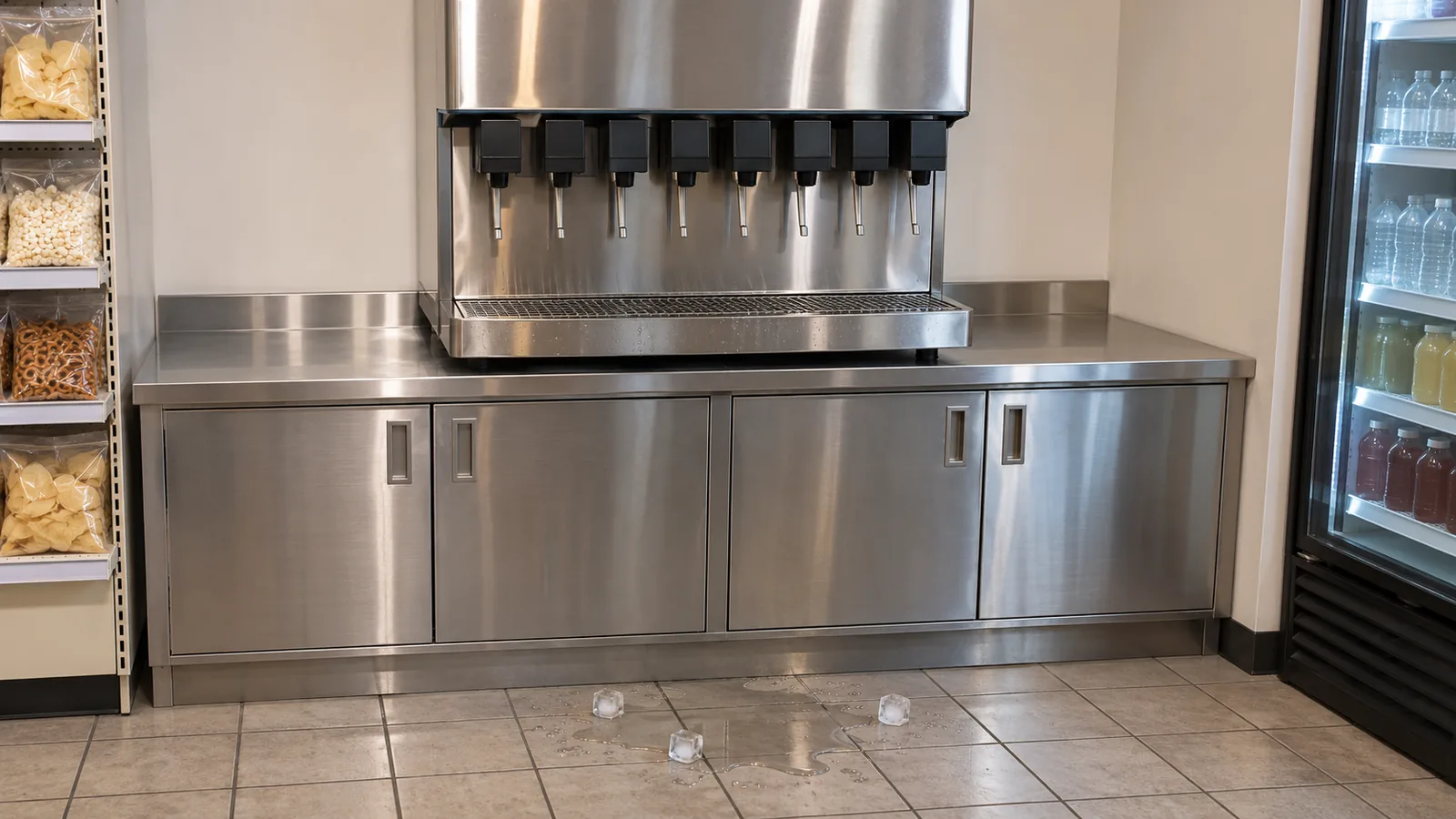
A spill near a 7-Eleven (7-11) drink station can support an injury claim when the evidence shows a dangerous condition, a responsible party that failed to act reasonably and a link to your injury. Selling drinks doesn't make a store negligent, so the questions are where the liquid came from, when it got there, who knew and what they did.
Question | Short answer |
|---|---|
Is a spill by the drink machine enough for a claim? | No. The evidence has to tie that spill to a responsible party's duty and to your injury. |
What matters most? | The source, the exact spot, the timing, who knew, and how staff responded. |
What should I photograph? | The machine, the floor, any mat, and a wider view of the walking route, if it's safe. |
Does it matter what the liquid looked like? | It can. Color, temperature, and residue are useful details, but don't overstate them. |
What should I do this week? | Get care, keep the receipt and photos, and ask a lawyer which records to preserve. |
This guide is part of the Texas 7-Eleven injury knowledge hub. If you'd like a lawyer to look at your fall now, request a review of your Texas 7-Eleven injury through InjuryAttorneyOfDallas.com or call (214) 200-4878.
Where did the liquid come from?
Start with what you actually saw, not with a guess about the cause.
Possible sources, with what might point to each (hypothetical)
- A customer's spill, such as a dropped cup and lid beside the coffee island.
- The equipment, such as a steady drip under the frozen-drink machine's nozzle.
- Drainage, such as water pooling around a floor drain near the ice chest.
- Cleaning, such as streaks from a mop and a bucket left by the counter.
- Tracked-in water, such as wet footprints leading from the front door on a rainy afternoon.
Ice can melt or get kicked aside after a fall, so the scene you photograph may not be the scene you slipped on.
Photos, and what each shows
- The exact dispenser and floor, for which machine and which tiles were involved.
- A wide shot, for how dispensers, mats, trash bins and the walking route relate to each other.
- The original files, kept unedited.
- A note about cleanup, for whether staff wiped the floor before you took the picture.
Which machine was it?
A store can have several drink units, and each may have a different service company.
Record this, with hypothetical examples
- The machine's position, such as "Second frozen-drink machine from the left, by the cup lids."
- Any label or number, such as a sticker reading "Unit 3" on the side panel.
- Which unit you believe leaked, such as "The ice dispenser, not the coffee brewer."
Records for the wrong machine can confuse the whole case, so match each service call to the right unit.
Leads, and what each can answer
- Maintenance tickets, for whether a ticket was opened for this unit and when.
- Leak complaints, for whether customers or staff reported water near it.
- Repair invoices, for who did the work and what they found.
- Staff messages, for whether anyone was told to watch or rope off the area.
- Out-of-service instructions, for whether the machine was supposed to be shut down.
- The request date against the repair date, because a repair asked for on Monday may not have happened until Thursday.
When did the spill start, and when did anyone notice?
The timeline has to separate when the liquid appeared from when someone saw it.
Possible history | What it suggests (hypothetical) |
|---|---|
A customer spilled a drink two minutes before the fall | Staff may not have had a fair chance to find it. |
A machine leaked on and off all week | A different history that may show the problem was known. |
An employee walked past the puddle twenty minutes earlier | A question for the video and staff statements. |
For a spill that comes and goes, Texas notice law makes the earlier timeline important. Being near a hazard isn't enough on its own; how long it existed matters [S7, S8]. Saying that drink areas often get wet doesn't replace evidence about your spill.
Read next
- Proving what a 7-Eleven store knew, for the legal framework for notice.
- How to preserve 7-Eleven surveillance video, on asking for the footage from before the fall.
Example: a mat and a leak (hypothetical)
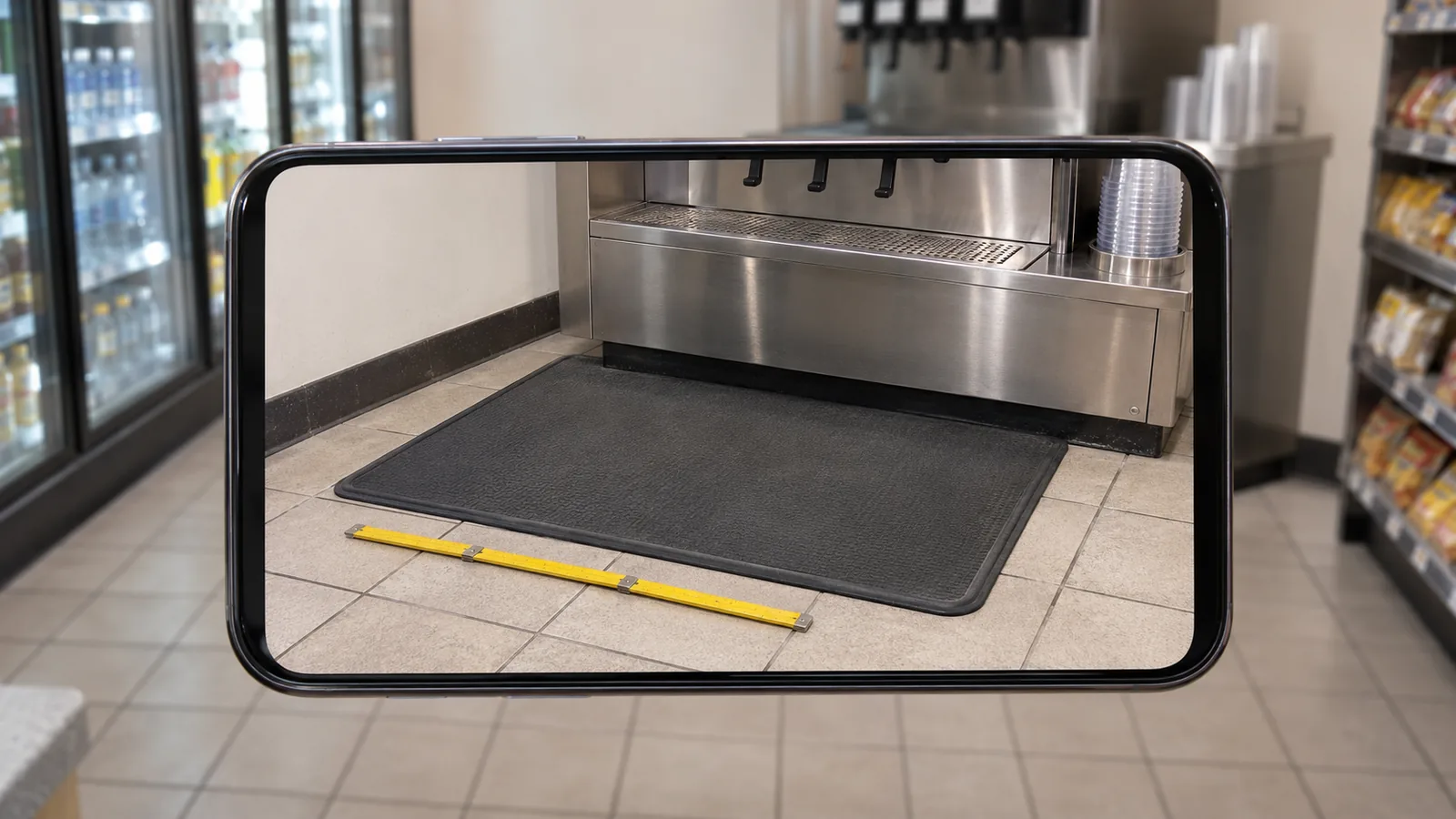
A customer falls beside a drink machine, and an absorbent mat is lying nearby.
Question about the mat | Why it matters |
|---|---|
Why was it put there? | General housekeeping means something different from a response to a leak. |
When was it placed? | Before or after the fall changes what it shows. |
What area did it cover? | The fall may have happened just past its edge. |
Did it change the surface? | A curled or soaked mat can be its own hazard. |
The mat doesn't prove a known leak or an adequate warning by itself.
What the records might show, and what each would mean (hypothetical)
- Mats put down at every drink station each morning, a routine practice rather than proof of a known leak.
- A text telling staff to cover the leak under Unit 3, evidence that the specific machine was known to leak.
- No record either way, a reason to ask more questions before choosing a theory.
When can an expert help?
An expert can explain one piece of the puzzle, but not all of it.
Expert | What they can address | What they can't settle alone |
|---|---|---|
Equipment specialist | Whether a failure could produce the liquid you saw. | How long it sat on the floor. |
Surface expert | Floor friction under defined conditions. | Whether staff knew about the spill. |
Testing should protect the evidence and explain any differences from the day you fell.
Later tests, and what needs explaining
- A slip test on a dry floor, and how it relates to a wet floor that day.
- An inspection after a repair, and what changed since the incident.
For practitioners: connect the operational records
Line up the incident timeline with staff assignments, service calls, inspection entries and video.
- The time of the fall, against the last inspection entry for that area.
- Shift assignments, against who was stationed near the drink counter.
- Service calls, against the unit and the date of the reported problem.
- A contractor’s role, against its written scope of work and what it actually did.
Treat gaps as questions to follow up, not as proof of misconduct. Marsh's public safety questions for franchisees raise maintenance and documentation topics that can guide discovery, but they don't show that a given operator adopted any of them [S21].
Marsh topics, and how to use each
- Floor safety walks, for asking whether walks were logged on the incident date.
- Non-slip mats and wet-floor signs, for asking where they were placed and when.
- Camera coverage, for asking which views covered the drink area.
Does a recurring problem automatically prove liability?
No. The recurring condition has to be tied to your injury and to the duty that applies.
Evidence
- Unrelated spills at other stores.
- Repeated leak reports for the same unit.
- A repair that failed a week before your fall.
The weight of each, in the same order (hypothetical).
- Not evidence about your machine or walkway.
- Much closer to the question.
- Worth investigating.
What should I bring to a consultation?
Bring what you have, and be honest about what you don't know.
Bring, with hypothetical examples
- Photos, such as three phone pictures of the puddle and the machine.
- The receipt, which shows the store and the time.
- The exact location, such as "In front of the ice dispenser."
- Witness details, such as a customer's name and phone number.
- What staff said, such as "The clerk said it's been dripping all day."
- Your uncertainties, such as whether you saw the liquid before you fell or only afterward.
Request a review of your Texas 7-Eleven injury
Ask how the firm would look into the machine, the timing, and who was responsible in your case.
Aaron Herbert holds Board Certification in Personal Injury Trial Law from the Texas Board of Legal Specialization, which you can confirm on his State Bar of Texas profile [S1]. Request a review of your Texas 7-Eleven injury from The Law Firm of Aaron A. Herbert, P.C. through InjuryAttorneyOfDallas.com or call (214) 200-4878.
Related reading
- Texas 7-Eleven injury knowledge hub, with all 15 guides in one place.
- Texas 7-Eleven claims and litigation guide, for the full claim and lawsuit process.
- Proving what a 7-Eleven store knew, on notice and timing.
- A wet-floor sign at 7-Eleven, on warnings and open-and-obvious hazards.
- Dallas slip and fall injuries, the firm's slip-and-fall page.
Sources
- S1. State Bar of Texas, Aaron Alan Herbert, Bar No. 24036761.
- S7. Wal-Mart Stores, Inc. v. Reece, 81 S.W.3d 812 (Tex. 2002).
- S8. Wal-Mart Stores, Inc. v. Spates, 186 S.W.3d 566 (Tex. 2006) (applying Reece).
- S21. Marsh, Risk Management Safety Questions to Ask Yourself to Protect Your 7-Eleven Store.

ABOUT THE ATTORNEY
Aaron A. Herbert
Founding Attorney
Board Certified in Personal Injury Trial Law
Aaron founded The Law Firm of Aaron A. Herbert in 2010 to focus on developing each client's case and seeking its maximum value. For over a decade, he has represented people seriously injured in major accidents and industrial catastrophes, pursuing trial verdicts and settlements while working to reduce the stress of litigation.
Education
- Texas A&M University · B.S., Criminal Justice, 1999
- University of Oklahoma College of Law · J.D., 2002; graduated in the top of his class
Trial experience & approach
Aaron earned numerous jury verdicts at boutique personal injury litigation firms. According to his biography, he spent a year as the top-earning litigation attorney at a firm that frequently appeared in verdict searches as having one of the highest numbers of trial wins in Texas. At another Dallas personal injury firm, he moved from managing pre-litigation attorney to managing litigation attorney over seven years as the firm grew into one of Dallas's largest personal injury firms.
His biography describes a reputation as one of America's most aggressive trial lawyers, with noteworthy recoveries from judges and juries and substantial pretrial settlements. Most of those settlements included confidentiality agreements requested by the defense. Aaron has said the recoveries were justified by the injuries and losses involved, which no amount of money could make someone choose to experience.
His approach combines passion, preparation, persistence and courtroom imagination. He believes a well-supported, engaged and motivated team working cooperatively helps deliver strong representation, with the goal of achieving the best possible result for every client.
Dallas roots, military service & publication
Born and raised in Dallas, Aaron enlisted in the United States Marine Corps after high school and later received an Honorable Discharge. He completed his university and law degrees after his military service and became a lifelong Sooners football fan in law school.
Publication: “Litigating Dog Bite Cases,” Texas Dog Law Seminar, Dallas, 2009.
Professional affiliations & recognition
Professional affiliations and recognition listed in Aaron’s biography:
- State Bar of Texas
- American Bar Association
- Association of Trial Lawyers of America (now American Association for Justice)
- Texas Trial Lawyers Association
- Dallas Trial Lawyers Association
- Dallas Bar Association
- Tarrant County Bar Association
- Million Dollar Advocates Forum
- The National Trial Lawyers – Top 100 Trial Lawyers