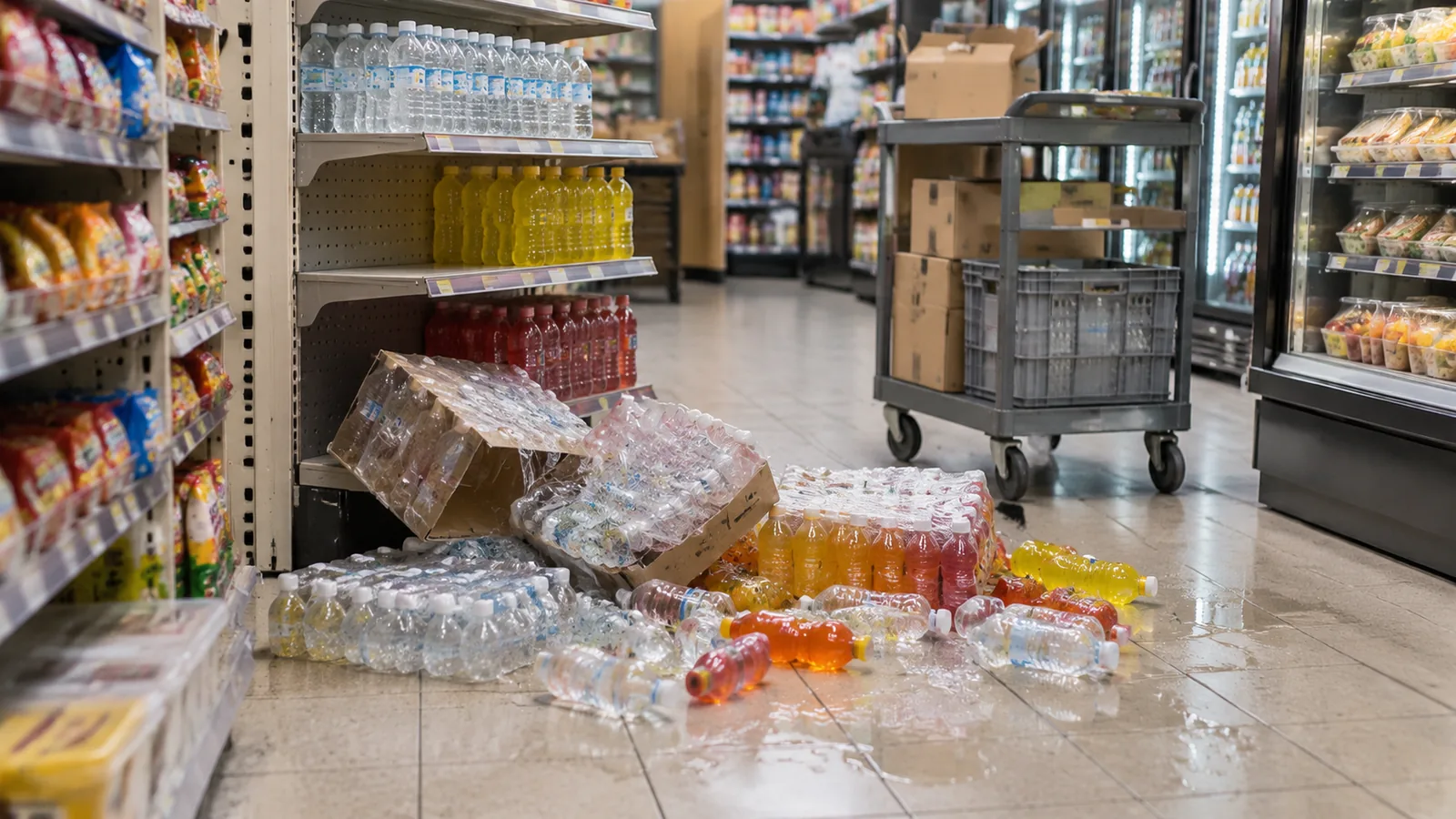
Not every store injury is a slip and fall. When a product drops, a display gives way, or a delivery cart hits you at a 7-11, the claim follows what was moving and who was acting. The label on the incident report doesn’t decide it.
| What happened | What gets looked at first |
|---|---|
| An item fell with no one touching it. | The display, how it was loaded, and who built it. |
| A worker was stocking the shelf. | What the worker was doing at that moment. |
| A delivery cart or dolly hit you. | Who employed the driver and who directed the job. |
| A shelf or fixture broke. | The fixture's condition and its repair history. |
| You were reaching for a product. | Exactly what you touched and how the item came down. |
This guide is part of the Texas 7-Eleven injury knowledge hub. To have a lawyer look at how the injury happened, request a review of your Texas 7-Eleven injury through InjuryAttorneyOfDallas.com or call (214) 200-4878.
Is every store injury a slip-and-fall case?
No. Falling products, unstable displays, stocking work, and delivery equipment can each call for a different liability theory than a spill on the floor.
- A premises-condition claim about the floor, such as melted ice on the floor by the cooler.
- A premises-condition claim about the display, such as a display left leaning after stocking.
- A claim about what the worker was doing at the time, such as a worker moving cases when they hit you.
- A claim involving the delivery company and possibly the store, such as a delivery driver's dolly striking you.
Those examples are hypothetical.
The right theory follows the event. An incident report that says "slip and fall" doesn't decide it.
| Ask | Why |
|---|---|
| What was moving? | It separates a falling object from a fall. |
| Who was acting? | It points to the worker, the driver, or no one. |
| What condition existed? | It shows whether a hazard was already there. |
| How did the injury happen? | It ties the hazard or the act to the harm. |
Describe the sequence before assigning blame
Write down what happened in order, including the parts you aren't sure about.
- Did the item fall without anyone touching it?
- Was a worker stocking the shelf?
- Did a cart strike you?
- Did a fixture fail?
- Were you reaching for a product?
Each answer suggests different witnesses and records. A uniform or a logo can help identify an employer, but it doesn't always settle the question.
Notes like these help. They are made-up examples.
- a name badge that said "Marcus," with a vendor logo on the shirt
- a box truck with a beverage distributor’s name parked by the door
- the truck pulling up about ten minutes before you were hurt
- a stacked hand truck being wheeled down the snack aisle
Preserve the product and the display
Photograph the item, its packaging, the shelf location, the fixture, and the area around it, as long as it's safe to do so.
- The product name and any lot or model number, to identify the item and its maker.
- Damaged belongings, such as glasses or a phone. They show the force of the impact.
- Your original photos, unedited, with the date and time the camera recorded.
- The shelf or end-cap location, which ties the item to one display.
Don't rebuild a display just to take a photo that isn't labeled as a re-creation. If a reconstruction is ever needed, document what went into it and how it differs from the original scene.
- A photo taken right after the injury, labeled as the original scene, with the date and time.
- A photo taken later at the store, labeled as a later photo, not the scene as it was.
- A rebuilt display, labeled as a reconstruction, with its inputs and differences explained.
Was it an existing condition or something a worker was doing?
The difference matters, because Texas law treats a dangerous condition on the property differently from an activity going on at the time.
| Situation (hypothetical) | How it may be analyzed |
|---|---|
| A stocking job finished an hour earlier left a tower of cases leaning. | Likely a premises-condition question about the display. |
| A worker is pushing a loaded cart down the aisle when it hits you. | Possibly a question about the worker's activity at that moment. |
One general negligence allegation doesn’t cover every event. Each premises or activity theory needs its own evidence, and pleading in the alternative may make sense while the facts develop.
- The jury question has to match the proved mechanism.
- Notice and the other condition elements still apply when a condition is called an activity.
Delivery contractors need their own investigation
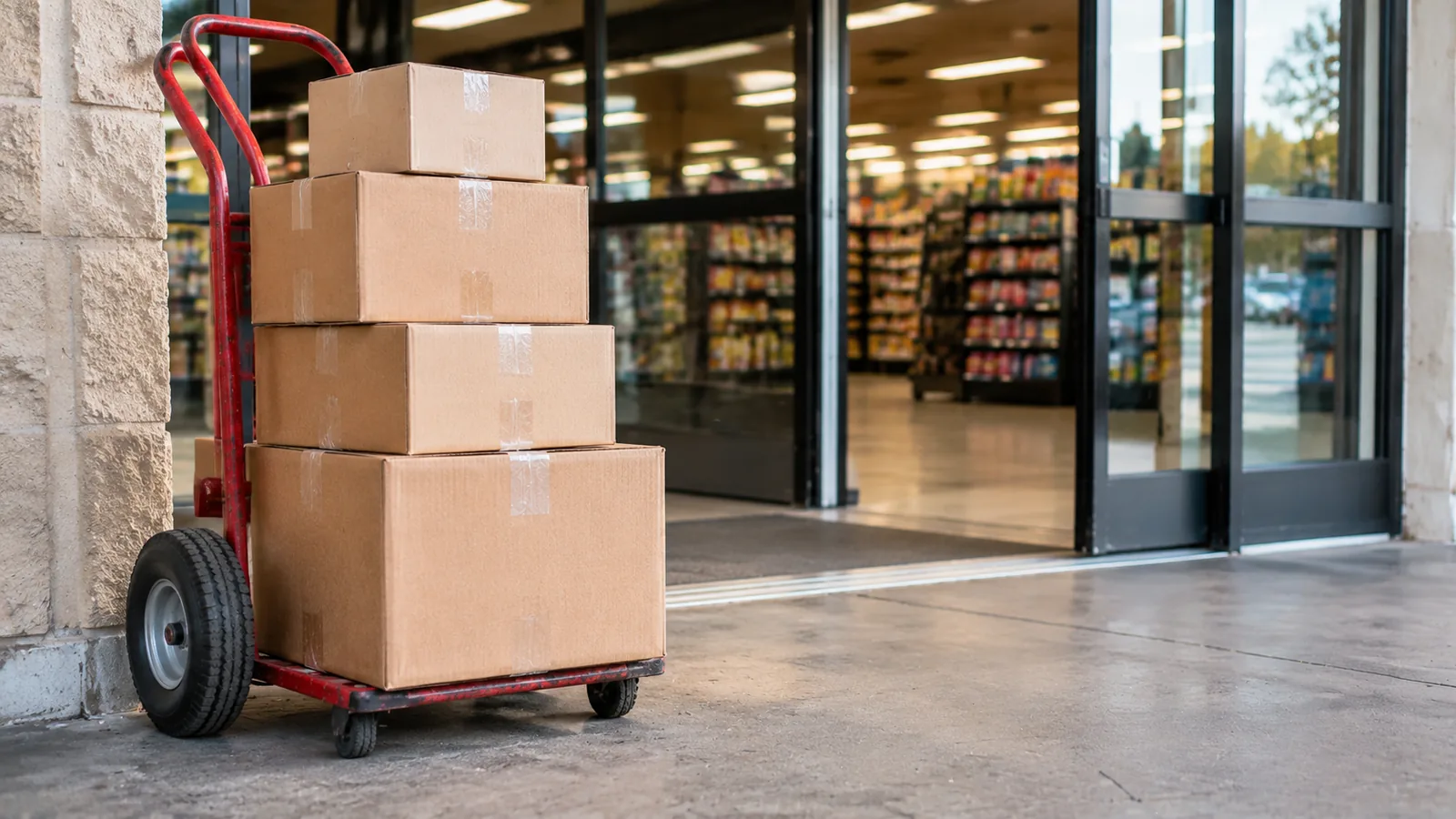
When a delivery is involved, find out who employed the driver, who directed the task, and what equipment was in use.
- Delivery records and schedules, for when the delivery was at the store.
- The contracts that apply, for who handled unloading and placement.
- Available recordings of where the driver and the cart were.
- Equipment details: a hand truck, a dolly, or a pallet jack.
A contractor's role can add questions without removing the store operator's possible part. Compare each account with the timing.
| Fact found later (hypothetical) | What it might mean |
|---|---|
| A bottle on the floor after the event. | It may have fallen because of the incident rather than caused it. |
| Video of the cart's path. | It can separate those two explanations. |
| A witness who saw the cart first. | Their order of events can be checked against the video. |
Hypothetical: a case of bottles falls from a display
Say a customer reports being hit by falling bottles, and a photo shows the display damaged afterward. That photo alone doesn't explain why the bottles fell, so the investigation should test each explanation instead of picking the one with the largest defendant.
- Store staff or a vendor's merchandiser, for who built the display.
- Staff, restocking records or video, for whether it had been changed since it was built.
- Witnesses and video, for whether another customer touched it.
- Staff and video, for whether a worker was handling it at the time.
- An inspection of the fixture, for whether the fixture failed, if failure is claimed.
For practitioners: define the expert question
An engineer may analyze load stability, fixture condition, or how the display was set up, but the opinion needs a factual basis tied to the actual display.
| Weak opinion | Stronger opinion |
|---|---|
| "Products shouldn't fall." | The shelf's load, the fixture's condition, and the stacking pattern, measured on this display. |
| Based on a catalog photo of a similar fixture. | Based on the actual fixture, the scene photos, and the handling records. |
Preserve access and handling information before testing. If the fixture is changed or thrown away, identify the surviving photos, records, and witnesses that could support a reliable reconstruction.
Designate experts on time under Texas Rule of Civil Procedure 195, in the official rules last amended October 1, 2026 [S16]. Lay the foundation for the opinion under Texas Rule of Evidence 702, in the official rules effective July 2, 2026 [S17].
Common questions about falling merchandise and deliveries
Do I need the delivery company’s name before I call a lawyer?
A logo on a shirt or the name on a box truck is enough to start. Share what you noticed and any photos, and a lawyer can look for the records that identify the company.
What if the store says I pulled the item down?
Keep the evidence and explain exactly what you did. Your conduct and the display’s condition may both need analysis. If you touched the item, say so.
Is a falling-merchandise claim the same as a slip and fall?
The theory depends on what moved, who was acting, and what condition existed, so the two can differ.
Request a review of your Texas 7-Eleven injury
Ask how the product, the display, and the delivery evidence would be investigated.
- Photos of the item and the display, such as the fallen cases and the empty shelf above them.
- The product or its packaging, such as a bottle label with a lot number.
- Notes about the delivery: the truck’s company name and the time it arrived.
- Your treatment records, starting with the urgent-care visit that afternoon.
Those examples are hypothetical.
Request a review of your Texas 7-Eleven injury from The Law Firm of Aaron A. Herbert, P.C. through InjuryAttorneyOfDallas.com or call (214) 200-4878. Aaron Herbert is Board Certified in Personal Injury Trial Law by the Texas Board of Legal Specialization, and his State Bar of Texas profile lists it [S1]. 7-Eleven stores are operated or franchised by 7-Eleven, Inc. The Law Firm of Aaron A. Herbert, P.C. is not affiliated with or endorsed by 7-Eleven, Inc.
Related reading
- Texas 7-Eleven injury knowledge hub, with all 15 guides in one place.
- Texas 7-Eleven claims and litigation guide, for the full claim and lawsuit process.
- 7-Eleven responsible parties guide, on operators, franchisees, landlords, and contractors.
- 7-Eleven discovery and trial guide, on records, experts, and jury proof.
- Texas fallen merchandise injuries attorney, the firm’s falling-merchandise page.
Sources
- S1. State Bar of Texas, Aaron Alan Herbert, Bar No. 24036761.
- S16. Texas Rules of Civil Procedure, official compilation, last amended October 1, 2026 (Rules 195 and 278).
- S17. Texas Rules of Evidence, official compilation, effective July 2, 2026 (Rule 702).

ABOUT THE ATTORNEY
Aaron A. Herbert
Founding Attorney
Board Certified in Personal Injury Trial Law
Aaron founded The Law Firm of Aaron A. Herbert in 2010 to focus on developing each client's case and seeking its maximum value. For over a decade, he has represented people seriously injured in major accidents and industrial catastrophes, pursuing trial verdicts and settlements while working to reduce the stress of litigation.
Education
- Texas A&M University · B.S., Criminal Justice, 1999
- University of Oklahoma College of Law · J.D., 2002; graduated in the top of his class
Trial experience & approach
Aaron earned numerous jury verdicts at boutique personal injury litigation firms. According to his biography, he spent a year as the top-earning litigation attorney at a firm that frequently appeared in verdict searches as having one of the highest numbers of trial wins in Texas. At another Dallas personal injury firm, he moved from managing pre-litigation attorney to managing litigation attorney over seven years as the firm grew into one of Dallas's largest personal injury firms.
His biography describes a reputation as one of America's most aggressive trial lawyers, with noteworthy recoveries from judges and juries and substantial pretrial settlements. Most of those settlements included confidentiality agreements requested by the defense. Aaron has said the recoveries were justified by the injuries and losses involved, which no amount of money could make someone choose to experience.
His approach combines passion, preparation, persistence and courtroom imagination. He believes a well-supported, engaged and motivated team working cooperatively helps deliver strong representation, with the goal of achieving the best possible result for every client.
Dallas roots, military service & publication
Born and raised in Dallas, Aaron enlisted in the United States Marine Corps after high school and later received an Honorable Discharge. He completed his university and law degrees after his military service and became a lifelong Sooners football fan in law school.
Publication: “Litigating Dog Bite Cases,” Texas Dog Law Seminar, Dallas, 2009.
Professional affiliations & recognition
Professional affiliations and recognition listed in Aaron’s biography:
- State Bar of Texas
- American Bar Association
- Association of Trial Lawyers of America (now American Association for Justice)
- Texas Trial Lawyers Association
- Dallas Trial Lawyers Association
- Dallas Bar Association
- Tarrant County Bar Association
- Million Dollar Advocates Forum
- The National Trial Lawyers – Top 100 Trial Lawyers