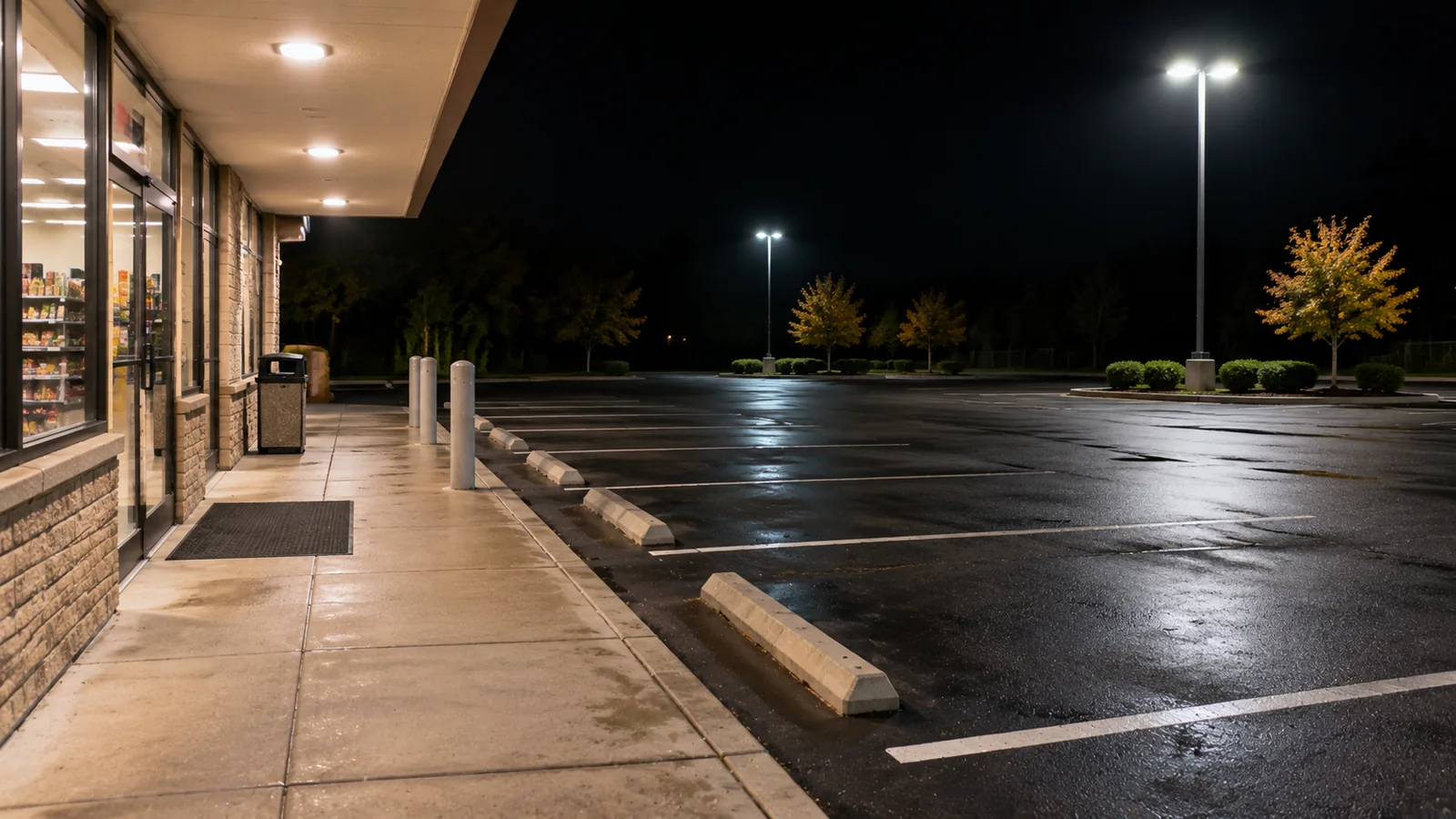
If you were attacked at a 7-11, the person who hurt you is responsible for the crime. Whether the store's operator also owes you money is a different question, and the answer depends on what the business knew and could have done.
| Question | What it looks at |
|---|---|
| Was there a duty? | Prior incidents, what the business knew, and the burden of preventing the harm. |
| Was there a breach? | A reasonable precaution that was missing. |
| Did the breach cause harm? | Whether that precaution would have changed what happened. |
| Who is responsible for the crime? | The attacker, which is a separate question. |
Your safety and medical care come first. This guide is part of the Texas 7-Eleven injury knowledge hub. When you're ready, request a review of your Texas 7-Eleven injury or call (214) 200-4878.
Begin with safety, treatment, and a police report
Get medical attention and contact law enforcement, then keep a record of what followed.
Keep, with hypothetical examples
- The police report or incident number, such as a case number written on a card by the responding officer.
- Witness contacts, such as a customer who gave you a phone number.
- Photos of injuries, such as pictures taken at the emergency room and three days later.
- Messages about the incident, such as texts to a friend sent right after.
Still worried about your safety? Tell the police and your lawyer. The criminal case and a civil claim run on separate tracks, with their own evidence, proof standards, people, and schedules.
Tell your lawyer about
- Any protective order, because it affects contact and communications.
- Requests from detectives or prosecutors, since the civil case shouldn't interfere with them.
- Contact from the attacker or others, which may matter for safety and for the evidence.
Preserve the timeline before the attack
The minutes leading up to an assault may matter as much as the attack itself.
- When a disturbance started, which shows how long there was to respond.
- Whether threats were made, which shows what was apparent beforehand.
- Who saw them, since they're the witnesses to the build-up.
- Whether staff was told, which shows what the business knew.
- What chance there was to respond, which frames what a reasonable response might have been.
Ask for preservation of relevant interior and exterior recordings, 911 and other emergency calls, incident records, and security records where they exist. Don't assume every store has the same camera system or security arrangement.
Who may hold each record (hypothetical)
- Video of the parking lot, held by the store operator or the property owner.
- A 911 recording, held by the local emergency-call center.
- Security guard logs, held by a security contractor, if one was hired.

Prior incidents need comparison, not just a count
The Supreme Court of Texas, in UDR Texas Properties v. Petrie, explained that whether a crime was foreseeable and whether the risk was unreasonable are separate questions [S24].
| Factor the Court lists for foreseeability | What to compare |
|---|---|
| Proximity | Did earlier crimes happen at this property or right next to it? |
| Recency and frequency | How recently and how often? |
| Similarity | Were they like this attack? |
| Publicity | Did the business know or have reason to know about them? |
Petrie involved a man shot and robbed in an apartment complex's visitor lot. The Court ruled for the owner because no evidence addressed the burden of preventing that kind of crime. Showing that a crime was possible isn't the same as showing a duty.
| Weak evidence | Stronger evidence |
|---|---|
| A citywide crime map. | Police reports from this property in the past two years (hypothetical). |
| Online reviews calling the area "sketchy". | Documented incidents the store reported. |
| Rumors from neighbors. | Records showing what management was told. |
Identify the missing precaution and its role
A claim should explain what reasonable step was missing and how it relates to the injury.
| Precaution that may be investigated | What has to be shown |
|---|---|
| Lighting | Whether better lighting would have mattered here. |
| Access control | Whether the attacker's route could reasonably have been limited. |
| Staffing | Whether staff could have seen and acted in time. |
| Reporting and response | Whether a call or a warning would have changed the outcome. |
None of these measures prevents every assault. A sudden attack raises different issues from a disturbance that built up over time, so the theory has to fit the real chance to act, not hindsight.
The likely question in two situations (hypothetical)
- If a stranger attacks without warning, was there any realistic chance to intervene?
- If an argument at the counter escalates for ten minutes, what did staff see, and what could they have done?
Security contractors may have their own role
Get the scope of any security engagement and look at what the contractor actually did.
Check
- The written scope of the security contract, for what the contractor agreed to cover.
- What the guard actually did that night, since practice can differ from the contract.
- Staffing records and communications, for who was on duty and what was said.
A contractor's presence doesn't mean it had every responsibility for the property. Each proposed defendant needs its own factual and legal basis.
The basis that would need support for each party (hypothetical)
- The store operator, on what it knew and what it could have done.
- The security contractor, on what it agreed to do and what it did.
- The property owner, on control of the lot, lighting or access.
For practitioners: what a security expert has to explain
The expert's report should name the measure, weigh its cost, and show how it would have stopped this attack, using incident records from this property.
| Incomplete opinion | Complete opinion |
|---|---|
| "More security would have helped." | Which measure, why it was reasonable given the burden, and how it would have changed this attack. |
| Built on a neighborhood crime map. | Built on incidents tied to this property and the business's knowledge. |
Test alternative explanations, the timing, and the limits of the evidence. A client's serious injuries deserve careful attention, but their severity can't supply missing proof of duty or causation.
Tests
- Timing, and whether there was enough time for the measure to work.
- Alternatives, and whether the attacker would have acted anyway.
- Burden, and what the measure would have cost the business.
Common questions after an assault at a store
Can I pursue a civil claim before the criminal case ends?
Possibly, but don't assume a criminal investigation pauses civil deadlines. Get advice promptly about evidence and deadlines.
What if I knew the attacker?
The relationship may affect the investigation and the legal analysis, so tell your lawyer about it and the full sequence. Leaving it out prevents a realistic assessment.
Does a store owe a duty to stop every crime?
A duty depends on a foreseeable and unreasonable risk, judged on the facts, so no.
Request a review of your Texas 7-Eleven injury
Share sensitive details through a private channel, not in a public comment or post.
Bring, with hypothetical examples
- The store location and date, with the street address and the time of the attack.
- The police reference number, meaning the case number from the officer's card.
- Your treatment records, including the emergency-room visit and follow-up care.
- Any evidence you have, such as photos, messages and witness names.
Request a review of your Texas 7-Eleven injury from The Law Firm of Aaron A. Herbert, P.C. through InjuryAttorneyOfDallas.com or call (214) 200-4878. Aaron Herbert holds board certification in Personal Injury Trial Law from the Texas Board of Legal Specialization, as shown on his State Bar of Texas profile [S1]. 7-Eleven stores are operated or franchised by 7-Eleven, Inc. The Law Firm of Aaron A. Herbert, P.C. is not affiliated with or endorsed by 7-Eleven, Inc.
Related reading
- Texas 7-Eleven injury knowledge hub, with all 15 guides in one place.
- Texas 7-Eleven claims and litigation guide, for the full claim and lawsuit process.
- 7-Eleven surveillance video guide, on asking for video to be preserved.
- 7-Eleven injury lawsuit deadline guide, on filing on time.
- Dallas negligent security lawyer, the firm's negligent-security page.
Sources
- S1. State Bar of Texas, Aaron Alan Herbert, Bar No. 24036761 (license and board certification).
- S24. UDR Texas Properties, L.P. v. Petrie, 517 S.W.3d 98 (Tex. 2017), No. 15-0197, majority opinion (foreseeability and unreasonableness are separate parts of the duty analysis).

ABOUT THE ATTORNEY
Aaron A. Herbert
Founding Attorney
Board Certified in Personal Injury Trial Law
Aaron founded The Law Firm of Aaron A. Herbert in 2010 to focus on developing each client's case and seeking its maximum value. For over a decade, he has represented people seriously injured in major accidents and industrial catastrophes, pursuing trial verdicts and settlements while working to reduce the stress of litigation.
Education
- Texas A&M University · B.S., Criminal Justice, 1999
- University of Oklahoma College of Law · J.D., 2002; graduated in the top of his class
Trial experience & approach
Aaron earned numerous jury verdicts at boutique personal injury litigation firms. According to his biography, he spent a year as the top-earning litigation attorney at a firm that frequently appeared in verdict searches as having one of the highest numbers of trial wins in Texas. At another Dallas personal injury firm, he moved from managing pre-litigation attorney to managing litigation attorney over seven years as the firm grew into one of Dallas's largest personal injury firms.
His biography describes a reputation as one of America's most aggressive trial lawyers, with noteworthy recoveries from judges and juries and substantial pretrial settlements. Most of those settlements included confidentiality agreements requested by the defense. Aaron has said the recoveries were justified by the injuries and losses involved, which no amount of money could make someone choose to experience.
His approach combines passion, preparation, persistence and courtroom imagination. He believes a well-supported, engaged and motivated team working cooperatively helps deliver strong representation, with the goal of achieving the best possible result for every client.
Dallas roots, military service & publication
Born and raised in Dallas, Aaron enlisted in the United States Marine Corps after high school and later received an Honorable Discharge. He completed his university and law degrees after his military service and became a lifelong Sooners football fan in law school.
Publication: “Litigating Dog Bite Cases,” Texas Dog Law Seminar, Dallas, 2009.
Professional affiliations & recognition
Professional affiliations and recognition listed in Aaron’s biography:
- State Bar of Texas
- American Bar Association
- Association of Trial Lawyers of America (now American Association for Justice)
- Texas Trial Lawyers Association
- Dallas Trial Lawyers Association
- Dallas Bar Association
- Tarrant County Bar Association
- Million Dollar Advocates Forum
- The National Trial Lawyers – Top 100 Trial Lawyers