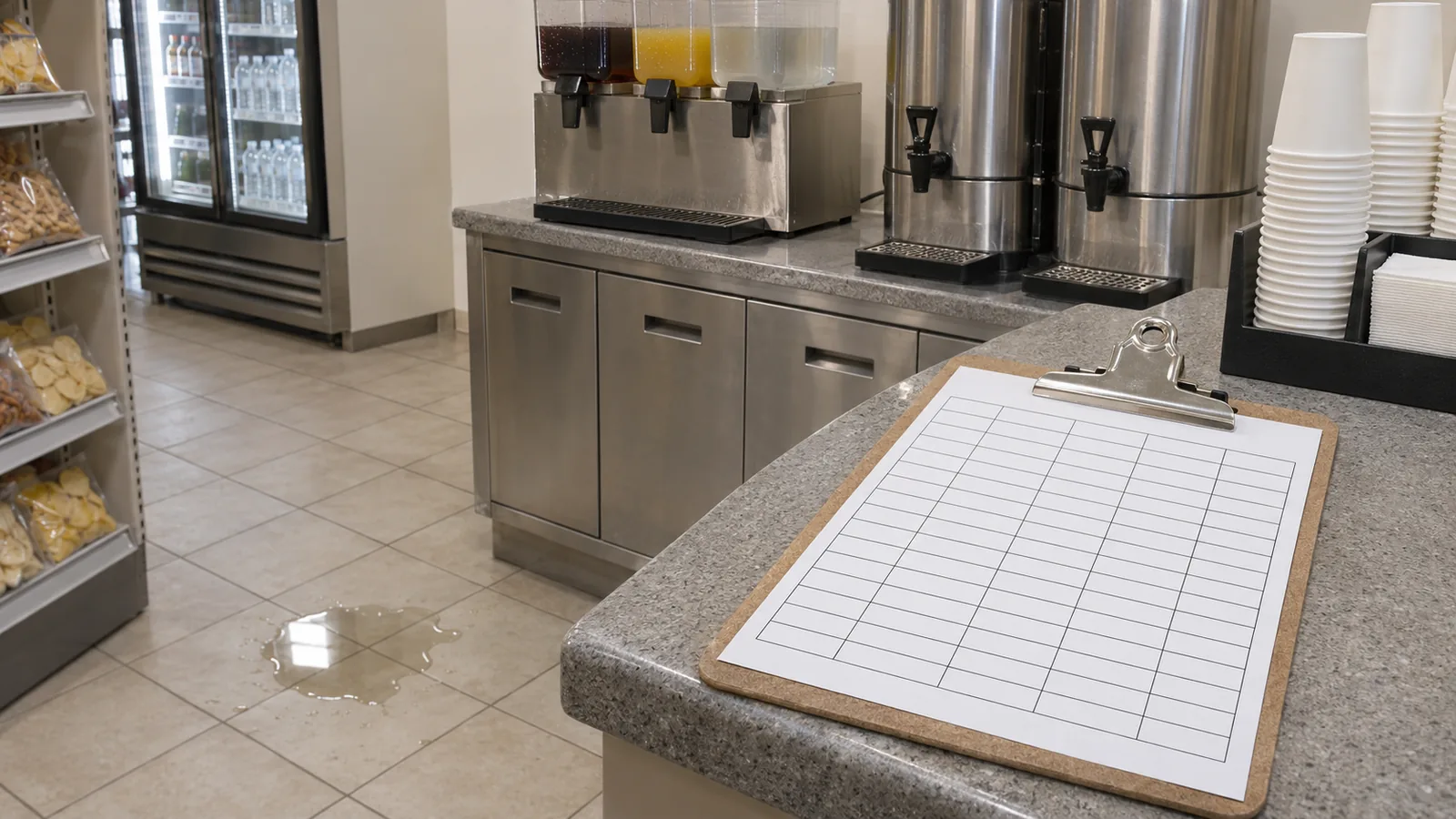
Notice is about what the business responsible for the 7-11 store knew, or should have found with reasonable care, about the specific hazard before you fell. Knowing that spills happen in general usually isn't enough.
What does "notice" mean? Knowledge of the particular condition that caused the fall, before the fall.
Does a photo of the spill prove notice? It shows the scene. It usually doesn't show how long the liquid was there.
Does an employee standing nearby prove it? Not by itself. Texas courts want evidence of how long the hazard existed [S7, S8].
What helps most? An earlier report, a witness who saw the spill before you fell, or video of when it started.
This guide is part of the Texas 7-Eleven injury knowledge hub. To have a lawyer look at your facts, request a review of your Texas 7-Eleven injury through InjuryAttorneyOfDallas.com or call (214) 200-4878.
Start with the right question for each piece of evidence
Match every fact to the one thing it can actually prove.
Evidence, and what it can show
- A photo of the liquid, for where it was and what it looked like.
- Your receipt, for the store and the time of your purchase.
- Your medical records, for how badly you were hurt.
What each may not show, in the same order.
- How long it had been there.
- When staff learned about the hazard.
- Whether the store is responsible.
A serious injury and the store's responsibility are separate questions, and a strong answer to one doesn't fill a gap in the other.
Two examples (hypothetical), each with its open question
- A customer breaks a wrist on spilled soda at 6:10 p.m. Was the soda there at 6:09 p.m. or since 5:00 p.m.?
- A photo shows footprints through the puddle. Footprints alone don't put an age on a spill.
Actual knowledge: look for an earlier report or observation
Actual knowledge means someone at the store knew about this hazard before the fall.
A customer complaint. Ask who heard it, when and what was described.
An employee's own observation. Ask whether anyone saw the liquid and left to get a mop.
A service request. Ask whether it was for the same machine in the same walkway.
An earlier cleanup. Ask whether the same spot was wiped once and then left.
A report about the same machine near your fall usually matters more than an unrelated repair across the store.
If an employee said
- "That happens sometimes."
- "We knew about that."
- "I was about to clean it."
A follow-up for each, in the same order.
- When did it last happen, and who saw it?
- Knew what, since when and who was told?
- When did you first see it?
Constructive notice: build the timeline
Constructive notice asks whether the hazard existed long enough that the store should have found it.
Case | What the Supreme Court of Texas held |
|---|---|
Wal-Mart Stores, Inc. v. Reece (2002) [S7] | An employee being near a hazard, without more, doesn't show the store should have known. How long the condition existed matters. |
Wal-Mart Stores, Inc. v. Spates (2006) [S8] | A plastic ring behind an employee for 30 to 45 seconds wasn't enough. The court applied Reece. |
H-E-B, L.P. v. Peterson, No. 24-0310 (April 10, 2026) [S6] | The customer needed some evidence of how long the puddle existed. Earlier roof leaks elsewhere and a rain-inspection routine didn't fill that gap. |
Don't give a puddle an age just because it was big, dirty, or tracked through.
Time anchors, with hypothetical examples
- Video of the spill, such as a camera that shows a cup tipping over at 5:42 p.m. and a fall at 6:10 p.m.
- A witness's earlier sighting, such as a customer who saw the puddle while paying at 5:50 p.m.
- A complaint on record, such as another shopper who told the clerk about it at 5:55 p.m.
How to preserve the timeline: How to preserve 7-Eleven surveillance video explains what to ask for.
A repair note is a lead, not the whole case
Maintenance records matter when they connect to the condition that caused the fall.
Version A (hypothetical) | Version B (hypothetical) |
|---|---|
A morning note says a drink machine "needs service." | A morning note says the machine is leaking water into the walkway. |
A customer falls nearby that evening. | Staff confirm the water kept spreading through the shift. |
Open questions: Was it leaking? Where did the liquid go? Was it fixed? Did it cause this fall? | The note now ties a known leak to the spot where the customer fell. |
The difference is detail: a record that names the same leak and the same spot can change the analysis, while a vague service note leaves the questions open.
Inspection records help, but they have limits
Inspection logs can show who checked the area and what they saw.
- An inspection record can show who walked the aisle and when, but it can't by itself prove when the spill began.
- It can conflict with the video or with testimony, but it can't by itself turn an unsigned or missed entry into proof of duration [S6].
- It can point to the right witnesses, but it can't by itself set the legal standard, since internal policies don't necessarily define it.
Words like "checked" or "completed" need an explanation from the person who wrote them.
Ask about the log
- Who filled it in, and when?
- Which area does it cover?
- What does each mark mean?
Why each matters, in the same order.
- Entries that are sometimes completed at the end of a shift.
- A log for the restrooms that says little about the coffee bar.
- A checkmark that might mean "walked past" or "inspected closely."
For practitioners: test the weakest inference first
Chart each notice theory against its proof before relying on it.
The chart's columns
- Condition.
- Knowledge theory.
- Source.
- Other explanation.
- Missing proof.
A row for water by the ice machine (hypothetical), in the same order.
- Water by the ice machine.
- Constructive notice.
- Witness saw it 20 minutes earlier.
- A second spill just before the fall.
- Video of the 20 minutes before.
A row for spilled coffee (hypothetical), in the same order.
- Spilled coffee.
- Actual knowledge.
- Clerk's remark at the scene.
- The clerk meant spills in general.
- The clerk's account of when he first saw it.
If an inference fits a spill from 30 seconds earlier just as well, find the evidence that could tell the two apart.
The chart also helps with intake decisions, demand letters and summary-judgment responses, and it shows the client why the period before the fall must be preserved.
Uses, and the benefit of each
- Intake, for an early read on whether the notice proof exists.
- The demand package, for each liability point tied to a source.
- Dispositive motions, for the duration evidence ready before the response deadline.
Common questions about notice
Question | Answer |
|---|---|
Does an employee standing nearby prove the store should have known? | Not by itself. What the employee saw or was told, and the hazard's history, can matter. |
Can I have a claim if I don't know who spilled the drink? | Possibly. An unknown spiller doesn't end every claim, but each element still needs evidence, so a lawyer should look at the timeline. |
Is a big puddle proof it sat there a long time? | No. Size alone doesn't show duration. |
Request a review of your Texas 7-Eleven injury
Ask what evidence could show the store knew in advance, and what is still uncertain.
Bring, with hypothetical examples
- The store address and the time, such as the receipt showing 6:04 p.m.
- Anything showing the spill earlier, such as a friend's text: "there's a puddle by the ice machine."
- Names of anyone who spoke to staff, such as the customer who warned the clerk.
Request a review of your Texas 7-Eleven injury from The Law Firm of Aaron A. Herbert, P.C. through InjuryAttorneyOfDallas.com or call (214) 200-4878. Aaron Herbert's Board Certification in Personal Injury Trial Law comes from the Texas Board of Legal Specialization and appears on his State Bar of Texas profile [S1].
Related reading
- Texas 7-Eleven injury knowledge hub, with all 15 guides in one place.
- Texas 7-Eleven claims and litigation guide, for the full claim and lawsuit process.
- How to preserve 7-Eleven surveillance video, on requests for the footage before the fall.
- Beverage-station spill evidence, on spills at the drink, coffee and ice stations.
- Dallas premises liability lawyer, the firm's property-injury page.
Sources
- [S1] State Bar of Texas, Aaron Alan Herbert, Bar No. 24036761
- [S6] H-E-B, L.P. v. Peterson, No. 24-0310 (Tex. Apr. 10, 2026), official opinion PDF
- [S7] Wal-Mart Stores, Inc. v. Reece, 81 S.W.3d 812 (Tex. 2002)
- [S8] Wal-Mart Stores, Inc. v. Spates, 186 S.W.3d 566 (Tex. 2006)

ABOUT THE ATTORNEY
Aaron A. Herbert
Founding Attorney
Board Certified in Personal Injury Trial Law
Aaron founded The Law Firm of Aaron A. Herbert in 2010 to focus on developing each client's case and seeking its maximum value. For over a decade, he has represented people seriously injured in major accidents and industrial catastrophes, pursuing trial verdicts and settlements while working to reduce the stress of litigation.
Education
- Texas A&M University · B.S., Criminal Justice, 1999
- University of Oklahoma College of Law · J.D., 2002; graduated in the top of his class
Trial experience & approach
Aaron earned numerous jury verdicts at boutique personal injury litigation firms. According to his biography, he spent a year as the top-earning litigation attorney at a firm that frequently appeared in verdict searches as having one of the highest numbers of trial wins in Texas. At another Dallas personal injury firm, he moved from managing pre-litigation attorney to managing litigation attorney over seven years as the firm grew into one of Dallas's largest personal injury firms.
His biography describes a reputation as one of America's most aggressive trial lawyers, with noteworthy recoveries from judges and juries and substantial pretrial settlements. Most of those settlements included confidentiality agreements requested by the defense. Aaron has said the recoveries were justified by the injuries and losses involved, which no amount of money could make someone choose to experience.
His approach combines passion, preparation, persistence and courtroom imagination. He believes a well-supported, engaged and motivated team working cooperatively helps deliver strong representation, with the goal of achieving the best possible result for every client.
Dallas roots, military service & publication
Born and raised in Dallas, Aaron enlisted in the United States Marine Corps after high school and later received an Honorable Discharge. He completed his university and law degrees after his military service and became a lifelong Sooners football fan in law school.
Publication: “Litigating Dog Bite Cases,” Texas Dog Law Seminar, Dallas, 2009.
Professional affiliations & recognition
Professional affiliations and recognition listed in Aaron’s biography:
- State Bar of Texas
- American Bar Association
- Association of Trial Lawyers of America (now American Association for Justice)
- Texas Trial Lawyers Association
- Dallas Trial Lawyers Association
- Dallas Bar Association
- Tarrant County Bar Association
- Million Dollar Advocates Forum
- The National Trial Lawyers – Top 100 Trial Lawyers