
A clean logbook doesn't clear a tired driver, and a messy one doesn't convict him. Here's how the hours proof gets built in a Texas truck case.
Which hours limits applied to this trip?
For a property-carrying truck, 49 C.F.R. § 395.3 stacks four clocks on top of each other. Each one points you to a different record.
| Limit | The rule in plain terms | What you check |
|---|---|---|
| Reset before driving. | A driver can't start driving until he's had 10 straight hours off duty (§ 395.3(a)(1)). | Where the last full break happened and whether loading cut into it. |
| 14-hour window. | Once he comes on duty after that break, he can't drive past the 14th consecutive hour (§ 395.3(a)(2)). | The first on-duty entry of the day, not the first mile driven. |
| 11 hours driving. | Driving inside that window can't top 11 hours, and he needs a 30-minute non-driving interruption after 8 hours behind the wheel (§ 395.3(a)(3)). | Every driving segment and whether the "break" was a real stop. |
| Weekly cap. | On-duty time stops at 60 hours in 7 days or 70 in 8, and a 34-hour off-duty stretch can restart the count (§ 395.3(b), (c)). | Which cycle the carrier runs and whether the restart happened. |
Short answer: You match the trip to the right federal hours limits, get the carrier's complete ELD data, and test it against records the driver didn't create. Then you still have to show that fatigue explains the way this crash happened.
Waiting at a shipper's dock usually counts as on-duty time under § 395.2, so a four-hour load can eat into the rest a log seems to show.
Expect the defense to reach for one of three exceptions:
- Bad weather or traffic. Under § 395.1(b)(1), unforeseen weather or unusual road or traffic conditions can allow up to 2 extra hours.
- Short haul. Section 395.1(e)(1) covers a driver who stays within 150 air-miles, is released within 14 hours, and has daily time records the carrier keeps for 6 months.
- Split sleeper berth. Under § 395.1(g)(1)(ii), two rest periods have to total at least 10 hours, one of at least 7 hours in the berth and neither under 2 hours.
What should the carrier's ELD production include?
A printout of daily log graphs isn't the record. Ask for all of this:
- every duty-status change, with time, location, engine hours, miles, and driver and vehicle IDs (§ 395.26(b), (c));
- the hourly location points recorded while the truck moves (§ 395.26(d)), because they can show driving during logged rest;
- every edit and annotation, plus the driver's recertification after each one (§ 395.30(b), (c));
- unidentified-driver records for driving with no one logged in, which the carrier must review (§ 395.32);
- bills of lading, dispatch records, receipts, fleet messages, and pay records, the supporting documents that exist to check the log (§ 395.11(c)(1)).
What to do now: The carrier only has to keep duty records and supporting documents for 6 months under § 395.8(k)(1), though it can't alter or erase the original hours data under § 395.30(f). Send a preservation letter early, along with the other electronic evidence to preserve after a Texas truck crash.
If the carrier hands over log graphs, ask in writing for native data in a named format under Tex. R. Civ. P. 196.4. If it says a stretch of driving was personal conveyance, ask for the annotation the device prompts the driver to enter under § 395.28(a)(2).
How do you test the log against records the driver didn't make?
Here's a hypothetical. A driver hauls steel from Houston to Denton. His log shows berth time from 11:30 p.m. to 6:00 a.m., and the crash happens at 6:40 a.m. Then the outside records come in.
| Outside record | What it shows | Next step |
|---|---|---|
| Shipper gate log. | Loading didn't finish until 10:50 p.m. | Treat the wait as possible on-duty time. |
| Fleet message. | The truck answered a dispatch ETA request at 1:34 a.m. | Ask who typed the reply and why he was awake. |
| Fuel card receipt. | A 2:12 a.m. purchase in Ennis lands in the middle of logged berth time. | Check whether the hourly ELD points show the truck moving. |
| Toll transponder. | A 4:58 a.m. toll north of Dallas conflicts with the berth entry. | Pull unidentified-driver and edit records for that hour. |
Keep each record's original timestamp beside any converted time. Our posts on what ELD records can prove and logbook audits explain the device side.
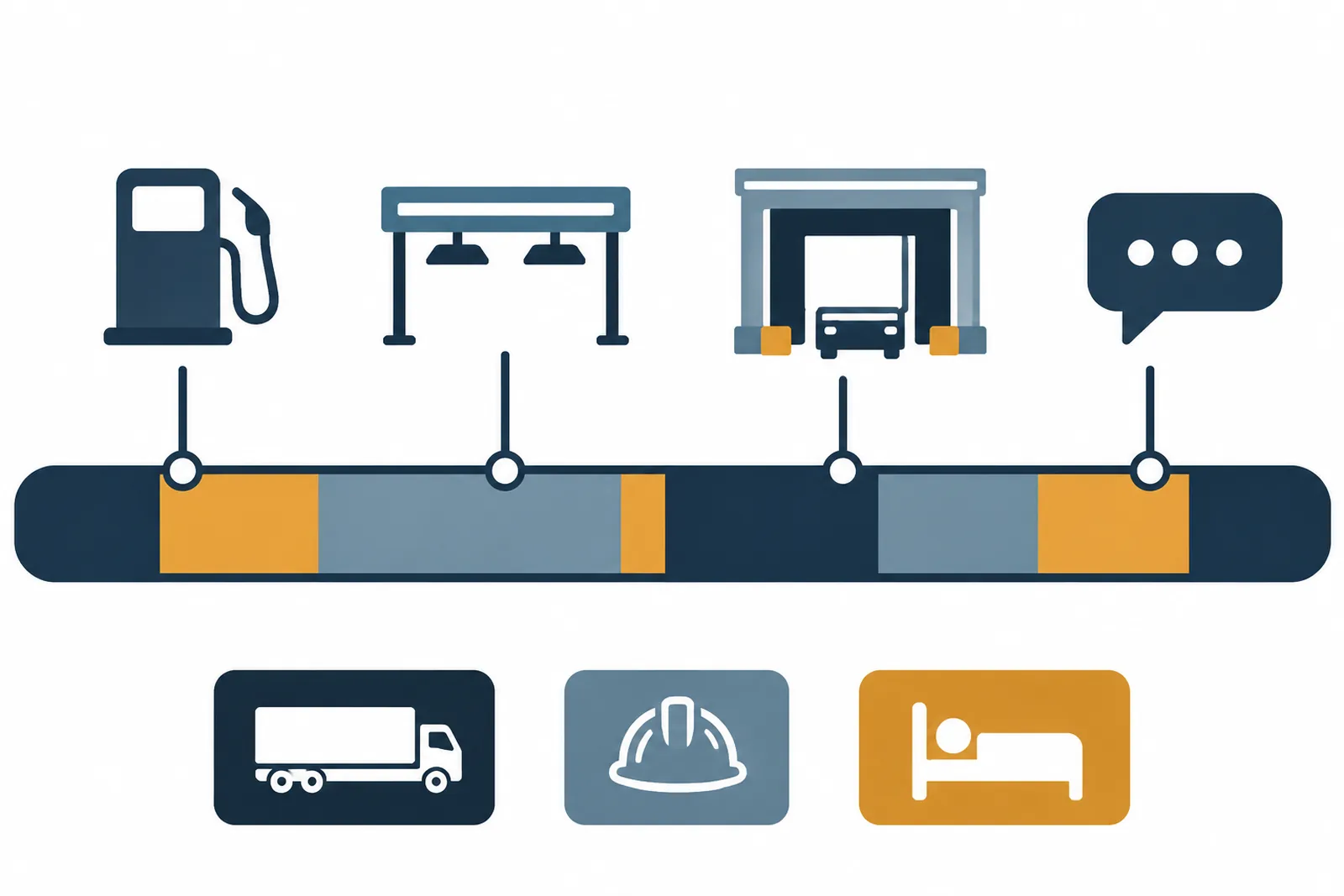
Did the driver actually get a chance to sleep?
A log can say "off duty" without saying whether he rested. Ten hours off duty in a loud dock lot doesn't tell you if noise or a knock on the door broke up his sleep, but facility video and his own testimony might. Off duty at home after a long commute doesn't show how much of the break he spent driving his own car. Phone location data can, if it's obtained in discovery. And a 2-hour daytime berth period may not have given any real sleep, which a sleep-medicine opinion based on his schedule can address.
How is the fitness rule in § 392.3 different from an hours violation?
The hours limits in § 395.3 measure clock time on duty and driving. Section 392.3 asks something else: whether fatigue, illness, or another cause made it unsafe to start or keep driving. Both rules bind the driver and a carrier that requires or permits the driving. The hours rules carry several exceptions in § 395.1. The fitness rule has one, for a grave emergency, when the driver may go on to the nearest place the hazard ends.
A fatigue theory also has to fit the physical evidence:
- No braking before a rear-end impact? That may mean he wasn't watching the road, but rule out phone use, brake failure, and a sudden cut-in first.
- A slow drift across the fog line on a straight road? That looks like a microsleep, unless a steering defect, a crosswind, or a work-zone lane shift explains it.
Our guide on using FMCSA rules to prove negligence covers that link.
Texas HB 19 adds two rules for a split trial. Under Tex. Civ. Prac. & Rem. Code § 72.053(b), a rule violation comes into the first phase only if it tends to prove the violation caused the injury. And § 72.054(c)(1)(G) lets a party show in that phase that the driver of a carrier covered by the federal safety act drove when § 395.3 barred it.
Who can explain the records to a jury?
Four witnesses can walk a jury through the records, and each one gets a pointed question:
- The driver knows the real trip and his rest. Ask him: "What were you doing at 2:12 a.m.?"
- The dispatcher set the appointment times. Ask: "When did you learn the load would be late?"
- The corporate representative speaks for hours monitoring. Ask: "What did your system flag on this driver that week?"
- The ELD vendor's technician knows how events are created, edited, and exported. Ask: "Does an edit leave the original entry in the data?"
A notice to the company must describe its deposition topics with reasonable particularity under Tex. R. Civ. P. 199.2(b)(1), such as hours monitoring for the driver in the 8 days before the crash. What those witnesses knew often shapes who is liable in a Texas truck accident.
Frequently asked questions
He was over his hours. Doesn't that prove he caused the crash? No. You still need evidence that fatigue or the extra driving played a part in the collision.
His log was clean. Can he still have been too tired to drive? Yes. Section 392.3 bars driving while impaired by fatigue whether or not a clock ran out.
The Texas truck accident litigation hub covers the rest of the evidence.
Texas statutes and cases cited in this article
- 49 C.F.R. § 395.3
- 49 C.F.R. §§ 395.1 and 395.2
- 49 C.F.R. §§ 395.8 and 395.11
- 49 C.F.R. part 395, subpart B
- 49 C.F.R. § 392.3
- Tex. Civ. Prac. & Rem. Code ch. 72
- Tex. R. Civ. P. 196.4 and 199.2
This article is general information about Texas law, not legal advice about a particular case. Results depend on the facts, the evidence, the court and the law that applies. Reading it does not create an attorney-client relationship.

ABOUT THE ATTORNEY
Aaron A. Herbert
Founding Attorney
Board Certified in Personal Injury Trial Law
Aaron founded The Law Firm of Aaron A. Herbert in 2010 to focus on developing each client's case and seeking its maximum value. For over a decade, he has represented people seriously injured in major accidents and industrial catastrophes, pursuing trial verdicts and settlements while working to reduce the stress of litigation.
Education
- Texas A&M University · B.S., Criminal Justice, 1999
- University of Oklahoma College of Law · J.D., 2002; graduated in the top of his class
Trial experience & approach
Aaron earned numerous jury verdicts at boutique personal injury litigation firms. According to his biography, he spent a year as the top-earning litigation attorney at a firm that frequently appeared in verdict searches as having one of the highest numbers of trial wins in Texas. At another Dallas personal injury firm, he moved from managing pre-litigation attorney to managing litigation attorney over seven years as the firm grew into one of Dallas's largest personal injury firms.
His biography describes a reputation as one of America's most aggressive trial lawyers, with noteworthy recoveries from judges and juries and substantial pretrial settlements. Most of those settlements included confidentiality agreements requested by the defense. Aaron has said the recoveries were justified by the injuries and losses involved, which no amount of money could make someone choose to experience.
His approach combines passion, preparation, persistence and courtroom imagination. He believes a well-supported, engaged and motivated team working cooperatively helps deliver strong representation, with the goal of achieving the best possible result for every client.
Dallas roots, military service & publication
Born and raised in Dallas, Aaron enlisted in the United States Marine Corps after high school and later received an Honorable Discharge. He completed his university and law degrees after his military service and became a lifelong Sooners football fan in law school.
Publication: “Litigating Dog Bite Cases,” Texas Dog Law Seminar, Dallas, 2009.
Professional affiliations & recognition
Professional affiliations and recognition listed in Aaron’s biography:
- State Bar of Texas
- American Bar Association
- Association of Trial Lawyers of America (now American Association for Justice)
- Texas Trial Lawyers Association
- Dallas Trial Lawyers Association
- Dallas Bar Association
- Tarrant County Bar Association
- Million Dollar Advocates Forum
- The National Trial Lawyers – Top 100 Trial Lawyers