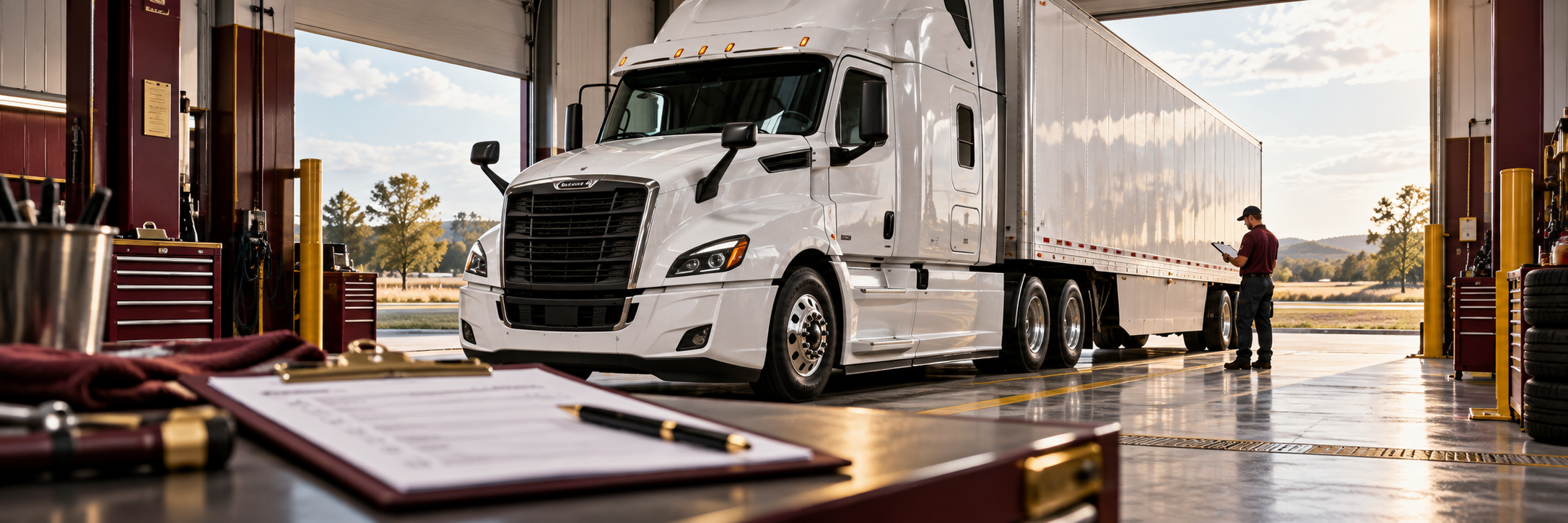
Direct answer: FMCSA records can tell you who the carrier is, what it hauls, how its trucks have done at inspections, which crashes were reported, and which federal rules may apply. They can’t tell you the carrier or driver caused your crash. To use a regulation as evidence, you need the exact rule, the party it governs, proof it applied to this trip or truck, and a link between the failure and the collision.
Begin with the company and vehicle
Start with names and numbers: the carrier’s legal and trade names, the USDOT number, and an MC number if there is one. Add the tractor and trailer IDs, the driver and the trip papers. Then sort out ownership. One company may own the truck while another leases, dispatches, maintains or controls it.
Those may be different companies. The dispatch record can name one business and the bill of lading another, and the lease, the insurance papers, the registration and the door of the truck can all disagree. Sorting that out overlaps with figuring out who can be held liable for the crash.
FMCSA’s SAFER Company Snapshot is a short public record. It shows a company’s identifiers and size, its cargo, inspection and out-of-service summaries, crash data, and a safety rating if there is one. Use it to find the right carrier and dates. It’s a starting point, though. Save the page with the date you pulled it. Then go after the registration, inspection, crash and company records behind it.
The Safety Measurement System (SMS) is something else. FMCSA says it uses two years of roadside inspection and crash data, plus investigation data, to decide which carriers get attention first. Its BASIC percentiles compare a carrier with similar carriers and update monthly.
A bad percentile isn’t a finding that the carrier was negligent in your crash. A good score, or no score, doesn’t prove the carrier acted safely that day either.
MCS-150 filings and public profiles help you check that you’ve got the right company and operation. Compare the listed operation, fleet, cargo and addresses with the trip records and the truck that was actually involved. If they don’t match, dig. A mismatch is a lead, not a conclusion.
Match a specific rule to the facts
The Federal Motor Carrier Safety Regulations cover a lot of ground, and different rules govern different people. The one you cite has to apply to this driver, carrier, truck, cargo and operation. Start with how the crash happened. Then look for the conduct or equipment failure that could have played a part.
- Part 382 covers drug and alcohol testing for covered transportation employees. A test record matters if the timing, the driver’s status and the testing rule tie back to the crash.
- Part 383 covers commercial licensing and qualification. Check the vehicle class, endorsements, restrictions and the driver’s status at the time.
- Part 390 sets out general applicability and carrier safety duties. Confirm the operation falls under the rules and which company fits the definition.
- Part 391 covers driver qualifications and qualification files. A file might hold the application, driving history, medical qualification, a road test or equivalent, and the employer’s review records, depending on the rule and retention period.
- Part 392 governs how commercial vehicles are driven. Cite the exact section. “Safe driving” in general doesn’t pin down the conduct or duty in dispute.
- Part 393 covers parts and accessories needed for safe operation. Tie a lighting, brake, tire, coupling or other equipment problem to inspection findings, measurements, photos and the crash sequence.
- Part 395 covers hours of service, records of duty status and, where they apply, ELDs. Check the driver’s entries against dispatch, fuel, toll, GPS, delivery and other time-stamped records.
- Part 396 covers inspection, repair and maintenance. Name the required inspection or repair, the part, the person responsible, and the record that shows the failure.
Don’t treat these Parts as a checklist of automatic violations. Whether one applies can depend on interstate or intrastate operation, cargo, the truck’s weight and use, exceptions, the driver’s status and the rule’s own wording. Read the current electronic Code of Federal Regulations, Title 49, and confirm which version was in effect on the trip date. The FMCSA regulations and guidance pages help you find material. Guidance doesn’t replace the regulation itself.

Build proof from the primary records
A public profile points you to records. The records and the witnesses prove what happened.
Say hours of service is disputed. You’d want the ELD export and edit history, the dispatch schedule, fuel stops, delivery records, and someone who can explain the time system. A maintenance fight calls for inspection reports, repair orders, diagnostic records, parts, photos and the mechanic or fleet witness. On driver qualification, find the file material that matters and what the carrier had to obtain or review. Much of this is the same electronic evidence that has to be preserved after a truck crash.
For each record, keep track of where it came from, the dates it covers, the custodian, how it was collected, its format, and any revision history. Native format is best; at least make it usable. Be honest about what a record shows and what it doesn’t. A roadside inspection shows what one inspector saw at one point in time. By itself it doesn’t tell you how a part worked during an earlier crash.
Find out who made the document, what event produced it, whether anyone edited it, how it was stored, and who can explain the system. A printed violation summary, a data export or a company report may need authentication, context and a witness. A citation or a regulatory finding can be relevant. It doesn’t settle causation, admissibility or damages on its own.
Texas law adds a separate admissibility question
In covered commercial motor vehicle injury or death cases, Texas Civil Practice and Remedies Code Chapter 72 can change the order of trial and how regulatory evidence comes in. Section 72.052 gives a defendant a bifurcated trial on a timely motion.
Section 72.053 is the key one. In the first phase, evidence that a defendant failed to comply with a regulation or standard comes in only if it meets the other legal requirements, tends to prove the failure proximately caused the bodily injury or death, and concerns a specific standard governing or forming an element of a duty that applies to the defendant, employee, property or equipment at issue. Section 72.054 deals with certain employer-liability issues, including what may be offered in the first phase.
None of that means corporate or regulatory evidence is automatically out. It doesn’t make every violation admissible, either. The current statute, the pleadings, the motion, any stipulations, the evidence and the purpose you offer it for all matter. Read the current Texas Civil Practice and Remedies Code, Chapter 72 with your case in front of you.
Common disputes about FMCSA evidence
The carrier may raise several arguments. The rule didn’t apply. Someone else ran the operation. A public score isn’t a safety rating. The violation didn’t cause this crash. A general safety rule won’t answer any of that. What answers it is the rule’s text, the party it regulates, the facts that trigger it, and its tie to how the crash happened.
Then there are the public records themselves, which can be thin, stale or contradictory. An SMS snapshot only reflects certain data from a certain window. A crash or inspection may be missing or corrected, disputed, or filed under another carrier. Pull the underlying report and check the date, DOT number and truck, along with any DataQs challenge or response. A percentile is not a verdict on fault, so don’t use it like one.
Overbroad requests backfire. Ask for every record on every driver and truck going back years and you’ll draw objections, and the real issue gets lost. Go after the one safety decision you’re testing, with the person, unit, trip and dates attached. Be ready to say why each record ties to the crash and whether a less burdensome source could answer the same question.
Questions for a focused investigation
- Who ran the truck on this trip? Who owned, leased, dispatched or maintained it?
- Which regulation, exactly, and did it cover this operation, truck and driver on the crash date?
- What event or conduct would break that section?
- What original document or system record proves it?
- Who made or kept that record, and can they explain its gaps and edits?
- How does the alleged violation connect to the crash and the injury?
- What does the FMCSA score or snapshot show, and what doesn’t it?
- Under Chapter 72, in which phase and for what purpose can the regulatory evidence come in?
Match each safety rule to the company, driver, vehicle, record, and collision question it can actually help answer.

Founding Attorney
Aaron A. Herbert is a Texas attorney, Board Certified in Personal Injury Trial Law by the Texas Board of Legal Specialization.
Education
- Texas A&M University (B.S. Criminal Justice, 1999)
- University of Oklahoma College of Law (J.D., 2002)
Professional background
For over a decade he has shown an unwavering commitment to clients who were seriously injured by major accidents and industrial catastrophes. During that time he has earned the reputation as one of America’s most aggressive trial lawyers by achieving noteworthy recoveries from judges and juries, as well as substantial settlements prior to trial, the majority of which contained negotiated confidentiality agreements at the request of the defense. When asked about these cases, Mr. Herbert has said that each case not only justified the recovery level, but that no one would trade places with any one of these victims in return for any amount of money, once they know the facts and severity of the injuries and tragedy involved. According to Mr. Herbert, “there can be no substitute for passion, preparation and persistence in the practice of law.” He is known not only for this tenacious preparation, but also for his imagination in the courtroom. He is passionate and persistent in seeking to obtain the maximum case value for each individual client at trial or through settlement, while reducing the stress of litigation on his clients.
Born and raised in Dallas, Texas, Mr. Herbert enlisted in the United States Marine Corps after high school and later received an Honorable Discharge. After the Marines, he obtained a Bachelor of Science in Criminal Justice from Texas A&M University, then a Juris Doctorate from the University of Oklahoma College of Law. There he graduated in the top of his class and became an eternal Sooners Football fan. Aaron has worked as a zealous advocate for injured clients at several boutique personal injury litigation firms where he amassed numerous jury verdicts. After spending a year as the top earning litigation attorney at a firm that frequently tops verdict search as one with the highest number of trial wins in Texas, Aaron accepted a position as the managing pre-litigation attorney at another Dallas personal injury firm. Over the next seven years he transitioned to the managing litigation attorney, and that firm grew to one of the largest personal injury firms in Dallas. In 2010 he formed the Law Firm of Aaron A. Herbert, to get back to a focus on developing each individual case and maximizing case value for each client.
Mr. Herbert practices law with the belief that a well taken care of, highly engaged and motivated team of employees working in a cooperative team environment will result in superior representation and great results for the firm clients. He believes in always setting a goal of achieving the best possible results for each and every client.
Professional affiliations and publication
Professional Associations
- Licensed to practice in Texas (2002)
- Board Certified in Personal Injury Trial Law, Texas Board of Legal Specialization (2008)
Publications
- Litigating Dog Bite Cases, Texas Dog Law Seminar, Dallas 2009
Member
- State Bar of Texas
- American Bar Association
- American Trial Lawyer Association
- Texas Trial Lawyers Association
- Dallas Trial Lawyers Association
- Dallas County Bar Association
- Tarrant County Bar Association
- Million Dollar Advocates Forum
- National Trial Lawyers – Top 100 Trial Lawyers
Texas Bar #24036761 · The Law Firm of Aaron A. Herbert, P.C. · Dallas, Texas
This article provides general information about federal motor-carrier regulations and Texas law. It is not legal advice for a particular case. Regulatory coverage, admissibility, and causation depend on the facts. Consult a Texas attorney about a specific collision.