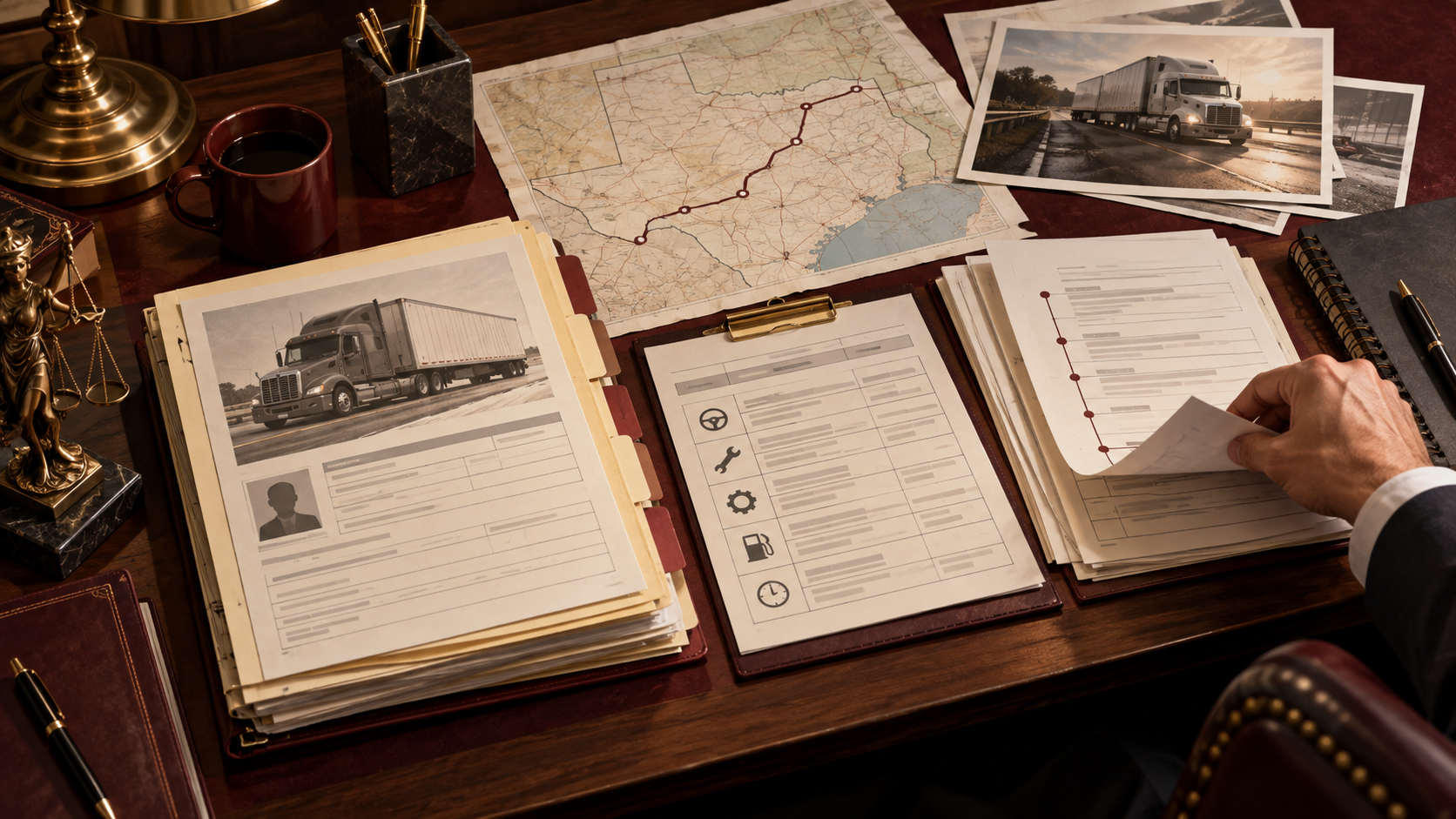
A driver qualification file shows what a trucking company checked before it hired a driver, and what it looked at afterward. A missing page, on its own, isn’t the point. What matters is whether the company had information, or should have gotten it under a duty that applied, that connects to the danger behind the crash. A paperwork gap is one thing. A negligent-hiring claim is another.
Identify the applicable qualification requirements
Start with the driver, the truck, the trip and the crash date. Then work out whether the federal qualification rules apply at all, and whether an exception or a different state rule comes into play. Use the version of the rule in force at the time. Today’s checklist is a fine place to begin, but check for changes before you apply it to an older hire.
49 CFR §391.51 lists what a driver qualification file has to contain. Depending on the driver and the provisions that apply, that can mean the employment application, motor-vehicle records, a road test or an accepted equivalent, annual review records and medical-qualification paperwork. The rule handles CDL medical-status records in its own way, so don’t assume every file will have the same paper medical certificate. Our guide to FMCSA and 49 CFR evidence explains how a rule like this gets tied to a crash.
Request the investigation history as well as the qualification file
The qualification file may not be the whole hiring record. Section 391.53 covers the driver investigation history file. That’s where prior-employer responses belong, along with records of the company’s efforts to get required safety-performance information. The section also limits who can see those records and how they’re secured, so spell out what you’re asking for and handle confidentiality through the proper discovery process.
Find out where each kind of record lives. The application might sit in a recruiting platform. The driving record could be in a compliance vendor’s portal, and the follow-up conversation in someone’s email. A folder labeled “DQ file” may have none of that. Learn enough to judge whether the production is complete, without pulling in every unrelated personnel record. The same scattered-records problem comes up with the electronic evidence to preserve after a truck crash.

Build a dated account of the hiring decision
Build a timeline of the hire from the application, inquiries, responses, tests and decision documents. Note when each record was asked for, when it came in, who looked at it and what happened next. At the hiring date, distinguish what the carrier knew or should have obtained under an applicable duty from information that only became available later. A record first found during litigation may still show what was available before hiring; the date you discovered it does not settle what the carrier could have known.
Write down anything left unresolved, as precisely as you can. In one file it’s a driving-history entry somebody misread. In another, the prior employer’s answer shows up after the driver started, or a restriction never got dealt with before an equipment assignment. Get the company’s explanation and the records behind it.
Connect the concern to the collision
Ask whether the earlier conduct looks like this crash, whether it was close in time, and whether the employer knew about it. If not, an administrative entry proves little about the driver being unsafe in the way alleged. If so, a full set of forms doesn’t make the warning irrelevant.
Unfamiliar equipment? Get the training and evaluation records for that equipment specifically. A restriction? Find its scope and the assignments that followed. Nobody’s duty is assumed here. These are just the questions to run down.
Examine monitoring after hiring
Hiring is only the start. Periodic reviews, reports, corrective training and later assignments can all bear on the safety issue in the case. Identify who had an applicable duty to respond to new information, then check what that person received and did. A supervision or retention theory needs its own facts, separate from the hiring theory.
Keep a corporate-representative deposition focused on how the records were gathered and evaluated. Ask what the witness reviewed to prepare and what’s missing. A general policy witness may not be able to explain one specific decision, so you may need the person who made it.
Account for Texas trial sequencing
Texas Civil Practice and Remedies Code Chapter 72 applies in covered commercial-vehicle cases, where it can change the trial order and how some employer evidence is treated. Look closely at the claim, the stipulations, the exceptions and the purpose. You can’t assume a qualification-file defect will reach the jury, and you can’t assume company-related theories are excluded. Our HB 19 overview covers the rules, and the broader question of who can be held liable for a truck crash helps sort which hiring theories are worth the effort.
A focused review checklist
- The rule that governed on the crash date
- Qualification file, investigation history, relevant vendor records
- Who requested, received and reviewed each important item, and when
- What was known before the hire versus after
- The link between the concern and the crash
- Confidentiality, foundation, and how the evidence can be used at trial
Questions after a truck crash
Does a missing qualification file prove negligent hiring?
No. Counsel must identify the duty that applied, the evidence of a breach and its connection to the collision and claimed injuries. A missing document may warrant further investigation, but it does not establish all of those facts. Ask which record is missing, who should have kept it and whether a copy exists elsewhere.
What should I bring if I do not have the trucking company's records?
Bring what you have: the crash report or report number, photographs, witness details and letters from insurers. A photo showing the truck's company name or USDOT number can help counsel identify the carrier. Do not delay a consultation while trying to obtain a private personnel file yourself. Explain what happened and let counsel assess the records to preserve and the lawful way to request them.
To discuss an injury claim, contact The Law Firm of Aaron A. Herbert, P.C. Tell the office about any approaching deadline. This article offers general information; the applicable rules and available claims depend on the facts of the case.

Founding Attorney
Aaron A. Herbert is a Texas attorney, Board Certified in Personal Injury Trial Law by the Texas Board of Legal Specialization.
For over a decade he has shown an unwavering commitment to clients who were seriously injured by major accidents and industrial catastrophes. During that time he has earned the reputation as one of America’s most aggressive trial lawyers by achieving noteworthy recoveries from judges and juries, as well as substantial settlements prior to trial, the majority of which contained negotiated confidentiality agreements at the request of the defense. When asked about these cases, Mr. Herbert has said that each case not only justified the recovery level, but that no one would trade places with any one of these victims in return for any amount of money, once they know the facts and severity of the injuries and tragedy involved. According to Mr. Herbert, “there can be no substitute for passion, preparation and persistence in the practice of law.” He is known not only for this tenacious preparation, but also for his imagination in the courtroom. He is passionate and persistent in seeking to obtain the maximum case value for each individual client at trial or through settlement, while reducing the stress of litigation on his clients.
Born and raised in Dallas, Texas, Mr. Herbert enlisted in the United States Marine Corps after high school and later received an Honorable Discharge. After the Marines, he obtained a Bachelor of Science in Criminal Justice from Texas A&M University, then a Juris Doctorate from the University of Oklahoma College of Law. There he graduated in the top of his class and became an eternal Sooners Football fan. Aaron has worked as a zealous advocate for injured clients at several boutique personal injury litigation firms where he amassed numerous jury verdicts. After spending a year as the top earning litigation attorney at a firm that frequently tops verdict search as one with the highest number of trial wins in Texas, Aaron accepted a position as the managing pre-litigation attorney at another Dallas personal injury firm. Over the next seven years he transitioned to the managing litigation attorney, and that firm grew to one of the largest personal injury firms in Dallas. In 2010 he formed the Law Firm of Aaron A. Herbert, to get back to a focus on developing each individual case and maximizing case value for each client.
Mr. Herbert practices law with the belief that a well taken care of, highly engaged and motivated team of employees working in a cooperative team environment will result in superior representation and great results for the firm clients. He believes in always setting a goal of achieving the best possible results for each and every client.
Education
- Texas A&M University (B.S. Criminal Justice, 1999)
- University of Oklahoma College of Law (J.D., 2002)
Professional Associations
- Licensed to practice in Texas (2002)
- Board Certified in Personal Injury Trial Law, Texas Board of Legal Specialization (2008)
Publications
- Litigating Dog Bite Cases, Texas Dog Law Seminar, Dallas 2009
Member
- State Bar of Texas
- American Bar Association
- American Trial Lawyer Association
- Texas Trial Lawyers Association
- Dallas Trial Lawyers Association
- Dallas County Bar Association
- Tarrant County Bar Association
- Million Dollar Advocates Forum
- National Trial Lawyers – Top 100 Trial Lawyers
Texas Bar #24036761 · The Law Firm of Aaron A. Herbert, P.C. · Dallas, Texas