Legally reviewed by: Aaron A. Herbert
Aaron A. Herbert has been licensed in Texas since 2002 and has been Board Certified in Personal Injury Trial Law by the Texas Board of Legal Specialization since 2008.Last substantively reviewed: September 15, 2026
A Texas truck-crash investigation may involve more than the driver. Examine the motor carrier, vehicle owners and lessors, repairers, cargo loaders, shippers, brokers and manufacturers where the facts point to their involvement. A roadway contractor, government entity or another driver or business may also have contributed. For each party, identify the duty, control, conduct and connection to the injury. Participation in the shipment alone is insufficient.
In a serious Dallas–Fort Worth truck accident, identifying every potentially responsible party can be important because the company listed on the truck, the company employing the driver, the registered owner of the tractor, the trailer owner, the freight broker, and the company that loaded the cargo may all be different entities.
Finding a violation does not finish the case. Nor does finding a related company. Texas law still requires proof that connects the conduct at issue to the injuries; the responsibility rules then determine how fault is divided.
Key Takeaways
What Determines Who Is Liable for a Texas Truck Accident?
The starting point is not simply asking, "Who was driving the truck?"
The more important questions are:
Who owed a duty? Who controlled the relevant activity? What did that person or company do or fail to do? Did that conduct breach a legal duty? And was the conduct a proximate cause of the collision or resulting injuries?
These questions can lead to different legal theories.
For example, a truck driver may be directly negligent for speeding, distracted driving, fatigue, impairment, or failing to respond appropriately to traffic conditions. A motor carrier may have responsibility for the driver's conduct under respondeat superior when the driver was acting within the course and scope of employment. A carrier may also face a separate claim based on its own conduct, although Texas law governing those claims requires careful analysis.
Suppose an outside repairer did negligent brake work that contributed to the crash. Its responsibility would arise from that work, independently of the driver's employment relationship.
Similarly, a cargo-loading company may face liability when improper loading or securement creates a dangerous condition that contributes to the crash.
The legal theory therefore matters as much as the identity of the defendant.
Quick-Reference Guide: Potentially Responsible Parties
| Potential party | Possible basis of liability | Evidence that may matter |
|---|---|---|
| Truck driver | Negligent driving, fatigue, distraction, impairment, unsafe operation | ELD records, phone records, video, citations, witness testimony |
| Motor carrier | Respondeat superior and qualifying direct-negligence claims | Driver file, dispatch records, policies, training, safety records |
| Truck or trailer owner/lessor | Maintenance responsibility, retained control, negligent conduct | Title, lease, inspection and repair records |
| Maintenance contractor | Negligent inspection, repair, or maintenance | Work orders, invoices, technician notes, replaced parts |
| Cargo loader/warehouse | Improper loading, weight distribution, or securement | Bills of lading, loading records, photographs, dock video |
| Shipper | Retained control or negligent loading/shipping conduct | Contracts, shipping documents, communications |
| Freight broker/logistics company | Potential negligent selection or other duties, subject to federal defenses | Carrier-selection records, contracts, insurance verification |
| Manufacturer | Design, manufacturing, or warning defect | Preserved components, recalls, expert inspection |
| Roadway contractor/government entity | Dangerous roadway or work-zone condition, subject to governmental-immunity rules | Road plans, maintenance records, notices, photographs |
| Other motorist/business | Independent negligence contributing to collision or injury | Dashcam/video, crash reconstruction, witnesses, business records |
The table is a starting point, not a conclusion that every listed party is liable in every case.
1. The Truck Driver
A collision alone doesn't prove that the truck driver was negligent. Examine what the driver did before and during the event.
The evidence may show speeding or speed unsafe for conditions, tailgating, an unsafe lane change, distraction, impairment, failure to yield, inadequate lookout or fatigue. The alleged act must be connected to the collision and injury.
Federal regulations also impose specific safety obligations on commercial drivers. For example, federal regulations address maximum driving time and require compliance with applicable hours-of-service requirements. Other regulations address equipment inspection and safe operation.
Compare the driver's ELD and phone records with onboard data, dashcam or surveillance video, police reports and witness accounts. Drug-and-alcohol testing and driver qualification materials may also bear on the issues being investigated.
A driver-hours violation is important evidence when it is connected to the circumstances of the crash, but the existence of a regulatory violation does not by itself answer every causation or liability question.
2. The Motor Carrier or Trucking Company
The motor carrier may be responsible for the driver's conduct when the driver was an employee acting within the course and scope of employment. This is generally analyzed under the doctrine of respondeat superior.
The carrier's legal position can become more complicated when the plaintiff alleges negligent hiring, negligent entrustment, negligent training, negligent supervision, maintenance failures, or other direct conduct by the company.
Texas Chapter 72 specifically addresses certain commercial-motor-vehicle collision cases. Under Section 72.052, qualifying cases can be subject to bifurcated trials. Section 72.054 also addresses the effect of an employer's stipulation that the driver was its employee and was acting within the scope of employment. The statute contains specific provisions concerning what evidence may be presented in the first phase of a bifurcated trial.
That makes the distinction between vicarious liability and direct negligence especially important in a Texas truck-accident case.
Texas law also requires attention to causation. In Werner Enterprises, Inc. v. Blake, decided by the Texas Supreme Court in 2025, the Court emphasized that negligence must be a substantial factor in causing the injury. The Court held that the particular evidence in that case did not establish the truck driver's negligence as a proximate cause of the plaintiffs' injuries and therefore also rejected the employer's derivative liability on those facts. The decision did not establish that a truck driver's negligence is always the sole cause of a collision; instead, it illustrates why causation must be analyzed from the actual evidence in each case.
For this reason, a strong truck-accident investigation should examine both the driver's conduct and the carrier's role without assuming either one establishes liability automatically.
3. The Truck or Trailer Owner and Equipment Lessor
The company operating a tractor-trailer may not be the legal owner of every piece of equipment involved in the collision.
A tractor may be owned by one company, leased to another, and operated by a motor carrier using an employee or independent contractor. A trailer may have a separate owner.
Ownership alone does not necessarily establish tort liability.
For example, the federal Graves Amendment generally protects qualifying businesses engaged in the rental or leasing of motor vehicles from liability based solely on vehicle ownership when the statutory conditions are satisfied, including the absence of negligence or criminal wrongdoing by the owner.
That does not mean an equipment owner or lessor can never be liable. The investigation may still need to determine who was responsible for maintenance, inspections, repairs, equipment selection, or other activities and whether the entity independently breached a duty.
Lease agreements and related records can therefore be important evidence.
4. A Truck Maintenance or Repair Company
A maintenance contractor can be liable when its negligent inspection, repair, or maintenance causes or contributes to a collision.
Federal regulations require motor carriers and certain intermodal equipment providers to systematically inspect, repair, and maintain vehicles and equipment under their control. The regulations also address the condition of safety-related components.
A maintenance investigation may involve:
- Repair orders
- Inspection reports
- Work orders
- Invoices
- Technician notes
- Parts invoices
- Warranty records
- Photographs
- Replaced components
- Maintenance contracts
- Communications concerning known defects
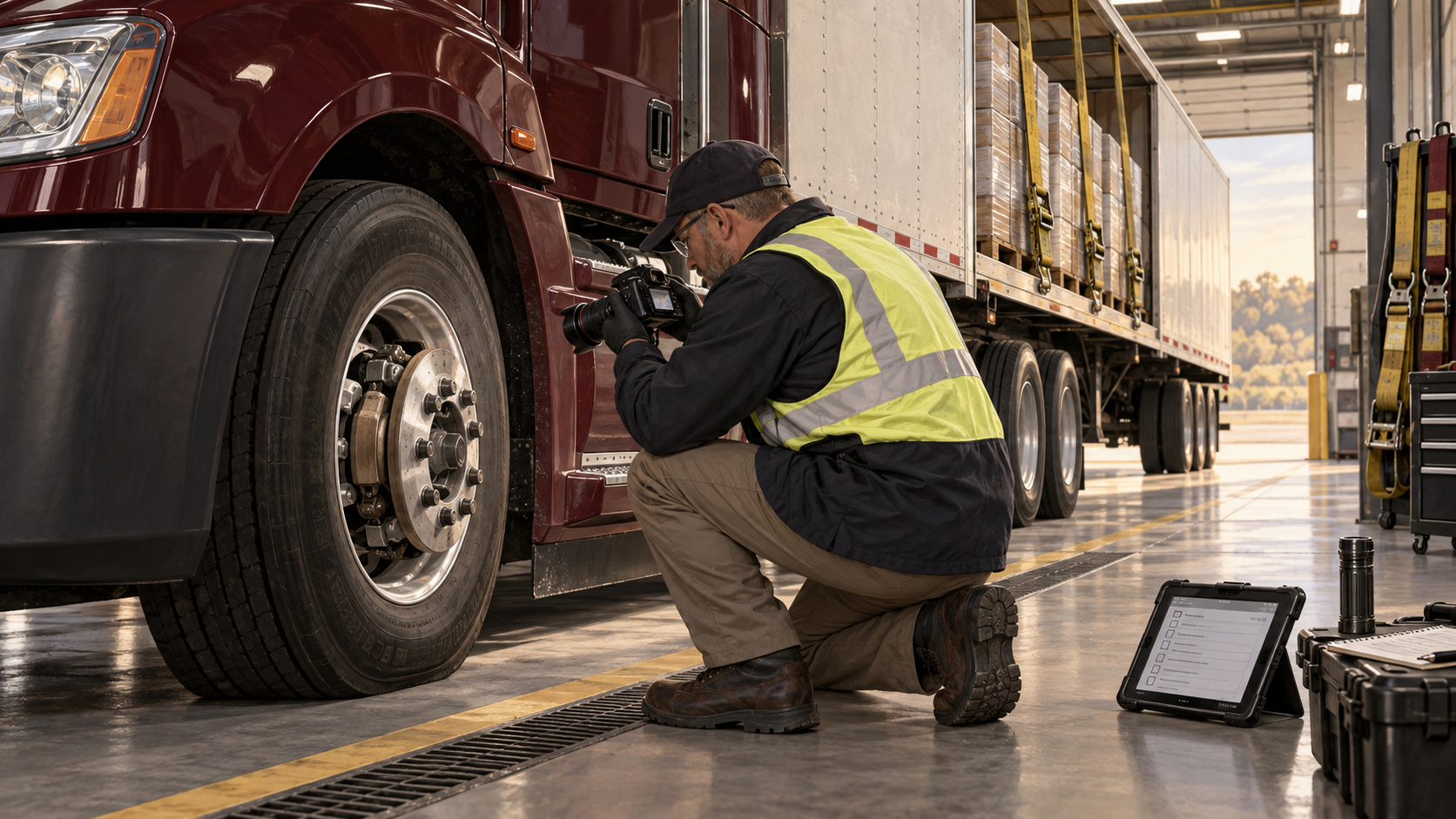
Consider a truck that loses braking capability after an outside repair. Did the driver know, or should the driver have known, of the problem? Had the carrier maintained the equipment? Was the repair performed correctly? The investigation must also establish whether that condition contributed to the collision. The repair's timing alone doesn't answer all of those questions.
That is why preservation of the tractor, trailer, and relevant components can be important in a serious truck accident.
5. A Cargo Loader or Warehouse Operator
Cargo can affect the stability, handling, braking, and safety of a commercial vehicle.
If cargo is improperly loaded, distributed, or secured, the resulting condition can create a significant safety risk.
A loading investigation may examine the bills of lading, weight tickets, loading diagrams, photographs, warehouse records, communications, loading instructions, and surveillance footage.
For example, if cargo shifts during transit and causes the trailer to become unstable, the investigation may need to determine who loaded the cargo, who was responsible for securement, what instructions were provided, and whether the driver or carrier had an opportunity to discover and correct the problem.
The identity of the company physically loading the cargo may therefore be different from the identity of the shipper or motor carrier.
6. The Shipper
A shipper may have a role in the transportation operation beyond simply sending goods.
Depending on the facts and contractual arrangements, a shipper may have responsibilities involving cargo preparation, loading, instructions, weight information, or other aspects of the shipment.
The relevant documents can include the bill of lading, shipping instructions, contracts, emails, text messages, weight records, and communications between the shipper and carrier.
Transporting a shipper's goods does not automatically make the shipper liable. Identify what it controlled or undertook, then connect its conduct to the accident.
7. A Freight Broker or Logistics Company
Freight brokers and logistics companies can occupy a different position from motor carriers.
A broker may arrange transportation without operating the truck itself. The legal analysis therefore depends on the company's actual role, contractual relationships, conduct, and the specific claim being asserted.
Potential issues can include carrier selection, representations about the carrier, retained control, contractual undertakings, and federal preemption.
The Supreme Court answered a broker-preemption question on May 14, 2026, in Montgomery v. Caribe Transport II, LLC. The negligent-hiring claim fell within the FAAAA safety exception and survived preemption. That ruling let the claim proceed. It did not decide whether the broker had been negligent.
For that reason, a plaintiff should not assume that every company involved in arranging transportation can be treated like the motor carrier.
A broker investigation should examine the broker agreement, carrier-selection process, insurance verification, safety information, communications, and the actual services performed.
8. The Truck or Component Manufacturer
A truck manufacturer, trailer manufacturer, or component manufacturer may become relevant when a defective product contributed to the collision or increased the severity of the injuries.
Potential issues can involve:
- Design defects
- Manufacturing defects
- Defective components
- Inadequate warnings or instructions
- Recalls or safety campaigns
- Failure of a critical component
These claims require their own legal and technical analysis. The vehicle or failed component should generally be preserved before it is repaired, discarded, altered, or destroyed.
The investigation may involve expert examination, engineering analysis, recall information, service bulletins, maintenance history, and examination of the original component.
9. A Roadway Contractor or Governmental Entity
Not every truck accident is caused solely by the vehicles involved.
Roadway design, construction, maintenance, signage, work zones, debris, or other conditions can sometimes become relevant to causation.
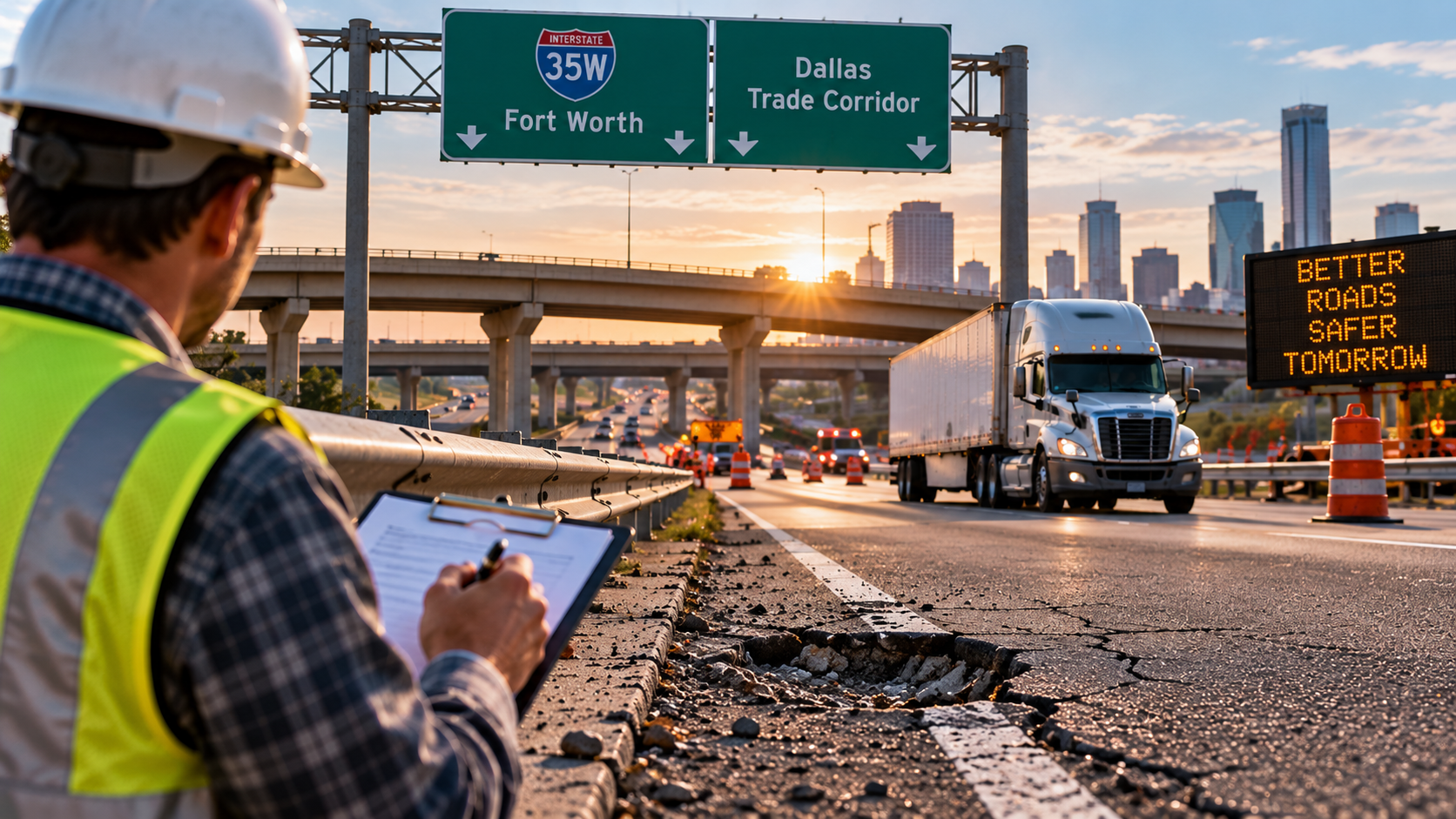
In the Dallas–Fort Worth area, commercial trucks use major transportation corridors throughout the region. TxDOT identifies I-35W as a major national trade corridor through Fort Worth, with substantial daily traffic and significant truck volumes.
When a roadway condition may have contributed to a collision, the investigation can involve photographs, traffic-control plans, construction records, maintenance records, inspection reports, prior complaints, incident records, and information about the entity responsible for the roadway or work zone.
Claims involving governmental entities require additional analysis because governmental-immunity rules, notice requirements, statutory limitations, and other procedural requirements may apply.
10. Another Driver, Business, or Other Third Party
A commercial truck may be involved in a collision that was caused or contributed to by another motorist.
Texas law does not automatically place responsibility on the truck simply because the truck was larger or caused more severe damage.
For example, another driver may have crossed lanes, failed to yield, entered the truck's path, or lost control of a vehicle.
Businesses can also become relevant when their conduct contributed to the collision or resulting injuries. Depending on the facts, this could involve an employer of another negligent driver, a contractor, or another entity that created a dangerous condition.
An alcohol-provider claim has its own statutory requirements under Texas Alcoholic Beverage Code Chapter 2. Evidence that a driver was impaired does not, by itself, establish the provider’s liability. The facts must satisfy the applicable statute.
The important question remains the same: What did the person or entity do, what duty applied, and did that conduct legally contribute to the injury?
How Do Texas Truck-Accident Liability Theories Differ?
Identifying the defendant is only the first step. The legal theory connecting that defendant to the injury also matters.
Direct negligence
Direct negligence focuses on the defendant's own conduct.
For example, a carrier may face a claim based on its own maintenance practices if the company failed to maintain equipment under its control and that failure contributed to the crash.
A maintenance contractor's liability would similarly be based on its own inspection or repair work.
Respondeat superior
Respondeat superior is different because it concerns an employer's responsibility for an employee's conduct within the course and scope of employment.
This is one reason identifying the actual employment relationship is important. The company name printed on the trailer does not necessarily establish who employed the driver.
Negligent hiring, entrustment, retention, training, or supervision
These theories can involve the employer's own conduct, such as whether it selected, retained, trained, supervised, or entrusted a vehicle to an employee.
Texas Chapter 72 now contains specific provisions governing certain commercial-motor-vehicle cases, including bifurcation and the treatment of particular evidence involving employer defendants.
These claims therefore should not be presented as though they operate identically in every Texas truck case.
Products liability
A products-liability claim is based on an allegedly defective product rather than ordinary driver negligence.
The investigation may therefore focus on the design, manufacturing process, warnings, component history, and technical condition of the vehicle or part.
Agency and right of control
When several companies participate in a transportation arrangement, contracts can help establish who had the right to control particular activities.
But a contract alone does not necessarily determine tort liability. The actual relationship, conduct, legal duties, and applicable law must be examined.
Can More Than One Party Be Liable for a Texas Truck Accident?
Yes. A truck collision can involve multiple responsible parties when separate acts or omissions contribute to the same injury.
Texas Chapter 33 governs proportionate responsibility in covered cases. Under Section 33.001, a claimant whose percentage of responsibility is greater than 50% cannot recover damages. Section 33.012 provides for reduction of damages according to the claimant's percentage of responsibility when the claimant is not barred from recovery.
Start with the percentage assigned to each defendant. Under Section 33.013, that percentage generally limits the defendant’s payment obligation. Exceptions can change the result: responsibility above 50%, for example, can trigger joint-and-several liability.
This means identifying all relevant parties can matter not only for determining fault but also for understanding how responsibility may ultimately be allocated.
Why the 51% Rule Matters
The Texas proportionate-responsibility system can affect a claim when the evidence indicates that multiple people or entities contributed to an injury.
Suppose the evidence supports negligence by the truck driver, an outside repairer and another motorist. Counsel must work through the allocations among them and any statutory rules affecting the claimant's recovery.
The specific allocation depends on the facts and the applicable law.
What Evidence Can Identify the Responsible Parties?
The police report is only one piece of the investigation.
In a serious Dallas or Fort Worth truck accident, relevant evidence may exist across multiple companies and databases.
For the broader evidence and discovery plan, explore the Texas truck accident litigation hub and the advanced Texas truck accident litigation guide.
Driver evidence
This can include:
- Electronic logging device records
- Driver qualification records
- Medical certification
- Drug-and-alcohol testing records
- Phone records
- Dashcam footage
- Traffic citations
- Training records
- Driver statements
Motor-carrier evidence
This may include:
- Driver employment records
- Dispatch records
- Safety policies
- Training materials
- Scheduling information
- Maintenance records
- Communications with the driver
- Accident-investigation materials
- Corporate safety records
Owner or lessor evidence
Relevant records can include:
- Vehicle title information
- Lease agreements
- Equipment-control agreements
- Inspection records
- Maintenance allocation provisions
- Repair records
- Communications concerning equipment condition
Maintenance evidence
This can include:
- Work orders
- Technician notes
- Repair invoices
- Inspection reports
- Parts records
- Warranty records
- Photographs
- Preserved components
Cargo evidence
Potentially relevant records include:
- Bills of lading
- Weight tickets
- Loading diagrams
- Cargo photographs
- Securement records
- Warehouse surveillance
- Loading instructions
Broker evidence
A broker investigation may involve:
- Broker-carrier contracts
- Carrier-selection records
- Insurance verification
- Safety information
- Communications
- Dispatch or booking records
- Documentation identifying the actual carrier
Manufacturer evidence
This can include:
- Recall information
- Service bulletins
- Warranty history
- Component specifications
- Engineering records
- Expert inspection of the preserved component
The important point is that different defendants leave different evidence trails.
What Should Be Preserved After a Serious Truck Accident?
Evidence can become more difficult to obtain as time passes.
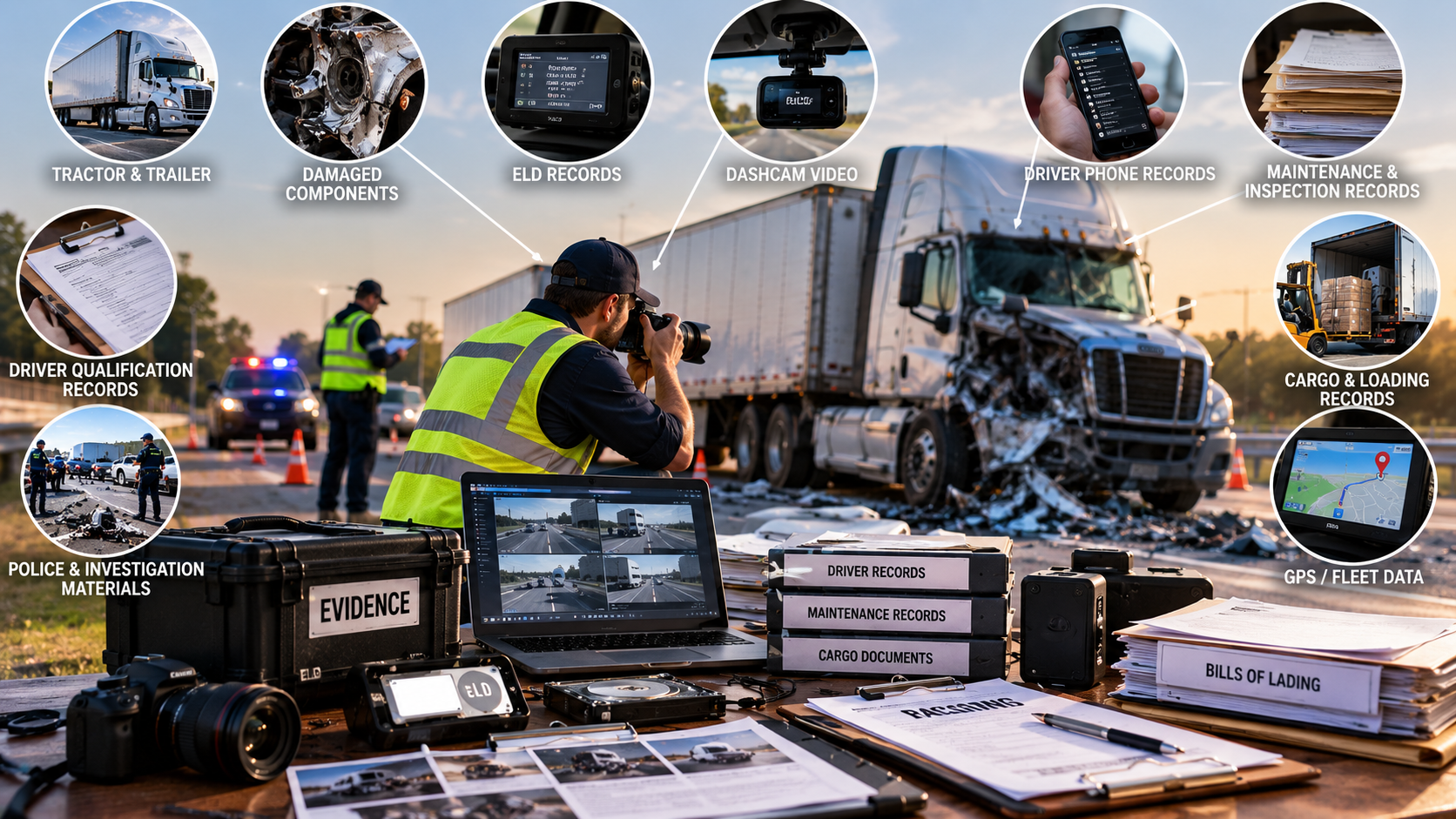
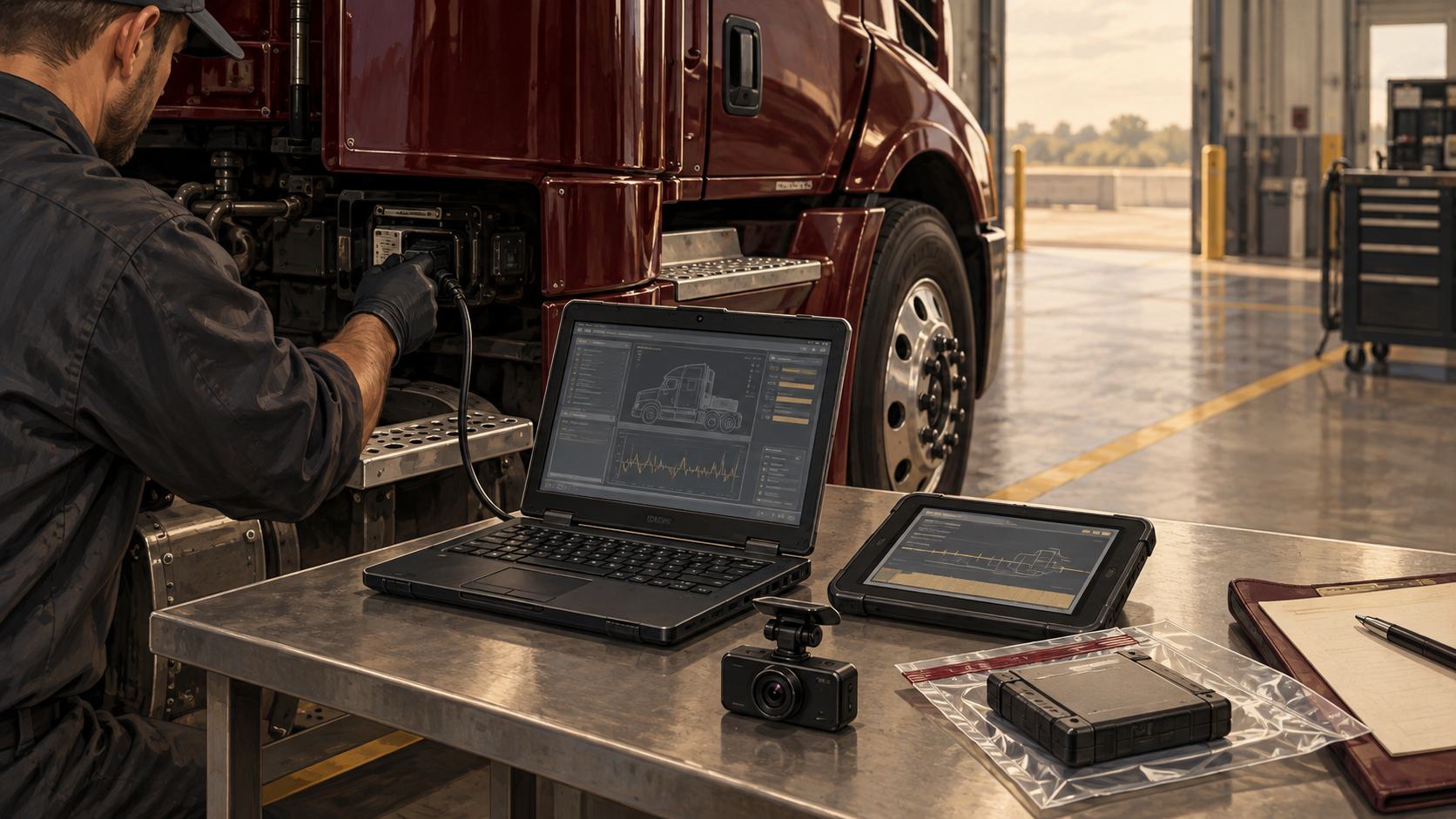
For a serious commercial truck collision, preservation efforts may include identifying and preserving:
- The tractor and trailer
- Damaged or failed components
- ELD records
- Electronic vehicle data
- Dashcam or surveillance video
- Driver phone records where legally obtainable
- Driver qualification records
- Maintenance and inspection records
- Cargo and loading records
- Bills of lading
- Dispatch communications
- GPS or fleet-management information
- Photographs of the vehicles and scene
- Witness information
- Police and crash-investigation materials
This is one reason a truck-accident investigation should consider the entire transportation chain rather than focusing only on the driver.
A Closer Look at Dallas–Fort Worth Truck Accident Investigations
Dallas–Fort Worth is a major transportation and distribution region, and commercial truck traffic moves through major interstate and arterial corridors throughout North Texas.
TxDOT identifies I-35W through Fort Worth as a major national trade corridor and reports significant daily traffic and truck volumes on the corridor.
For a DFW truck accident, local relevance should mean more than adding the words "Dallas" and "Fort Worth" throughout an article.
A meaningful investigation may need to consider the location of the crash, the roadway authority, nearby commercial facilities, truck routes, distribution operations, local businesses, and the companies involved in moving the particular load.
A collision in Dallas County may involve a carrier headquartered in another state, a trailer owned by a separate company, a broker located elsewhere, and cargo loaded at a North Texas warehouse. The location of the crash is therefore only one part of the liability investigation.
Aaron Herbert's Analysis: Why the Name on the Truck May Not Tell the Whole Story
In a serious commercial truck accident, the company identified on the truck is often only the starting point of the investigation.
Trace the employment relationship, then the ownership of the tractor and trailer. They may lead to different companies. Follow the equipment servicing, broker's shipment arrangements and warehouse loading as well, including any instructions from the shipper.
Read the contracts alongside the dispatch, repair and employment records. A contract may assign a duty to one business while the records show another business doing the work. Resolve that discrepancy and trace what each company knew and did before assigning responsibility.
That is why documents can be just as important as the crash report.
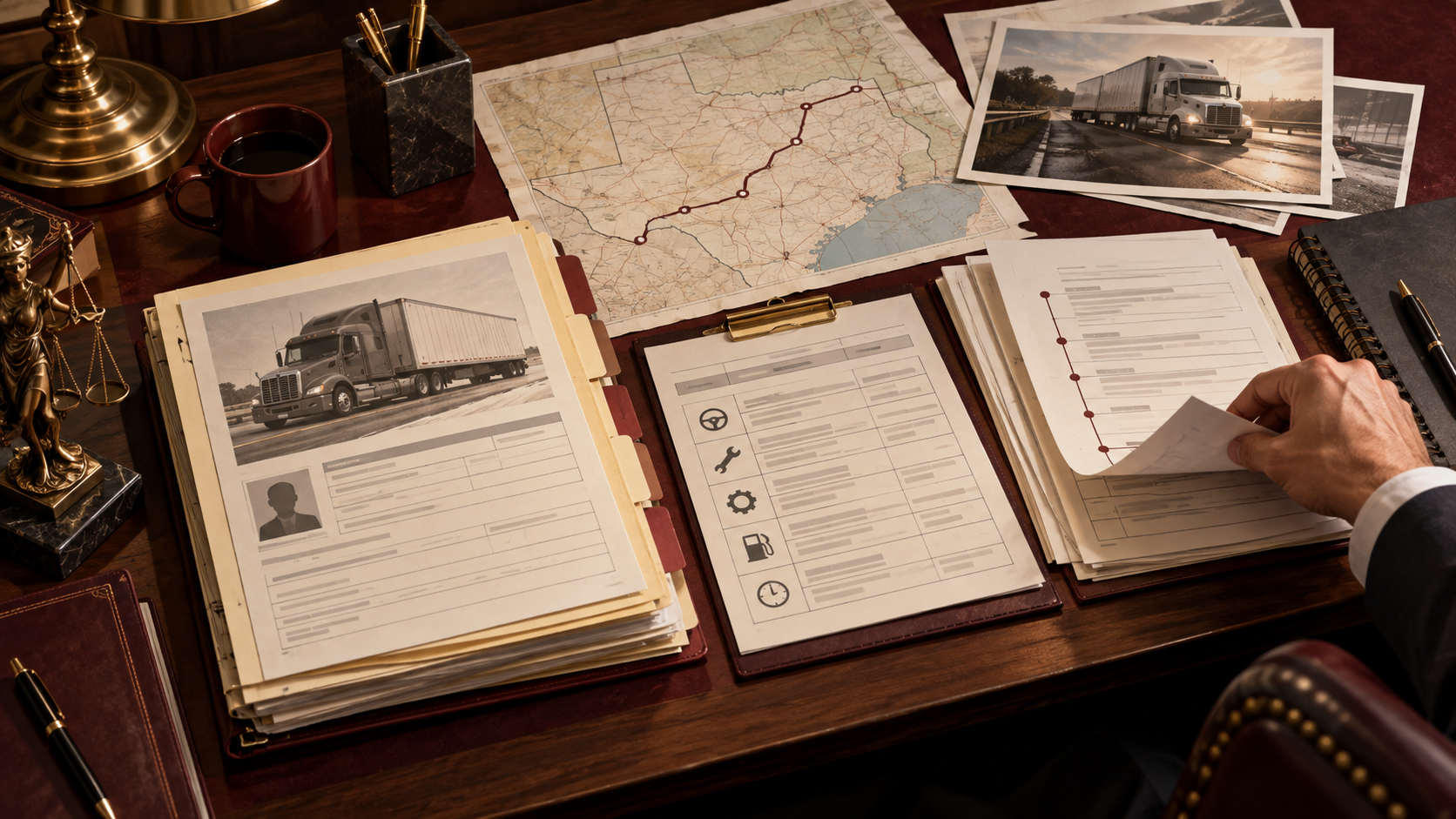
For example, a police report may identify the motor carrier, but the lease agreement may reveal who controlled maintenance. A bill of lading may identify the shipper and cargo. Dispatch communications may show how the driver's route or schedule was established. Maintenance records may reveal a recurring mechanical problem. ELD records may help establish the driver's hours and movements.
In a serious truck case, these records can help reconstruct what happened before the collision—not just what happened at the moment of impact.
That broader investigation can be especially important when multiple companies dispute responsibility.
What Are Some Common Defenses in Texas Truck Accident Cases?
A defendant may dispute liability for several reasons, depending on the facts.
Lack of causation
A defendant may argue that its conduct did not cause or substantially contribute to the injury.
The Texas Supreme Court's 2025 decision in Werner Enterprises v. Blake illustrates the importance of this issue. The Court explained that negligence must satisfy the requirements of proximate causation and concluded on the facts before it that the truck driver's conduct was not a substantial factor causing the plaintiffs' injuries.
Independent-contractor relationship
A company may dispute that a driver or another participant was its employee or agent.
The actual contracts and working relationship can become important.
Lack of control
An owner, lessor, broker, or shipper may argue that it did not control the conduct that allegedly caused the collision.
Regulatory compliance
A defendant may argue that it complied with applicable federal or Texas regulations. Compliance may be relevant evidence, although the legal effect depends on the particular claim and facts.
Federal preemption
For broker negligent hiring, Montgomery (2026) is now essential to the preemption analysis. The safety exception saved the claim there. Other theories require their own analysis, and defeating preemption still leaves the negligence claim to prove.
Graves Amendment
A qualifying vehicle rental or leasing business can invoke the Graves Amendment, 49 U.S.C. § 30106, against ownership-only liability if the statutory conditions are met. Its own negligence or criminal wrongdoing is not protected.
Comparative responsibility
A defendant may argue that another person—including the claimant—was also responsible for the injury.
Texas Chapter 33 governs proportionate responsibility and can affect both the claimant's recovery and the allocation of responsibility among liable parties.
How Long Do You Have to File a Texas Truck Accident Lawsuit?
Texas generally provides a two-year limitations period for personal-injury claims and claims for injury resulting in death under Section 16.003 of the Texas Civil Practice and Remedies Code.
However, a truck accident involving a governmental entity, a minor, a wrongful-death claim, a product-liability theory, or other special circumstances can involve additional rules or deadlines.
For example, claims involving governmental entities can raise notice requirements and governmental-immunity issues. Product-liability claims can also involve different limitations provisions.
Because missing an applicable deadline can affect the ability to pursue a claim, the limitations period should be evaluated based on the specific facts rather than relying only on the general two-year rule.
When Should You Speak With a Texas Truck Accident Attorney?
A commercial truck accident can involve more evidence, companies, contracts, and regulatory requirements than a typical passenger-vehicle collision.
Speaking with a truck-accident attorney can be particularly important when:
- The collision caused serious or catastrophic injuries.
- A person died in the collision.
- The truck driver or carrier disputes responsibility.
- Multiple companies are involved.
- The truck was owned or leased by a different company.
- Mechanical failure may have contributed to the crash.
- Cargo loading or securement may be involved.
- Fatigue or hours-of-service compliance is disputed.
- A manufacturer or component defect may be involved.
- A governmental entity or roadway contractor may have contributed.
- Important electronic, vehicle, or business records may need to be preserved.
The purpose of an early investigation is not to assume who is liable. It is to identify the relevant parties, preserve evidence, determine what duties applied, and evaluate how the evidence connects each party's conduct to the collision.
Why Aaron A. Herbert Is Qualified to Discuss Texas Truck Accident Liability
Reviewed by Aaron A. Herbert
Aaron A. Herbert has practiced law in Texas since 2002 and has been Board Certified in Personal Injury Trial Law by the Texas Board of Legal Specialization since 2008.
His background includes representing clients in serious personal-injury matters and litigating claims involving commercial vehicles and other significant injury cases.
For truck-accident content, attorney review is particularly important because liability can involve Texas statutes, federal motor-carrier regulations, employment relationships, causation principles, evidence preservation, and multiple potentially responsible entities.
Frequently Asked Questions
Who can be held liable for a commercial truck accident in Texas?
Potentially responsible parties can include the truck driver, motor carrier, truck or trailer owner, maintenance provider, cargo loader, shipper, freight broker, manufacturer, roadway contractor or governmental entity, and another negligent motorist or business. The responsible defendant depends on the evidence, applicable legal duties, control, conduct, and causation.
Is the trucking company automatically liable if its driver caused the accident?
Not automatically in every circumstance. If the driver was an employee acting within the course and scope of employment, respondeat superior may make the employer responsible for the driver's negligence. Texas Chapter 72 also contains specific rules affecting certain commercial-motor-vehicle litigation. The precise relationship and claims must be evaluated under the facts of the case.
Can a truck owner be liable if another company operates the truck?
Possibly. Look at maintenance duties, retained control and the owner's conduct. Ownership alone does not prove liability. Qualifying rental and leasing businesses may also have a Graves Amendment defense to ownership-only claims.
Can a trucking company be liable for negligent hiring or training?
Yes, where the facts and applicable law support that theory. Before presenting hiring or training evidence, check Chapter 72’s rules on separate trial phases and employer evidence. The treatment can differ with the claim and any employer stipulation.
Can a maintenance company be liable for a truck accident?
Yes, if negligent inspection, repair or maintenance contributed to the crash and the other claim elements are met. Look at the work orders, inspection records, invoices, technician notes and maintenance agreement, and examine the failed component.
Can a freight broker be liable for a truck accident in Texas?
A broker may face a claim. In Montgomery (2026), the Supreme Court allowed a negligent-hiring claim to survive the FAAAA preemption defense through the safety exception. Winning that issue is only a step; proof of negligence is still required.
Can more than one company be responsible for a truck accident?
Yes. A carrier, repair shop and cargo loader, for instance, could each have contributed through separate acts. Chapter 33 supplies the allocation rules for covered claims. Joint-and-several liability applies only when its requirements are met.
How long do I have to file a truck accident lawsuit in Texas?
Texas generally provides two years for personal-injury claims and claims for injury resulting in death, subject to statutory exceptions and other rules. Governmental claims, product-liability claims, and other circumstances may require additional analysis.
What evidence can prove who was responsible for a truck accident?
Match the disputed role to the records. ELD and vehicle data, driver files, phone records, dispatch messages, maintenance records and leases may help. So may cargo documents, bills of lading, loading records, video, photographs, witnesses and preserved components. Different evidence identifies different participants.
Get Help Investigating a Texas Truck Accident
A serious truck accident may involve the driver, motor carrier, equipment owner, maintenance provider, shipper, broker, cargo loader, manufacturer, roadway entity, or other responsible parties.
The company identified in the crash report is not necessarily the only entity that should be investigated.
An early investigation can help identify the parties involved, preserve important evidence, evaluate the applicable Texas and federal requirements, and determine how the available evidence relates to the collision.
If you or a family member has been seriously injured in a commercial truck accident in Dallas, Fort Worth, or elsewhere in Texas, contact the Law Firm of Aaron A. Herbert to discuss the circumstances of the collision.
24/7 Free Consultation
No Fees or Expenses Unless You Recover.
This article provides general information about Texas truck-accident law and is not legal advice. The law can change, and the outcome of any particular claim depends on its facts. An attorney should review the specific circumstances of a collision before legal conclusions are made.
Published: September 23, 2026
Written by: Aaron A. Herbert, P.C.

ABOUT THE ATTORNEY
Aaron A. Herbert
Founding Attorney
Board Certified in Personal Injury Trial Law
Aaron founded The Law Firm of Aaron A. Herbert in 2010 to focus on developing each client's case and seeking its maximum value. For over a decade, he has represented people seriously injured in major accidents and industrial catastrophes, pursuing trial verdicts and settlements while working to reduce the stress of litigation.
Education
- Texas A&M University · B.S., Criminal Justice, 1999
- University of Oklahoma College of Law · J.D., 2002; graduated in the top of his class
Trial experience & approach
Aaron earned numerous jury verdicts at boutique personal injury litigation firms. According to his biography, he spent a year as the top-earning litigation attorney at a firm that frequently appeared in verdict searches as having one of the highest numbers of trial wins in Texas. At another Dallas personal injury firm, he moved from managing pre-litigation attorney to managing litigation attorney over seven years as the firm grew into one of Dallas's largest personal injury firms.
His biography describes a reputation as one of America's most aggressive trial lawyers, with noteworthy recoveries from judges and juries and substantial pretrial settlements. Most of those settlements included confidentiality agreements requested by the defense. Aaron has said the recoveries were justified by the injuries and losses involved, which no amount of money could make someone choose to experience.
His approach combines passion, preparation, persistence and courtroom imagination. He believes a well-supported, engaged and motivated team working cooperatively helps deliver strong representation, with the goal of achieving the best possible result for every client.
Dallas roots, military service & publication
Born and raised in Dallas, Aaron enlisted in the United States Marine Corps after high school and later received an Honorable Discharge. He completed his university and law degrees after his military service and became a lifelong Sooners football fan in law school.
Publication: “Litigating Dog Bite Cases,” Texas Dog Law Seminar, Dallas, 2009.
Professional affiliations & recognition
Professional affiliations and recognition listed in Aaron’s biography:
- State Bar of Texas
- American Bar Association
- Association of Trial Lawyers of America (now American Association for Justice)
- Texas Trial Lawyers Association
- Dallas Trial Lawyers Association
- Dallas Bar Association
- Tarrant County Bar Association
- Million Dollar Advocates Forum
- The National Trial Lawyers – Top 100 Trial Lawyers
Trial experience & approach
Aaron earned numerous jury verdicts at boutique personal injury litigation firms. According to his biography, he spent a year as the top-earning litigation attorney at a firm that frequently appeared in verdict searches as having one of the highest numbers of trial wins in Texas. At another Dallas personal injury firm, he moved from managing pre-litigation attorney to managing litigation attorney over seven years as the firm grew into one of Dallas's largest personal injury firms.
His biography describes a reputation as one of America's most aggressive trial lawyers, with noteworthy recoveries from judges and juries and substantial pretrial settlements. Most of those settlements included confidentiality agreements requested by the defense. Aaron has said the recoveries were justified by the injuries and losses involved, which no amount of money could make someone choose to experience.
His approach combines passion, preparation, persistence and courtroom imagination. He believes a well-supported, engaged and motivated team working cooperatively helps deliver strong representation, with the goal of achieving the best possible result for every client.
Dallas roots, military service & publication
Born and raised in Dallas, Aaron enlisted in the United States Marine Corps after high school and later received an Honorable Discharge. He completed his university and law degrees after his military service and became a lifelong Sooners football fan in law school.
Publication: “Litigating Dog Bite Cases,” Texas Dog Law Seminar, Dallas, 2009.
Professional affiliations & recognition
Professional affiliations and recognition listed in Aaron’s biography:
- State Bar of Texas
- American Bar Association
- Association of Trial Lawyers of America (now American Association for Justice)
- Texas Trial Lawyers Association
- Dallas Trial Lawyers Association
- Dallas Bar Association
- Tarrant County Bar Association
- Million Dollar Advocates Forum
- The National Trial Lawyers – Top 100 Trial Lawyers