
A Kroger trip claim needs proof of the actual object or surface that caught you, how it caused the fall, who controlled it, and what the store knew. A produce tie near where you landed doesn't prove causation, and a measured height difference doesn't prove a code violation. Keep the original scene photos and work out the mechanism before picking a legal theory.
Proof that usually matters, by hazard
- Evidence of contact, and when the item appeared, for a produce bag or tie on the floor.
- Whether it was moving or parked, who placed it and how far it stuck out, for a U-boat stocking cart or a pallet in the cereal aisle.
- Its projection, your approach and who set it up, for a display base at the end of an aisle.
- Whether it was curled, shifted or wet when you reached it, for the entry mat inside the automatic doors.
- The equipment's condition and evidence that the store knew, for a motorized cart charging cord.
- The measured height, later repairs and who controls the area, for a threshold or an exterior transition.
This guide is part of our Kroger injury knowledge hub. If you were hurt, tell us about your Kroger fall or call (214) 200-4878.
Bring this
- Store address, date and exact location in the store, since they fix the scene and the video window.
- The incident report reference, which leads to the store's account.
- Original photographs, including unflattering ones, since a less favorable image may explain a discrepancy.
- Witness details, since they may have seen the contact or a change in the scene.
- Treatment information, which connects the fall to the injury.
How do you show what actually tripped you?
Rebuild the approach first: where you came from and which foot caught, then what you felt and what you could see.
- Direction of travel, lighting, merchandise and anything you carried, since they shape what you could see.
- Which foot caught and what it felt like; you can remember a sudden catch without seeing the object, so keep that distinction.
- What changed after the fall, since a rack can move and a mat can fold during the fall or cleanup.
- The first photograph, which is evidence, though taking it promptly doesn't make it a perfect reconstruction.
A wrist fracture from bracing fits many kinds of falls, so it doesn't identify the rack, tie or threshold. Each part of the claim needs its own proof.
- A medical opinion, for whether the fall caused the injury.
- A premises or engineering expert, for the geometry and the mechanism.
- A witness or video, for what the foot actually contacted.
What if a small object like a produce tie tripped you?
A photo of the object on the floor afterward isn't enough. The evidence has to link it to the contact.
| Evidence | What it shows |
|---|---|
| Photos of shape, size, color, and location, taken without handling the item | Identification. |
| A witness who saw the shoe catch | Contact, which is different from seeing the tie afterward. |
| Video | Movement or trajectory, limited by image quality; a blurry shape isn't an identified produce tie. |
| An item kept lawfully | A record of who collected it and how it was stored. |
Leave store property where it is and stay out of restricted areas; counsel can request preservation and an inspection.
The store's knowledge still matters, and a busy merchandise area doesn't create notice of every dropped item.
- Video and witnesses, for when the object appeared; see preserving Kroger surveillance evidence.
- Staff testimony and store records, for whether an employee saw or created it.
- Timing and employee proximity, for how long it was there; our guide to proving knowledge of the condition covers both.
Was the stocking cart moving or parked when you hit it?
The answer can decide whether the claim is a premises condition or a negligent activity under Keetch v. Kroger Co.
| Situation (hypothetical) | Likely framework |
|---|---|
| An employee pushes a U-boat stocking cart into you. | Possibly negligent activity, if you were hurt by or as a contemporaneous result of the activity itself. |
| A pallet left in the cereal aisle after stocking ended | A premises condition claim, with the knowledge element. |
| A display base someone shifted earlier | A condition; identify who moved it. |
Keetch fell about 30 minutes after plants were sprayed. Nothing was ongoing, so the negligent-activity submission was properly refused. Anderson-Brown v. Kroger Texas, an unpublished Fifth Circuit opinion that binds no Texas court, also rejected a negligent-activity claim on condition facts. [S21] [S15]
| Document | Why |
|---|---|
| Rack dimensions, base projection, merchandise overhang, and aisle width | They show what you faced. |
| Eye-level photos from the original camera position | A close-up exaggerates a base; a distant view hides it. |
| Who placed and controlled it: vendor, employee, or another customer | Each changes the analysis. |
| Layout records or diagrams | A seasonal reset can make a later visit look different from the accident date. |
| "I tripped near a pallet" | That's a location until a witness ties the shoe or body to the pallet. |
Hypothetical: a rack base measured twice
Eight inches after the fall and six inches later are two separate observations. Averaging them to seven proves nothing.
| Observation (hypothetical) | Potential value | Verification needed |
|---|---|---|
| Eight-inch apparent projection beyond the merchandise | Post-event scene | Scale, angle, and rack movement. |
| Witness says the rack moved during the response. | Change during response | Position, timing, and personal observation. |
| Six-inch later measurement | Current configuration | Whether it's comparable to the accident date. |
| Shoe contact account | Mechanism | What was felt or actually seen. |
Counsel shouldn't declare a seven-inch defect. The work is finding the incident configuration and whether that projection created an unreasonable risk.
Who answers each question
- An expert, within the available data, for the geometry.
- The factfinder, for which account of the scene is right.
- The court's instructions applied to the proof, for whether the risk was unreasonable.
What has to be shown about a curled or wet entrance mat?
You need proof of the mat's condition as you met it: a curled corner, a shifted edge, an overlap, the backing or water.
Mat issues, and what each calls for
- A curled or overlapped edge, which calls for photos of the edge, the doors, the floor transition and the lighting.
- Movement during the fall, the assistance or cleanup, which calls for witnesses and video.
- A wet mat on a rainy afternoon, where rain explains why mats were out but not the defect or the store's knowledge.
- A later dry-day visit, which gives dimensions only, not the incident conditions.
- A different mat tested later, which may not reproduce friction, backing or wear.
Ask about
- The mat service company, for who supplied, installed and maintained it.
- Store staff, for who checked placement and whether anyone reported a problem.
- A landlord, for whether it controlled an adjoining common area.
- An overhead photo, which may make an edge look obvious when an approaching shopper wouldn't see it.
A vendor label is a lead, not proof of negligent installation. A replacement record after the fall doesn't, by itself, show the condition before it.
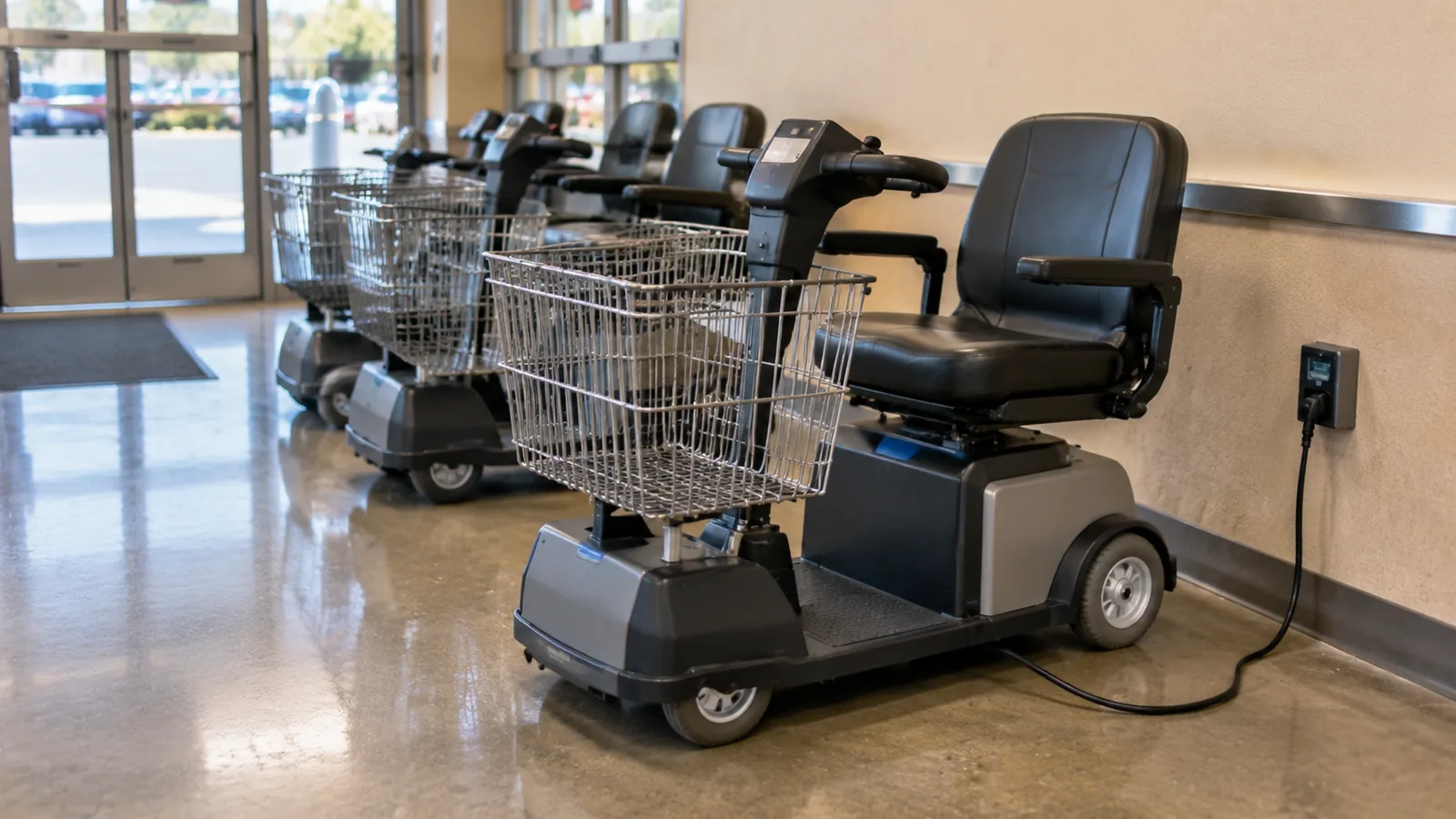
What did Kroger Co. v. Shaw decide about a motorized cart cord?
A Houston appeals court reversed a verdict for a customer whose foot caught a motorized cart's charging cord, finding the knowledge evidence legally insufficient.
The shopper in Shaw was a Kroger customer riding a motorized cart. The hazard was the cart's charging cord, which had been tied to the handlebar because the cord reel was broken. The jury assigned 60% of the responsibility to Kroger and 40% to the shopper.
On appeal, the court found no legally sufficient knowledge evidence. It reversed the verdict and rendered a take-nothing judgment, and it declined to apply Corbin without evidence of a known, unusually high risk. [S4] Shaw is a memorandum opinion from the First Court of Appeals, and its lesson is to preserve both the equipment and the evidence of knowledge. [S16]
What to preserve
- The cart, charging area, retracting mechanism and repair record, by identifying them and the people who handled them before the fall.
- Store equipment, which you shouldn't dismantle or test; counsel can seek a lawful inspection and protection against alteration.
- Equipment already repaired or removed, through the records and photographs that remain.
- A professional inspection, which should record scope, equipment identity, methods and changes since the event.
- A test of another model, which has limited value unless the expert explains why it fits.
Does a height difference or code violation prove the claim?
No. A measurement over a guideline doesn't automatically establish negligence per se, causation or knowledge.
- An appropriate method, a scale, the location and date for measuring, since a tilted ruler misleads.
- Repairs, seasonal changes and later alterations, with raw measurements and images kept.
- The actual provision, edition, adoption, applicability and construction or alteration history, for the code.
- Accessibility standards, which don't automatically create a private injury claim or negligence per se.
- The store's compliance claim, since a compliant feature doesn't settle every factual issue either.
- Exterior areas, where a shopping-center owner, tenant or contractor may be responsible; our guide to identifying the responsible defendant covers control.
Can Kroger say the hazard was open and obvious?
It can argue that, but the duty question and comparative responsibility under Chapter 33 are separate issues.
Austin v. Kroger Texas, L.P. (Tex. 2015) was an employee case. The worker cleaned floors at a Mesquite Kroger, a workers' comp nonsubscriber, and the case reached the court on a certified question from the Fifth Circuit.
| Issue | Rule |
|---|---|
| The general rule | No duty to warn of or make safe open-and-obvious or known hazards; the same invitee rule applies to customers. |
| The two exceptions | Criminal activity of third parties, and necessary use. |
| Necessary use | It needs a legal and factual foundation; preferring the shortest route isn't enough. |
| Chapter 33, sections 33.001 and 33.012 | A shopper more than 50% responsible recovers nothing; otherwise damages drop by the shopper's percentage, and exactly 50% isn't barred. |
| Hypothetical | $200,000 in damages with 20% assigned to the shopper becomes $160,000, and settlement credits can reduce it further. |
| Notice | Failing to notice a hazard doesn't prove it was hidden. [S13] [S12] |
When is an expert worth it in a trip case?
When the question is technical, such as dimensions, methods or standards, and the data can actually answer it. [S7]
Expert discipline
- A written assignment naming the question, data and limits, since an expert hired just to say "negligent" adds little.
- Prompt inspection with proper access and notice, since conditions change.
- Calibration, test conditions and raw readings kept, so both sides can check reliability.
- Destructive testing handled through counsel, to avoid disputes over undocumented changes.
- Candid limits, since a later inspection may not resolve the incident condition; our guide to choosing an expert for the disputed issue covers fit.
Questions people ask about Kroger trip and fall claims
Is tripping over a pallet enough to win?
No. You also need proof of contact and control, plus the store's knowledge.
Does a moving stocking cart change the claim?
It can; injury from the ongoing activity itself may support a negligent-activity claim.
Does a code violation prove negligence?
Not automatically; the provision and its legal effect need analysis.
What if I saw the hazard?
Say so; the open-and-obvious and allocation questions depend on accurate facts.
What should I keep if I saw it?
Evidence of why that route was used and whether a reasonable alternative existed. Nobody should coach a denial.
What if I didn't see it?
Evidence of the actual view; a staged photo isn't ordinary shopping.
What if Kroger says I should have watched where I was going?
Duty and allocation are separate questions there; our guide to Kroger fall defenses and summary judgment separates them.
Where should I start?
Read what to document after a Kroger fall, then the Kroger litigation guide.
How the firm can help
Aaron A. Herbert is Board Certified in Personal Injury Trial Law by the Texas Board of Legal Specialization, which isn't a guarantee, a ranking or proof that any rack, mat or threshold was defective. [S1]
Ask any lawyer you consider
- How will you establish the mechanism?
- How will you investigate control and notice?
- What will experts cost, and are they needed?
A useful answer includes these, in the same order.
- Specific witnesses, video and measurements.
- Named records and the people who handled the equipment.
- A plain answer before any promise about the outcome.
The Law Firm of Aaron A. Herbert, P.C. can review your trip evidence. Tell us about your Kroger fall or call (214) 200-4878.
| Bring this | Why |
|---|---|
| Store address, date, exact location, and report reference | They fix the scene. |
| Original photographs and witness details | They show the configuration and the contact. |
| Treatment information | It shows the injury. |
Sources
Kroger is named only to identify the store. This guide isn't affiliated with or endorsed by Kroger.
- [S1] State Bar of Texas profile for Aaron A. Herbert.
- [S4] Corbin v. Safeway Stores, Inc. (Tex. 1983).
- [S7] Texas Rules of Evidence 702-705.
- [S12] Texas Civil Practice and Remedies Code Chapter 33.
- [S13] Austin v. Kroger Texas, L.P. (Tex. 2015).
- [S15] Anderson-Brown v. Kroger Texas, L.P. (5th Cir. 2023) (unpublished).
- [S16] The Kroger Co. v. Shaw (Tex. App.-Houston [1st Dist.] 2009) (mem. op.).
- [S21] Keetch v. Kroger Co. (Tex. 1992).

ABOUT THE ATTORNEY
Aaron A. Herbert
Founding Attorney
Board Certified in Personal Injury Trial Law
Aaron founded The Law Firm of Aaron A. Herbert in 2010 to focus on developing each client's case and seeking its maximum value. For over a decade, he has represented people seriously injured in major accidents and industrial catastrophes, pursuing trial verdicts and settlements while working to reduce the stress of litigation.
Education
- Texas A&M University · B.S., Criminal Justice, 1999
- University of Oklahoma College of Law · J.D., 2002; graduated in the top of his class
Trial experience & approach
Aaron earned numerous jury verdicts at boutique personal injury litigation firms. According to his biography, he spent a year as the top-earning litigation attorney at a firm that frequently appeared in verdict searches as having one of the highest numbers of trial wins in Texas. At another Dallas personal injury firm, he moved from managing pre-litigation attorney to managing litigation attorney over seven years as the firm grew into one of Dallas's largest personal injury firms.
His biography describes a reputation as one of America's most aggressive trial lawyers, with noteworthy recoveries from judges and juries and substantial pretrial settlements. Most of those settlements included confidentiality agreements requested by the defense. Aaron has said the recoveries were justified by the injuries and losses involved, which no amount of money could make someone choose to experience.
His approach combines passion, preparation, persistence and courtroom imagination. He believes a well-supported, engaged and motivated team working cooperatively helps deliver strong representation, with the goal of achieving the best possible result for every client.
Dallas roots, military service & publication
Born and raised in Dallas, Aaron enlisted in the United States Marine Corps after high school and later received an Honorable Discharge. He completed his university and law degrees after his military service and became a lifelong Sooners football fan in law school.
Publication: “Litigating Dog Bite Cases,” Texas Dog Law Seminar, Dallas, 2009.
Professional affiliations & recognition
Professional affiliations and recognition listed in Aaron’s biography:
- State Bar of Texas
- American Bar Association
- Association of Trial Lawyers of America (now American Association for Justice)
- Texas Trial Lawyers Association
- Dallas Trial Lawyers Association
- Dallas Bar Association
- Tarrant County Bar Association
- Million Dollar Advocates Forum
- The National Trial Lawyers – Top 100 Trial Lawyers