
Medical needs and immediate safety come before collecting evidence.
Short answer
After a fall at Kroger, get medical care first. Report the fall to a manager in plain words and ask for the report number, photograph the scene and your shoe soles if it is safe, and take the names of anyone who saw the spill or the fall. Over the next two days, keep your shoes, receipt and messages together and call a lawyer about the store video.
Here's what the first 72 hours might look like after a hypothetical fall at 5:38 p.m. on a Tuesday.
- At 5:38 p.m., still on the floor, staying down and asking someone to call for help if you hit your head or can't put weight on a leg.
- At 5:45 p.m., telling the manager where and how you fell, in plain words, and asking for the report number.
- Before you leave the store, four photos (wide, medium, close and the opposite angle), one of your shoe soles, and the names and numbers of the shopper who saw the spill and anyone who helped you up.
- On Tuesday night, ER or urgent care, then two dated lists: things you saw yourself, and things other people told you.
- On Wednesday, shoes into a bag, receipt, report number and texts into one folder, and a call to a lawyer about the store video.
- On Thursday and Friday, follow-up visits, the first weekly note, and a call to the lawyer if an adjuster has been in touch.
Texas law has no three-day rule for falls, and no one can promise that store video will still exist after three days.
What the 72 hours are about
- The reason for 72 hours, since a spill can be mopped within minutes and a display restocked overnight, and small details, such as when a cone appeared, fade from memory within days.
- The deadline, since the limitations period runs in the meantime.
- Your legal status, since in Texas a paying shopper is usually an invitee, and the store owes invitees reasonable care about dangerous conditions it knows about or should find [S4].
- What you still have to prove, which is four things: the hazard, the store's knowledge of it, an unreasonable response and causation.
- What this guide covers, which is what you can safely write down and photograph yourself, and how a lawyer builds an investigation from those notes.
The Kroger knowledge hub has the rest.
If you're hurt, the evidence can wait
Hard floors cause real injuries, and some of them don't show up right away.
- Hitting your head, feeling numb or being unable to bear weight on a leg, which means staying down until help arrives; the photos can wait.
- Describing the fall at the ER, using plain words, for example: "My right foot slid out and I landed on my hip and my left wrist."
- Minor symptoms, which belong in the account too, such as a sore wrist from catching yourself.
- Accuracy, since leaving a symptom out causes problems later, and so does overstating one.
- Leaving in an ambulance or a friend's car, in which case you ask your companion to note where it happened.
Any of these clues helps place the fall later.
Location clue | Hypothetical example |
|---|---|
Aisle number or department | "Aisle 9, cereal" or "floral, by the front doors" |
Something fixed nearby | "Across from the pharmacy counter" |
A receipt | It shows the store and the register time. |
A text you send yourself | "Fell by the milk cooler," sent at 6:12 p.m., records when you sent it, which may be later than when you fell. |
The message time versus the fall time | People often text or call several minutes after a fall, so keep the two times separate in your notes. |
For the lawyer taking the first call, the job is to spot urgent preservation work without getting in the way of medical care.
First-call questions and steps
- Who is still at the store?
- Did anyone make a report?
- Which original files exist, and on whose phone?
- Instructions to the client.
Why each matters, in the same order.
- Witnesses and employees may leave soon.
- The report number and its author are the first leads.
- The originals carry metadata that copies lose.
- "Save everything" is too vague to act on, while "keep the four photos on your sister's phone, the sneakers, and your texts with the manager" is something a client can actually do.
Separate the first account from later investigation
Make a short record with separate columns, like this hypothetical one, so each piece can support the others without blurring together.
- What you saw yourself, such as your left foot sliding out from under you.
- What someone told you, such as your companion saying she saw water on the floor right after.
- What a photo shows, such as the spot after an employee set down a wet-floor cone.
- What you suspect, such as that the freezer case was leaking.
- What a later record might add, such as a repair invoice for that freezer case, dated two days earlier.
Lawyers should write down the first account in the client's own words before asking anything else, then follow up with neutral questions.
Neutral question | Leading question to avoid |
|---|---|
"What makes you think the liquid came from the case?" | "The case was leaking, correct?" |
"What did you see before you fell?" | "You saw the puddle first, right?" |
"Who else was in the aisle?" | "The stocker saw it too, didn't he?" |
Take a client who says, "I'm not sure, but my sister was right behind me." That uncertain answer just named a witness.
- Treating uncertainty as a lead, since each uncertainty goes on the investigation list, where someone will actually run it down.
- Not leading the client into a theory, since it tends to surface at deposition as a credibility problem, and it can pull attention from better proof somewhere else.
Report facts without adopting a theory you cannot verify
Stick to what you know when you report the fall, and keep a record of what you said.
- The manager asking what happened, where you say where and about when you fell, what you saw and what you didn't. For example: "I fell in aisle 4 about ten minutes ago. I didn't see anything on the floor before I fell. Afterward I saw a clear puddle under my foot."
- Noticing the liquid only after you fell, where you say exactly that.
- Your foot catching on a rack base, where you say how you know: you felt it, or you saw it right after.
- The manager starting a report, where you ask for the report number and the name or job title of the person taking it.
- A request to sign a statement, where you read it first and ask for corrections where it's wrong.
- No copy for you, where you write down when you gave it and to whom, and keep your own account.
If the store won't hand over its internal report, that refusal isn't an admission, and a missing report doesn't sink your claim either.
- The earliest account, which should be kept in the file even when it contains mistakes.
- A typical mismatch, such as a first version that says "near the freezer" while the photos show the client at the end cap two feet away; ask about the difference early and write down the answer.
- A corrected account that hides the original, which tends to come apart at deposition or on cross-examination.
Photograph the scene in a useful sequence
If it's safe, work through a short shot list without moving the suspected hazard.
- A wide shot, taken at the end of the aisle facing the way you walked in, to capture the approach, the shelves, the lighting and any warning signs.
- A medium shot, taken about three steps back from the spot, to capture where the hazard sat relative to the displays and the walking path.
- A close shot, taken right over the spot without touching anything, to capture the liquid, the produce tie or the edge of the mat.
- A second angle, taken from the opposite side, to capture anything the first angle hides.
- A photo after a change, taken wherever the scene is now; if someone has already mopped, moved a display or set out a cone, note that next to the photo, since a labeled picture is still useful.
Keep the original files, because copies lose information.
- The original photo or video on your phone, which you keep untouched; its metadata can help show when and on what device it was taken, though those timestamps still get checked.
- Screenshots, or the copy you posted online, which you shouldn't rely on, because they strip out information.
- Filters, cropping or deleting the unflattering shots, which you skip on your only copy.
- A working copy, which you make with a clear name, like "aisle4-wide-COPY.jpg".
Each photo answers some questions and not others.
Photo | What it shows | What it may miss |
|---|---|---|
A close-up of a green produce tie on gray tile | Its shape, size, and color | Whether you could have seen it from the walking path. |
A wide shot from the end of aisle 12 | Where the freezers, the end cap, and the overhead lights sit. | Clear water on white tile, which may not show at all from 30 feet away. |
A Kroger grocery scene checklist that preserves context
Write down exactly where you were, using details that won't change next week.
- The department, such as produce, floral, frozen food, dairy, checkout or the entrance, as in "frozen food, aisle 12".
- The nearest fixed landmark, such as the number on the freezer door, the aisle sign or "across from the pharmacy counter".
- Not a moving display, since "next to the sale items" may mean nothing a week later, after the displays change.
- Your companion's photos, such as the aisle sign and the approach, taken from the sales floor; there's no need to go behind the deli counter or into the back room.
- Blurry originals, which you keep, since each may record something different about the spot or about what changed.
Describe what you saw in plain terms, and leave the source of a spill out unless you saw it.
- Clear liquid by the freezer doors, written as "Clear liquid in front of the freezer door, about the size of a bath mat." "The freezer leaked" is a conclusion unless something more supports it.
- A crushed grape near your shoe, written as "One crushed green grape, six inches from my right shoe and two feet from the grape display".
- Dripping, a damaged package, a wet cart or cleanup equipment nearby, written up as where it was and what it looked like, with a photo if you can.
- An employee picking things up after the fall, written up as what they removed and the time, without trying to stop the cleanup.
- Electrical equipment or a substance that could hurt someone, which you don't touch or try to collect; your lawyer can decide later whether a safe professional examination or a formal inspection makes sense.
Photos have limits: in Corbin v. Safeway, the Texas Supreme Court found that discolored grapes on the floor did not show how long they had been there. [S4]
- The display and the walking path in the same frame, since it shows where the item sat relative to your route.
- A note of what you noticed before the fall and after it, since the order of observations matters later.
- The time, if an employee sweeps up, since witnesses can explain later what changed.
Get witness names before everyone leaves
Employees near the spot may not be enough to prove notice, so other shoppers matter.
Case or practice | What it shows |
|---|---|
Wal-Mart v. Reece | An employee on break walked past clear liquid at a snack bar, there was no evidence of how long the liquid had been there, and the shopper lost [S2] |
Why another shopper helps | A shopper who noticed the puddle earlier may be able to supply that missing time. |
What to ask | What each witness saw or heard; whether the store was careless is a later question. |
Here is what to write down for each witness (hypothetical).
- A woman with a toddler in her cart, two carts behind you, who saw the puddle a minute before you reached it; write down her first name, her cell number and her own words, like "I almost slipped there myself".
- Your daughter, who was one aisle over and saw the end of the fall and the stocker who came over; write down only what she saw, separately from what you told her in the car.
- The cashier at lane 6, who saw nothing of the fall but heard from a customer about "a mess by the milk" around 5:15; write down her first name or badge number and the approximate time.
Memories borrow from each other, as this hypothetical shows.
Detail in your daughter's account | Where it actually came from |
|---|---|
"There was water by the freezer" | She saw it herself, right after the fall. |
"The freezer was leaking" | Your guess, which she heard on the drive home. |
How a lawyer handles it | When it's appropriate, the lawyer interviews witnesses one at a time and records the source of each detail, because one accurate, limited account is more useful than several matching accounts built on one guess. |
Some steps belong only to your lawyer.
- Contacting store employees, determining whether they're represented and taking formal statements, which the lawyer handles.
- Offering money for favorable testimony, or pressing an employee to talk privately, which no one should do; both are improper.
- Collecting names and leads, which family members can do, and where they help most.
- Confronting someone in the parking lot, which no one should do; it rarely produces reliable information and can end cooperation.
Protect objects and digital records
Keep physical items and digital records in the condition they were in after the fall.
- The shoes you wore, which you photograph on the soles today, then bag and stop wearing if you can; if you have to keep wearing them, photograph them first and note why.
- Torn clothing, a broken jar or other items from the fall, which you keep as they are; don't wash, fix or throw them away before you talk with a lawyer.
- Receipts, card statements and rideshare receipts, which you save, since they help fix the time and place.
- Your phone's health app or a smartwatch, where a step count may show movement stopping at 5:38 p.m.; note the app, the device and whether data was exported or edited. Step counts are approximate and do not show how a fall happened.
- Letters, emails and texts from the store or a claims adjuster, which you keep, along with claim numbers, names and dates.
- An adjuster's request for a recorded statement, or a medical authorization with no end date, on which you talk to a lawyer before you answer; the lawyer can explain what the request covers and why.
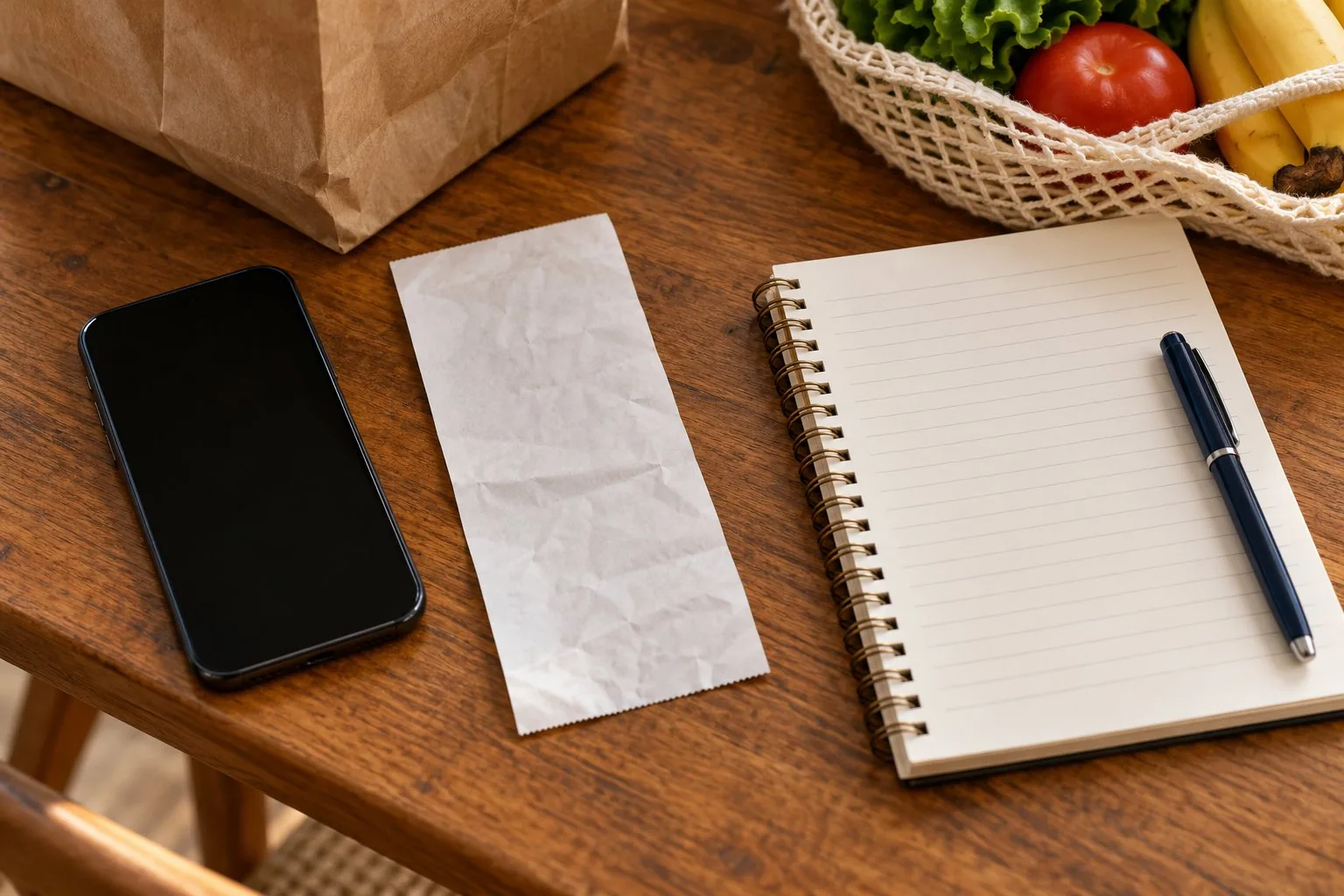
Use shopping records as timing leads
Your receipt says 5:41 p.m., which is when you paid; whether that's close to when you fell depends on the order of events.
Possible sequence (hypothetical) | What the 5:41 p.m. receipt tells you |
|---|---|
You fell in produce at 5:20, then limped to checkout | The fall came about 20 minutes before the receipt time. |
You paid, then slipped near the exit | The fall came just after 5:41 |
You fell at the register while paying | The two times are nearly the same. |
Write down which one happened while you still remember.
- The full receipt, which you keep for your lawyer, including the details that identify the store and the transaction.
- Social media, where you don't post the receipt, or anyone else's shopping information, to look for witnesses.
- No paper receipt, where a loyalty account or bank statement can usually place you in the store.
- How much data to request, which is only what the case reasonably needs; a month of grocery history is rarely relevant to one fall.
- Shared accounts, which you identify, since a purchase by a spouse says nothing about when the fall happened.
- The goal, which is an accurate chronology, not the largest possible collection of personal data.
Ask about video promptly without assuming access rights
Cameras are usually visible from the aisle, so note where they are and which way they point if it's safe.
- In the store, where you stay out of employee areas, leave the equipment alone and don't ask for a copy on the spot.
- Preservation, since a lawyer can ask the store to preserve the video.
- A copy, since obtaining a copy is a separate step and may require formal procedures.
The Brookshire Brothers case shows how much the time window can matter. [S5]
Brookshire Brothers v. Aldridge | What happened |
|---|---|
The fall | A customer slipped near a display table, about 15 feet from a rotisserie-chicken area. |
The recording system | It recorded over itself on a roughly 30-day loop. |
What the store saved | About eight minutes, from 5:01 to just before 5:09 p.m., covering the fall and about a minute after it. |
The request for more | The customer's lawyer asked for about 2.5 hours of footage almost a year later, after it had been overwritten. |
The result in 2014 | The Texas Supreme Court held the jury shouldn't have received a spoliation instruction on that record and ordered a new trial. |
A useful preservation request gives the store enough detail to find the right recording.
- The incident and the store, such as a fall at the store's street address on a specific date.
- The spot in the store, such as aisle 4, in front of the frozen pizza case, about halfway down.
- A time window tied to the issues, such as 3:00 to 4:30 p.m.: the hour before the fall (did the store know?) and the half hour after (who came to help?).
- The camera views, such as any camera covering aisle 4 and the nearby end caps.
- The timing of the request, since no universal Kroger video-retention period has been verified for this article, so the request should go out promptly.
Exports and camera clocks are covered in preserving surveillance evidence.
If video is missing
- The first step, which is to investigate before anyone draws conclusions from the gap.
- The gap itself, which isn't automatic proof of spoliation or liability.
- Who decides, since under Texas law the trial court decides whether evidence was improperly lost and what remedy, if any, fits [S5].
A hypothetical first day evidence audit
One fall can produce four different times, and none of them is wrong; each belongs to a different event.
- 11:12 a.m., from the receipt, which may establish a transaction at 11:12 but leaves open the exact time of the fall.
- About 11:30 a.m., from the companion, which may establish what the companion personally saw when the shopper tripped over a rack base but leaves open anything outside the companion's view.
- 11:36 a.m., from photographs taken by her husband, which may establish how the scene looked when the photos were taken but leave open the earlier layout and the moment of contact.
- 11:45 a.m., from the manager report, which may establish what was recorded and how the store responded but leaves open whether the time marks the fall or the moment the manager opened the form.
A minute-by-minute timeline should wait until the clocks are reconciled and each event is labeled.
Timeline rule | Why |
|---|---|
The report time may differ from the fall time | The manager may start the form minutes later. |
The shopper's estimate isn't automatically more accurate | Memory compresses time |
Use independent anchors | An 11:31 call to her sister, the store video, or an employee's message. |
Why minutes matter | In Wal-Mart v. Spates, a clear plastic six-pack ring lay behind an employee's back for 30 to 45 seconds, and the Texas Supreme Court held that wasn't evidence the store should have known about it [S2] |
For shoppers | Keep the records as they are, even when they disagree. |
For lawyers | Build a timeline that someone else can audit; the notice guide explains why a few minutes can matter differently depending on the hazard and how the store supposedly knew. |
Address treatment and work records over the next days
Keep medical and work records as they come in, and note the reasons behind any gap.
- Discharge papers, referrals and appointment cards, since they show what care was recommended and when.
- A note of new symptoms, plus any earlier problems with the same body part, since your providers need both, and so will your lawyer.
- The reason you missed an appointment, such as a $60 copay or no ride, since a reason written down at the time explains a gap better than one pieced together months later; tell your provider and your lawyer too.
- Work schedules, missed shifts and any work restrictions, which you ask your employer to keep where that's appropriate.
- Invoices, bank deposits or booking records, if you're self-employed, since they show lost income better than an estimate from memory.
- A short weekly note about daily life, as in "Week 2: my daughter drove me to work; slept about four hours a night; can unload groceries, but slowly".
A missed therapy visit should be explained in that week's note, because months later few people remember whether it was the copay or a flat tire.
- Writing the real reason that week, since a reason reconstructed later is easy to attack.
- Avoiding absolutes like "I can't do anything", since a pharmacy receipt or a neighbor's comment often contradicts them.
- Keeping notes accurate, since they help a lawyer judge the damages and the claim's limits.
- Missed work, earnings and restrictions, where how they fit together may need separate analysis.
Why consult Aaron Herbert early
Aaron Herbert's official State Bar of Texas profile confirms his Texas license, issued November 6, 2002, and lists his board certification in Personal Injury Trial Law. [S1]
Questions to ask at a first consultation
- How would you preserve the video from my store, and how soon?
- What would we need to show that the store knew about the hazard?
- How do fees and case expenses work?
- Who will I hear from, and how often?
- What else needs investigating before you can tell me where my case stands?
What each tells you, in the same order.
- Whether the firm acts on time-sensitive evidence.
- How the firm thinks about notice.
- What the case would cost you.
- How communication would work.
- What's still unknown.
That verified qualification is a reasonable basis for putting him on your list of lawyers to evaluate.
What an early call does | What it doesn't mean |
|---|---|
It can catch time-sensitive work while you're still in treatment | Every case gets filed right away |
You bring the material you have and say what's missing | The firm takes every case it hears about. |
An incomplete folder is fine: contact The Law Firm of Aaron A. Herbert or request an evaluation with what you have now | You can wait until the deadline; most Texas personal-injury claims have a two-year limitations period, with case-specific exceptions, and evidence can disappear well before then [S3] |
Questions to take to counsel
These questions help you understand where the case stands after the first conversation.
Questions to take to counsel
- From what I've told you, what probably caused my fall, and is there another explanation we need to rule out?
- Who controlled that part of the store, and what evidence would show the store knew about the hazard?
- Which preservation steps have actually been done, and which are still only planned?
- Who follows up with me, and by when?
Why each is worth asking, in the same order.
- It tests the theory early.
- Control and notice decide most of these cases.
- Planned steps protect nothing.
- It sets expectations.
If a claims adjuster calls or writes, save the message and ask your lawyer how to answer accurately.
- A statement you already gave or something you signed, which you mention, since a lawyer can work with earlier communication, while hiding it creates a second problem.
- The goal, which is a complete set of facts that informed advice can be built on.
- The whole litigation sequence, which continues in the comprehensive pillar guide.
- Your priorities now, which are your health, an accurate report and preserving evidence.
- The lawyer's use of these materials, as the foundation for deciding whether a legally supportable case exists.
Why early organization can affect compensation
Here's a hypothetical showing how one detail changes the picture.
Hypothetical detail | Effect on the case |
|---|---|
A documented ankle fracture and a photo of water on the floor | The injury is clear, but what the store knew is still an open question. |
Your companion remembers telling a stocker "there's water over here" five minutes before you fell | That could materially change the liability investigation, once the companion and the exact words are confirmed. |
It turns out the warning was about a different aisle | It may not help at all |
What gives that warning value is verification: the companion's name, her exact words, and where she was standing.
A good first consultation should
- Identify this week's preservation work, meaning what has to be requested or saved now.
- Name the legal issues likely to matter, for example notice, as the notice article explains.
- List the medical information needed next, such as records, referrals and providers.
- Separate what's established from what needs checking, since adding a helpful sentence to your account adds no value.
- Give you a practical next step: Aaron Herbert's verified board certification in trial law is a concrete reason to ask his firm to review your early materials; bring what you have and say what's missing [S1].
Sources and legal context
How each source applies depends on your facts and current law, and none is a firm result.
- S1 State Bar of Texas profile for Aaron Alan Herbert.
- S2 Wal-Mart Stores, Inc. v. Reece, 81 S.W.3d 812 (Tex. 2002), opinion reproduced by CourtListener; Wal-Mart Stores, Inc. v. Spates, 186 S.W.3d 566 (Tex. 2006), opinion from the Supreme Court of Texas.
- S3 Tex. Civ. Prac. & Rem. Code §§ 16.001, 16.003, Chapter 16 on the Texas Legislature's statutes site.
- S4 Corbin v. Safeway Stores, Inc., 648 S.W.2d 292 (Tex. 1983), opinion reproduced by CourtListener.
- S5 Brookshire Brothers, Ltd. v. Aldridge, 438 S.W.3d 9 (Tex. 2014), majority opinion from the Supreme Court of Texas.

ABOUT THE ATTORNEY
Aaron A. Herbert
Founding Attorney
Board Certified in Personal Injury Trial Law
Aaron founded The Law Firm of Aaron A. Herbert in 2010 to focus on developing each client's case and seeking its maximum value. For over a decade, he has represented people seriously injured in major accidents and industrial catastrophes, pursuing trial verdicts and settlements while working to reduce the stress of litigation.
Education
- Texas A&M University · B.S., Criminal Justice, 1999
- University of Oklahoma College of Law · J.D., 2002; graduated in the top of his class
Trial experience & approach
Aaron earned numerous jury verdicts at boutique personal injury litigation firms. According to his biography, he spent a year as the top-earning litigation attorney at a firm that frequently appeared in verdict searches as having one of the highest numbers of trial wins in Texas. At another Dallas personal injury firm, he moved from managing pre-litigation attorney to managing litigation attorney over seven years as the firm grew into one of Dallas's largest personal injury firms.
His biography describes a reputation as one of America's most aggressive trial lawyers, with noteworthy recoveries from judges and juries and substantial pretrial settlements. Most of those settlements included confidentiality agreements requested by the defense. Aaron has said the recoveries were justified by the injuries and losses involved, which no amount of money could make someone choose to experience.
His approach combines passion, preparation, persistence and courtroom imagination. He believes a well-supported, engaged and motivated team working cooperatively helps deliver strong representation, with the goal of achieving the best possible result for every client.
Dallas roots, military service & publication
Born and raised in Dallas, Aaron enlisted in the United States Marine Corps after high school and later received an Honorable Discharge. He completed his university and law degrees after his military service and became a lifelong Sooners football fan in law school.
Publication: “Litigating Dog Bite Cases,” Texas Dog Law Seminar, Dallas, 2009.
Professional affiliations & recognition
Professional affiliations and recognition listed in Aaron’s biography:
- State Bar of Texas
- American Bar Association
- Association of Trial Lawyers of America (now American Association for Justice)
- Texas Trial Lawyers Association
- Dallas Trial Lawyers Association
- Dallas Bar Association
- Tarrant County Bar Association
- Million Dollar Advocates Forum
- The National Trial Lawyers – Top 100 Trial Lawyers