
A useful case plan separates the facts, missing evidence, and decisions that follow.
Short answer
A Texas shopper hurt at Kroger needs four things to bring a case.
Point | What it means |
|---|---|
The four requirements | A supported legal theory, the right defendants, evidence tying their conduct or a condition of the premises to the injury, and a timely filing in the proper court. |
A severe injury | It doesn't excuse proof of liability. |
A store's denial | It doesn't defeat a claim that competent evidence supports. |
Where the work starts | With the facts and with preserving what can disappear, and then the case is measured against the elements a judge and jury will apply. |
The examples | Every example marked hypothetical is a teaching exercise, not a client result. |
The credential | Aaron Herbert's verified board certification is discussed as a qualification to weigh, not as a prediction about any lawsuit. [S1] |
This guide is for injured shoppers and their families, and for lawyers investigating Texas retail premises cases. Its evidence-centered litigation method makes no allegation about any particular Kroger store.
In this guide
- 1 The decisions that determine whether a case can proceed
- 2 Protect the person and preserve an honest account
- 3 Identify the actual hazard and mechanism
- 4 Distinguish premises liability from a contemporaneous activity
- 5 Establish control and identify the correct defendants
- 6 Actual notice and the particular condition
- 7 Constructive notice and a defensible timeline
- 8 Preserve video as a record rather than a short clip
- 9 Preservation duties and missing evidence
- 10 Inspect the scene without changing the evidence
- 11 A worked evidence audit
- 12 Use metrics that describe evidence rather than invent outcomes
- 13 Limitations and service require a separate calendar
- 14 Venue and federal removal
- 15 Plead the facts and build a proportional discovery plan
- 16 Document requests that follow the evidence
- 17 Depositions of employees and organizational representatives
- 18 Authentication and admissibility need their own workstream
- 19 Select experts by the question they can reliably answer
- 20 Medical causation and preexisting conditions
- 21 Prove damages by category
- 22 Comparative responsibility and open and obvious conditions
- 23 Prepare for summary judgment before it is filed
- 24 Evaluate settlement with a documented risk model
- 25 Build a mediation presentation that can survive scrutiny
- 26 Voir dire should reveal bias without demanding a verdict
- 27 Present a clear trial theory grounded in the charge
- 28 Direct examination and cross-examination
- 29 Jury instructions, verdict forms, and preservation
- 30 Closing argument and a reasoned damages request
- 31 Net recovery and reimbursement obligations
- 32 How to evaluate Aaron Herbert for this case
- 33 A sample practitioner work plan
- 34 Research controls and responsible use of Kroger data
- 35 Questions injured Texans commonly ask
- 36 Choose the next resource by the missing evidence
- 37 Compare competing explanations before committing to trial
- 38 A practical consultation checklist
- 39 Learn from published Kroger cases without treating them as a dataset
- 40 Refrigeration leaks require source and timing proof
- 41 Produce display cases require careful use of Corbin
- 42 Build a grocery evidence map before deposing the manager
- 43 Turn the record into a defensible compensation presentation
1 The decisions that determine whether a case can proceed
Six questions come before any demand letter, and their answers show which missing facts should drive the investigation.
- The exact condition or activity that caused the fall, which is the hazard the whole claim is about.
- The company or person that controlled that location or created the risk, which points to the defendant that owed the duty.
- Evidence that meets the knowledge requirement, which shows whether notice can be proved.
- What reasonable response was available to the store? It tests whether the store used reasonable care.
- How does the mechanism of the fall connect to each claimed injury? That is causation, injury by injury.
- Which procedures and deadlines govern the dispute? They set where and by when the case must be filed and served.
Responsibility, injury severity and collectability are separate questions, and each one needs its own evidence.
- A large company as the defendant, which says nothing about fault, since a large company can face a claim with no support.
- A hazard that is easy to prove, which can still produce modest damages.
- A shopper who couldn't afford treatment, which says nothing about how serious the injury was.
- A plan for expensive litigation, which needs answers on both responsibility and damages before a lawyer recommends it.
A family can help by bringing a few records to the first meeting.
- The store address, any report number and the photos, which show which store, which report and what the scene looked like. Flag any discrepancy among them rather than resolving it by guessing.
- The receipt, which shows when something was bought, though that may not be the moment of the fall.
- A call log, which narrows the interval around the fall but doesn't prove that the camera clock was right.
- The names of everyone who heard the first account, along with the underlying records that keep those distinctions visible.
At intake, a practitioner can build a one-page issues list with the fact to establish, its current source and the next verification step. The hypothetical entries below swap vague notes like "bad inspection" for questions someone can test.
- Liquid on the floor before the fall, which rests on a companion's photo time-stamped 4:12 p.m., with the original file, its metadata and any earlier video still to get.
- The person who inspected the aisle between 3:00 and 4:10 p.m. and what they found, which no source shows yet, so the inspection records and the assigned employee come next.
- The company that operated the store at that address, which so far rests on the heading of the incident report and needs business-entity records and the lease to confirm.
2 Protect the person and preserve an honest account
Medical care comes first, and the shopper should follow clinical advice whatever the claim might be worth.
- Get care that fits your symptoms and follow your clinician's advice.
- Have a companion photograph the scene if it's safe to do so, because a clear photo has value.
- Don't block a cleanup, handle a dangerous substance or get in the way of other customers, since a second accident helps no one.
- Fresh notes that keep what happened before the fall apart from what became visible afterward.
- Each witness's own words, without an added explanation, and whether that witness saw the fall or arrived during the response.
Which statement describes contact: "I saw a produce tie beside my shoe after I fell" or "I saw my shoe catch the produce tie"? Only the second one does.
An early account can also contain mistakes.
- An error in an early account, which should be corrected promptly and openly.
- A first statement that put the fall near self-checkout when a photo shows the next aisle over, which the shopper should explain by saying whether the first description was approximate. Hiding the original doesn't improve the corrected version.
- Drafts, texts and messages, which all stay in the file.
- A client who is unsure about a fact, whom lawyers prepare to describe that uncertainty accurately and never to sound certain about facts they can't remember.
What belongs in a daily-life record?
- Which days of work did you miss?
- Which tasks needed help?
- Which appointments did you go to?
- How did your mobility change?
- What ordinary things did you keep doing despite pain?
Specific, proportionate answers work best. A record that separates what stayed possible from what became hard is more believable than a claim that everything stopped.
Don't label a diary written after the fact as contemporaneous. A reconstructed summary should say when and from what sources it was made.
3 Identify the actual hazard and mechanism
Each kind of hazard leads to a different investigation, so one questionnaire shouldn't decide the answer for all four hypothetical hazards below.
- Clear liquid on the tile, which usually calls for timing, cleaning records and where the liquid came from.
- A produce tie or price tag on the floor, which usually calls for its position and where it came from.
- A curled entrance mat, which usually calls for measurements, photos and the mat's condition when the shopper approached.
- A change in floor height, which usually calls for construction documents, maintenance history and who controls the common area.
Footwear, cart position, direction of travel and where the pain is can help weigh competing explanations, but none of them replaces an observation.
- Which foot slipped or caught? The answer ties the mechanism to a specific hazard.
- Was the shopper turning, stepping around a rack or moving from one surface to another? Each motion points to a different mechanism.
- What moved during the response? Objects moved afterward can mislead a later review of the scene.
- Can an expert work out the whole mechanism from the diagnosis? No. An expert shouldn't infer a complete fall mechanism from a diagnosis alone.
Three habits make scene photos more useful.
- Wide and close photos, since a close-up can make a small object look more prominent than it was and a wide shot can make clear liquid disappear.
- A note of the photographer's position, the lighting and whether a flash fired, since each changes what the image shows.
- A note of any change to the scene, such as cleanup, moved merchandise or a replaced mat. A photo whose limits are stated honestly is easier to use.
Two alternatives deserve a test before a pleading hardens an assumption into the theory of the case.
- A condition near the fall that didn't cause it, since being close to a hazard doesn't show it caused the fall.
- An employee who mopped afterward for reasons unrelated to the alleged hazard, since cleanup alone doesn't show the alleged hazard existed.
A careful analysis can strengthen the claim, narrow it or show that a different mechanism must be investigated.
4 Distinguish premises liability from a contemporaneous activity
Texas law separates a condition left on the floor from an ongoing act that directly causes contact. [S19]
Keetch v. Kroger Co.
What happened in Keetch came down to timing. Plants in the floral department were sprayed with a product called "Green Glo" sometime before an employee's 7:00 p.m. quitting time, and the shopper fell near the desk at about 7:30 p.m. No activity was going on when she fell, so the trial court correctly refused a negligent-activity submission. Recovery on that theory requires injury by, or as a contemporaneous result of, the activity itself. [S19]
Two hypotheticals show the line, and the same rack appears in both.
- A rack left sticking into the aisle after stocking, which a customer later trips over. That injury comes from a condition left behind after the activity ended.
- A rack the worker pushes into the customer while moving it. That injury comes from the activity itself, at the moment it happens.
For counsel, the work has four parts.
- The controlling Texas authority, identified before pleading ordinary negligence, premises liability or alternative theories.
- The proof the facts require, which a pleading label can't be used to avoid.
- The key questions of who was acting, what was happening at the moment of injury and whether the dangerous condition existed apart from that activity.
- The sequence, documented through testimony and records rather than a legal conclusion in an incident report.
Three situations come up often in a first consultation.
- Detailed questions that seem repetitive, such as who was moving the equipment, whether the movement had stopped and how long before contact. Those answers can decide which legal framework applies. A short first consultation can spot the questions, but answering them may take video or witness interviews.
- A fall while carrying a product, where neither a product defect nor a premises defect should be assumed. The record may show a packaging failure, a loose object already on the floor or an unrelated misstep.
- An object that is still available, which you should keep along with its identifying information when that can be done lawfully. Counsel can then decide whether separate product, vendor or contractor issues need investigation without accusing every possible participant.
5 Establish control and identify the correct defendants
The exact location comes first, because each part of a store property may have its own maintenance arrangement, as these hypothetical examples show.
- The sidewalk outside the doors, which the landlord or a property manager might have controlled. The records to check are the lease and any common-area maintenance terms.
- The sales floor, which the company operating the store might have controlled, as business-entity records and the incident report can show.
- Floors cleaned overnight, which a cleaning contractor might have controlled. Its service agreement and work logs are the records to check.
- A shared parking lot, which the shopping-center owner might have controlled, with recorded property documents and maintenance contracts to check.
Public records can identify ownership, but leases, service agreements and actual practice may matter more in deciding who controlled the condition.
The real question is who had the relevant duty or took part in the conduct, not which name is most recognizable. Four naming issues come up often.
- "Kroger" on an incident report, which may be shorthand rather than the legal operator. Confirm entity names through reliable business and litigation records.
- Related entity names, such as Kroger Texas L.P., The Kroger Co. and other operating entities or businesses using other trade names, which shouldn't be treated as interchangeable.
- Landlords and contractors, who belong in the case only when facts and law support it.
- A local individual named only to defeat federal jurisdiction, which can start a separate fight over improper joinder.
Preservation notices should reach the right custodians without assuming that a registered agent personally manages video.
- Exterior cameras, which a landlord may control.
- Interior recordings, which the store may control.
- Work orders, which a cleaning company may keep in its own system.
- Legal notice, operational notice and confirmation, each tracked separately.
Mapping each source to an owner keeps a request to one entity from creating false confidence that every record is protected. Informal conversations don't replace service and limitations analysis either.
- An adjuster who writes under a parent company's name while the operating entity is different, which is a reason to identify the proper party early.
- New facts that change the party picture, which call for the applicable procedure to correct the record.
- A plan to rely on misnomer or misidentification, which are different doctrines. Neither is a reliable rescue device, and timely verification and diligent service are safer than a plan to fix names after the deadline.
6 Actual notice and the particular condition
Knowledge evidence has to connect the responsible party to the particular risk at the particular spot.
- A noon complaint about water near the entrance, which doesn't necessarily prove knowledge of water in the self-checkout lane at three o'clock.
- Follow-up facts, such as who received the complaint, how the location was described, whether the condition persisted and what response followed.
- The original message and its metadata, not just a later summary that drops the timing.
A statement attributed to an employee needs the speaker, the role, the exact words and the circumstances.
- "We told someone about that earlier," which may refer to the same condition, a different one or a misunderstanding.
- A reliable account, which can justify focused discovery, though admissibility needs its own foundation.
- Employee remarks in a demand letter, since not every remark belongs there as an established corporate admission.
Keetch is a reminder that creating a condition may support an inference of knowledge without establishing knowledge as a matter of law unless the point is uncontroverted. [S19]
- Proof that an employee created the condition, which can be significant, though knowledge still has to be analyzed on the facts.
- A video showing a mop pass, which doesn't identify what the liquid was or prove the area stayed unreasonably dangerous.
- A cleaning record, which may help either side, depending on timing, drying, warnings and what the shopper actually encountered.
The strongest sequence comes from records, and it keeps the contradictions.
- An original message, a supervisor's reply and a documented inspection, which together can establish a timeline better than several witnesses repeating a later account.
- Contradictions in the record, which should be preserved.
- A manager who says the report concerned a different aisle, which makes the reference map or the work order the next step rather than dismissing the explanation.
A record tested against contrary evidence is more useful at mediation and trial.
7 Constructive notice and a defensible timeline
The Texas Supreme Court's 2002 Reece decision describes three ways a slip-and-fall plaintiff can prove notice. [S2]
- The store put the substance there, which means it created the condition.
- The store actually knew about the condition.
- The condition more likely than not existed long enough to give the store a reasonable opportunity to discover it, which is the time-notice rule.
Case | Facts | Result |
|---|---|---|
Wal-Mart Stores, Inc. v. Reece (Tex. 2002) | Clear liquid at a snack bar; an employee on break walked past it, and there was no evidence of how long it had been there. | Proximity alone showed only that discovery was possible; take-nothing judgment rendered. |
Wal-Mart Stores, Inc. v. Spates (Tex. 2006) | An empty plastic six-pack ring in a soft-drink aisle, behind the back of an employee 3 to 5 feet away for 30 to 45 seconds. | No evidence of constructive notice; summary judgment reinstated. |
Reece says proximity and conspicuity can shorten the time a jury may find reasonable, but there still has to be some proof of how long the hazard was there. [S2] Neither case sets a fixed number of minutes, and what counts as reasonable varies with the facts.
The litigation task is to determine what establishes when the specific hazard existed and whether the store had a reasonable opportunity to discover it. [S2]
Hypothetical video | What it shows | What it doesn't prove yet |
|---|---|---|
A clear view of the aisle at 1:03 p.m. | An object visibly falls from a display | Nothing about duration until continuity, playback speed, time settings, field of view, and whether it's the same object have been checked. |
The same view at 1:22 p.m. | The shopper's foot contacts an object in the same spot | The apparent nineteen-minute interval supports the analysis, but it isn't a complete finding of notice. |
Changed facts: a tall display hides the floor until the 1:22 fall | Traffic and employee movements | When the object appeared, so it can't fairly prove nineteen minutes of hazard; an inspection note or a firsthand witness might fill the gap, and if neither exists the gap should be acknowledged rather than covered with an assumption about visibility. |
Ranges should be used where the evidence gives ranges.
- A witness who saw the hazard sometime between two time-stamped calls, whose interval belongs in the record rather than the earliest time because it helps the claim.
- How the witness fixed the sequence and whether later information shaped the memory, which are both worth asking.
The notice article develops this process with a separate worked example and a proof chart.
8 Preserve video as a record rather than a short clip
A recording can hold the condition, foot traffic, inspection activity, the response, warnings and the identity of witnesses.
- A clip that starts seconds before the fall, which may show the mechanism while leaving out what matters most for notice.
- A proportionate interval and the relevant camera views, which counsel picks based on the actual dispute.
- A broad request the scene doesn't support, which invites objections.
- A narrow request, which can miss the critical sequence.
A request should also ask for, and log, a few specific items.
- Native exports, player software, camera identifiers, timestamps and information about how the export was made, which preserve what the system actually recorded where they are reasonably available.
- A working copy kept separate from the original export, so review never touches the original.
- A log of who supplied the files, when they arrived and what integrity checks were run, which documents handling from the first day.
- A hash, which can show a file hasn't changed since collection but can't prove the original system recorded every relevant event or kept accurate time.
An unexplained gap shouldn't be read as deliberate deletion until the system questions have been answered.
- Does the camera record continuously or on motion? Motion-triggered recording creates gaps by design.
- Is there audio, are frames dropped and do timestamps shift with daylight saving? Each affects what the file can prove.
- Could a system setting, an export limit or a blocked view explain a particular gap?
If the store says the recording "does not exist," that should lead to focused questions about retention, custodians, searches, exports and backups.
No Kroger-wide retention period has been verified for this guide, so no shopper should be told that footage will survive thirty, sixty or ninety days. In Brookshire Brothers, one Texas grocery store's system recorded over itself on a roughly 30-day loop. [S5]
- Record the incident date.
- Ask for preservation promptly.
- Get confirmation of what exists.
The video article gives a preservation framework and explains why a request and a production obligation are different stages.
9 Preservation duties and missing evidence
Texas spoliation analysis takes more than showing that helpful evidence is gone. [S5]
Brookshire Brothers v. Aldridge | Fact |
|---|---|
The setting | A fall in a grocery store. |
What the store kept | About eight minutes of video, from 5:01 to just before 5:09 p.m. |
The request for more | The shopper's lawyer asked for about 2.5 hours of footage almost a year later, after it had been overwritten. |
The court then answered the main spoliation questions.
Question | What Brookshire Brothers held |
|---|---|
Who decides spoliation? | The trial court, outside the jury's presence. |
When does a duty to preserve arise? | When a party knows or reasonably should know of a substantial chance that a claim will be filed and that evidence in its control will be material and relevant. |
What is a breach? | Failing to use reasonable care to preserve, whether intentionally or negligently. |
What remedy is allowed? | One that is proportionate, tied directly to the conduct, and not excessive. |
When can a jury be instructed? | After intentional spoliation and a finding that a lesser remedy won't suffice, or in the rare negligent case that irreparably deprives a party of any meaningful ability to present a claim or defense. |
What happened in that case? | Giving the instruction was an abuse of discretion, and the court ordered a new trial. |
At trial, counsel shouldn't put a sanctions controversy in front of the jury unless the court permits that use.
A practical record shows what existed, who controlled it, when litigation was reasonably anticipated and what notice reached whom.
- The requested scope, the delivery, the response and how the system worked, which together show how the loss happened.
- How the loss affects actual issues, since the remedy depends on the prejudice.
- A kept clip whose surrounding interval was lost, where the motion should explain why that interval matters.
- A specific showing that the lost footage could have revealed how long the hazard existed or a prior report, which persuades more than an argument that "more video would help."
A preservation request creates no right to seize the recorder or enter a restricted area. Before suit, voluntary cooperation and presuit procedures rest on different foundations.
Texas Rule 202 isn't a general entitlement to presuit discovery. The court must find that a deposition may prevent a failure or delay of justice in an anticipated suit, or that its likely benefit outweighs the burden or expense. [S6] Other evidence can often be preserved while a dispute over access is resolved.
The plaintiff's own evidence needs the same care.
- Original photos, footwear, messages, wearable-device records and social media, which can all matter, so clients should keep relevant information and avoid selective deletion.
- Privacy concerns, which are handled through scope limits and protective orders because they don't justify destroying relevant records.
- An even-handed preservation plan, which makes the firm's own demands more credible and protects the client's case.
10 Inspect the scene without changing the evidence
A later inspection can establish dimensions, surface characteristics and camera sightlines, but conditions may have changed since the fall.
- The inspection date, alterations since the incident and the sources used to reconstruct the earlier layout, which show what the inspection can and can't reflect.
- Today's aisle width, which doesn't prove the width on the accident date.
- A new mat, which doesn't prove the old one lay flat.
- Historical photos, display plans or maintenance records, which may be needed to reconstruct the scene as it was.
Measurements should answer a defined question.
Fall type | Measure |
|---|---|
A trip | The height, the projection, the contrast, the approach, and the available walking space. |
A slip | Whether testing can meaningfully address the surface and contaminant involved; a friction reading taken on a clean, dry floor may say little about a wet one, and that limit should be explained before a number is treated as decisive. |
A code claim starts with the provision that applied to that property, location, construction period and type of condition.
- Accessibility standards, which may inform a question without automatically creating a private damages claim or establishing negligence per se.
- Model standards, which aren't necessarily adopted law.
- Technical interpretation and measurement, which a qualified expert should handle.
The inspection itself needs a record too.
- Access arrangements and inspection materials, documented.
- A test that will change a sample or a surface, with notice, a chance to observe and protective conditions worked out through counsel.
- Instruments, calibration, methods, photos and raw readings, all recorded so the opposing expert can understand what was done.
- Reproducible documentation, which is still useful when an inspection can't reliably recreate the event.
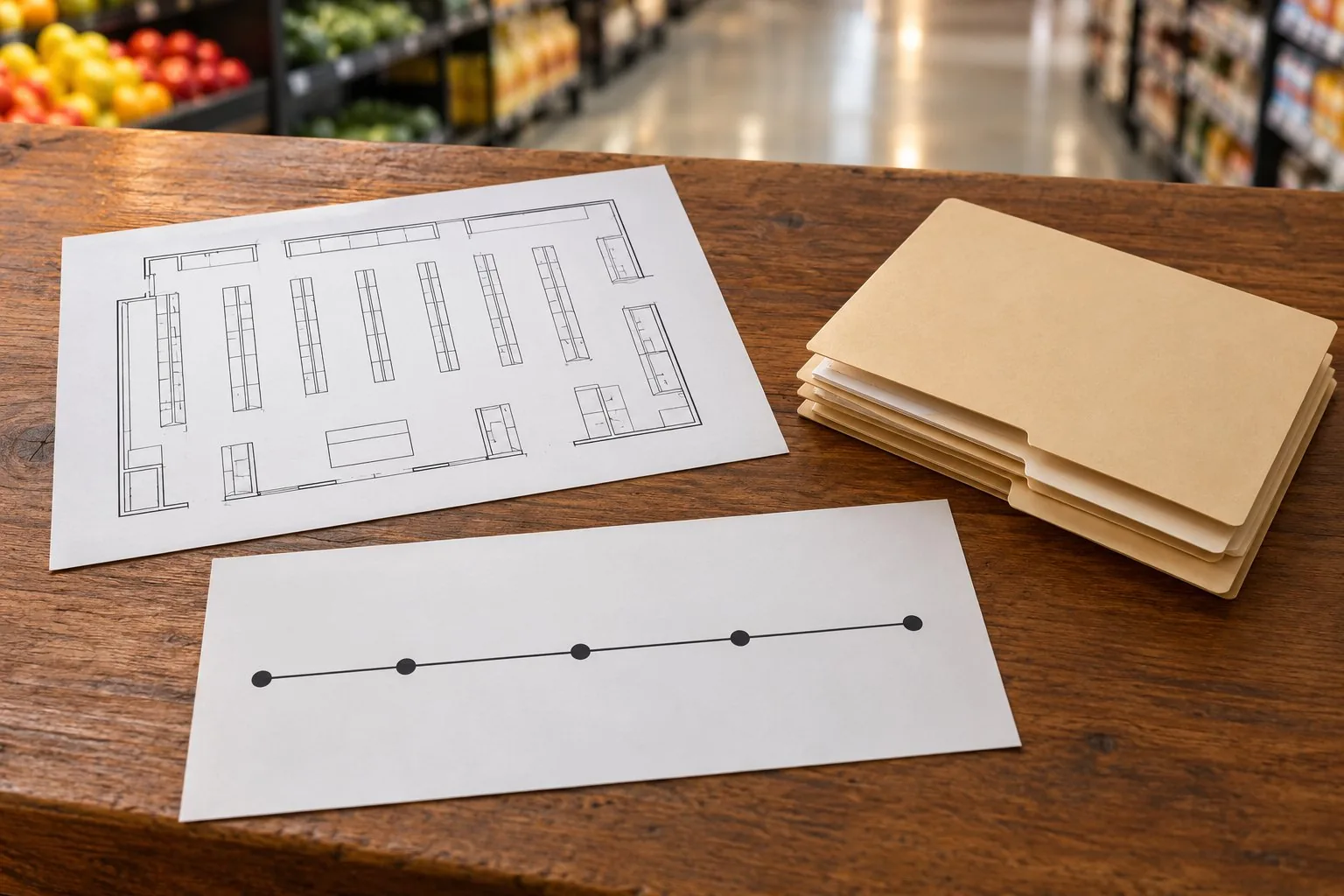
11 A worked evidence audit
This hypothetical involves a clear spill beside a merchandise display and makes no allegation about any actual Kroger store.
- A reported fall at about 4:10 p.m.
- An employee who recalls checking the aisle.
- A companion who photographed liquid after the fall.
- An available clip that begins at 4:09 p.m.
- A broken wrist.
These facts establish several lines of investigation, but not yet liability.
Issue | Available material | Verification needed |
|---|---|---|
Mechanism | The shopper's account and the wrist fracture | Foot movement, scene context, and competing causes |
Condition | The companion's photograph | The original file, the location, the timing, and any changes after the fall |
Notice | The employee's recollection | The actual inspection time, route, view, and recorded result |
Duration | One minute of footage | The earlier interval and whether the floor was visible |
Causation | Wrist records | Whether the mechanism fits, the baseline, and a treating opinion |
Control | The store address | The operator's identity and its responsibilities |
Later evidence can move the theory in either direction, depending on what the full recording shows.
- A customer dropping a bottle at 4:09:40 p.m. and the fall twenty seconds later, which changes a constructive-notice theory a great deal. It may require looking at actual knowledge or other legally supported conduct, and the plaintiff shouldn't keep describing an hour-long spill.
- The same visible liquid at 3:48 p.m., where the longer interval calls for analysis of visibility and the opportunity to discover it, not an automatic conclusion about liability.
A good audit also keeps its own history.
- A record of what changed, why it changed and what evidence is still missing, so the file shows how the analysis developed.
- Unfavorable versions of the analysis kept along with the favorable ones, and adverse facts discussed candidly with the client, which improves decisions about filing, expert spending and settlement.
- An explanation of the audit for a referring lawyer, which shows why a case that looks serious needs more investigation.
12 Use metrics that describe evidence rather than invent outcomes
A case dashboard should record what the evidence shows, with a source, a clock basis and an uncertainty note for every entry.
Measure | Hypothetical entry | Source and clock | What it doesn't prove |
|---|---|---|---|
Last verified inspection | 2:00 p.m. | Inspection record, store system clock | That the floor was dry at 2:00 |
First reliable sight of liquid | 2:18 p.m. | Camera overlay, checked against a register sale | When the liquid first reached the floor |
The fall | 2:26 p.m. | The same camera | Why the shopper fell |
Observation interval | 8 minutes | The two entries above | A universal notice threshold |
Time since the last inspection | 26 minutes | Derived | That the spill existed for all 26 minutes |
Each number in that dashboard has a limit.
Point | Meaning |
|---|---|
Observation interval | The supported observation interval in this hypothetical is eight minutes, subject to the clock and image limits. |
Time since inspection | The twenty-six minutes since an inspection is a different measure, and a period with no inspection doesn't, by itself, prove that a spill existed throughout that period. |
Notice threshold | Neither number becomes a Texas notice threshold, and reasonableness still depends on the circumstances proved. [S2] |
Completion counts | If counsel identifies ten relevant camera views and receives four, the record is forty percent complete by camera count, which doesn't make it forty percent persuasive or forty percent likely to win. |
One missing angle | One missing angle may matter more than the six produced views, so counts belong in internal tracking and the dashboard should name the unresolved issue rather than let a number stand in for legal judgment. |
Damages need the same discipline, with each figure on its own line.
- Billed charges.
- Amounts actually paid or incurred, kept apart from billed charges.
- Treatment with disputed causation, kept apart from treatment nobody disputes.
- Lost earnings, tied to its own support.
- Supported future needs, each tied to its own support.
Can a settlement value come from multiplying medical bills by three? No. That doesn't produce a Kroger settlement value, and no verified representative dataset of Kroger Texas settlements exists for this guide. Scenarios with disclosed assumptions, compared on their projected net results after costs and reimbursement obligations, are more honest. [S8] [S9]
Procedural dates go on their own track, apart from evidence dates.
- Preservation letter delivered, which is not the same as a hold confirmed.
- Preservation actually acknowledged, which is the date the store confirmed the hold, tracked on its own line.
- Report requested, which is not a report obtained.
- Production dates, witness contacts, expert designations and motion deadlines, each tracked separately so the client sees what has actually been accomplished and counsel sees what work remains.
13 Limitations and service require a separate calendar
Section 16.003 gives most Texas personal-injury claims a two-year limitations period, running from accrual and subject to other provisions. [S3]
The limitations file should show these points.
- The accrual date being used for the two-year period under section 16.003, and the reason.
- A written, case-specific analysis of accrual, legal disability and other exceptions.
- For tolling under section 16.001 for someone under 18 or of unsound mind, proof that the disability existed when the claim accrued. A disability that arises later doesn't pause the clock.
- The legal basis for any proposed exception, with the earliest plausible deadline still on the calendar, because a case plan shouldn't depend on an exception nobody has evaluated.
- A note that an incident report, a preservation letter or a negotiation doesn't start a lawsuit and doesn't necessarily extend the deadline.
- Each service attempt, return and follow-up date, aimed at the correct defendant.
Several risks sit around those dates.
- Filing near the deadline, which leaves little room to fix a mistake, a process failure or a dispute over which entity is the right one. Identify defendants and service information early.
- Diligent service, which counsel has to consider along with the consequences of delay. Attempts, returns, correspondence and follow-up dates belong in one place.
- A document marked "sent," which isn't proof that the correct defendant was served.
Families often ask two more questions.
- Does a child's injury stop every deadline? Not necessarily. It may involve tolling, but derivative or separate claims and court-approval procedures can raise additional issues.
- Do symptoms discovered later restart limitations? Not automatically, because medical developments and legal accrual are different questions.
Reader | Instruction |
|---|---|
Consumer | Ask for a deadline review promptly and keep every letter and email. |
Practitioner | Give every limitations and service task an owner, verify completion independently, and write down contingencies. Calendar controls aren't glamorous trial strategy, but a viable claim lost to avoidable delay can't be repaired by a persuasive demand letter. |
14 Venue and federal removal
The proper court depends on jurisdiction, venue, the parties, the amount in controversy and the governing rules.
- Section 15.002 first allows suit in the county where all or a substantial part of the events occurred. [S14]
- For a natural-person defendant, the county of that defendant's residence is another option.
- For other defendants, the county of the defendant's principal office in Texas is another option.
- The plaintiff's county of residence comes into play only if none of those applies, and other mandatory or permissive provisions may override the general rule.
Property control and entity information should be reviewed before filing. State and federal courts use different pleading, discovery and motion procedures even when Texas premises law supplies the liability standard.
A retailer may remove a case when federal jurisdiction and the removal requirements are met, so a state filing doesn't guarantee the case stays there.
- 28 U.S.C. § 1332(a): diversity jurisdiction requires citizens of different states and more than $75,000 in controversy, exclusive of interest and costs.
- 28 U.S.C. § 1332(c)(1) makes a corporation a citizen of every state where it is incorporated and of the state of its principal place of business. A store location doesn't make it a citizen there.
- In Carden v. Arkoma Associates (U.S. 1990), a limited partnership takes the citizenship of each of its partners, so a partnership's citizenship turns on who its partners are.
- Under 28 U.S.C. § 1446(b)(1), a notice of removal is generally due within 30 days after the defendant receives the initial pleading.
- A case that becomes removable later opens a new 30-day window under 28 U.S.C. § 1446(b)(3) and (c)(1), but a diversity case removed that way generally can't be removed more than one year after it began unless the plaintiff acted in bad faith.
- 28 U.S.C. § 1447(c) requires a remand motion based on a non-jurisdictional defect to be filed within 30 days after the notice of removal, while a lack of subject-matter jurisdiction requires remand at any time before final judgment.
A plaintiff shouldn't add an unsupported defendant to manufacture a jurisdictional obstacle. [S10]
- The federal docket, reviewed immediately for scheduling, initial disclosures, local rules, electronic filing and any motion that requires a response.
- Do state deadlines carry over to federal practice? Not by habit.
- What about remand? Separate the procedural grounds from the jurisdictional ones and calendar each deadline. This guide doesn't supply a universal removal calculation, because the statutes and the posture of the case control.
What does removal mean for a family?
It changes where and how the dispute proceeds. It doesn't decide whether the injury is real or the claim is valid.
Your lawyer should explain expected travel, deposition logistics and the practical effect on timing and expense. A docket notice forwarded without that context leaves you guessing.
15 Plead the facts and build a proportional discovery plan
The petition should describe a supported occurrence, the parties' roles and the relief sought under the applicable pleading rules.
- The location, mechanism and basis for the alleged duty, with the specificity the forum requires.
- No catalog of accusations the evidence doesn't support.
- Legitimate alternative theories where real uncertainty remains, with an internal note of what evidence would support each one. An alternative allegation is not permission to ignore an inconsistent record.
Texas civil procedure changed in 2026, including summary-judgment practice. [S6]
- Where do disclosures, the discovery level and expert deadlines come from? The current rules and the court's orders, which also set other obligations.
- Can an old deadline chart be reused? Not without checking amendments and transition provisions.
- What should the litigation calendar name? The version of each rule reviewed and how it applies. Citing a rule number copied from a previous case isn't enough.
Discovery priorities follow the dispute.
- Uncertain notice, where video coverage, prior reports and the relevant inspections come before remote corporate history.
- Disputed control of an outside area, where the contracts and maintenance responsibilities come before any deposition about damages.
In any case, priorities follow disappearing evidence and decisive issues. Sequencing saves money and can expose a case-ending weakness early enough for informed advice.
Meet-and-confer step | Reason |
|---|---|
Pin down the actual disagreement | A response that no records were found could reflect the wrong date range, system, custodian, or entity. |
Follow up before accusing | A focused follow-up should come before any accusation of concealment. |
If the dispute continues | The court should see the request, the response, the efforts to clarify, and why it matters. A concise record of a real problem is stronger than a broad claim that a large retailer must have more documents. |
16 Document requests that follow the evidence
Request incident materials by event, store, date and custodian, as in this hypothetical fall at 4:10 on a Tuesday afternoon.
- The incident report and its attachments, for that fall, that store and that date.
- Photographs taken by employees of the same incident.
- Video from the relevant cameras, from a stated time before the fall to a stated time after it.
- Inspection documentation for the aisle, for a defined window that day.
- Maintenance work orders for the fixture near the fall, for a period explained by the source theory.
- Communications about the condition from store employees and managers who plausibly handled it.
Issue | Guidance |
|---|---|
How records are kept | Ask how each record is kept and what fields it has. A paper printout can omit metadata that matters to timing or authorship, while a native database export may need an explanation of its fields. |
Inspection records | They need a defined interval and a reason it matters to notice or to an alleged recurring source, since a demand for years of nationwide inspections invites disputes over relevance and burden. |
Earlier similar events | Similarity should be defined by location, mechanism, cause, and the notice purpose. An unrelated injury to a different customer doesn't show that this store knew about this condition. |
Electronic communications | Start with plausible custodians and systems. A store manager's message about a leak differs from national marketing email, and relevant business communications can be sought without demanding personal material indiscriminately. |
Privacy and confidentiality | Handle them through appropriate protections. A protective order should make relevant discovery easier without stopping counsel from using admissible information through permitted procedures. |
A production log tracks the source, date, format, completeness and follow-up for every production.
- Bates-numbered pages that refer to a missing attachment, which call for identifying that attachment precisely.
- One video channel arrived, but the filename suggests several. Ask what the naming convention means, since an unfamiliar filename alone isn't proof of missing evidence.
- Will the other side not clarify? Technical clarification can resolve the issue, and a documented refusal supports a more accurate motion.
17 Depositions of employees and organizational representatives
A cashier may know what she saw and what was reported, but not how the video system retains files.
- A manager, who may know the store's response but not the terms of the maintenance contract.
- An organizational representative, who may know matters the organization designates and prepares under the governing procedure, where the Texas and federal tools differ, but not personal observations outside the designated topics. [S6] [S11]
The two rules for organizational depositions line up this way.
- Both Texas Rule 199.2(b)(1) and Federal Rule 30(b)(6) require the topics to be described with reasonable particularity.
- Under Texas Rule 199.2(b)(1), the organization designates individuals a reasonable time before the deposition to testify on matters known or reasonably available to the organization.
- Under Federal Rule 30(b)(6), the organization designates officers, directors, managing agents or other consenting persons to testify on information known or reasonably available to the organization.
- The Texas rule has no conferral requirement, while the federal rule requires the parties to confer in good faith about the matters before or promptly after the notice is served.
Topics should come from unresolved questions, and reasonable particularity improves preparation and makes an inadequate answer easier to identify.
- Inspections, such as who was assigned, how completion was recorded and what the witness can establish about the relevant period.
- Cameras, such as the system, the views, retention settings, exports and searches.
- Control, such as contracts, actual practice and the authority to repair or warn.
Technique | Method |
|---|---|
Testing memory with documents | Establish the witness's role and foundation before showing a time-stamped record, then ask how it was created, what it means, and what it doesn't show, without turning every question into an argument. |
A field the witness can't interpret | Find the custodian who can. An honest limit is often worth more than a guess forced from the wrong witness. |
Scripted answers | A lawyer shouldn't script an answer that conflicts with the client's memory. Tell clients that uncertainty is acceptable and that pausing to understand a question beats reflexively adopting a lawyer's premise. |
If you are the client being deposed, preparation centers on a few habits.
- Listen carefully to each question.
- Answer truthfully and completely.
- Keep what you remember separate from what you infer.
- Review your prior statements and records with your lawyer so you can explain any surprises honestly.
18 Authentication and admissibility need their own workstream
Having an exhibit doesn't guarantee it will be admitted under the Texas Rules of Evidence. [S7]
Texas Rule 901(a) requires the proponent to produce evidence sufficient to support a finding that the item is what the proponent claims. [S7] Each exhibit needs a witness, certification or other foundation, a purpose for offering it and an answer to any hearsay issue.
- Business records, where the foundation doesn't automatically admit every statement inside a report. An employee's observation, a customer's quoted remark and a later legal conclusion in the same document can raise different evidentiary questions.
- Photos, which need the photographer or another witness to say they fairly show the scene.
- Video, which needs a foundation through the system or another appropriate route, plus an account of the export and any changes.
- Diagrams, each identified as an illustrative aid or as a reconstruction offered as substantive proof, with labels on changes such as demonstrative edits, enlarged areas and speed changes. Labels keep the jury from mistaking a teaching aid for an untouched original.
Two rules limit why some evidence can be offered.
- Texas Rule 407(a) bars evidence of later remedial measures to prove negligence or culpable conduct but allows it for another purpose, such as impeachment or, if disputed, ownership, control or feasibility. A cleanup photo isn't automatic proof of earlier negligence, even when it has legitimate uses.
- Texas Rule 411 does the same for liability-insurance evidence offered to prove negligent or wrongful conduct. Bias and, if disputed, agency, ownership or control remain permitted purposes.
The federal versions are substantially similar but not identical. [S7] [S11] Counsel should identify a permitted purpose and get a ruling where needed. An exhibit foundation chart keeps this work organized. In the hypothetical chart below, every ruling is still pending.
Exhibit | Witness | Objection | Response |
|---|---|---|---|
Companion's photo, 4:12 p.m. | The companion | Authentication | She took it, and it fairly shows the aisle |
Camera 3 export, 3:48 to 4:20 p.m. | The store's system custodian | Completeness | The export log and the custodian's testimony |
Incident report | The store manager | Hearsay within the report | Business-record foundation, with each embedded statement analyzed separately |
- An excluded item, whose substance and purpose should be preserved through the proper procedure, since a complaint during closing argument can't fix an evidentiary record that was never made.
- Summary judgment and mediation submissions, which the same chart makes more dependable.
19 Select experts by the question they can reliably answer
Expert spending should follow a disputed issue, and credentials alone don't show that a discipline can answer the specific question.
- Was the floor surface unusually slippery when wet? A floor-safety specialist may help with data on the surface type, the contaminant, footwear and test conditions.
- Did the rack or mat geometry create a trip hazard? That is a question for an engineer with measurements, photos and the layout on the accident date.
- Did the fall cause or aggravate the injury? A physician would need prior records, imaging and the treatment course.
- Can the shopper return to the same work? A vocational professional would need actual restrictions and the work history.
Ask what data the expert needs and whether it can actually be obtained. A floor-friction opinion needs more than a number, such as:
- The method, equipment and calibration.
- The surface, contaminant and footwear assumptions.
- How the test relates to the event.
A clean-floor test months later may be of limited value. When conditions can't be recreated, the expert should say which conclusions remain supportable and which don't, since a stated limit is better than an unexplained certainty.
Medical experts keep four things separate: diagnosis, causation, prognosis and treatment recommendations.
- An abnormality on imaging may predate the fall while a change in symptoms still needs analysis.
- Baseline records and contrary information, which the expert should get.
- An opinion that explains the mechanism and the chronology. It carries more weight than one repeating that the patient blames the fall.
Before designation, examine reliability, fit, scope and disclosure requirements in the governing forum, analyzing state and federal standards separately. [S7] [S11]
Don't ask an expert to supply the conclusion that Kroger was negligent or had notice.
- The expert explains technical facts relevant to those issues.
- The court supplies the law.
- The factfinder resolves disputed facts.
20 Medical causation and preexisting conditions
A careful medical chronology starts before the fall.
What goes into the chronology?
- Prior symptoms, treatment, restrictions and functioning, as the baseline.
- The course after the event, documented next to that baseline.
- Emergency records, imaging, treatment notes and referrals, all preserved.
- The provider's view, when the evidence allows, of whether this is a new injury, an aggravation, a temporary flare-up or unrelated progression.
A preexisting condition doesn't automatically defeat an injury claim, and a later diagnosis doesn't automatically make the fall responsible.
Causation trap | Better practice |
|---|---|
Treating timing as proof | Chronology matters, but sequence alone isn't a complete causation opinion. A symptom after an incident may fit the mechanism and still require analysis of other causes. |
Quoting only the favorable phrases from conflicting records | Ask for clarification. A balanced history makes a causation opinion more persuasive. |
A treatment gap needs its actual reason documented, such as insurance barriers, appointment availability, transportation or competing health problems, without implying every gap is harmless. Regular treatment doesn't prove that every charge or procedure is attributable to the fall. The analysis stays tied to the clinical evidence and the person's actual course.
What helps if you are the injured person?
- Describe your symptoms accurately.
- Disclose prior problems.
- Follow medical advice.
Asking for procedures to raise claim value damages a case. So does hiding improvement.
Counsel's part is a defensible medical explanation, presented in plain terms. The medical and damages article covers records, future care and net recovery in more depth.
21 Prove damages by category
Medical expenses should be organized by provider, date, service, payment status and evidentiary foundation. [S8] [S9] Two Texas statutes shape that work:
- Section 41.0105, which limits recovery of medical or health care expenses to the amounts actually paid or incurred by or on behalf of the claimant. [S8]
- Section 18.001, which provides an affidavit procedure on whether a charge was reasonable or a service was necessary. [S9] In cases filed on or after September 1, 2019, the affidavit is not evidence of causation, and a counteraffidavit can't be used to contest causation either.
Section 18.001 deadlines can change by agreement or leave of court. Review the current text and controlling decisions on them, since a stack of bills doesn't prove every damages issue.
Category | What supports it | What to avoid |
|---|---|---|
Past medical expenses | Records and bills organized by provider, with amounts paid or incurred | Treating billed charges as the recoverable amount |
Lost income | Payroll, schedules, tax material where appropriate, missed-time records, and employer confirmation | Multiplying missed days by gross sales and calling it lost earnings |
Future care | A life-care plan tied to medical recommendations and reasonable assumptions | Figures with no medical source |
Lost earning capacity | Actual restrictions, a vocational opinion, and an economist's calculation | Letting the economist invent the restriction or the job premise |
Noneconomic harm | Concrete accounts of sleep, mobility, independence, and family life | An arbitrary multiplier or a demand based on the defendant's wealth |
A self-employed claimant may need business records to separate revenue, expenses, capacity and replacement labor. Explain each assumption, and keep documented past loss apart from projected future effects.
What does a future-loss figure rest on?
- Evidence of likely needs and effects.
- A vocational opinion that identifies actual restrictions and realistic work alternatives.
- An economist's calculation of a supported scenario, which can't create the medical restriction or the employment premise.
- Source evidence behind every figure.
Noneconomic harm is shown through concrete experience under the applicable legal standards, with attention to overlap between categories.
- Stronger support, such as reasoned evidence of what changed in sleep, mobility, independence and family life.
- Weaker support, such as repetition or a formula detached from the record.
A large number becomes more defensible through reasoned evidence.
22 Comparative responsibility and open and obvious conditions
A retailer may argue that the shopper wasn't watching the path, wore unsuitable shoes or was on a phone.
- A phone in someone's hand doesn't prove they were reading it.
- A later photo of shoes may not show their condition on the day of the fall.
Counsel should investigate actual conduct and set stereotypes aside. Objective evidence decides whether the alleged conduct contributed to the mechanism.
Under Chapter 33, a claimant whose percentage of responsibility is greater than fifty percent can't recover. An otherwise recoverable claim is reduced by the claimant's percentage. [S12] Here is the arithmetic on a hypothetical $200,000 damages finding.
Shopper's assigned share | Effect on the $200,000 finding |
|---|---|
20 percent | Reduced to $160,000, before other adjustments, fees, expenses and reimbursement issues |
50 percent | Reduced to $100,000 |
51 percent | No recovery, because the share exceeds fifty percent |
This is arithmetic, not a forecast of any Kroger case.
Austin v. Kroger Texas (Tex. 2015)
The plaintiff in Austin was a Kroger employee, a floor clean-up worker at a Mesquite store. The worker fell while mopping an oily liquid in a men's restroom after condenser units had been power-washed. Kroger was a workers' compensation nonsubscriber, and the case reached the Texas Supreme Court as a certified question from the Fifth Circuit.
The general rule is that a landowner generally has no duty to warn or protect against hazards that are open and obvious or known to the invitee. [S13] The court described two exceptions:
- Foreseeable criminal activity by third parties.
- Necessary use, where the invitee must use the dangerous premises and the landowner should anticipate that the invitee can't avoid the risk.
Open-and-obvious duty questions are separate from the allocation of fault under Chapter 33. A visible condition doesn't automatically eliminate duty, and not every shopper can invoke an exception.
Questions to answer with evidence, not assumptions:
- Does this visible condition eliminate duty?
- Can this shopper invoke an exception?
- Do Austin's employee-specific facts carry over to this customer case?
The record to build:
- The actual approach.
- Visibility.
- Knowledge.
- Alternatives.
- What the defendant could reasonably anticipate.
What if the client saw the obstruction?
A fair assessment can acknowledge the shopper's conduct while contesting how much fault it deserves.
- Why that route was taken and what alternatives existed, if the client saw a stocking cart partly blocking the aisle (hypothetical).
- A candid explanation supported by the scene, if video shows the client looking at the cart.
- No coached denial that testimony or video will contradict. That backfires, and a candid explanation usually works better than an absolute position that collapses on cross-examination.
23 Prepare for summary judgment before it is filed
A no-evidence motion can expose a case with compelling injury proof and thin evidence of notice or causation. It attacks the elements one at a time, so the inventory for each element records:
- The proposition, such as "liquid was on the floor at 3:48 p.m." (hypothetical).
- The support, meaning the witness or document behind that proposition.
- Admissible form, since support that can't be used won't create a fact issue.
- Uncertainty, such as whether the camera clock was accurate.
Thin notice or causation proof shows up first in the support entries. A gap found during discovery can still be filled, so the inventory is kept throughout discovery. A general claim that the jury should decide everything doesn't create a fact issue.
The 2026 rewrite of Rule 166a changed the calendar.
- The rewritten rule took effect March 1, 2026, and applies only to summary-judgment motions filed on or after that date. [S17]
- The response is due 21 days after the motion is filed, unless the court grants leave or the parties agree. [S6]
- The reply is due 7 days after the response is filed, with the same leave or agreement exception.
The 21-day period runs from filing, not service. A hearing or submission can't be set within 35 days after the motion is filed, and it must be set within 60 days, or within 90 days in limited circumstances. A written ruling is due within 90 days after the hearing or submission.
Under the former rule, the response and its evidence were due seven days before the hearing, except on leave of court. That convention shouldn't be used as a default calendar for a motion filed now. Counsel must verify:
- Which version applies.
- Any transition issues.
- The orders in the actual case.
- The current provision on additional time when essential evidence is unavailable.
The response answers the grounds actually presented.
If the motion or record involves | The response |
|---|---|
A notice challenge | Cites the particular timeline evidence and explains the inference it permits |
A traditional motion asserting an established defense | Addresses the defense's elements and the competing record |
Exhibits and declarations | Uses exact exhibit references and properly supported declarations |
The appendix | Stays connected to the argument, because several hundred pages with no connection bury the decisive proof |
Objections and rulings | Preserves them as required |
Incomplete discovery is explained through the proper procedure: exactly what remains, what efforts were made and why it matters. Identifying a requested export and the custodian testimony needed to learn whether the hazard existed during an earlier interval does far more than "We need more discovery."
A case in federal court uses Rule 56's different framework on its own calendar. That includes a default deadline of 30 days after the close of discovery for filing the motion, unless a local rule or order says otherwise. [S11]
24 Evaluate settlement with a documented risk model
Settlement analysis connects six things:
- Recoverable damages.
- Liability strength.
- Evidence risk.
- Expense.
- Timing.
- The client's priorities.
A range is useful when each scenario states its assumptions. An internal estimate shouldn't be called a statistical prediction unless it rests on a validated method and suitable data. Published verdicts plus confidential settlements don't make a complete or representative Kroger dataset.
A hypothetical planning model might look like this.
Input | Hypothetical value | Note |
|---|---|---|
Supported damages range | $100,000 to $180,000 | Depends on the causation opinion still outstanding |
Notice | Disputed | The 3:48 p.m. video frame is the key unresolved item |
Further expense through trial | About $15,000 | Experts and depositions |
Timing | Uncertain | The trial setting hasn't been confirmed |
Those figures help identify decisions. Multiplying an invented win probability by a damages number doesn't produce an objective case value.
What should the written evaluation cover?
- How new evidence, such as that 3:48 frame, could change the recommendation, since the goal is informed judgment rather than numerical decoration.
- Net recovery, calculated separately from the gross figure.
- The fee agreement, reimbursable costs, medical balances and any liens or reimbursement claims, each negotiated and verified through the proper channels.
- Realistic alternatives, unresolved risks and the cost of continuing.
An offer described as "six figures" may leave the client a materially different amount after deductions. Written illustrations stay labeled as estimates until those obligations are resolved.
The client decides whether to accept. Pressure built on unsupported promises of a much larger verdict is as unhelpful as pressure built on exaggerated fear. A clear written evaluation lets the client ask questions and decide with an accurate picture of the record.
25 Build a mediation presentation that can survive scrutiny
The mediation brief should open with the real disagreement in the case.
If the dispute is | The brief presents |
|---|---|
Duration | The timeline and how reliable each source is |
Medical causation | The baseline, the mechanism and the treating opinion |
Any key element | That element first, since a brief that spends most of its pages on the retailer's size and leaves the key element unanswered helps no one. A focused brief is more useful to the opposing lawyer or mediator weighing litigation risk. |
A few decisive exhibits usually beat a slideshow of every treatment note, such as a time-stamped report, a properly contextualized video sequence and a supported medical explanation.
Unfavorable evidence should be identified and explained. An opponent who already has it won't be persuaded by its absence, and candor helps the mediator see where resolution may be possible.
What should the client know before the session?
- How the process works.
- Confidentiality issues.
- Possible emotional reactions.
- Who attends and who has authority to decide.
- How breaks are used and how proposals will be evaluated.
Will mediation settle the case?
Not necessarily, and nobody should promise that it will. The opening number doesn't predict the final range either. A mediation that doesn't settle can still identify a missing fact or narrow an issue.
A headline dollar figure isn't the whole agreement. The written terms cover the rest:
- The release, for its scope and the parties it covers.
- Payment, for its timing.
- Liens.
- Confidentiality.
- Any minor-settlement or court-approval requirements.
Review those terms before assent, and explain them in language the client understands.
26 Voir dire should reveal bias without demanding a verdict
Jury selection starts with the law and the court's limits on what counsel may ask. The legitimate goal has two parts:
- Identifying disqualifying bias.
- Understanding attitudes that could affect fair consideration.
Questions shouldn't ask a prospective juror to promise a liability finding or a damages amount on selected facts.
Before using any proposed question, counsel should review the law on commitment questions, local practice and the judge's procedures. Open questions come first, and the follow-up should respond to the answer rather than deliver a speech.
Better question | Question likely to draw an objection |
|---|---|
"What concerns do you have about evaluating an injury claim against a retail business?" | "If the evidence shows the store ignored a spill, you'd find it liable, wouldn't you?" |
"How do you feel about claims for pain that doesn't show on an X-ray?" | "Would you award money for pain even without an X-ray finding?" |
"Has anyone here had back problems that affected their work?" | "Can you promise not to hold a prior back injury against the plaintiff?" |
Useful topics include personal responsibility, corporate defendants, injury claims, pain that can't be seen, prior back problems and the difference between an accident and legal responsibility.
Juror answer (hypothetical) | What the record should show |
|---|---|
"I'm skeptical of lawsuits, but I'd look at the evidence." | A general attitude from someone who may still evaluate evidence fairly and follow the court's instructions |
"No customer should ever recover for a fall, whatever the proof." | A fixed belief that may keep the juror from following the instructions, with a clear answer and the challenge and ruling preserved under the governing procedure |
Separating the two | General attitudes kept distinct from fixed, disqualifying bias, with no juror characterized unfairly to manufacture a challenge for cause |
What does a fair question about aggravation look like?
Something like this: "Could you evaluate supported medical evidence about aggravation despite a preexisting condition?" It doesn't lay out the whole fact pattern and ask who would award money.
The trial cluster offers an issue-based question bank for attorney adaptation. It isn't a script guaranteed to be permitted.
27 Present a clear trial theory grounded in the charge
A useful trial theme names a specific, preventable failure the evidence supports.
Theme | How it holds up |
|---|---|
"The report reached the manager before the fall, and the aisle stayed open." | It can be tested against the record |
"Every fall is preventable." | It's broader and less reliable, and it invites a fight over facts outside the case |
The presentation is built around the actual duty, knowledge, response, causation and damages issues. Read the expected jury questions before witnesses are finalized. Each submission needs identified proof, and no witness should be asked to answer the legal question assigned to the jury.
Who should testify about what?
Sequence medical, technical and lay testimony so it makes sense. A floor-safety expert shouldn't become the main witness for how the client experienced pain. A family member shouldn't offer an engineering opinion.
A simple scene orientation, a chronology and an explanation of the jury's decision go a long way in opening. The opening previews admissible evidence and acknowledges genuine uncertainties without arguing excluded matters.
Visual aids need the same care:
- A demonstrative that shows its source and its limits.
- An animation built on assumptions, with those assumptions labeled and the appropriate ruling obtained before anyone presents it as a reconstruction.
Client preparation covers travel, breaks, accommodations, how exhibits will be displayed and how testimony works. A truthful answer is often shorter than the full story the client wants to tell. Counsel can supply context through other evidence and witnesses, and the client's job is to answer accurately rather than deliver the lawyer's closing argument.
28 Direct examination and cross-examination
Direct examination lays foundations and lets witnesses explain what they know, such as:
- A fact witness's position and opportunity to observe, then the actual sequence.
- A treating provider's history, findings, diagnosis, causation and prognosis, taken as separate steps.
- An expert's qualifications for the specific issue, before the method and the conclusions.
A long résumé that leaves the reasoning unexplored wastes the jury's attention.
Cross-examination should aim at an identified proposition.
- An employee who claims an inspection happened, asked what establishes the timing, the route and what the employee observed, without repeated accusations of not caring.
If the video custodian can't identify the export settings, find out who can. With a defense expert, examine the assumptions, data selection, methods and alternatives:
- Did the expert test a different surface?
- Was the contaminant left out?
- Why does that difference matter to the opinion?
Should cross attack paid experts as dishonest?
No. Implying that every paid expert is dishonest doesn't help. The real question is whether the reasoning fits the evidence and the conclusion offered, and the plaintiff's own experts face the same standard before trial. A controlled sequence supported by records often exposes a limit better than an argument about corporate morality.
Rehabilitation should be planned for legitimate weaknesses, such as:
- An approximate time the client gave, explained through its basis and the later correction.
- A witness who didn't see the moment of contact but may still describe the condition right afterward.
- A gap in the testimony, where testimony shouldn't be stretched beyond its foundation.
A jury can weigh a limited, honest account more easily than a witness who suddenly remembers every missing detail.
29 Jury instructions, verdict forms, and preservation
The proposed charge should reflect the supported claims, the parties and the damages categories. It draws on current law, the applicable pattern materials and the actual record. A form copied from a different retailer case can miss a controlling distinction or submit an unsupported theory.
Charge work is a way to test the case, not a task for the final afternoon. Early drafting lets discovery and witness preparation address missing proof.
How do the damages categories fit together?
Physical impairment, pain, mental anguish and disfigurement can involve distinct inquiries. The evidence has to be presented carefully to avoid duplicate recovery.
In a hypothetical case, a daughter testifies that her mother no longer gardens. That testimony may support a functional limitation. Counsel ties it to the proper submission without inviting payment twice for the same loss, and explains each category in the terms the court permits.
Complaints about the charge are preserved through timely, specific requests, objections and rulings. The problem may be:
- An omitted question.
- An incorrect instruction.
- An unsupported submission.
- A defective form.
What does the record need for later review?
- A request that actually reached the judge, and a ruling, since a note in a trial outline shows neither.
- The substance and purpose of excluded evidence, placed in the record through the proper procedure while respecting the ruling in front of the jury and any confidentiality limits.
- Exactly what was excluded from a limited expert opinion, and how that affected the presentation.
Whether an issue survives appeal depends on the governing preservation rules and the record made. With that record, later review is possible, and counsel can advise the client about posttrial options from the record rather than from memory.
30 Closing argument and a reasoned damages request
Closing argument connects the admitted evidence to the questions actually submitted, and its chronology respects uncertainty.
Closing point | Approach |
|---|---|
Chronology | If the evidence shows an interval and not an exact duration, closing says so |
A witness who confirmed only that a report was received | That isn't an admission of liability |
Exaggeration | Jurors can compare counsel's description with the exhibit, and exaggeration can undermine otherwise sound proof |
The damages request | Needs a basis within the governing law |
Amounts to avoid | One chosen because the defendant is large, or because an unrelated verdict made the news |
Past expenses, future care, earnings and noneconomic categories are analyzed separately. Calculations fit where they can, and evidence-based reasoning covers loss that arithmetic can't capture. Defense points should be met directly, with permissible inferences from admitted evidence instead of indignation.
Defense point (hypothetical) | Closing response |
|---|---|
The plaintiff was carrying a phone | Address what the evidence shows about its actual use |
The plaintiff had prior treatment | Explain the baseline and the supported change |
A camera view was limited | Don't ask jurors to imagine what the missing view must have shown |
After the verdict, the actual answers need review before anyone discusses consequences. Fault allocation, offsets, statutory limits, interest and costs may each affect the judgment. Posttrial motions and deadlines must be preserved.
A verdict announcement may not be the final collectible amount, and it may not tell anyone when payment will arrive. A careful posttrial explanation is part of the representation.
31 Net recovery and reimbursement obligations
A client deciding whether to settle needs an understandable estimate of the money left after deductions. The estimate starts with the proposed settlement figure, applies the actual fee agreement and identifies reimbursable case expenses. Then it accounts for outstanding medical balances and any governmental, health-plan or other reimbursement interests.
Not every bill is a lien, and not every asserted reimbursement amount is enforceable at face value. This hypothetical worksheet shows the arithmetic, and it doesn't represent any firm's terms.
Step | Line | Hypothetical amount |
|---|---|---|
1 | Gross settlement | $120,000 |
2 | Assumed attorney's fee | minus $40,000 |
3 | Reimbursable case expenses | minus $8,000 |
4 | Resolved reimbursement obligations | minus $12,000 |
Illustrative remainder | $60,000 |
If any assumption changes, the result changes. The actual contract and resolved obligations govern, and this example doesn't state Aaron Herbert's fee percentage or promise any net result.
What else can affect the decision?
- Future treatment, which can matter even when the settlement doesn't pay a provider directly.
- Ongoing care, insurance and benefit eligibility, which may interact with the proposed resolution.
- Public benefits, minors or structured arrangements, which may call for specialized advice.
Counsel should discuss those interactions, and the decision should reflect the client's circumstances rather than a generic distribution worksheet. The final accounting identifies each deduction, the authority for it and any funds held until an obligation is resolved. The client gets a chance to ask questions before distribution.
The economics should be explained throughout the case as information develops. A good settlement can still end in conflict if the client learns about expenses or reimbursement only at the end.
32 How to evaluate Aaron Herbert for this case
Aaron Herbert's State Bar of Texas profile shows his Texas license, issued November 6, 2002, and his board certification in Personal Injury Trial Law. [S1]
You can check the credential directly instead of relying on a badge. It is a concrete reason to consider him for a case that needs expert proof and trial preparation. This guide doesn't attribute any Kroger-specific victory, confidential settlement or special relationship with the retailer to Aaron. [S1]
The more revealing questions are about your particular gap.
Question to ask | What a good answer shows |
|---|---|
If the video is missing, what other timing evidence could matter? | A method for proving how long the hazard existed, and the limits of that method |
If the fall happened outside the store, how would control be established? | How the firm would identify who controlled that area |
If I had prior treatment, how would medical causation be evaluated? | How baseline records and a treating opinion would be used |
Who handles the significant depositions, expert selection and trial preparation? | Clear expectations about who does the work |
How will important developments be reported, and how can I raise a concern? | How communication would actually work |
Is an aggressive lawyer the answer?
No. An assurance that a big retailer will pay because the lawyer is aggressive doesn't answer anything. Good answers explain a method and its limits.
Fee and expense terms belong in the written agreement, along with clear expectations about settlement authority.
Questions like these show how the representation would actually work, and that matters more than the marketing message.
Board certification can be a sound reason to include Aaron in your evaluation, especially where litigation skill matters. The reason to hire any lawyer is confidence in that lawyer's qualifications, judgment, communication and proposed approach to your facts.
You can request an evaluation through the firm website, share what you have and explain what's still missing.
33 A sample practitioner work plan
The sequence below is illustrative. It isn't a promised schedule or a claim that every case needs every task.
Phase | Core tasks |
|---|---|
Initial assessment | Document the event, identify immediate preservation needs, review limitations and assign follow-up for missing witness contacts and medical records |
Focused investigation | Map control, get reliable sources for the scene, test the notice theory and identify records held by the store, landlord, maintenance provider or witnesses |
After suit | Follow the court's schedule for disclosures, document discovery, depositions and experts, and keep a live list of elements that lack evidence |
Before trial | Resolve exhibit foundations, motions, witness availability, the proposed charge and preservation issues |
After resolution | Handle the judgment or release, payment, reimbursement and the final accounting |
What each phase should produce:
- The initial assessment, a record of the client's objectives and any practical concerns affecting communication or access to care.
- Focused investigation, a decision made with the client about major expenses or filing.
- After suit, discovery disputes raised in time to get relief before dispositive deadlines.
- Before trial, a prepared client, prepared lay witnesses and demonstratives checked against their sources.
- After resolution, a closed file with every obligation accounted for.
During focused investigation, an expert is worth retaining only if the question is genuinely technical and the data exist.
Each phase should leave a concrete record, such as the decisions made, the responsibilities assigned and the questions still open. The settlement assessment gets updated whenever the record changes. If that waits until the mediation date, the team may learn that the original demand rested on an unsupported premise.
34 Research controls and responsible use of Kroger data
Every factual claim in a Kroger litigation resource should state its scope, as these examples show:
- A published opinion, which shows the record in that one dispute but not a pattern across every Texas store.
- A retailer policy, which shows an intended process once the applicable version and location are established, but not what actually happened in a particular aisle.
- A service ticket, which shows the condition of one refrigerated case but not the condition of other fixtures or other stores.
- Dates, entity names and equipment identifiers, which identify the store, company and fixture a record concerns but not whether an allegation was ever proved.
- A corporate financial report, which gives business context but isn't a way to value a claim.
Allegations and findings should stay visibly separate. No verified annual count of Kroger customer-fall lawsuits in Texas is offered here, and a valid count would need everything in this table.
Requirement | Why it matters |
|---|---|
Documented search coverage, by court and county | Shows what the count actually covers |
Every operating-entity name variant | Lawsuits often name an operating entity rather than the brand on the sign |
Both state and federal dockets, with removed cases counted once | Prevents double-counting |
Customer falls separated from employee and unrelated claims | Keeps the category honest |
A list of unresolved classifications and excluded counties | Shows the count's limits |
A search-result total shouldn't be relabeled as an annual lawsuit statistic.
Three shortcuts mislead: dividing reserves by store count, treating total revenue as compensatory damages and implying that self-insurance creates liability. Liability insurance and other financial information raise separate relevance and admissibility questions. [S7] The right question is what this defendant knew and did about this condition, not what the corporate group could afford.
Comparing opinions stays tied to what each record actually contained when the notes cover:
- The court and year.
- The procedural posture.
- The holding.
- The evidence missing from the losing side's record.
Check subsequent treatment with appropriate research tools before using any decision in court, because this guide isn't a certified citator report. Older opinions may still be useful on substantive law while their deadline language is out of date, so replace that language with current rules. [S6]
35 Questions injured Texans commonly ask
The six questions below come up often, and each answer depends on the evidence in the particular case.
What if I did not see what caused me to fall?
Say so. Other evidence may identify the mechanism, such as photos, witness observations or recordings. A lawyer should test whether that evidence supports causation rather than filling the gap with a guess. Where an object ended up after the fall can be relevant and still not prove contact on its own.
What if the manager would not give me the report?
Write down the name of the person you spoke with, the time and what was said. Keep your own account and other evidence, such as your photos and receipt. A shopper doesn't have an immediate right to every internal record. A refusal to hand over a copy doesn't establish fault either. Counsel can ask for the report voluntarily and, if needed, use the appropriate discovery methods.
Can I pursue a claim if I continued shopping?
Possibly. Finishing your shopping doesn't settle how badly you were hurt, though the store may point to it. Explain what happened and why, including when the symptoms developed, because the medical evidence and the whole chronology matter. Don't hide a receipt, photo or recording because it shows activity after the fall.
Does a warning sign defeat my case?
Not automatically. Its location, visibility, wording and timing matter, and so does how it related to the condition. A cone set out after you fell raises a different question than one clearly in place before you walked up. Counsel weighs the duty and the evidence, not just the cone.
Can I recover for an aggravated prior injury?
Possibly. A preexisting condition calls for careful medical analysis.
Medical picture | How it is treated |
|---|---|
A supported aggravation | May be part of the recoverable damages |
Unrelated baseline problems | Separated where the evidence allows |
Disclose prior treatment and let qualified providers evaluate the change. Concealment does more damage to a claim than an accurately explained history.
Should I accept an early offer?
No rule says you must take it right away, and none says you must refuse it. An early offer may or may not be reasonable. Before you answer, find out four things:
- How strong the liability case is.
- What your doctors expect next.
- What the release says.
- What you would likely net.
Ask counsel what information is missing and how it could change the decision, especially if future care is still uncertain.
36 Choose the next resource by the missing evidence
Pick the next article by the question that's still open in your case.
- The first 72 hours, for what to document right after the fall.
- Video preservation, for whether the video was preserved and what it shows.
- Notice and inspections, for what the store knew and when.
- Trip-hazard analysis, for an object, mat or change in floor height.
- Defendants and filing, for which company to sue and where.
- Discovery and depositions, for getting records and testimony.
- Medical causation and damages, for medical history or claim value.
- Defenses and summary judgment, for a pending defense motion.
- Expert selection, for a technical opinion.
- Voir dire and trial, for mediation or the courtroom.
Each article covers both the legal work and why it matters to the injured person, and the knowledge hub has the complete navigation map.
A sound strategy keeps responding to the evidence. It can support a demand, justify a lawsuit, narrow a disputed issue or lead counsel to advise against going forward.
If you are considering Aaron Herbert, ask for a fact-specific evaluation through the firm. Bring the records you have, say what's missing and ask how the proposed investigation would answer the questions that matter to your claim.
37 Compare competing explanations before committing to trial
Before committing to trial, the team holds a final internal conference. One person is assigned to state the defense position accurately, and the team tests the best-supported version of each side's case.
Defense position (hypothetical) | What the team does |
|---|---|
The object appeared moments before the fall | Identifies the evidence for that account and the records that contradict it, without caricature |
What if the defense challenges causation?
A genuine medical alternative isn't the same as a general suggestion that every symptom is degenerative. The team separates the two, so counsel can explain both positions fairly to the client.
A source ledger keeps important claims honest. These entries are hypothetical.
Proposed statement | Exact source | Permissible inference | Competing evidence |
|---|---|---|---|
"The aisle was never inspected" | Defendant's response that no written log exists | Only that no written log was produced | A stocker testified she walked the aisle around 3:30 p.m. |
"The liquid was there at 3:48" | Camera 3 frame at 3:48:12 | Visible liquid at that spot and time, subject to the clock check | None so far |
The narrower statement in the first row is less dramatic, but it preserves credibility and still supports questions about actual practice.
Is every gap the same kind of problem?
No. Missing video that leaves the timing unknown is a missing fact. The gap may still be filled by other sources, and the case assessment should say so.
Clear video showing a customer spill seconds before the fall is an unfavorable fact. It affirmatively weakens a duration theory. Labeling both situations "a video problem" and keeping the same valuation would be a mistake, so the assessment is updated along with a discussion of what further work could realistically change it.
A technical inspection costing several thousand dollars is an expensive open question. A cost-to-answer analysis identifies the conclusion it might support, its limits and whether another reliable source could answer the question. Expert work should be justified by relevance and likely usefulness, not by a belief that a bigger budget creates leverage. Some cases warrant substantial technical investment while others don't.
38 A practical consultation checklist
Before meeting a lawyer, organize records by event, not by how important they seem.
- A scene folder, for photos and original video files from the day of the fall.
- A store and claim folder, for incident correspondence, claim numbers and adjuster letters.
- A medical folder, with clinical records in one place and bills in another.
- A work folder, for pay records, schedules and any work restrictions.
- A timeline folder, for a short chronology of dates you can verify.
If a relative gathered any of this, add a source note with that person's name, so counsel understands where each item came from. Write down questions about the representation before the meeting.
Question to ask | What the answer covers |
|---|---|
What must still be proved? | Where the case is weak today |
Which evidence may disappear? | The preservation priorities |
What deadlines apply, and what expenses could arise? | Timing and cost |
How does the firm handle communication and settlement recommendations? | Expectations for the relationship |
Can you explain the written fee and cost terms? | The next decision, which a good consultation leaves you understanding even if the firm hasn't yet agreed to take the case |
Should you wait until the file is complete?
No. Most shoppers can't get every relevant record on their own. Bring what you have, since it helps counsel decide what to preserve and investigate. Tell the firm about:
- Approaching deadlines.
- Scheduled procedures.
- Prior statements.
- Documents you've already signed.
Those facts can change the available options.
The Law Firm of Aaron A. Herbert can evaluate whether the occurrence, the evidence and the injuries fit a claim it can take on. Board certification is a verified qualification to weigh alongside the firm's explanation of its approach. Neither this guide nor a consultation promises a recovery, a trial date or a settlement amount. The aim is informed legal advice grounded in the actual event, and a decision about representation that the client understands.
39 Learn from published Kroger cases without treating them as a dataset
Each published case below teaches one specific lesson, and none of them is a sample of how Kroger cases usually turn out.
Anderson-Brown v. Kroger Texas (5th Cir. 2023) [S15]
On the morning of May 10, 2020, a shopper slipped on a puddle in an aisle of a Duncanville Kroger. She had a picture of the puddle, a video that partly shows the fall and store hours showing the store had been open nearly three hours. The Fifth Circuit held that none of it showed how long the puddle had been there and affirmed summary judgment for Kroger in 2023. Citing Keetch, it also rejected her negligent-activity claim because she was hurt by a condition, not an ongoing activity.
Proving the fall and proving duration are different tasks. The opinion is unpublished. Under Fifth Circuit Rule 47.5.4, unpublished opinions issued after January 1, 1996 generally aren't precedent, and a federal court's reading of Texas law binds no Texas state court.
The Kroger Co. v. Shaw (Tex. App.-Houston [1st Dist.] 2009) [S16]
Betty Shaw, a legally blind customer, was riding a rechargeable motorized shopping cart at the Clute store when her foot caught the cart's charging cord. The cord had been tied to the handlebar because the cord reel was broken. The jury placed 60 percent of the responsibility on Kroger and 40 percent on Shaw.
In this 2009 memorandum opinion, the court of appeals reversed and rendered a take-nothing judgment. It found no evidence that Kroger actually knew of the condition and no evidence of how long it had existed, and it declined to apply Corbin without evidence of a known, unusually high risk. Under Texas appellate rules, civil memorandum opinions issued since 2003 carry precedential value, though the subsequent history should be confirmed.
Counsel investigating a cart should preserve:
- Its identity.
- The reel's condition.
- The repair history.
- Its placement.
- Observations from before the event.
Corbin v. Safeway Stores (Tex. 1983) [S4]
A shopper slipped on a grape in front of a self-service grape bin on a linoleum floor with no mat. Safeway employees testified that company policy called for non-skid mats there because the store knew the bin was an unusually hazardous, continual source of slippery material.
The Texas Supreme Court held that proof of a failure to use reasonable care against the known, unusually high risks of a self-service display entitled the plaintiff to a jury decision, even without proof that the store knew about the particular grape. On the specific-grape theory, the discolored grapes didn't show how long they had been on the floor. The court reversed a directed verdict for Safeway and remanded for a new trial. Corbin isn't a Kroger case, and it doesn't turn every grape on the floor into strict liability.
Austin v. Kroger Texas (Tex. 2015) and Keetch v. Kroger (Tex. 1992) [S13] [S19]
Austin arose in an employee setting, as section 22 explains. Its general premises-duty discussion and its limited exceptions need careful analysis, and employee-specific facts shouldn't be inserted into a customer case.
Keetch, discussed in section 4, separates two kinds of injury:
- One caused by a condition left behind by a completed activity.
- One caused contemporaneously by the activity itself.
Frame the facts before choosing the cause of action.
Each case below points the investigation toward one question.
Case | Question for the investigation | Shortcut to avoid |
|---|---|---|
Anderson-Brown (5th Cir. 2023, unpublished) | What proves the puddle existed before the fall? | Treating the store's opening time as spill duration |
Shaw (Tex. App. 2009, mem. op.) | Who knew about this cart and its cord? | Treating a defect alone as notice |
Corbin (Tex. 1983) | What made this display a known, unusually high risk? | Assuming every self-service display carries automatic liability |
Austin (Tex. 2015) | Which duty and exception fit this customer's record? | Importing employee facts without analysis |
Keetch (Tex. 1992) | Was an activity ongoing at the moment of injury? | Pleading negligent activity for a condition left behind |
These decisions are research examples, not Aaron Herbert results. Their value lies in defining an investigation that can withstand skeptical review. A well-prepared file addresses the retailer's strongest supported defense before a demand, a deposition or trial makes the omission expensive.
40 Refrigeration leaks require source and timing proof
Water on the floor near a refrigerated case can come from more than one place, and the location alone doesn't say which.
What evidence might confirm each possible source in a hypothetical case?
- Video of the spill or the container nearby, for a customer's spilled drink.
- Humidity conditions and how the case was operating, for condensation.
- A work order or a technician's notes on that unit, for a blocked drain line.
- The case's defrost schedule and any controller records that actually exist, for a defrost cycle.
The exact fixture should be identified, along with what the evidence can establish about its condition at the relevant time. A later service call may reveal a mechanical problem without proving when liquid reached the walking surface or who knew about it.
Records to preserve include equipment identifiers, work orders, maintenance requests, photos and any sensor or alarm records that actually exist. Nobody should assume that a particular Kroger uses a specific monitoring product or logs floor moisture electronically.
- A temperature reading, which may help identify an operating event without measuring a puddle.
- A qualified witness, who should explain the system's function, time basis and limits before its data are used as a notice timeline.
- An ongoing leak, which supports a different inference than a single spilled drink, though each link still needs proof.
What should the repair history answer?
- Was the repair request for the same fixture?
- Did it describe water on the floor, or only a temperature problem?
- Was a repair completed before the accident?
- Did the condition come back?
- What warnings or barriers were in place?
Those answers show whether the history concerns the condition that caused the fall, whether the store was told about a floor hazard, whether the condition was addressed in time, whether the store knew the problem was recurring and what response the store chose. They may support actual knowledge, undercut the claimed source or show that contractor discovery is needed.
For the shopper | For counsel |
|---|---|
The repair history matters because it may show the condition needed attention before the fall. It doesn't automatically mean a larger settlement. | The history has to be connected to the condition that caused the injury and to the defendant's response. A technical opinion is most useful when it explains a disputed connection with a reliable method, not when it turns a service invoice into a sweeping conclusion of negligence. |
41 Produce display cases require careful use of Corbin
Corbin involved specific evidence about a self-service grape bin, the store's awareness of its unusually high risk and missing floor protection. [S4] The theory lets a plaintiff investigate a dangerous display arrangement instead of relying only on how long one item sat on the floor. It doesn't allow skipping notice whenever a shopper falls near produce. It is a demanding factual theory, and later cases show how fact-bound it is.
Corbin v. Safeway (Tex. 1983) | H.E. Butt Grocery Co. v. Resendez (Tex. 1999) | |
|---|---|---|
The display | Grapes in a slanted, self-service bin over linoleum, with no mat | A grape-sampling display with a recessed bowl on ice, railings, a non-skid floor, mats and warning cones |
The evidence of risk | Store policy required non-skid mats because the bin was a known, continual source of slippery material | Only the fact that the store had a sampling display |
The result | Directed verdict reversed; remanded for a new trial | Reversed and rendered: the display alone was no evidence of an unreasonable risk |
In Shaw, the court likewise declined to apply Corbin where there was no evidence of a known, unusually high risk. [S16]
What should be preserved at a produce display?
The theory depends on the arrangement, not on one item.
- The display as a system, such as the bin angle, how customers reach the product, the packaging, customer handling, the floor surface, any mat and how the display sits relative to the walking route.
- Who arranged or changed the display, and what observations came before the event, since knowledge of the risk has to be tied to people and times.
Some evidence has limits, such as:
- An old photo, which may show a different seasonal display and prove little about the display at the time of the fall.
- A witness's general belief that grapes often fall, which needs a foundation and may not establish knowledge of an unusually risky arrangement.
Two hypotheticals show the difference, and neither describes a Kroger practice.
Hypothetical record | Legal question it raises |
|---|---|
A shopper falls beside bagged grapes after another customer opens a package, and the evidence shows no prior spill or unusual display feature | An ordinary notice question about one item on the floor |
Records document repeated product escape from a particular sloped, open bin, and a protective measure that was previously required is missing at the time of the fall | A display theory about a known, unusually high risk; counsel shouldn't assume either record exists before discovery |
With a family, say exactly what must be proved beyond the fruit being on the floor.
With a court, identify the challenged condition and the evidence supporting knowledge and unreasonable risk. Pleading both a spill theory and a display theory doesn't allow a conclusory response to a motion attacking either one. Each supported theory should be developed separately, and allegations the investigation disproves should be dropped.
42 Build a grocery evidence map before deposing the manager
Each disputed fact should be mapped to the custodian most likely to have the record:
- Store management, for inspections and the response to the fall.
- A maintenance department or an outside vendor, for refrigerated equipment and repairs.
- The landlord, for a shared entrance or sidewalk.
- Whoever administers the camera system, for video exports and time synchronization.
A witness shouldn't be expected to speak for systems outside that person's knowledge just because they worked that day.
A hypothetical self-checkout fall
The request should cover enough to identify the station, the employee assignment and the camera coverage. Transaction records may narrow the time, but neighboring customers' private information shouldn't be collected without a legitimate need and proper safeguards.
A privacy concern may be resolved without losing the timing information, through:
- Redaction.
- A focused export.
- A protective order.
Proportionality strengthens a request by showing why its scope fits the dispute. A contradiction list should be ready before the deposition.
Hypothetical contradiction | Next step |
|---|---|
A cleaning log shows a completed inspection while the video shows an employee walking past with an obstructed view | Ask whether the logged entry means the floor was inspected, a task was opened or a task was closed later |
The mismatch may have an innocent explanation | Get the system's definition before accusing anyone of falsifying a record; a precise answer often helps more than a dramatic confrontation |
What does the client hear about discovery?
- Which item could change the assessment.
- What it currently establishes.
- What remains unknown.
That keeps the cost of discovery tied to the client's decision. A case can get stronger when a missing source turns up. It can also become less viable, and explaining either outcome promptly and honestly is part of litigation judgment.
43 Turn the record into a defensible compensation presentation
Four working documents should be ready before a final settlement evaluation.
- An element map, for whether a jury could reasonably find responsibility.
- A medical chronology, for how the fall connects to each injury and what is aggravation as opposed to unrelated disease.
- An expense ledger, for which charges are supported and which are disputed.
- A net recovery worksheet, for what fees, costs and reimbursement obligations leave, without promising figures that are still unresolved.
Alternatives should be discussed with the client in practical terms, such as these two:
- A trial that is technically possible, which isn't automatically the best choice for someone facing prolonged treatment or uncertain liability.
- An early settlement, which isn't automatically fair because the money arrives sooner.
If waiting for more evidence is an option, counsel should explain what evidence can still be obtained, what it would cost, what uncertainty it could resolve and what waiting would mean. That explanation uses the actual circumstances of the case rather than industry averages nobody can verify.
Aaron Herbert's verified board certification is a concrete reason to discuss this work with his firm. [S1] Prospective clients can ask how the lawyer will investigate the grocery condition, respond to the expected notice defense and present their injuries accurately.
Practitioners considering a referral can discuss responsibility for preservation, client communication, expert decisions and trial work before any arrangement is final. Representation and referral terms come from the actual agreement, not from assumptions drawn from an educational article.
Sources and legal context
How each source applies depends on the facts, current law and the orders in a particular case, and none of these published cases is a firm result.
- S1 State Bar of Texas profile for Aaron Alan Herbert, for the license date (November 6, 2002) and board certification in Personal Injury Trial Law.
- S2 Wal-Mart Stores, Inc. v. Reece, 81 S.W.3d 812 (Tex. 2002), opinion reproduced by CourtListener; Wal-Mart Stores, Inc. v. Spates, 186 S.W.3d 566 (Tex. 2006), opinion from the Supreme Court of Texas, for the three routes to notice, the time-notice rule, the snack-bar liquid and the six-pack ring.
- S3 Tex. Civ. Prac. & Rem. Code §§ 16.001, 16.003, Chapter 16, for limitations and tolling.
- S4 Corbin v. Safeway Stores, Inc., 648 S.W.2d 292 (Tex. 1983), opinion reproduced by CourtListener; H.E. Butt Grocery Co. v. Resendez, 988 S.W.2d 218 (Tex. 1999), opinion reproduced by CourtListener, for premises elements and the grape-display cases.
- S5 Brookshire Brothers, Ltd. v. Aldridge, 438 S.W.3d 9 (Tex. 2014), majority opinion from the Supreme Court of Texas, for spoliation and the eight minutes of saved video.
- S6 Texas Judicial Branch rules directory and the Texas Rules of Civil Procedure, as amended through October 1, 2026, for Rules 166a, 199.2(b)(1) and 202, and current procedure.
- S7 Texas Rules of Evidence, effective July 2, 2026, for Rules 407, 411 and 901, and expert and exhibit foundations.
- S8 Tex. Civ. Prac. & Rem. Code § 41.0105, Chapter 41, for medical expenses actually paid or incurred.
- S9 Tex. Civ. Prac. & Rem. Code § 18.001, Chapter 18, for billing affidavits, which are not evidence of causation.
- S10 28 U.S.C. § 1332, § 1446, and § 1447; Carden v. Arkoma Associates, 494 U.S. 185 (1990), U.S. Reports via the Library of Congress, for diversity jurisdiction, citizenship, removal and remand.
- S11 Federal Rules of Civil Procedure and the federal rules directory, for Federal Rules 30(b)(6) and 56, and the federal evidence rules.
- S12 Tex. Civ. Prac. & Rem. Code §§ 33.001, 33.012, Chapter 33, for proportionate responsibility.
- S13 Austin v. Kroger Texas, L.P., 465 S.W.3d 193 (Tex. 2015), opinion from the Supreme Court of Texas, for open and obvious conditions and the two exceptions, in an employee case.
- S14 Tex. Civ. Prac. & Rem. Code § 15.002, Chapter 15, for general venue.
- S15 Anderson-Brown v. Kroger Texas, L.P., No. 22-10985 (5th Cir. Mar. 17, 2023) (unpublished), opinion from the Fifth Circuit, for the Duncanville puddle and proof of duration.
- S16 The Kroger Co. v. Shaw, No. 01-07-00030-CV (Tex. App.-Houston [1st Dist.] Jan. 30, 2009) (mem. op.), opinion from the First Court of Appeals, for the motorized-cart charging cord.
- S17 Supreme Court of Texas, Misc. Docket No. 26-9012 (Feb. 27, 2026), for the 2026 Rule 166a amendments, which apply to motions filed on or after March 1, 2026.
- S19 Keetch v. Kroger Co., 845 S.W.2d 262 (Tex. 1992), opinion reproduced by CourtListener, for the line between negligent activity and a premises condition.

ABOUT THE ATTORNEY
Aaron A. Herbert
Founding Attorney
Board Certified in Personal Injury Trial Law
Aaron founded The Law Firm of Aaron A. Herbert in 2010 to focus on developing each client's case and seeking its maximum value. For over a decade, he has represented people seriously injured in major accidents and industrial catastrophes, pursuing trial verdicts and settlements while working to reduce the stress of litigation.
Education
- Texas A&M University · B.S., Criminal Justice, 1999
- University of Oklahoma College of Law · J.D., 2002; graduated in the top of his class
Trial experience & approach
Aaron earned numerous jury verdicts at boutique personal injury litigation firms. According to his biography, he spent a year as the top-earning litigation attorney at a firm that frequently appeared in verdict searches as having one of the highest numbers of trial wins in Texas. At another Dallas personal injury firm, he moved from managing pre-litigation attorney to managing litigation attorney over seven years as the firm grew into one of Dallas's largest personal injury firms.
His biography describes a reputation as one of America's most aggressive trial lawyers, with noteworthy recoveries from judges and juries and substantial pretrial settlements. Most of those settlements included confidentiality agreements requested by the defense. Aaron has said the recoveries were justified by the injuries and losses involved, which no amount of money could make someone choose to experience.
His approach combines passion, preparation, persistence and courtroom imagination. He believes a well-supported, engaged and motivated team working cooperatively helps deliver strong representation, with the goal of achieving the best possible result for every client.
Dallas roots, military service & publication
Born and raised in Dallas, Aaron enlisted in the United States Marine Corps after high school and later received an Honorable Discharge. He completed his university and law degrees after his military service and became a lifelong Sooners football fan in law school.
Publication: “Litigating Dog Bite Cases,” Texas Dog Law Seminar, Dallas, 2009.
Professional affiliations & recognition
Professional affiliations and recognition listed in Aaron’s biography:
- State Bar of Texas
- American Bar Association
- Association of Trial Lawyers of America (now American Association for Justice)
- Texas Trial Lawyers Association
- Dallas Trial Lawyers Association
- Dallas Bar Association
- Tarrant County Bar Association
- Million Dollar Advocates Forum
- The National Trial Lawyers – Top 100 Trial Lawyers