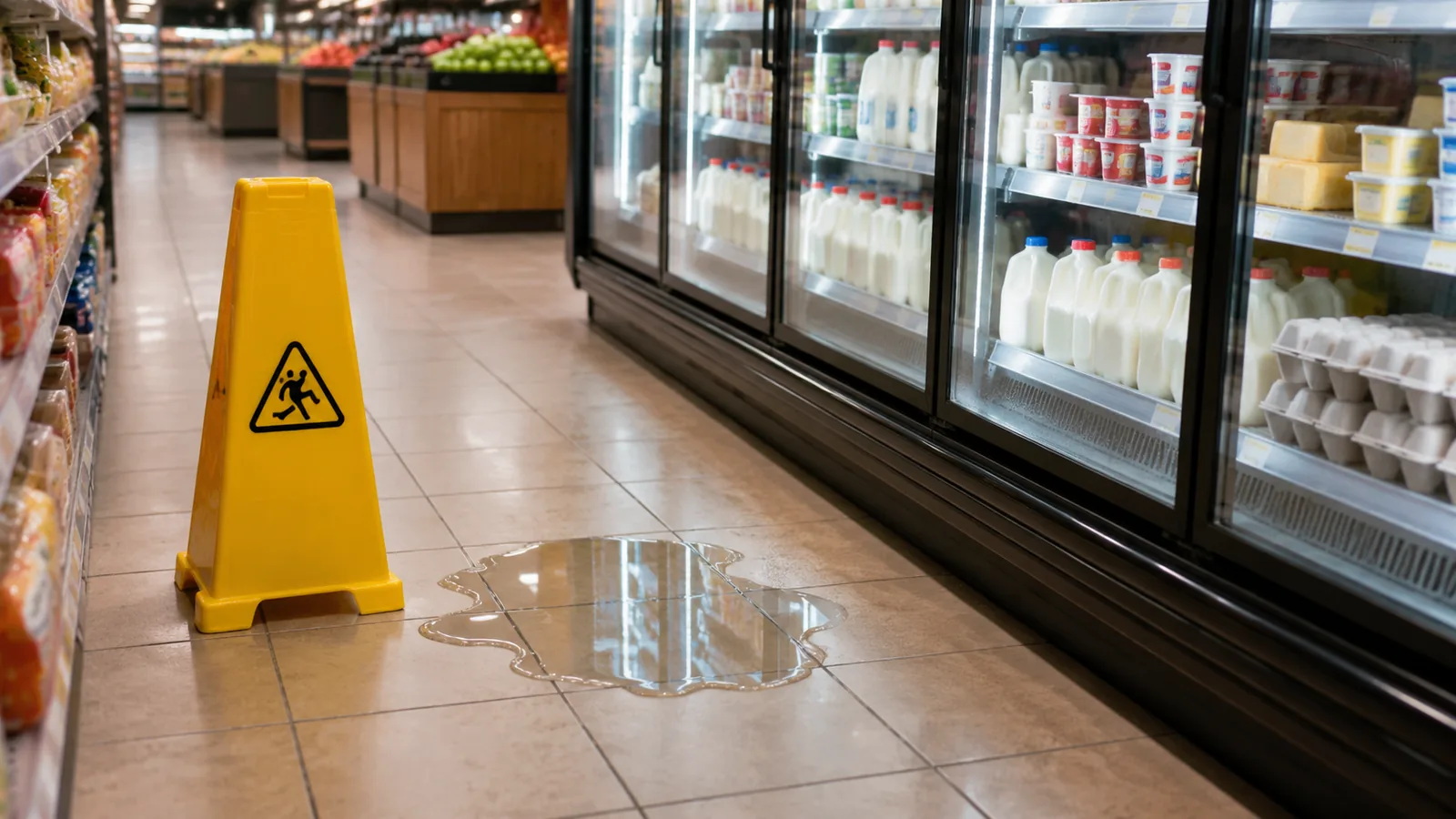
To win a Texas Kroger spill case, you usually have to show the store knew, or should have known, about the specific hazard at the time and place you fell. That can be a report, an employee who saw it, proof the store put it there, or evidence of how long it sat on the floor. A nearby employee or a written inspection policy doesn't prove notice by itself.
Three ways notice gets proved, with a grocery example of each (hypothetical)
- The store put the hazard there, such as when a stocking clerk's mop bucket leaks by the dairy cooler door.
- The store actually knew, such as when a shopper warns a clerk about water by the frozen-food case at 4:55 p.m.
- The hazard was there long enough to find, such as when video shows the same puddle in frame well before the fall.
What usually falls short, route by route
- Proof the store sells the product that spilled.
- "Someone mentioned water earlier," with no name, place or time.
- An employee nearby, with no evidence of how long the spill was there.
This guide is part of our Kroger injury knowledge hub. If you were hurt, tell us about your Kroger fall or call (214) 200-4878.
Bring this
- Store address, date and time, since they fix the shift and the video window.
- The exact spot in the store, since notice is about this place, not the store in general.
- The incident report reference, which leads to the store's own account.
- Original photographs, since the files keep the camera's recorded time.
- Witness details and treatment information, since they can show how long the hazard was there and what it did to you.
What does a hurt Kroger shopper have to prove?
A shopper is an invitee and must prove four elements, starting with the store's actual or constructive knowledge of the condition.
Keetch v. Kroger Co., 845 S.W.2d 262, 264 (Tex. 1992), citing Corbin v. Safeway Stores, Inc., 648 S.W.2d at 296, lists them: (1) the store actually knew, or reasonably should have known, about the condition; (2) the condition posed an unreasonable risk of harm; (3) the store failed to exercise reasonable care to reduce or eliminate the risk; and (4) that failure proximately caused the injury. [S21] [S4]
Keetch is itself a Kroger case. Keetch fell about 30 minutes after plants were sprayed, and the argument that a store which creates a condition must know about it didn't carry the day: creating the condition is relevant to knowledge but doesn't establish it as a matter of law. The opinion also keeps negligent activity apart from premises defects. An activity claim needs injury by or as a contemporaneous result of the activity itself; otherwise it's a premises condition claim.
Is a photo of the spill proof that Kroger knew?
No; a photo shows the liquid after the fall, not who knew about it or for how long.
The same photo could mean
- A customer who spilled a drink seconds earlier, told apart by video of the aisle in the minutes before the fall.
- An employee who got a warning and didn't act, told apart by the original message, form or the person who gave the warning.
- A leaking cooler that kept wetting the floor, told apart by repair tickets for that specific fixture.
- A witness who walked past it earlier, told apart by the witness's own words, kept as a range if that's all they can give.
How do you prove a Kroger employee actually knew?
By tracing the warning from the person who saw the hazard to the employee who heard about it, then pinning down the words, the timing and the response.
| Link | Pin down |
|---|---|
| Observer | Name, position, and what they actually saw. |
| Employee told | Who it was, and whether they were responsible for the area. |
| The words used | Whether they describe the same spot and the same condition. |
| Timing and response | When it was said, what was done, and the original message or form. |
| Store says it was a restroom leak | Records showing where the reported leak was. |
| Witness can't name the employee | Keep that limit on the record; look for independent sources linking the same hazard. |
"Someone mentioned water earlier" justifies questions. It isn't a confirmed admission that management ignored this precise spill for an hour.
How long does a spill have to be on the floor in Texas?
There's no fixed number of minutes, but the shopper needs some evidence of how long that specific hazard existed. Employee proximity alone doesn't satisfy the time-notice rule. [S2] [S5] [S19]
| Time anchor | What to check |
|---|---|
| A receipt or a text | The send time, which may differ from when the author first saw the hazard. |
| A camera timestamp | Clock accuracy, and whether a cart blocked the view. |
| A log entry at 2:00 p.m. | Whether it marks the start, the finish, or a later write-up. |
| An object on video | Whether it stayed in one place and wasn't removed and replaced; blocked stretches stay unknown. |
In Wal-Mart Stores, Inc. v. Reece (Tex. 2002), a customer fell on clear liquid at a snack bar, and the Court reversed and rendered for the store. Reece sets out three notice routes. The third, the time-notice rule, needs temporal evidence, and proximity and conspicuity don't replace it.
In Wal-Mart Stores, Inc. v. Spates (Tex. 2006), the hazard was an empty six-pack ring in a soft-drink aisle. It sat behind an employee's back, 3 to 5 feet away, for 30 to 45 seconds. That was no evidence of constructive notice, and summary judgment was reinstated.
Peterson describes Brookshire Bros., Ltd. v. Aldridge (Tex. 2014) as a case where video of employees repeatedly passing a large grease spill within five minutes before the fall was some evidence of constructive knowledge.
In H-E-B, LP v. Peterson (Tex. 2026), the Court held that a shopper answering a no-evidence summary judgment motion must show some evidence of duration. Puddle size alone doesn't do it. Summary judgment for H-E-B was reinstated.
Hypothetical: a produce tie and a blocked camera
The evidence here shows a five-minute observed interval. At first glance it seems to show twenty.
| Time | Record | Open point or effect |
|---|---|---|
| 5:10 p.m. | Last documented inspection | What the entry means, the route, and who did it. |
| 5:12 p.m. | An employee message about the same tie, if found | It adds an actual-notice route. |
| 5:15 p.m. | Video shows the aisle | Whether the floor is clear in the image. |
| 5:15 to 5:24 p.m. | A cart blocks the floor | Other cameras covering that stretch. |
| 5:24 p.m. | Another camera shows a customer dropping the tie, if found | The inference changes. |
| 5:25 p.m. | An object appears where the fall happens | Whether it's the object involved. |
| 5:30 p.m. | Fall; a witness says a produce tie was there "for a while" | An independent time anchor for the witness's phrase. |
Facts that hurt the first theory still get preserved. Get the earlier footage fast; our guide to preserving Kroger surveillance evidence explains how.
Neither "five minutes wins" nor "twenty minutes wins" is automatic, since visibility and nearby work matter. Severity doesn't prove notice either.
Hypothetical: water at a refrigerated case
Two intervals answer different questions: three minutes since the first sighting, twenty since the reported inspection.
- Three minutes, which measures the gap between a witness first seeing water at 5:17 and the fall at 5:20 p.m. It says nothing about the floor before 5:17.
- Twenty minutes, which measures the time since an inspection a manager says occurred at 5:00. The record is silent on the floor at 5:00.
An authenticated 4:55 message reporting a leak at the same fixture, with the leak persisting, would make a much stronger actual-knowledge case. If it concerned another fixture, it would show much less. A timeline with times only gives the order of events; location and source need their own columns.
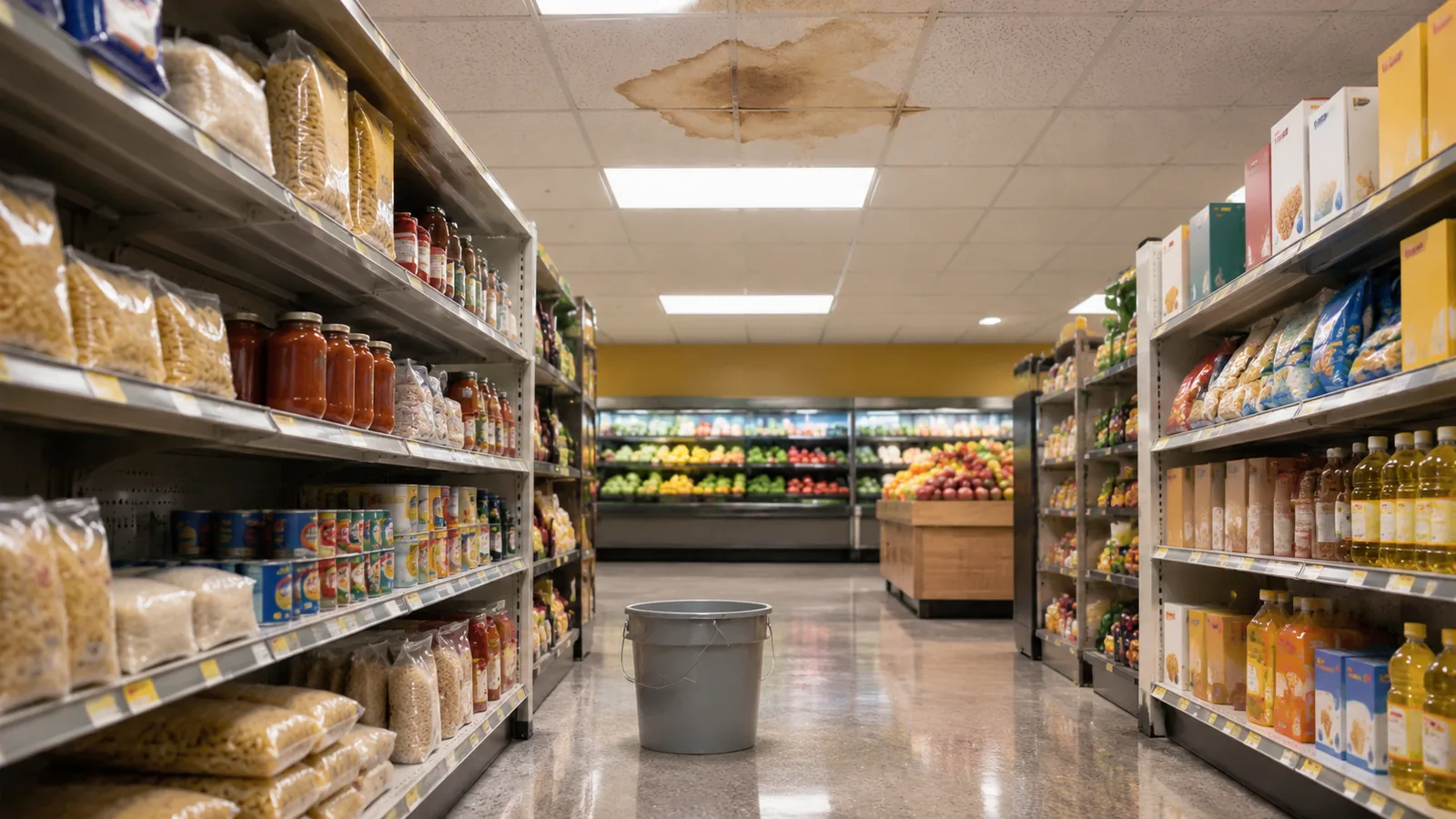
Do leaks elsewhere in the store prove Kroger knew?
Usually not; Texas courts look for knowledge of the dangerous condition at the time and place of the injury.
| Case | Facts | Holding |
|---|---|---|
| Albertsons, LLC v. Mohammadi (Tex. 2024) | Water near a bank branch and restroom in a Randall's store | Knowledge must be of the condition "at the time and place" of injury, not an earlier situation that produced it; take-nothing judgment reinstated. |
| H-E-B, LP v. Peterson (Tex. 2026) | Puddle in the toy aisle; earlier roof leaks elsewhere from a remodel; heightened rainy-day inspections; video showed no employee in the aisle in the two hours after the rain stopped | Leaks elsewhere weren't notice of this puddle; rain and a drip speak to cause, not duration. |
| City of San Antonio v. Rodriguez (Tex. 1996), as discussed in Peterson | Roof leaks and a wet floor | A leak in the vicinity of the liquid can still matter. |
Mohammadi quoted Brookshire Grocery Co. v. Taylor, 222 S.W.3d 406, 407 (Tex. 2006). Peterson doesn't end actual-knowledge claims, and roof repair records may still support other elements. [S20] [S19]
Gather
- Rainfall for the date, since it shows a possible cause, not duration.
- Repairs to the roof above that aisle, since a nearby leak counts more and an old repair doesn't prove a leak on the date.
- Where buckets, cones and signs were; in Peterson, none were in the toy aisle.
- Who controlled the roof, since it can bring in a landlord or contractor.
Can a refrigeration repair record show notice?
It can, if the ticket reports water at the same case before the fall and the problem remained.
- Equipment identifier, to verify it's the same dairy cooler or frozen-food case.
- Description, to verify whether it reports floor water or only warm product.
- Recipient and response, to verify who got it and what they did.
- Completion date, since a repair days earlier may show the condition was addressed.
- Outside contractor, since notice to a vendor isn't automatically notice to the store; our guide to identifying the responsible defendant covers adding one.
Does every grocery hazard use the same notice proof?
No; a cooler puddle, a grape under an open bin and a curled entrance mat each need different evidence.
- Source, duration, complaints and inspection opportunities, for a puddle at the dairy cooler.
- The arrangement and what the store knew about its risk, for a grape beneath the self-service grape bin.
- Installation, movement, inspection and earlier reports, for a curled mat inside the automatic doors.
- Nothing on its own, for a spill at another Kroger; unrelated spills don't show knowledge of this one.
Can a produce display itself be the hazard Kroger knew about?
Sometimes, if evidence shows the store knew a particular display created an unusually high, continual risk.
In Corbin v. Safeway Stores, Inc. (Tex. 1983), the display was a self-service grape bin on linoleum with no mat, known to be a continual source of slippery grapes. The Court found a jury question on the display theory, reversed a directed verdict and remanded for a new trial, without finding Safeway liable.
In H.E. Butt Grocery Co. v. Resendez (Tex. 1999), the sampling display had a recessed bowl, railing, mats, non-skid floor and cones. The display alone wasn't evidence of unreasonable risk, and the Court reversed and rendered for the store.
Selling loose produce doesn't prove a dangerous display. Plead it only when facts support it, and check later cases before using Corbin against a duration challenge. [S4]
| Display evidence | Its limit |
|---|---|
| Photos and layout instructions | They may not match the accident-day setup. |
| Earlier reports about the same configuration | They need time and similarity limits. |
| Unrelated falls in other departments | They can't prove this arrangement carried the known risk. |
Does a Kroger inspection policy prove the store knew?
No; under Peterson an internal policy doesn't raise the standard of care or show how long a hazard existed.
- Which version applied here, on this date, since an online policy may not have governed the store.
- Whether this aisle was on the route, since checklists and actual practice can differ.
- Whether a check was missed, which may bear on reasonable care, tied to what a proper check would have found.
- A missing or completed entry, since missing doesn't prove no inspection and completed doesn't prove an adequate one.
- Every departure from a manual, which isn't its own cause of action; our guide to Kroger fall discovery covers focused record requests.
How should witnesses separate what they saw from what they assumed?
Ask where they stood and what they could see before offering any timeline.
Ask about
- Position, lighting and distance, since someone facing away may know when an employee arrived but not whether the floor was checked.
- Where a time estimate came from, since a duration heard in a family conversation isn't memory.
- Specific exhibits at deposition, since testimony tied to a document is usable.
- Store software fields, which call for the proper system witness, not any manager.
How does notice evidence hold up at summary judgment and trial?
Only proper evidence counts against a summary judgment motion, so chart each element early.
For each item, record
- The element, for which notice route or other element it supports.
- The foundation, for who authenticates it under Texas Rule of Evidence 901 and any hearsay issue. [S7]
- The inference, for what the factfinder is asked to conclude.
In H-E-B, LP v. Peterson (Tex. 2026), the Court noted that motions filed before March 1, 2026 follow the old Rule 166a and that, apart from deadlines, the rewrite isn't meant to change the law. [S19] For motions filed on or after that date, Rule 166a sets the response within 21 days after filing, absent leave or agreement. [S6] [S17]
- A no-evidence motion under Rule 166a(b)(3)(B) still requires adequate time for discovery, so missing records are worth chasing early.
- A request for more time identifies the material, the efforts made and why it's essential.
- A trial timeline labels unknown periods instead of drawing a solid line between two sightings.
The store's defenses are covered in our guide to Kroger fall defenses and summary judgment.
How does the notice question affect settlement?
Better notice proof can shift litigation risk, but no formula turns it into a settlement figure.
| Situation | What it means |
|---|---|
| High bills with weak notice evidence | The store can still contest knowledge. |
| Video showing the spill happened just before the fall | Reassess honestly, before avoidable expense. |
| "What do Kroger cases settle for?" | Our sources have no reliable statewide Kroger injury count, settlement average, or policy limit. |
Questions people ask about proving Kroger knew about a spill
Does an employee standing nearby prove the store knew?
No; it needs some evidence of how long the hazard was there.
Is there a set number of minutes?
No; Texas sets no fixed interval.
Does a roof leak elsewhere prove notice?
Usually not. Mohammadi requires knowledge of the condition at the time and place you fell.
What if I don't know how long the spill was there?
Say so. Video and witnesses are how that question gets answered.
Where should I start?
Read what to document after a Kroger fall, then the Kroger litigation guide.
How the firm can help
Aaron A. Herbert is Board Certified in Personal Injury Trial Law by the Texas Board of Legal Specialization, which isn't a guarantee or a ranking. [S1]
Ask any lawyer you consider
- Which notice theory fits the evidence now?
- What's missing, and how do we get it?
A useful answer includes these, in the same order.
- Placement, actual knowledge or duration.
- A specific video, record or witness, and a focused request.
The Law Firm of Aaron A. Herbert, P.C. can review your notice evidence. Tell us about your Kroger fall or call (214) 200-4878.
| Bring this | Why |
|---|---|
| Store address, date, exact location, and report reference | Notice is tied to a time and place. |
| Original photographs and witness details | They can anchor duration. |
| Treatment information | It shows the injury. |
Sources
- [S1] State Bar of Texas profile for Aaron A. Herbert.
- [S2] Wal-Mart Stores, Inc. v. Reece (Tex. 2002) and Wal-Mart Stores, Inc. v. Spates (Tex. 2006).
- [S4] Corbin v. Safeway Stores, Inc. (Tex. 1983) and H.E. Butt Grocery Co. v. Resendez (Tex. 1999).
- [S5] Brookshire Bros., Ltd. v. Aldridge (Tex. 2014).
- [S6] Texas Rules of Civil Procedure, Rule 166a.
- [S7] Texas Rules of Evidence, Rule 901.
- [S17] Misc. Docket No. 26-9012 (Tex. 2026).
- [S19] H-E-B, LP v. Peterson (Tex. 2026).
- [S20] Albertsons, LLC v. Mohammadi (Tex. 2024).
- [S21] Keetch v. Kroger Co. (Tex. 1992).
Kroger is named only to identify the store. This guide isn't affiliated with or endorsed by Kroger.

ABOUT THE ATTORNEY
Aaron A. Herbert
Founding Attorney
Board Certified in Personal Injury Trial Law
Aaron founded The Law Firm of Aaron A. Herbert in 2010 to focus on developing each client's case and seeking its maximum value. For over a decade, he has represented people seriously injured in major accidents and industrial catastrophes, pursuing trial verdicts and settlements while working to reduce the stress of litigation.
Education
- Texas A&M University · B.S., Criminal Justice, 1999
- University of Oklahoma College of Law · J.D., 2002; graduated in the top of his class
Trial experience & approach
Aaron earned numerous jury verdicts at boutique personal injury litigation firms. According to his biography, he spent a year as the top-earning litigation attorney at a firm that frequently appeared in verdict searches as having one of the highest numbers of trial wins in Texas. At another Dallas personal injury firm, he moved from managing pre-litigation attorney to managing litigation attorney over seven years as the firm grew into one of Dallas's largest personal injury firms.
His biography describes a reputation as one of America's most aggressive trial lawyers, with noteworthy recoveries from judges and juries and substantial pretrial settlements. Most of those settlements included confidentiality agreements requested by the defense. Aaron has said the recoveries were justified by the injuries and losses involved, which no amount of money could make someone choose to experience.
His approach combines passion, preparation, persistence and courtroom imagination. He believes a well-supported, engaged and motivated team working cooperatively helps deliver strong representation, with the goal of achieving the best possible result for every client.
Dallas roots, military service & publication
Born and raised in Dallas, Aaron enlisted in the United States Marine Corps after high school and later received an Honorable Discharge. He completed his university and law degrees after his military service and became a lifelong Sooners football fan in law school.
Publication: “Litigating Dog Bite Cases,” Texas Dog Law Seminar, Dallas, 2009.
Professional affiliations & recognition
Professional affiliations and recognition listed in Aaron’s biography:
- State Bar of Texas
- American Bar Association
- Association of Trial Lawyers of America (now American Association for Justice)
- Texas Trial Lawyers Association
- Dallas Trial Lawyers Association
- Dallas Bar Association
- Tarrant County Bar Association
- Million Dollar Advocates Forum
- The National Trial Lawyers – Top 100 Trial Lawyers