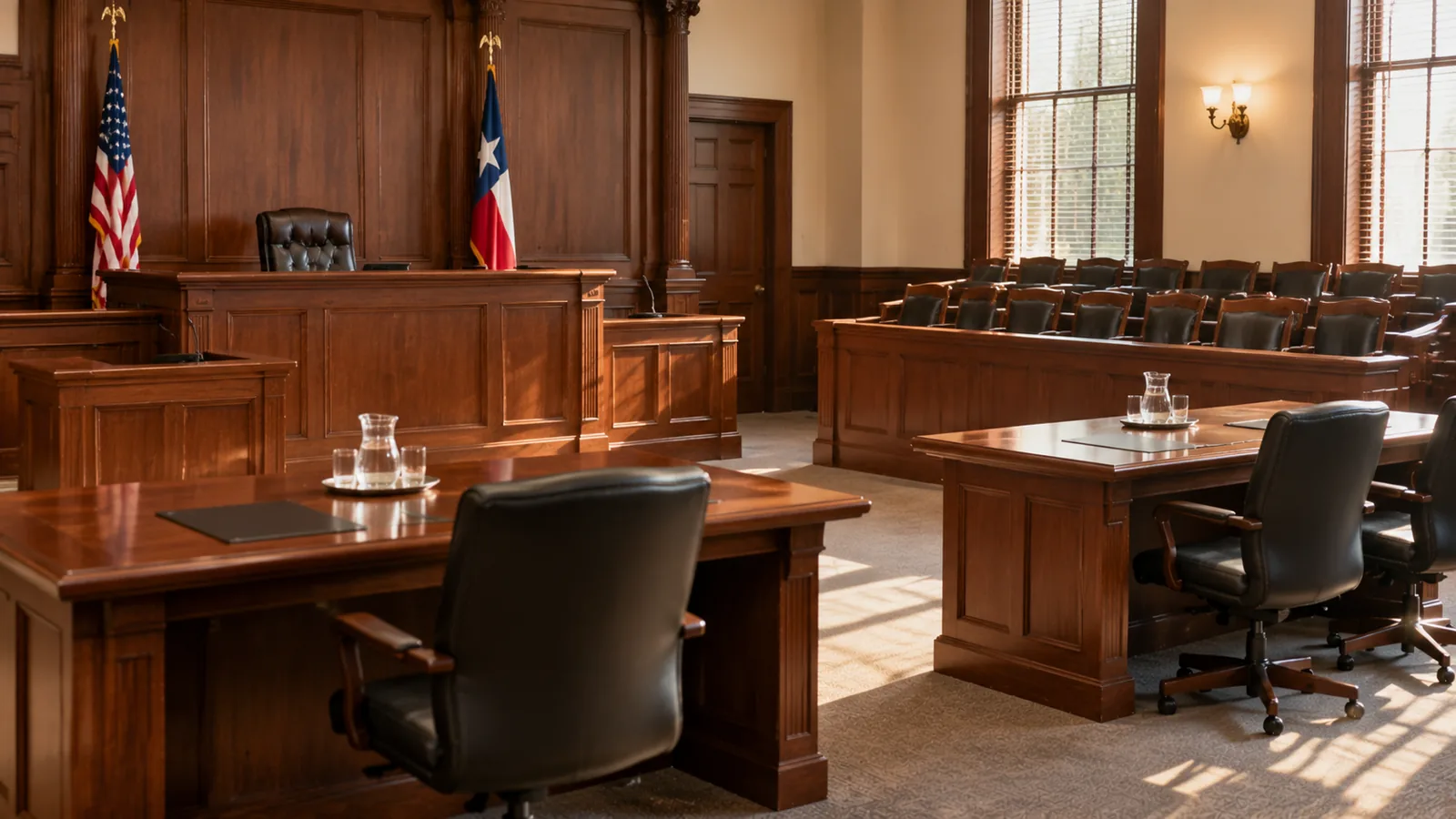
Getting a Kroger injury case ready for trial means building it around admissible evidence and the questions the jury will actually answer. Voir dire looks for bias within the court's limits, not verdict promises. Each witness stays inside their own foundation. Mediation weighs documented strengths, weaknesses, costs and your priorities. Preparation improves decisions; it doesn't guarantee Kroger will settle or pay a set amount.
| Stage | What it's for | What it isn't |
|---|---|---|
| Jury selection | Finding bias that keeps a juror from following the law. | A way to get promises about a verdict. |
| Witnesses and exhibits | Proving each disputed point with proper foundation. | One witness carrying everything. |
| Mediation | A confidential, informed settlement decision. | A mediator deciding the case. |
| The charge and record | Preserving complaints for appeal. | Something to fix after the jury leaves. |
This guide is part of our Kroger injury knowledge hub. If you were hurt, tell us about your Kroger fall or call (214) 200-4878.
Bring this
- Store address, date and exact location in the store, since the proof has to match one place and time.
- The incident report reference, which is often an early exhibit.
- Original photographs, since originals avoid authentication fights.
- Witness details, since someone has to testify to what they saw.
- Treatment information, which connects the fall to the harm.
What issue decides a Kroger fall trial?
Usually one or two disputed facts, such as spill duration, a recurring leak, a display, a cart's condition or medical causation.
| Usable theme | Overstated theme |
|---|---|
| "The same obstruction remained after the report." | "Stores must prevent every fall." |
| "The cooler leak was reported at 4:55, and nobody came." (hypothetical) | "Big retailers never care about customers." |
| "The fall aggravated a shoulder that had been fine for years." (hypothetical) | "Any pain after a fall proves the fall caused it." |
A usable theme is specific enough to test; the first one depends on proof of identity, timing and response. Work backward from the anticipated charge to find which witness or exhibit supports each point.
Witness or exhibit for each element under the theory (hypothetical)
Condition and duty The produce clerk, photographs of the frozen-food case.
Knowledge The 4:55 p.m. message, the store's response log.
Response Video of the aisle between the report and the fall.
Causation The treating orthopedist.
If a link is missing, fix it before trial. Severity alone can leave the notice question unanswered, and a complete premises case can still fail to show what the injury changed in a person's life.
| For the client | Why it matters |
|---|---|
| Trial focuses on a few disputed facts. | The court's questions organize what must be proved. |
| Not every frustrating event gets told. | Your full experience matters, but the jury questions set the frame. |
| Unfavorable facts get explained. | Hiding them weakens credibility; the defense can fairly raise them. |
What can lawyers ask jurors in voir dire?
Lawyers can explore attitudes and bias, but the court controls the questioning and commitment-question limits apply.
Lawyers may uncover attitudes about injury suits, corporations, prior conditions and damages, ask whether a belief would stop a juror from following the instructions, follow up on a concern with open questions and look at a juror's actual answers. They may not ask for a promise to find liability on selected facts or for a commitment to a specific damages number after a preview of injuries. A detailed hypothetical followed by a demand for a result is also out of bounds, as are stereotypes about occupation, age or shopping habits and prohibited discrimination.
Review proposed questions against current authority, local practice and the judge's directions. Texas rules add specific limits. [S6]
What the Texas rules say
Rule 228 A challenge for cause alleges a fact that legally disqualifies a juror or, in the court's opinion, makes the juror unfit; other evidence may be heard.
Rule 230 Jurors can't be asked questions whose answers may show a disqualifying conviction or a pending theft or felony charge.
Rule 233 Each party gets six peremptory challenges in district court and three in county court, adjusted when multiple parties are aligned.
Rule 226a Sets the instructions given to the jury panel and jury.
A skeptical person may still apply the instructions fairly; another may reveal a fixed belief that prevents it. Preserve the actual answer, and never turn a moderate concern into a claimed inability to be fair.
What the challenge record needs
The juror's own words A truthful record, not a paraphrase.
A proper, timely challenge Preservation under the rules and the court's procedure.
A sample voir dire question bank
These are proposed teaching prompts, subject to attorney review and the court's rulings, not approved questions for any trial.
Issue, and a proposed opening prompt
Injury claims
What concerns come to mind when you hear about an injury lawsuit?
Corporate parties
What experiences might affect how you evaluate a retail business as a party?
Prior conditions
Would you automatically reject a claim that a fall made an earlier condition worse?
Personal responsibility
Do you believe a shopper should always lose if a condition could have been seen?
Invisible symptoms
What concerns do you have about symptoms that don't show up in a photograph?
Each follow-up asks whether the belief would stop the person from following the court's actual instructions. Fair jury selection means a panel that decides the evidence under the law, not one that automatically favors plaintiffs.
Juror answer, and a follow-up (hypothetical)
"I think a lot of these suits are about money." "Would that stop you from following the judge's instructions on the evidence?"
"I've worked retail for twenty years." "How might that shape how you see a store's inspection records?"
How should witnesses be organized?
Each witness proves what they personally know or are qualified to explain, in an order the jury can follow.
What each witness proves
- Position, opportunity to observe and the sequence, for a scene witness.
- How the system works and the foundation, for a records custodian.
- History, findings, causation and prognosis, for a treating provider.
- Method and fit, for a retained expert.
Scene orientation usually comes before technical testimony, and medical testimony is clearer once a supported mechanism is in.
| Witness | Keep them from |
|---|---|
| Scene witness | Guessing about timing they didn't see. |
| Records custodian | Interpreting fields they don't manage. |
| Treating provider | Blending those four together. |
| Retained expert | Carrying issues outside the expertise. |
Coordinate exhibits and terms, but keep each person's independent account; consistency should come from accurate preparation, not scripting.
Preparing the client
- Reviewing earlier statements and records, so differences can be explained accurately.
- Testifying truthfully, including uncertainty, since a memorized narrative can override real memory.
- Learning courtroom procedure, breaks and accommodations, which reduces anxiety without manufacturing testimony.
Using demonstratives that show their limits
A demonstrative should separate what was observed from what is inferred or unknown.
What each exhibit should disclose
- Verified events, estimates and unknown periods, labeled, for a timeline.
- Whether it's to scale and which dimensions were measured or reconstructed, for a floor diagram.
- Context, speed changes and annotations, for a video excerpt.
- The event, diagnosis, treatment and projected care, kept separate, for a medical chart.
- Its assumptions, with appropriate rulings first, for an animation or reconstruction.
Don't draw a continuous puddle across an unrecorded interval, or put an invisible spill into an animation just because the shopper says it was there.
Check before trial
- A permitted printed backup, ready in case software fails.
- Readability, playback and page references, confirmed in the courtroom.
- A simple printed timeline, which may communicate better than a complicated visual.
An aid explains testimony without pretending to add new evidence.
Cross-examining the store's witnesses and experts
Test the proposition, not the person, with a focused sequence supported by documents.
What to test with each witness
- Timing, route, what they could observe and what each record field means, for the store inspection witness.
- The gap between general practice and this aisle, shown respectfully, for a manager with no memory of the aisle.
- Exports, clocks and limits, for the system custodian, with clocks reconciled before showing a contradiction.
- History, assumptions and alternative causes, for the defense medical expert.
- A later dry-floor test of a wet-floor fall, or a configuration that changed, for the defense floor or scene expert.
Being paid doesn't make an expert unreliable; point to the mismatch between method and issue. Counsel's question isn't evidence, so don't slip unsupported facts in through questions. Our guide to choosing expert witnesses covers both sides' experts.
Apply the same test to your own witnesses
- Testimony limited to what they saw, for a family member who didn't see the contact.
- A time presented accurately as approximate, for a client who gave an approximate time.
- A check that it doesn't assume restrictions the doctor never gave, for a vocational projection.
What lessons do Kroger appellate cases offer for trial?
Showing a fall on video doesn't prove how long the hazard was there, and proving an equipment problem doesn't prove the store knew.
| Case | Lesson for trial preparation |
|---|---|
| Anderson-Brown v. Kroger Texas, L.P. (5th Cir. 2023) (unpublished, not controlling) | A picture, a video that partly showed the fall, and the store's opening time didn't show how long the puddle existed; summary judgment affirmed. |
| Kroger Co. v. Shaw (Tex. App.-Houston [1st Dist.] 2009) | Proof of a motorized-cart charging-cord problem didn't settle knowledge; the verdict was reversed and judgment rendered for Kroger. |
Evaluate each exhibit by element, not by dramatic impact. A vivid video helps, but ask whether the rest of the record supplies the missing proof; our guide to preserving Kroger surveillance evidence explains getting the earlier footage. [S15] [S16]
The element an exhibit may not prove
- Duration of the hazard, for video of the fall itself.
- That the store knew of the risk, for a photo of a frayed cord.
How does mediation work in a Texas Kroger case?
A mediator helps the sides talk and may not impose a decision or force a settlement; the client decides.
What the Texas mediation rules mean for you
CPRC 154.023 The mediator facilitates communication and may not impose their own judgment on the issues.
CPRC 154.053 The mediator may not compel or coerce a settlement and keeps confidences unless authorized.
CPRC 154.073 Communications in mediation are generally confidential and can't be used as evidence against you, with listed exceptions; facts provable independently stay provable.
CPRC 154.071 A signed written settlement agreement is enforceable like any other written contract.
Texas Rule of Evidence 408 Offers and negotiation statements aren't admissible to prove or disprove the validity or amount of the claim, though a court may admit them for another purpose, such as bias.
| Prepare the client for | What to discuss |
|---|---|
| The mediation brief | It should include weaknesses the defense already knows, such as a short duration, an unclear mechanism, or a large prior condition; candor explains the issue without abandoning the claim. [S26] [S7] |
Trial preparation doesn't guarantee a higher offer. Mediation can still narrow issues or show what information would change the evaluation.
Also prepare the client for
Proposals, breaks and uncertainty
An opening number doesn't predict the final result.
Net recovery estimates
Gross and net stay separate; our guide to medical proof and damages explains why.
Further expense and what happens without agreement
What the next phase may cost and what it could resolve.
The decision itself
The client decides whether to settle, after advice and with time to think.
"What do Kroger cases settle for?"
Our sources have no reliable Kroger settlement average.
If terms are agreed, review
The release Its scope and the covered parties.
Payment Timing and method.
Reimbursement issues and other obligations Duties that last beyond payment.
Preserving the record and explaining the outcome
Complaints about the charge and excluded evidence have to be made on time and in the right form. Current rules and case orders control, and federal procedure needs separate attention. [S6] [S7] [S11]
What the Texas charge rules require
Rule 273 Requested questions, definitions and instructions go in writing, separate from objections.
Rule 274 An objection must distinctly point out the matter and the grounds.
Rule 277 Broad-form questions whenever feasible; a percentage question when the jury apportions responsibility; no direct comment on the weight of the evidence.
Rule 278 Failing to submit a question generally isn't reversible unless a substantially correct version was requested in writing and tendered.
Rule 279 Grounds neither submitted nor requested are generally waived on appeal.
Preserve excluded evidence through the proper procedure; a complaint made after the jury leaves may be too late.
What to keep closing argument tied to
Admitted evidence The submitted questions.
Economic damages Supported calculations.
Noneconomic damages A reasoned basis under controlling law, not corporate wealth or an unrelated headline verdict.
A lost recording Only the instruction the court actually gave.
After a verdict or settlement, the client needs a realistic explanation of what's next.
What remains
- Judgment and post-trial deadlines, since a verdict isn't the final collectible amount.
- A possible appeal, since payment may not be immediate.
- Payment, reimbursement and accounting, with every deduction explained.
Questions people ask about Kroger trials and mediation
| Question | Short answer |
|---|---|
| Can my lawyer ask jurors to promise a verdict? | No; voir dire tests bias, and commitment questions are limited. |
| Does the mediator decide my case? | No; a Texas mediator can't impose a decision or force a settlement. |
| Can Kroger use what I said at mediation against me? | Generally no, under CPRC 154.073 and Rule 408, with exceptions. |
| Who decides whether to settle? | You do, after advice. |
| Does a verdict mean I'm paid right away? | Not necessarily; judgment, post-trial steps, and appeals can follow. |
How the firm can help
Aaron A. Herbert is Board Certified in Personal Injury Trial Law by the Texas Board of Legal Specialization, which isn't a guarantee or a ranking, nor a promise of a Kroger verdict or that every claim will be accepted. [S1]
Ask any lawyer you consider
- The decisive issue.
- How the record would be shown to a jury and how that shapes settlement advice.
- Fees, expenses and communication.
- For referring lawyers, who handles what.
A useful answer to each, in the same order.
- One tied to your facts, with the unknowns named.
- A plan that connects both.
- Written into the actual engagement agreement.
- Examinations, experts, client communication and post-verdict work assigned.
The Law Firm of Aaron A. Herbert, P.C. can review your case and any litigation papers. Start with the Kroger litigation guide or our guide to Kroger fall defenses and summary judgment, then tell us about your Kroger fall or call (214) 200-4878.
Bring this
- Store address, date, exact location and report reference, since the case is tied to a time and place.
- Original photographs and witness details, since they're the trial evidence.
- Treatment information and litigation documents, since they show the injury and the case's stage.
Sources
Kroger is named only to identify the store. This guide isn't affiliated with or endorsed by Kroger.
| Source | What it supports |
|---|---|
| [S1] State Bar of Texas profile for Aaron A. Herbert | Board certification by the Texas Board of Legal Specialization. |
| [S6] Texas Rules of Civil Procedure, Rules 226a through 279 | Jury selection, the charge, and preservation. |
| [S7] Texas Rules of Evidence, Rule 408 | Compromise offers and negotiations. |
| [S11] Federal Rules of Civil Procedure and Evidence | Federal procedure. |
| [S15] Anderson-Brown v. Kroger Texas, L.P. (5th Cir. 2023) | Video of a fall and duration. |
| [S16] Kroger Co. v. Shaw (Tex. App. 2009) | Equipment evidence and knowledge. |
| [S26] Tex. Civ. Prac. & Rem. Code ch. 154 | Mediation and confidentiality. |

ABOUT THE ATTORNEY
Aaron A. Herbert
Founding Attorney
Board Certified in Personal Injury Trial Law
Aaron founded The Law Firm of Aaron A. Herbert in 2010 to focus on developing each client's case and seeking its maximum value. For over a decade, he has represented people seriously injured in major accidents and industrial catastrophes, pursuing trial verdicts and settlements while working to reduce the stress of litigation.
Education
- Texas A&M University · B.S., Criminal Justice, 1999
- University of Oklahoma College of Law · J.D., 2002; graduated in the top of his class
Trial experience & approach
Aaron earned numerous jury verdicts at boutique personal injury litigation firms. According to his biography, he spent a year as the top-earning litigation attorney at a firm that frequently appeared in verdict searches as having one of the highest numbers of trial wins in Texas. At another Dallas personal injury firm, he moved from managing pre-litigation attorney to managing litigation attorney over seven years as the firm grew into one of Dallas's largest personal injury firms.
His biography describes a reputation as one of America's most aggressive trial lawyers, with noteworthy recoveries from judges and juries and substantial pretrial settlements. Most of those settlements included confidentiality agreements requested by the defense. Aaron has said the recoveries were justified by the injuries and losses involved, which no amount of money could make someone choose to experience.
His approach combines passion, preparation, persistence and courtroom imagination. He believes a well-supported, engaged and motivated team working cooperatively helps deliver strong representation, with the goal of achieving the best possible result for every client.
Dallas roots, military service & publication
Born and raised in Dallas, Aaron enlisted in the United States Marine Corps after high school and later received an Honorable Discharge. He completed his university and law degrees after his military service and became a lifelong Sooners football fan in law school.
Publication: “Litigating Dog Bite Cases,” Texas Dog Law Seminar, Dallas, 2009.
Professional affiliations & recognition
Professional affiliations and recognition listed in Aaron’s biography:
- State Bar of Texas
- American Bar Association
- Association of Trial Lawyers of America (now American Association for Justice)
- Texas Trial Lawyers Association
- Dallas Trial Lawyers Association
- Dallas Bar Association
- Tarrant County Bar Association
- Million Dollar Advocates Forum
- The National Trial Lawyers – Top 100 Trial Lawyers