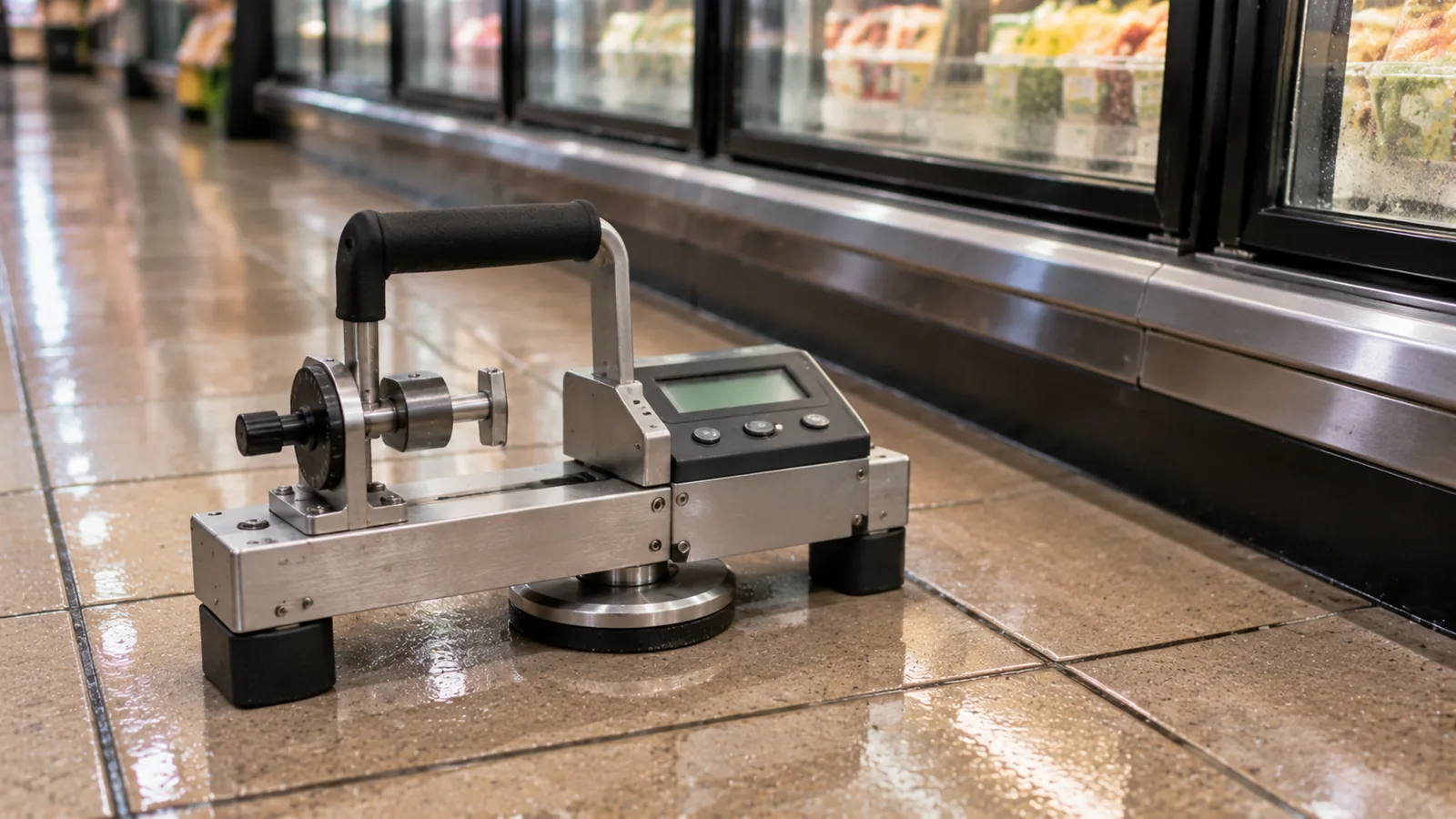
Hire an expert in a Kroger fall case only when a disputed question needs specialized knowledge a jury can't supply on its own. Match the discipline, method and data to that question. A safety expert can't fill in missing notice evidence, and an economist can't invent medical restrictions. Qualifications, a reliable method, a fit with the facts and timely disclosure all count.
Disputed questions
- Was the wet floor by the dairy cooler unusually slick?
- Did the frozen-food case leak from a drain or defrost line?
- Did the shoulder injury come from the fall?
- Can you go back to your old job?
The expert who might help, in the same order.
- A floor-safety or traction specialist.
- A refrigeration technician or engineer.
- The treating doctor or a retained medical expert.
- A vocational expert.
What that expert can't do, in the same order.
- Prove the store knew about the water.
- Show how long the puddle sat there.
- Decide fault for the fall.
- Create restrictions no doctor gave.
This guide is part of our Kroger injury knowledge hub. If you were hurt, tell us about your Kroger fall or call (214) 200-4878.
Bring this
- The store address, date, exact spot and incident report reference, for the real scene and the store's own description.
- Original photographs and witness details, for the condition no one tested.
- Treatment information and work history, for the starting point of medical and vocational opinions.
What question should the expert answer?
Write the disputed question in plain words before looking at anyone's resume.
| Too broad | Better assignment |
|---|---|
| "Prove Kroger was negligent." | "Was the entry mat inside the automatic doors curled on the date of the fall, and by how much?" |
| "Explain the video." | "Is the recorder's clock right, and is the export complete?" |
| "Show the injury is serious." | "Did the fall aggravate an earlier shoulder condition?" |
A broad instruction invites conclusions outside the witness's role. Ask what data the expert needs, and have the expert explain limits before major expense.
Data gaps
- A later clean-floor test.
- No reliable restrictions yet.
- No original mat.
What each may mean, in the same order.
- No answer about a particular liquid on the accident date.
- A premature vocational projection.
- A substitute test that may not show the original configuration.
Is an expert always needed?
No; a clear photograph, a fact witness or a treating doctor sometimes answers the question without a retained expert.
Situations
- A simple positional question about a pallet in the cereal aisle.
- An injury question the doctor already treats.
- A video timing question.
- A real contested technical dispute.
Possible alternatives, in the same order.
- Clear photographs and a fact witness.
- The treating physician.
- A knowledgeable records custodian.
- A retained expert, possibly worth the cost.
"More experts make a stronger claim." Not automatically; weigh complexity, the disputed issues and how useful the work would be.
Floor safety and friction testing
A traction number means something only if the method and conditions fit the surface and condition at the time of the fall.
Document these
- The instrument and its calibration or verification, so the number can be checked.
- The exact surface location, because a tile sample from another aisle may differ.
- The contaminant, footwear or test interface, because dry tile doesn't describe a wet aisle.
- Cleaning, wear, weather or resurfacing since the fall, because a replaced floor may not represent the original.
- Raw measurements, so the other side and the court can test them.
If the test can't recreate the event, the expert should say which limited questions it can answer. A dry test done months later may answer a different question from the wet condition alleged.
| If someone says | The careful answer |
|---|---|
| "The coefficient proves Kroger broke the law." | A standard isn't self-executing law; counsel evaluates adoption, applicability, and legal effect. |
| "One number is the legal threshold." | Standards vary in purpose, test method, and applicability. |
| "It has four decimal places, so it's exact." | Precision isn't reliability if the conditions don't fit. |
| "The expert decides admissibility." | The court decides admissibility; the jury weighs supported opinions under the instructions [S7] [S11]. |
Refrigeration, engineering and display opinions
Pick the discipline by the system involved: a cooler drain, a floor surface and a display's geometry are different questions.
| Grocery issue | Possible expert | Watch for |
|---|---|---|
| Suspected leak at a refrigerated case | Refrigeration expert | A temperature log may track product, not water on the floor. |
| Threshold, display projection or clearance | Engineer | A later measurement may not show the event-day condition; keep historical photos. |
| Component replaced after the fall | Any technical expert | It may not reproduce the earlier configuration. |
For a suspected cooler leak, a useful assignment asks whether the records and physical condition support the proposed source and timing, with alternative sources named. A broad safety title doesn't prove expertise in every store system; ask for relevant training, method and case-specific fit. Our guide to Kroger trip hazards covers the scene evidence behind these opinions.
What a reconstruction or code opinion needs
- Camera angle, lens distortion, scale and object movement, for photogrammetry or a scaled drawing.
- Each dimension marked measured, estimated or assumed and traceable to its source, for the same drawing or photogrammetry.
- The correct jurisdiction, version and provision, for a building or accessibility code.
- No implication that every deviation is negligence per se or a private damages claim, for a claimed code violation.
Human factors and visibility opinions
A visibility opinion has to rest on a supported reconstruction of what the approaching shopper could actually see.
| Factor | Why it matters |
|---|---|
| Shopper's position and line of sight | A close photo from above isn't the walking view. |
| Lighting, contrast, displays and carts | Clear liquid on light tile can vanish; a cart can block it. |
| Layout or lighting changes since the fall | A later reconstruction has to disclose them. |
An animation is a demonstrative aid, not independent proof that its assumptions are true, and the scope should stay clear of legal conclusions.
| Expert may say | Expert shouldn't say |
|---|---|
| How visible a condition was under supported conditions | Whether Kroger had legal notice; that's law applied to the proved facts. |
| What perception research suggests about attention | What a witness "must have seen" without addressing actual viewing conditions. |
Digital video and recording specialists
Call a digital specialist only when exports, clocks, frame timing or file integrity are genuinely disputed.
Start by asking whether a knowledgeable custodian and ordinary records can settle it.
What each tool can and can't show
- A hash value, which shows integrity after collection, not that the recorder caught the whole event or had the right time.
- Image enhancement, which gives better visibility of existing detail, never new detail the source can't support.
- Slowed or annotated clips, which are useful if clearly labeled.
- A vehicle-style reconstruction for a human fall, which is often unsupported because a limited camera view may not allow force or body-motion calculations.
A forensic engagement needs a defined purpose, lawful access and an evidence-handling plan; our guide to preserving Kroger surveillance evidence explains why technical certainty can't exceed the camera's view.
Keep
- The original file and a processing log, since every labeled version is checked against them.
Medical experts and treating providers
The medical witness should separate diagnosis, causation, prognosis and treatment recommendations.
What the record needs for each medical question
- An accurate event history and relevant baseline records, for causation.
- Whether it was asymptomatic, symptomatic or unrelated, for an earlier condition.
- A mechanism and chronology too, or the reasoning has a gap, for "symptoms started afterward."
- Likely services, timing, frequency and assumptions with a clinical basis, for future care.
- Different roles and disclosure duties, for treating versus retained; decide what each will say.
- Treatment decisions that belong to clinicians and patients, not every conceivable intervention added to raise a demand, for a care plan.
Vocational, economic and life-care testimony
Each of these experts depends on the one before it, so the chain starts with supported medical restrictions.
What each expert builds on
- Physician restrictions, skills, work history and realistic jobs, for a vocational expert.
- The vocational findings and disclosed assumptions, for an economist.
- Appropriate medical recommendations, quantities, duration and cost sources, for a life-care planner.
What each can't do, in the same order.
- Create the medical premise.
- Fix an unsupported assumption.
- Treat contingencies as certain.
A plan should separate existing needs, probable future needs and contingencies, and change when the doctor's recommendation does. Our guide to medical proof and damages covers the medical side.
Ask the lawyer
- Why is this specialist needed?
- What might the engagement cost?
- How are expert costs advanced and repaid under our agreement?
The reason for each, in the same order.
- A real disputed issue for the opinion to answer.
- Written terms before major commitments.
- No assumption that they disappear when the case resolves.
Hypothetical: choosing experts in order
In this hypothetical, a shopper says a curled mat caused the fall, has a prior shoulder condition and struggles to return to warehouse work.
| Question (hypothetical) | Possible discipline | Prerequisite |
|---|---|---|
| How the mat was configured | Fact witnesses, then engineering if needed | Reliable scene evidence. |
| Shoulder aggravation | Appropriate medical provider | Baseline and post-event records. |
| Work restrictions | Medical, then vocational | Supported functional limits. |
| Effect on future income | Economics if needed | A defensible vocational premise. |
The file has photographs after the fall but no original mat and incomplete baseline records. Hiring an economist first won't resolve whether the restrictions relate to the fall.
- Order matters, which means building the factual and medical foundation first; the matrix also shows when an opinion can't responsibly be reached.
- Fewer can be right, which means a lawyer may recommend fewer experts after reviewing the record, or more for a real technical dispute.
It's an illustration, not a Kroger case or a description of firm practice.
When must experts be designated in Texas state court?
Unless the court orders otherwise, Texas Rule of Civil Procedure 195.2 sets designation by dates tied to the end of the discovery period.
- Experts testifying for a party seeking affirmative relief, usually the injured shopper, are designated 90 days before the end of the discovery period.
- All other experts are designated 60 days before the end of the discovery period.
- If a scheduling order sets different dates for any party, the court's order controls; the rule comment notes a court may modify expert deadlines for good cause.
Rule 195.1 limits discovery about testifying experts to disclosures, depositions and reports. Rule 195.5(a) requires disclosure without waiting for a request. [S6]
Disclosures for a retained expert
- Materials provided to or prepared for the expert.
- A current resume and bibliography.
- Publications from the previous 10 years.
- Cases testified in during the previous four years.
- A compensation statement.
Other Rule 195 points
- Lawyer-expert communications are protected, except those about compensation, facts or data the lawyer provided that the expert considered, and assumptions the lawyer provided that the expert relied on.
- Draft reports and disclosures are protected from discovery.
- Changed opinions require amendment and supplementation, including a retained expert's deposition testimony or report (Rule 195.6).
- When one side deposes the other side's retained expert, the retaining party pays the expert's reasonable fees for that deposition time (Rule 195.7).
- Billing affidavit and counteraffidavit deadlines are tied partly to the expert designation deadlines (CPRC 18.001) [S9].
- In federal court, Federal Rule of Civil Procedure 26 and the scheduling order govern expert disclosure [S11].
How do Texas courts test an expert's opinion?
The trial judge decides whether an opinion comes in, using Texas Rules of Evidence 702 through 705 and controlling cases. [S7]
- A qualified expert may testify if specialized knowledge will help the jury understand the evidence or decide a fact (Rule 702).
- Facts or data experts in the field reasonably rely on need not be admissible themselves (Rule 703).
- An opinion isn't objectionable just because it embraces an ultimate issue (Rule 704).
- The other side may question the expert about the underlying facts outside the jury's hearing (Rule 705(b)).
- An opinion is inadmissible if the underlying facts or data don't provide a sufficient basis (Rule 705(c)).
Federal Rule of Evidence 702 was amended December 1, 2023 to say the proponent must show it's more likely than not that the testimony meets the rule; federal procedure needs separate review. [S11]
| Grocery example | What happened |
|---|---|
| H-E-B, LP v. Peterson (Tex. 2026), as the opinion describes the lower courts | The trial court excluded the shopper's expert report and testimony; the court of appeals affirmed exclusion of the expert's drip experiment as unreliable, and the shopper didn't seek Supreme Court review of that ruling. |
| What the Supreme Court said about the rest | It didn't decide the remaining expert testimony because that testimony didn't show how long the puddle existed [S19]. |
Preparing for a reliability or scope challenge
Read the report the way the other side will, before designation.
What to check
- Qualifications for this exact question, because a general safety resume isn't enough for every technical opinion.
- Underlying data, photographs and testing materials, since gaps found now can be fixed or the opinion narrowed.
- Assumptions and alternative explanations, because unsupported certainty invites exclusion.
- Disclosure rules, scheduling orders and deposition needs, since state and federal procedure differ.
- A promised later foundation, because nobody may have arranged to get it.
Late changes can create procedural problems even when they improve the science. Our guide to Kroger fall discovery covers getting the records an expert needs.
At trial
- Direct examination, which covers what the expert did, why the method fits and how the conclusion follows; our guide to Kroger trial and mediation covers presentation.
- Cross-examination of the other expert, which goes to the same features: method, fit and data.
- Payment for work, which doesn't prove dishonesty; point to a specific weakness in the method.
What happens when new facts come in?
Send new video, measurements or medical records to the expert through counsel and ask whether the analysis changes.
Changes and how to handle them
- A new opinion supported by new evidence, which is legitimate; preserve the earlier version and follow disclosure duties.
- An unexplained shift, which can create credibility and procedural problems.
- More work and expense, for which the client gets a plain explanation; a disciplined update isn't an admission the first work was improper.
Questions people ask about Kroger fall experts
| Question | Short answer |
|---|---|
| Can an expert prove the store knew about a spill? | No; notice comes from facts like reports, video and timing. |
| Can the judge keep an expert out? | Yes; the judge screens qualifications and reliability under Rules 702 through 705. |
| Does a paid expert mean a biased one? | Not by itself; the method and data are what get tested. |
| Will good experts guarantee a settlement? | No; they can strengthen the evidence but can't cure a missing fact. |
How the firm can help
Aaron A. Herbert is Board Certified in Personal Injury Trial Law by the Texas Board of Legal Specialization, which isn't a guarantee or a ranking and doesn't guarantee that any opinion gets admitted. [S1]
Ask any lawyer you consider
- Which technical issue could affect liability or damages?
- Will an expert likely give a reliable answer, at what expense?
A useful answer includes these, in the same order.
- A specific disputed question, not "we always hire experts."
- An honest view of the data, its limits and a sequence tied to the evidence.
The Law Firm of Aaron A. Herbert, P.C. can review whether your facts call for expert work. Start with what to document after a Kroger fall and the Kroger litigation guide, then tell us about your Kroger fall or call (214) 200-4878.
Bring this
- Store address, date, exact location and report reference, because every expert opinion starts from the scene.
- Original photographs and witness details, because they show the condition nobody measured.
- Treatment information and work details, plus what's changed and what records are missing, because medical and vocational work depends on them.
Sources
Kroger is named only to identify the store. This guide isn't affiliated with or endorsed by Kroger.
- [S1] State Bar of Texas profile for Aaron A. Herbert.
- [S6] Texas Rules of Civil Procedure, Rule 195.
- [S7] Texas Rules of Evidence, Rules 702 through 705.
- [S9] Tex. Civ. Prac. & Rem. Code 18.001.
- [S11] Federal Rule of Evidence 702 and Federal Rule of Civil Procedure 26.
- [S19] H-E-B, LP v. Peterson (Tex. 2026).

ABOUT THE ATTORNEY
Aaron A. Herbert
Founding Attorney
Board Certified in Personal Injury Trial Law
Aaron founded The Law Firm of Aaron A. Herbert in 2010 to focus on developing each client's case and seeking its maximum value. For over a decade, he has represented people seriously injured in major accidents and industrial catastrophes, pursuing trial verdicts and settlements while working to reduce the stress of litigation.
Education
- Texas A&M University · B.S., Criminal Justice, 1999
- University of Oklahoma College of Law · J.D., 2002; graduated in the top of his class
Trial experience & approach
Aaron earned numerous jury verdicts at boutique personal injury litigation firms. According to his biography, he spent a year as the top-earning litigation attorney at a firm that frequently appeared in verdict searches as having one of the highest numbers of trial wins in Texas. At another Dallas personal injury firm, he moved from managing pre-litigation attorney to managing litigation attorney over seven years as the firm grew into one of Dallas's largest personal injury firms.
His biography describes a reputation as one of America's most aggressive trial lawyers, with noteworthy recoveries from judges and juries and substantial pretrial settlements. Most of those settlements included confidentiality agreements requested by the defense. Aaron has said the recoveries were justified by the injuries and losses involved, which no amount of money could make someone choose to experience.
His approach combines passion, preparation, persistence and courtroom imagination. He believes a well-supported, engaged and motivated team working cooperatively helps deliver strong representation, with the goal of achieving the best possible result for every client.
Dallas roots, military service & publication
Born and raised in Dallas, Aaron enlisted in the United States Marine Corps after high school and later received an Honorable Discharge. He completed his university and law degrees after his military service and became a lifelong Sooners football fan in law school.
Publication: “Litigating Dog Bite Cases,” Texas Dog Law Seminar, Dallas, 2009.
Professional affiliations & recognition
Professional affiliations and recognition listed in Aaron’s biography:
- State Bar of Texas
- American Bar Association
- Association of Trial Lawyers of America (now American Association for Justice)
- Texas Trial Lawyers Association
- Dallas Trial Lawyers Association
- Dallas Bar Association
- Tarrant County Bar Association
- Million Dollar Advocates Forum
- The National Trial Lawyers – Top 100 Trial Lawyers