Freight sitting in the wrong place after a crash doesn’t prove somebody loaded it badly. You have to work out how the load was arranged and tied down before the crash, what forces hit it, and what the emergency crews or the recovery team changed afterward. Only then can you connect a loading or inspection duty to something that actually caused an injury.
Document the load before it is moved again
Let first responders do their jobs. From a safe position, document what you can before the scene changes, using photos or video.
Start with the cargo and the packaging around it. Include the straps and chains and where they were anchored. Record the trailer numbers. Find out who moved or unloaded the freight, when they did it, and why. If the photograph was taken later, check for changes before describing it as the untouched post-impact scene.
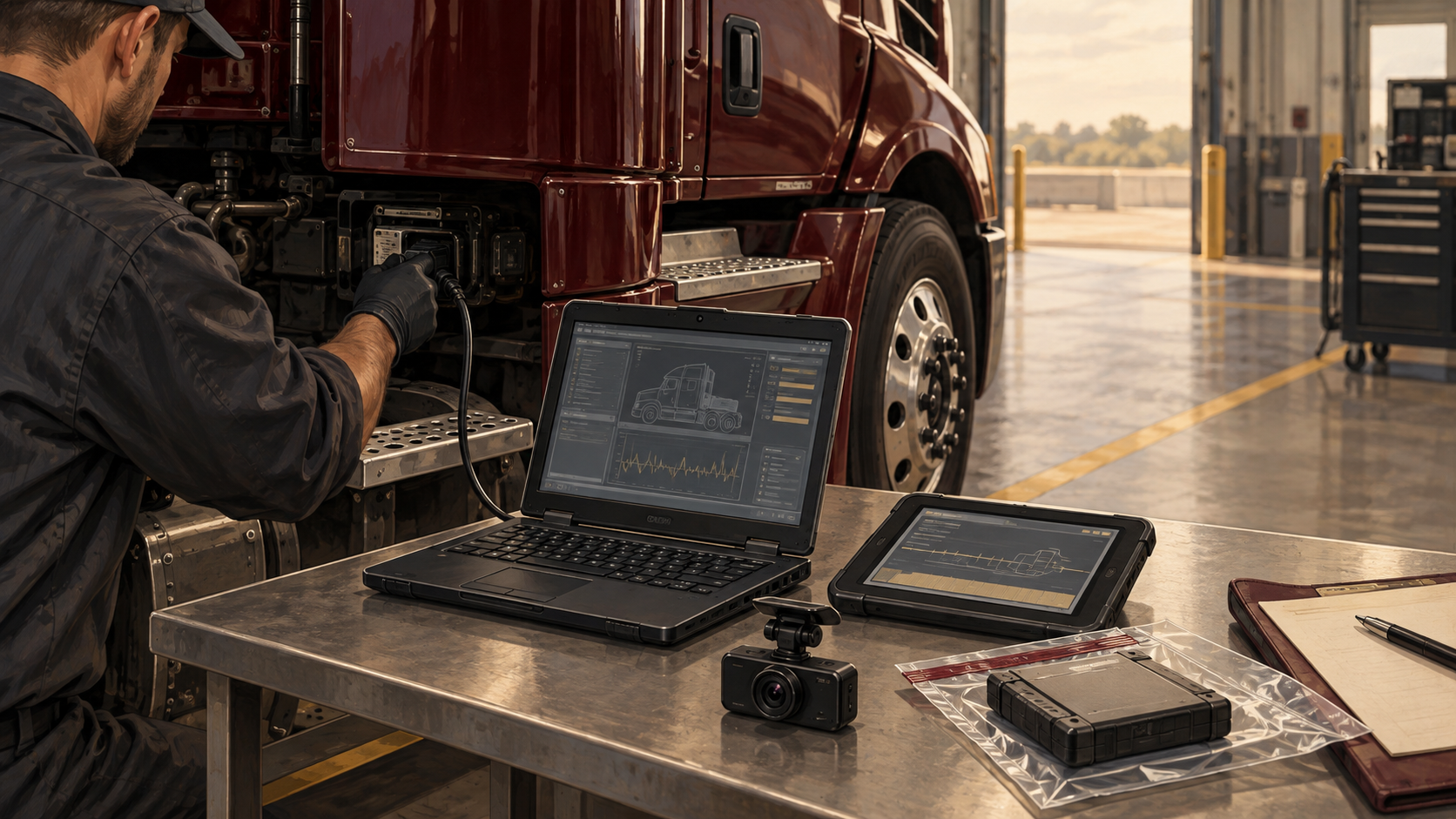
When it’s safe and makes sense, keep the damaged straps, chains, fasteners, and other parts, labeled by where they came from. Measure and document them in an inspection both sides agree on. Destructive testing is a different matter: don’t do it without the required authorization and a plan that tells everyone what’s going to be altered. The electronic evidence to preserve after a Texas truck crash should be secured at the same time.
Match the securement rule to the cargo
FMCSA’s cargo securement guidance lays out the general performance requirements, plus extra rules for certain commodities. A load of machinery, logs, or metal coils can raise questions that boxed freight never would. So figure out the actual commodity, its weight and configuration, and the kind of vehicle before you pull out a general checklist.
Use the inspection to answer these questions about each securement device. A far-off photo is not enough if the rating, dimension, or connection cannot be seen.
| Inspection topic | What to document |
|---|---|
| Capacity | Record its capacity and any applicable working-load limit. Get missing ratings and records rather than guessing at compliance. |
| Condition | Examine the device and take the measurements needed for the analysis. Distinguish what can be established from what is still unknown. |
| Position and attachment | Record where the device was placed and how it was attached. If the photograph leaves that unclear, find other evidence. |
| Calculation review | Ask a qualified witness to explain the calculations and the assumptions used. |
Our guide to proving negligence with FMCSA rules explains how to tie a rule to the crash.
Identify the loading and inspection roles
Bills of lading, dock records, loading photos, contracts, and witnesses can identify who did the work. Keep a separate entry for each job:
| Job to identify | Question the evidence must answer |
|---|---|
| Loading and securement | Who physically loaded the freight and secured it? |
| Load arrangement | Who selected where and how to place the cargo? |
| Securement equipment | Who supplied the straps, chains, or other devices? |
| Trailer seal and instructions | Who sealed the trailer, and who told the driver what to do? |
A shipper's name on a document does not answer all those questions. Sorting out who can be held liable for a truck crash requires evidence of each participant's work.
49 CFR §392.9 covers proper distribution and securement, making sure of it before the trip, and certain reinspection duties along the way. Paragraph (b)(4) excludes the following drivers from paragraph (b):
| Situation | Condition to establish |
|---|---|
| Sealed vehicle | The vehicle is sealed, and its driver has been ordered not to open it to inspect the cargo. |
| Inspection impracticable | The cargo was loaded in a way that makes inspection impracticable for the driver. |
These exceptions concern paragraph (b), not duties elsewhere in §392.9. Look hard at the facts behind either claim. A seal, or a general statement about how the truck was loaded, does not settle everyone’s duties on its own.

Reconstruct the loading and travel sequence
Put the shipment records in time order. Use them to check what changed between loading and the crash:
| Part of the trip | Records and questions |
|---|---|
| Loading | Weight tickets, loading diagrams, dock video, and shipping instructions. |
| Changes during the trip | Was freight added, taken off, or moved around? Keep the seal numbers and records of trailer openings. |
| Stops and road events | Could a stop or another event along the way explain why the cargo shifted? |
| Delivery | Include the delivery records in the shipment history. |
Inspection claims deserve a few follow-up questions. What could the person actually see? What did they check, and did they adjust anything? A checkmark on a form may not say much about how this load was examined. On the other hand, the lack of a photo doesn’t prove nobody looked. Weigh all of it, records and testimony together.
Test whether movement preceded or followed the collision
Have the expert start by asking whether the crash itself could explain the load’s movement. Then test whether the load moved before impact and caused the crash.
That timing claim needs observations and calculations behind it. Work through the truck’s path, braking, steering, point of impact, and road conditions. Do not let the final position of the freight stand in for the sequence of events.
What if nobody knows where the freight was originally placed? Put that limitation in the report. The same goes for a strap whose condition before the crash cannot be established. You can use a drawing to explain an assumed arrangement, provided it is labeled that way. Don’t present it as the layout investigators actually recovered.
Keep the liability questions separate
For each company, spell out the duty you’re claiming it had, what it did that breached that duty, and how that caused the harm. Regulatory compliance, contract terms, and what people actually did on the dock may each speak to a different piece of that. A claim can’t rest just on the fact that several companies had a hand in the shipment.
Move fast on preservation, and don’t stop at one company. Loading video might be at the warehouse. Trip messages may be with the carrier, and the straps and chains could be in some third company’s hands. One letter to one business can leave important sources untouched.
Related: Who is liable for a truck accident caused by improperly loaded cargo in Texas.

ABOUT THE ATTORNEY
Aaron A. Herbert
Founding Attorney
Board Certified in Personal Injury Trial Law
Aaron founded The Law Firm of Aaron A. Herbert in 2010 to focus on developing each client's case and seeking its maximum value. For over a decade, he has represented people seriously injured in major accidents and industrial catastrophes, pursuing trial verdicts and settlements while working to reduce the stress of litigation.
Education
- Texas A&M University · B.S., Criminal Justice, 1999
- University of Oklahoma College of Law · J.D., 2002; graduated in the top of his class
Trial experience & approach
Aaron earned numerous jury verdicts at boutique personal injury litigation firms. According to his biography, he spent a year as the top-earning litigation attorney at a firm that frequently appeared in verdict searches as having one of the highest numbers of trial wins in Texas. At another Dallas personal injury firm, he moved from managing pre-litigation attorney to managing litigation attorney over seven years as the firm grew into one of Dallas's largest personal injury firms.
His biography describes a reputation as one of America's most aggressive trial lawyers, with noteworthy recoveries from judges and juries and substantial pretrial settlements. Most of those settlements included confidentiality agreements requested by the defense. Aaron has said the recoveries were justified by the injuries and losses involved, which no amount of money could make someone choose to experience.
His approach combines passion, preparation, persistence and courtroom imagination. He believes a well-supported, engaged and motivated team working cooperatively helps deliver strong representation, with the goal of achieving the best possible result for every client.
Dallas roots, military service & publication
Born and raised in Dallas, Aaron enlisted in the United States Marine Corps after high school and later received an Honorable Discharge. He completed his university and law degrees after his military service and became a lifelong Sooners football fan in law school.
Publication: “Litigating Dog Bite Cases,” Texas Dog Law Seminar, Dallas, 2009.
Professional affiliations & recognition
Professional affiliations and recognition listed in Aaron’s biography:
- State Bar of Texas
- American Bar Association
- Association of Trial Lawyers of America (now American Association for Justice)
- Texas Trial Lawyers Association
- Dallas Trial Lawyers Association
- Dallas Bar Association
- Tarrant County Bar Association
- Million Dollar Advocates Forum
- The National Trial Lawyers – Top 100 Trial Lawyers