
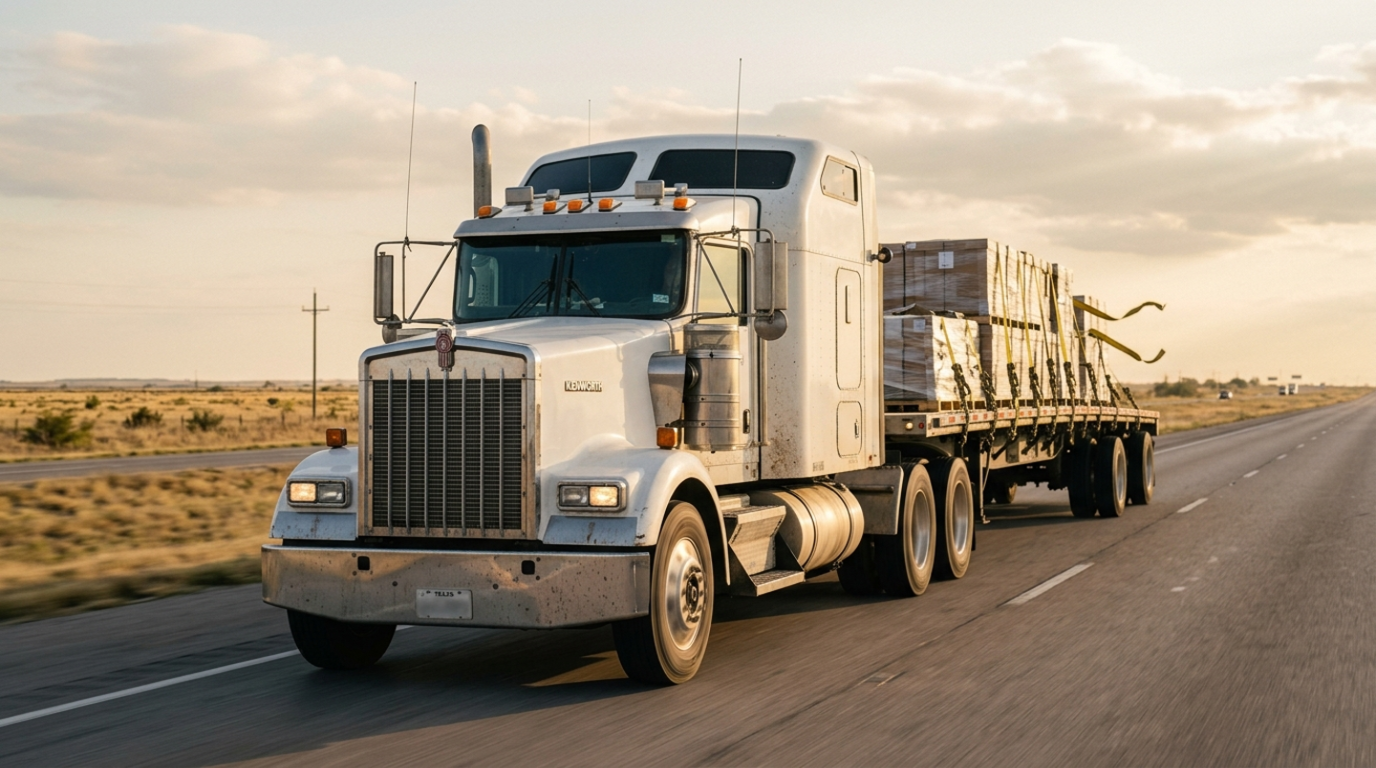
Last Updated: October 8, 2026
If improperly loaded or secured cargo contributes to a truck accident in Texas, responsibility may extend beyond the truck driver. Depending on who loaded, controlled, inspected, or knowingly allowed the unsafe condition to continue, potential defendants can include the driver, motor carrier, shipper, loading company, warehouse operator, or another responsible party. But participation in the transportation process does not automatically establish liability. The evidence must connect a specific act, omission, duty, or control over the cargo to the crash and resulting injuries.
For an injured person, the important questions are: Who created or could have detected the unsafe condition? Who controlled the cargo at that stage? What records show what happened before the truck left the loading location? And can the evidence establish that the cargo condition was a substantial factor in causing the crash?
Who May Be Responsible for Improperly Loaded Cargo?
| Potential party | Conduct to investigate | Particularly useful evidence |
|---|---|---|
| Driver | Failed to perform an applicable inspection, ignored warning signs, or continued operating after discovering a problem | Inspection records, driver statements, messages, photographs |
| Motor carrier | Permitted unsafe operation or had deficient loading and securement practices | Dispatch records, policies, training, safety records |
| Shipper or loader | Created the unsafe load, selected unsuitable equipment, or controlled how cargo was loaded | Dock video, loading instructions, photographs, weight tickets |
| Warehouse operator | Participated in loading or handling that created the dangerous condition | Employee testimony, loading records, contracts, video |
This is a starting point for investigation, not a finding that every listed party is liable. A commercial transportation relationship alone does not establish legal responsibility.
Federal Rules Governing Cargo Inspection and Securement
Federal regulations make cargo distribution and securement an important part of a commercial truck accident investigation.
Under 49 CFR §392.9, a driver may not operate a commercial motor vehicle, and a motor carrier may not require or permit operation, unless the cargo is properly distributed and adequately secured. The regulation also addresses equipment used to secure the cargo and conditions that can interfere with safe operation.
49 CFR §392.9 — Inspection of cargo, cargo securement devices and systems
Section 392.9(b) separately addresses driver inspection duties. Generally, the driver must inspect the cargo and load-securement devices within the first 50 miles and reexamine them during the trip at specified intervals.
What if the trailer was sealed?
There is an important exception that should not be overlooked.
Under 49 CFR §392.9(b)(4), the paragraph (b) inspection rules do not apply to the driver of a sealed commercial motor vehicle who has been ordered not to open it to inspect the cargo, or to a vehicle loaded in a manner that makes inspection of the cargo impracticable.
A sealed trailer therefore can change the driver's inspection analysis. It does not automatically resolve liability for an unsafe load. The general requirements in §392.9(a) remain relevant, and the investigation should still examine who loaded the cargo, who controlled the loading process, what the carrier knew, and whether inspection was actually possible.
FMCSA guidance explains that when a shipper has loaded and sealed a trailer, a motor carrier may address safe-loading responsibilities through measures such as supervising the loading, obtaining a notation on the freight bill that the load was properly loaded, or obtaining approval to break the seal for inspection.
FMCSA guidance on safe loading when a shipper has loaded and sealed a trailer
The driver also does not necessarily have to personally load, block, brace, and tie down the cargo. FMCSA states that the driver is not required to perform the physical loading but must understand cargo-securement methods and may have inspection and adjustment duties under §392.9.
That distinction can be important when determining whether the driver, loader, shipper, carrier, or another participant had responsibility for the condition that caused the accident.
Why Loading Evidence Matters
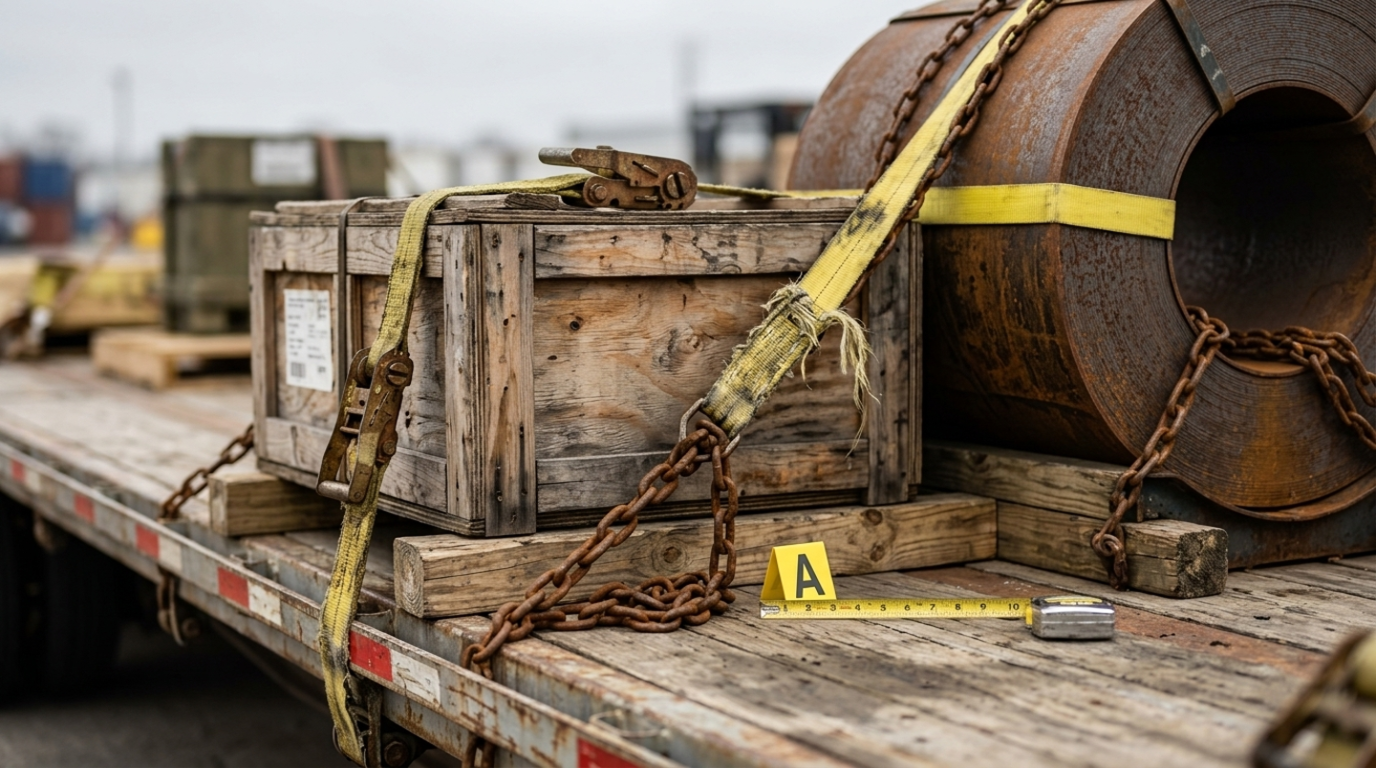
A cargo-loading claim can depend on evidence that disappears quickly. Before a trailer is unloaded, repaired, or returned to service, investigators may need to document the tractor, trailer, cargo, securement devices, straps, chains, blocking, bracing, tie-down points, and the condition of the load.
Important evidence may include:
- Photographs and measurements of the cargo and securement system
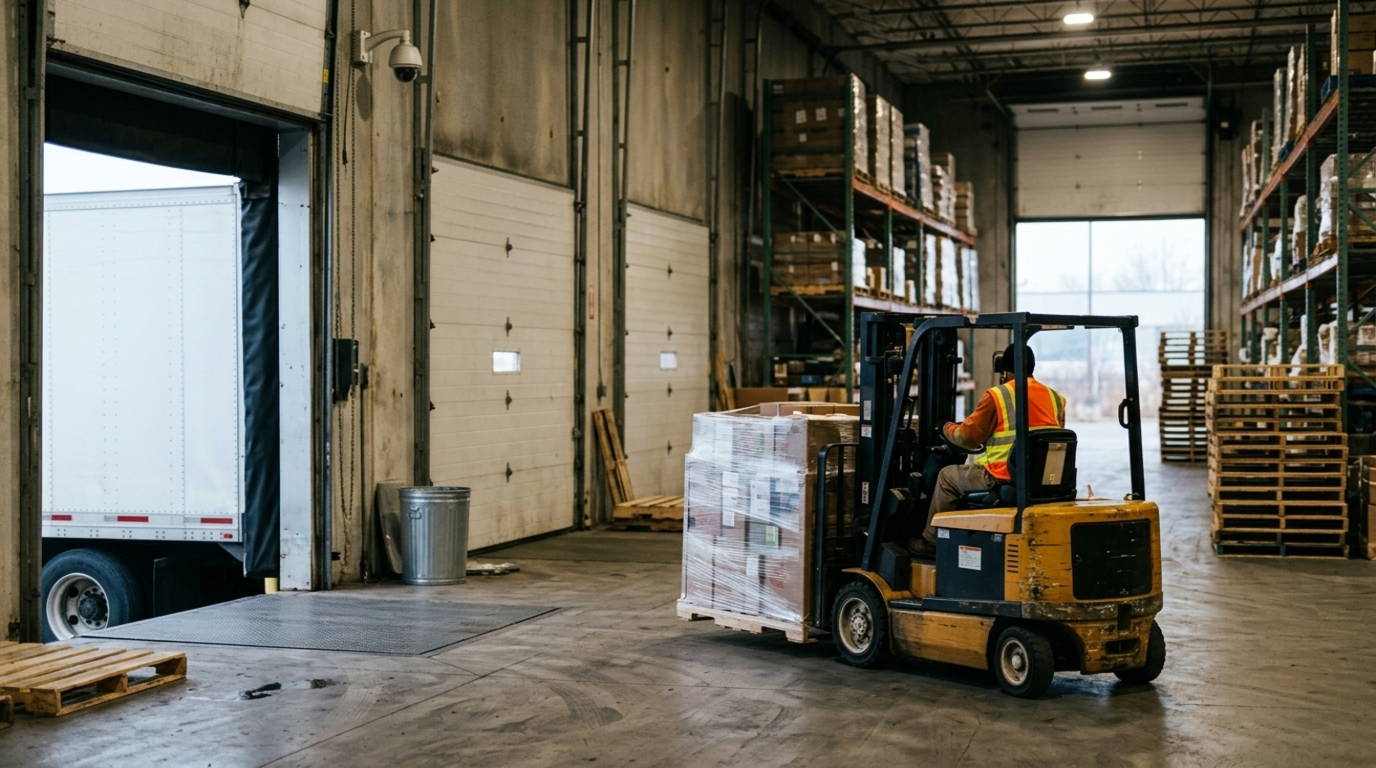
- Warehouse or loading-dock surveillance video
- Bills of lading, weight tickets, loading instructions, and seal records
- Driver inspection records and written reports
- Dispatch messages and communications about the load
- Loading and securement policies
- Witness testimony from drivers, loaders, warehouse employees, and others
- Physical inspection of damaged securement equipment
- Accident-scene photographs and reconstruction evidence
The investigation also needs to distinguish between cargo that was improperly loaded before the collision and cargo that became displaced because of the collision itself. That distinction can be critical to causation.
Texas Law on Shipper Responsibility
Texas law requires careful attention to what a shipper actually did.
In In re Home Depot U.S.A., Inc., No. 25-0317, decided May 15, 2026, the Texas Supreme Court addressed whether a shipper owed a duty based simply on its relationship with a motor carrier. The Court distinguished a passive shipper of ordinary goods from circumstances in which a party's affirmative conduct creates or increases a dangerous condition.
Read In re Home Depot U.S.A., Inc., No. 25-0317 — Texas Supreme Court
The decision should not be interpreted as giving every shipper immunity from every cargo-related claim. The facts and the shipper's own conduct matter.
That is especially important when the allegation involves the actual loading, placement, selection, securement, or handling of cargo. The right question is not simply, “Who shipped the goods?” It is, “What did that company or its employees actually do, and did that conduct contribute to the dangerous condition?”
What I Would Investigate Before Identifying the Responsible Parties
In a cargo-loading case, I would first determine whether the cargo condition existed before the collision or was created by the impact.
I would then work backward through the loading process:
- Who selected the trailer or equipment?
- Who determined how the cargo would be positioned?
- Who supplied the blocking, bracing, straps, chains, or other securement devices?
- Was the driver present during loading?
- Was the trailer sealed?
- Who controlled the seal?
- What instructions were given to the driver?
- Did anyone document the completed load?
- Was there surveillance video at the loading facility?
Loading photographs, dock video, seal records, freight documents, and driver observations can help answer those questions.
I would also want the tractor, trailer, cargo, and damaged securement equipment preserved before unloading or repair changes the physical evidence. Depending on the circumstances, a reconstructionist or cargo-securement specialist may be necessary to determine whether the load could have shifted or fallen under ordinary driving conditions.
The objective is not simply to identify a regulation that was violated. The investigation must connect the conduct, the unsafe condition, the collision, and the claimed injuries with evidence.
Preserving Evidence Is Different From Obtaining Evidence
Preservation and obtaining evidence are two different steps.
A preservation request is designed to prevent relevant evidence from being lost, overwritten, altered, repaired, discarded, or otherwise changed. It does not automatically give an injured person possession of the evidence.
For example, warehouse surveillance may be controlled by a third party, electronic records may be held by a motor carrier, and the truck or trailer may remain with an owner, carrier, insurer, towing company, or repair facility.
A prompt preservation effort should identify the vehicles, cargo, loading location, surveillance systems, electronic records, communications, and physical evidence that should be retained. Obtaining those materials may later require cooperation, formal discovery, an inspection agreement, or appropriate court procedures.
For a broader framework, see the Texas Truck Accident Litigation Hub, which organizes truck-case evidence, responsible parties, electronic records, preservation, and other litigation issues.
The firm's Texas truck accident litigation guide also provides additional information about investigating commercial truck claims.
Multiple Responsible Parties and Texas Comparative Responsibility
A truck accident can involve more than one negligent actor. Texas Civil Practice and Remedies Code Chapter 33 addresses proportionate responsibility and requires allocation of responsibility among the claimant, defendants, settling persons, and responsible third parties when the statutory requirements are met.
Under §33.001, a claimant who is more than 50% responsible generally cannot recover damages. Under §33.012, recoverable damages are reduced according to the claimant's percentage of responsibility.
That makes accurate identification of responsible parties important. The evidence should establish what each party did, what duty or responsibility applied, and how that conduct contributed to the accident.
The name printed on the truck or the company listed on a shipping document does not necessarily identify every party whose conduct should be investigated.
Dallas and North Texas Cargo-Truck Investigations
A cargo-related truck accident in Dallas or North Texas may require investigation beyond the crash scene.
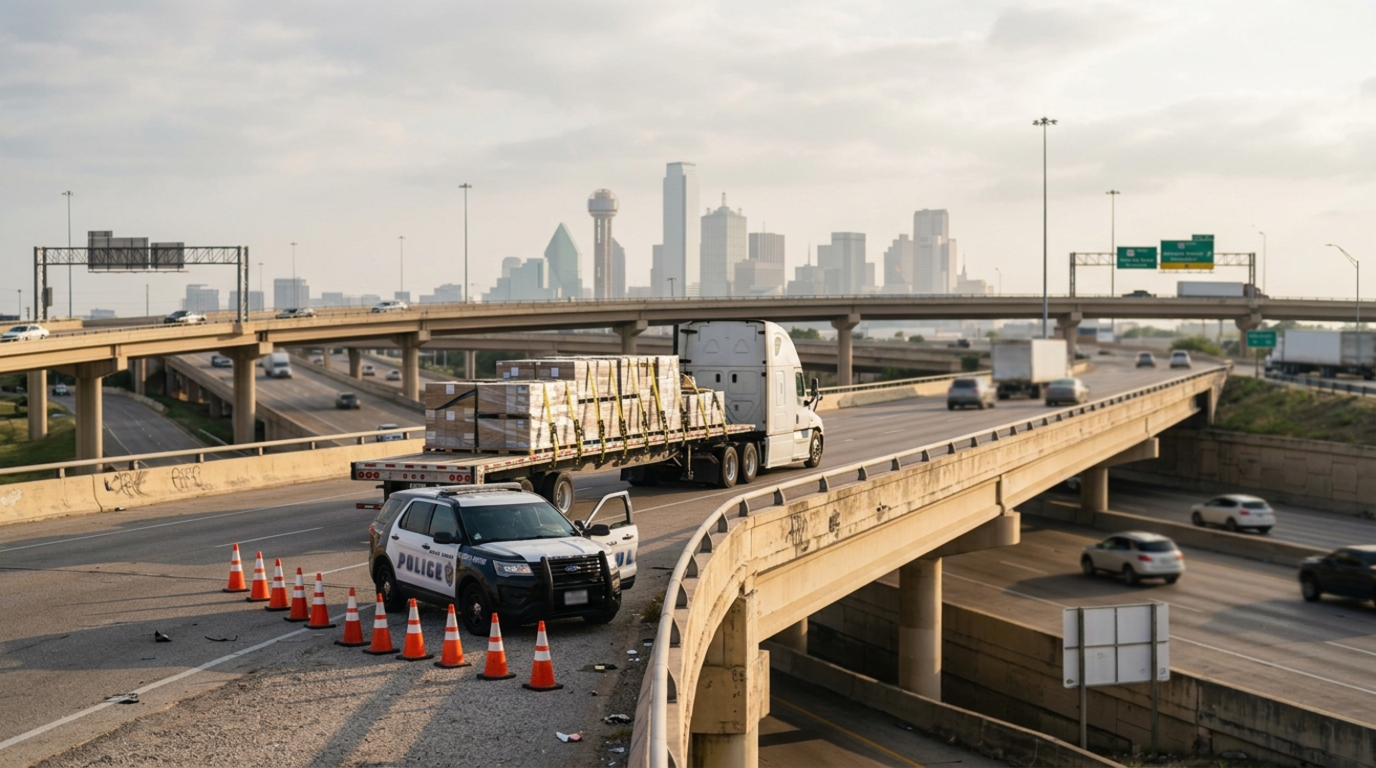
A collision on I-35E, I-30, I-20, US-75, Loop 12, or another major corridor may involve a loading facility, warehouse, distribution center, or shipping location somewhere else in the transportation chain.
That is why an investigation should not rely only on the police report. Evidence at the loading facility may include surveillance video, loading records, employee testimony, photographs, freight documents, and communications that help establish what happened before the truck entered the roadway.
For broader truck-accident information, see the firm's Dallas truck accident lawyer resource.
Where the facts involve a broader roadway collision, the Texas Highway Accident Lawyer resource may also be relevant. If cargo shifted or fell and contributed to a lateral-impact collision, the Texas Sideswipe Accident Lawyer page may provide additional context.
What Should an Injured Person Do After a Cargo-Related Truck Crash?
After receiving necessary medical care, preserve photographs, videos, medical records, insurance communications, and information about witnesses.
If you know where the truck was loaded, record the loading facility and any information identifying the shipper, warehouse, carrier, or other company involved.
Do not assume that the company name on the truck identifies every potentially responsible party. Cargo cases may require investigation into ownership, loading, dispatch, contracts, inspection practices, communications, and physical evidence.
For related information, see Injuries From 18-Wheeler Accidents.
If the circumstances involve an 18-wheeler and potential commercial-carrier liability, the firm's 18-wheeler truck accident lawyer in Dallas resource provides information about truck accident claims and representation.
Texas Chapter 72 and H.B. 19: Why the Commercial-Truck Liability Analysis Matters
Texas Civil Practice and Remedies Code Chapter 72, Subchapter B, governs certain civil actions involving commercial motor vehicles. The provisions were added through H.B. 19, which became effective September 1, 2021.
The statute defines a covered “civil action” to include an action seeking damages for bodily injury or death caused in a collision involving a commercial motor vehicle, including claims involving a person who operated, owned, leased, or otherwise held or exercised legal control over the commercial motor vehicle or its operator.
Texas Civil Practice and Remedies Code Chapter 72 — Official Texas Statutes
That framework is important in a cargo-loading case because the investigation may involve more than the person sitting behind the wheel. Depending on the facts, the relevant inquiry can include the conduct of the motor carrier, owner, lessor, shipper, loader, warehouse operator, or another participant whose conduct or control is connected to the commercial vehicle or the events leading to the collision.
Chapter 72 also contains specific procedural rules for commercial-motor-vehicle cases. Those rules should be considered alongside the underlying negligence, causation, federal cargo-securement requirements, and Texas proportionate-responsibility rules rather than treated as a substitute for proving how the cargo condition caused the crash.
For an improperly loaded cargo claim, the practical question remains evidence-driven: Which party had responsibility or control over the relevant part of the loading or securement process, what did that party do or fail to do, and can that conduct be connected to the collision and injuries?
H.B. 19 therefore makes it especially important to identify the actual actors and legal relationships involved in a commercial-truck accident rather than assuming that the driver or the company name displayed on the truck identifies every potentially relevant party.
Because Chapter 72 contains detailed provisions governing commercial-motor-vehicle litigation, the applicable statutory language should be reviewed based on the facts and claims in the particular case.
Conclusion
Improperly loaded cargo can create a complicated liability question because the driver may not be the only person who had responsibility for the unsafe condition.
The key questions are who controlled the loading or securement process, who knew or should have known about the condition, what federal or state duties applied, whether any inspection exception affected the driver's obligations, and whether the evidence connects the condition to the collision and injuries.
The most useful early investigation usually focuses on the cargo itself, the securement system, loading records, surveillance video, driver observations, the tractor and trailer, and the people who controlled each step.
A consultation should evaluate not only who appears responsible, but also what evidence can establish that responsibility before it disappears.
For information about the firm and its attorney, see The Law Firm of Aaron A. Herbert, P.C..
Frequently Asked Questions
Who can be liable for improperly loaded truck cargo in Texas?
Potentially the driver, motor carrier, shipper, loading company, warehouse operator, or another party whose conduct or legal duty contributed to the unsafe condition and caused the accident. Liability depends on the evidence and applicable law.
Is the truck driver always responsible for cargo that was loaded incorrectly?
No. Federal rules impose specific inspection duties on drivers, but §392.9(b)(4) contains an exception for certain sealed vehicles and situations where inspection is impracticable. The loading process and conduct of other parties must also be investigated.
Can a shipper be liable for a truck accident caused by cargo?
Sometimes, but hiring a motor carrier or owning the freight does not automatically create liability. In re Home Depot U.S.A., Inc. illustrates the distinction between a passive shipper and circumstances involving affirmative conduct that creates or increases a dangerous condition.
What evidence is important in an improperly loaded cargo case?
Important evidence can include loading photographs, warehouse video, bills of lading, weight tickets, seal records, driver inspection records, dispatch communications, securement equipment, witness testimony, and physical inspection of the truck, trailer, and cargo.
Why should the truck and cargo be preserved after a crash?
The physical condition of the cargo and securement system may change when the trailer is unloaded, repaired, or returned to service. Early preservation can help prevent important evidence from being lost or altered.
Does a cargo-loading violation automatically prove liability?
No. A regulatory violation does not by itself resolve every legal issue. The evidence must connect the relevant conduct or unsafe condition to the accident and claimed injuries.
Should an attorney investigate the loading location, not just the crash scene?
Often, yes. If the alleged problem began during loading, evidence at the warehouse, distribution center, or shipping facility may be essential to determining who handled the cargo and what was known before the truck left.
Legal Sources
- Texas Civil Practice & Remedies Code Chapter 72 — Actions Regarding Commercial Motor Vehicles
- 49 CFR §392.9 — Inspection of cargo, cargo securement devices and systems
- FMCSA — Safe loading when a shipper has loaded and sealed the trailer
- FMCSA — Driver loading and cargo-securement guidance
- In re Home Depot U.S.A., Inc., No. 25-0317 — Texas Supreme Court
- Texas Civil Practice & Remedies Code Chapter 33 — Proportionate Responsibility
About Aaron A. Herbert
Aaron A. Herbert is a Texas attorney and is Board Certified in Personal Injury Trial Law by the Texas Board of Legal Specialization. He has been licensed to practice law in Texas since 2002 and has represented injured clients in Dallas and throughout Texas.
His truck-accident work includes investigating commercial-vehicle liability, evidence preservation, causation, and the conduct of companies and individuals involved in a crash.
Attorney Review Date: October 8, 2026
If you have been injured in a truck accident involving improperly loaded or shifted cargo, a case evaluation can focus on loading responsibility, evidence preservation, causation, and which claims may be supported by the available evidence.