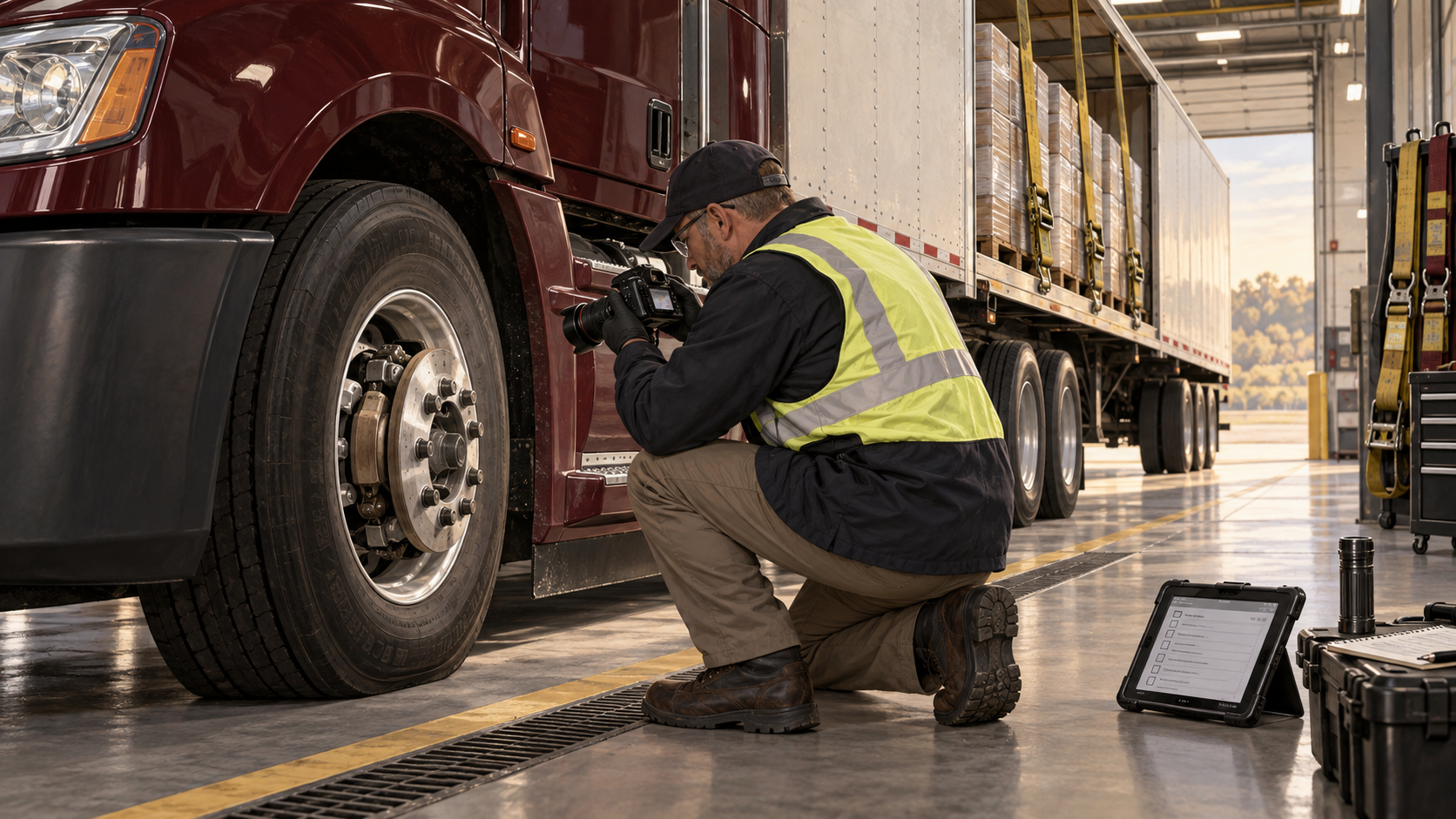
The maintenance file earns its place when it shows a problem that existed before the crash and explains what that problem did to the truck. Finding a wrecked brake assembly or a blown tire afterward doesn’t tell you much on its own. The damage might predate the crash. It could also come from the impact or from the recovery work, or from some combination. Sorting that out takes the actual parts and the paperwork, so both have to be kept.
Preserve the vehicle before repairs or disposal
Start by pinning down the tractor, the trailer and the key parts by their actual ID numbers. Find out where the equipment is sitting and who controls access to it. Get photos of its condition at the scene, during recovery and in storage. If anyone moves it, takes it apart, repairs it or swaps a part, that needs to be written down, or an expert won’t be able to tell the original condition from what changed later.
Work out an inspection protocol with the other side before anyone touches anything: notice, who attends, photos, measurements, data downloads, and where the parts get stored. Testing that could change a part is its own problem. Under Texas Rule of Civil Procedure 196.5, testing, sampling or examination that destroys or materially alters an item needs the court’s permission first. A general agreement to inspect doesn’t cover destructive work. The electronic evidence to preserve after a Texas truck crash should be locked down at the same time.
Identify the relevant maintenance duty
49 CFR §396.3 requires covered carriers and intermodal equipment providers to systematically inspect, repair and maintain the equipment they control. It also deals with vehicle identification, maintenance schedules and records. Before you lean on it, confirm that it applies, which version was in force on the crash date, and who actually controlled the equipment. Our guide to proving negligence with FMCSA rules goes further into that.
Then get specific about the part. A brake problem needs a different inspection and a different performance analysis than a tire, steering or coupling problem. Your expert should be able to say which standard applies and which measurements or observations back up the opinion. Calling the truck “unsafe” in general doesn’t get you there.
Follow a defect report through the repair decision
Gather the driver reports, work orders, roadside inspection reports, periodic inspections, invoices and emails or texts with repair shops. Then line up the dates, the vehicle numbers, the symptoms someone reported, the work that got done and the decision to put the truck back on the road. An invoice tells you work was billed. It doesn’t necessarily tell you what was inspected, or whether the reported problem actually got fixed.
Section 396.11 covers driver vehicle inspection reports and corrective action, with some exceptions. Under its current text, no report is required if the driver didn’t find a defect or deficiency and nobody reported one to him. So a missing daily form isn’t automatically a violation. You have to figure out whether a report was required on the actual facts.

Distinguish a pre-crash condition from impact damage
The big question for the expert is when. What did the inspection actually find that dates the defect before the crash? Check those findings against the earlier complaints and service history, the vehicle data and the scene. Keep the alternatives open, too, because a part that’s broken after a violent impact may simply have broken in the impact.
Photograph the tire markings and keep the pieces that can be recovered. Record brake measurements before adjustments or teardown; include the measuring method. For an electronic download, document the tool and any power cycles after the crash. Ask the expert which findings can date the damage and which cannot. A gap in that proof belongs in the report.
Connect the condition to vehicle performance
Even a real defect has to have mattered. Did it change how the truck stopped, steered or held the road? That theory then has to survive the speed evidence, the road conditions, the load and the driver’s own actions. If nothing ties the maintenance problem to the crash, it isn’t the cause, however bad it looks on paper. The broader question of who can be held liable for a truck crash can turn on that link.
If an outside shop worked on the truck too, split out what the shop handled from what the carrier handled, and what each one knew. Track the complaint from whoever received it to whoever authorized the work, did it, and released the truck. A subcontractor’s involvement doesn’t answer those questions for either side.
Organize the proof for discovery and trial
- Put the reports, inspections, repairs and the crash on one timeline.
- Tie every document and every part to the right tractor or trailer.
- Preserve the original condition, and record every later change.
- Find the person who can explain each repair decision.
- Keep regulatory compliance, physical condition and causation separate.
- Account for what’s missing and for other explanations.

Founding Attorney
Aaron A. Herbert is a Texas attorney, Board Certified in Personal Injury Trial Law by the Texas Board of Legal Specialization.
For over a decade he has shown an unwavering commitment to clients who were seriously injured by major accidents and industrial catastrophes. During that time he has earned the reputation as one of America’s most aggressive trial lawyers by achieving noteworthy recoveries from judges and juries, as well as substantial settlements prior to trial, the majority of which contained negotiated confidentiality agreements at the request of the defense. When asked about these cases, Mr. Herbert has said that each case not only justified the recovery level, but that no one would trade places with any one of these victims in return for any amount of money, once they know the facts and severity of the injuries and tragedy involved. According to Mr. Herbert, “there can be no substitute for passion, preparation and persistence in the practice of law.” He is known not only for this tenacious preparation, but also for his imagination in the courtroom. He is passionate and persistent in seeking to obtain the maximum case value for each individual client at trial or through settlement, while reducing the stress of litigation on his clients.
Born and raised in Dallas, Texas, Mr. Herbert enlisted in the United States Marine Corps after high school and later received an Honorable Discharge. After the Marines, he obtained a Bachelor of Science in Criminal Justice from Texas A&M University, then a Juris Doctorate from the University of Oklahoma College of Law. There he graduated in the top of his class and became an eternal Sooners Football fan. Aaron has worked as a zealous advocate for injured clients at several boutique personal injury litigation firms where he amassed numerous jury verdicts. After spending a year as the top earning litigation attorney at a firm that frequently tops verdict search as one with the highest number of trial wins in Texas, Aaron accepted a position as the managing pre-litigation attorney at another Dallas personal injury firm. Over the next seven years he transitioned to the managing litigation attorney, and that firm grew to one of the largest personal injury firms in Dallas. In 2010 he formed the Law Firm of Aaron A. Herbert, to get back to a focus on developing each individual case and maximizing case value for each client.
Mr. Herbert practices law with the belief that a well taken care of, highly engaged and motivated team of employees working in a cooperative team environment will result in superior representation and great results for the firm clients. He believes in always setting a goal of achieving the best possible results for each and every client.
Education
- Texas A&M University (B.S. Criminal Justice, 1999)
- University of Oklahoma College of Law (J.D., 2002)
Professional Associations
- Licensed to practice in Texas (2002)
- Board Certified in Personal Injury Trial Law, Texas Board of Legal Specialization (2008)
Publications
- Litigating Dog Bite Cases, Texas Dog Law Seminar, Dallas 2009
Member
- State Bar of Texas
- American Bar Association
- American Trial Lawyer Association
- Texas Trial Lawyers Association
- Dallas Trial Lawyers Association
- Dallas County Bar Association
- Tarrant County Bar Association
- Million Dollar Advocates Forum
- National Trial Lawyers – Top 100 Trial Lawyers
Texas Bar #24036761 · The Law Firm of Aaron A. Herbert, P.C. · Dallas, Texas