
Say you slipped by the dairy case, the ER bill is $4,800, and your wrist is in a splint. A Texas claim can still fail on one question: did the store know about that puddle, or had it been there long enough that someone should have found it?
What you can prove
- You fell and were hurt.
- The floor was wet afterward.
- An employee mopped it up later.
- A worker had reported it earlier.
What each does and doesn't settle, in the same order.
- The injury part of the claim, not the store's knowledge.
- That a condition existed, not how long it was there.
- That staff learned of it at some point, maybe only after the fall.
- Possible actual notice, if it was the same spill in the same spot.
This guide is part of the Target injury knowledge hub. If you'd like a lawyer to look at the notice evidence in your case, tell us about your Target fall or call (214) 200-4878.
What does "notice" mean in a Texas store fall?
Notice means the store knew about the specific hazard, or should have known because it existed long enough to be discovered.
Types of notice (hypothetical examples)
- Actual notice, such as a shopper telling a team member about a leaking cooler in aisle 14 at 2:40 p.m.
- Actual notice, such as an employee setting a cone next to the spill before you arrive.
- Constructive notice, such as video showing the puddle on the tile for 25 minutes before the fall.
- Constructive notice, such as a witness who saw the same wet streak on her way in and on her way out.
Each example ties knowledge to one condition at one place. That link is what courts look for.
Start by describing the hazard precisely
Water under a refrigerated display is a different case from a curled entrance mat or a hanger in a checkout lane.
| Vague description | Precise description |
|---|---|
| "The store was unsafe." | "Clear liquid about two feet wide in front of the dairy case." |
| "Something on the floor." | "A plastic hanger near register lane 6." |
| "Bad pavement out front." | "A raised slab edge between the doors and the cart return." |
If you don't know what caused the slip, say so. Someone who saw liquid afterward may be accurate about the aftermath without knowing what made your foot slide. Control matters too: a parking area next to the store may be maintained by a landlord, not the retailer.
How is actual notice proved?
Actual notice comes from evidence that someone responsible knew about this hazard before you fell.
Statements you hear and the follow-up questions
- Who reported it, which manager and what location they described, for "Someone told a manager."
- Whether it was the same leak and when they learned of it, for "They knew about the leak."
- Whether it was sympathy or an admission of earlier knowledge, for "The employee said sorry."
After-the-fall cleanup shows awareness at some point, not necessarily before the injury. Quote what was said accurately before calling it an admission.
How is constructive notice proved?
Constructive notice asks whether the condition existed long enough that a reasonable store would have had a chance to find it. Texas has no universal spill timer.
| Case | Point it stands for |
|---|---|
| Wal-Mart Stores, Inc. v. Reece (Tex. 2002) | There must be some evidence of how long the hazard existed; an employee being nearby isn't enough by itself [S4]. |
| Wal-Mart Stores, Inc. v. Spates (Tex. 2006) | Proximity, conspicuity, and how long the condition existed are weighed together [S4]. |
| H-E-B, LP v. Peterson (Tex. Apr. 10, 2026) | Duration evidence has to concern the condition at the time and place of the injury; older leaks elsewhere in the store don't fill the gap [S2]. |
Proof that the store was busy, or that something leaked somewhere last month, doesn't tell a jury about this puddle.
Helpful duration evidence
- Video of the liquid on the floor before the fall.
- A witness who saw the spill 15 minutes earlier.
- A service ticket for the same cooler that morning.
- Cart tracks running through the liquid.
The weak substitute for each, in the same order.
- Proof that the store was crowded that afternoon.
- A general complaint about the roof last spring.
- A repair log for equipment in another department.
- An inspection gap with no proof the spill existed during it.
What if an employee caused the hazard?
When store activity may have created the condition, the proof has to show the specific act and the resulting hazard.
Evidence of store activity
- Video of a team member stocking juice.
- An employee standing near the aisle.
- A wet mop bucket in the frame.
What each can and can't show, in the same order.
- A possible source, if the spill appears after that moment.
- Presence only, not that they dropped anything.
- A question to investigate, not an answer.
Keetch v. Kroger holds that creating a condition is circumstantial evidence of knowledge, not knowledge as a matter of law [S9]. United Scaffolding v. Levine separates an ongoing activity that injures someone from a condition left behind [S9]. Calling a condition claim "negligent activity" doesn't remove the premises requirements.
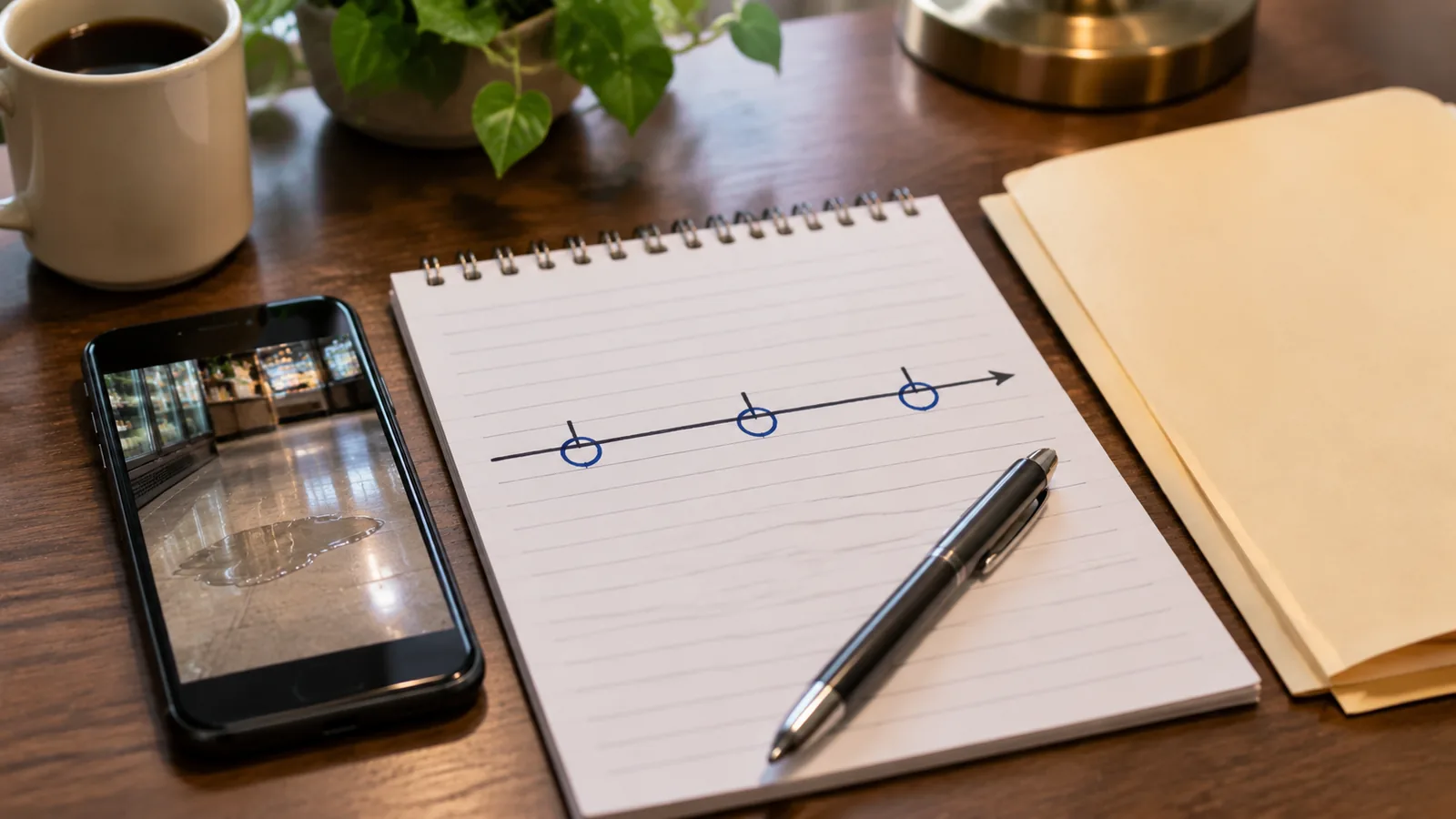
Build a notice timeline from independent sources
Write each event on its own line and note where it came from.
| Time (hypothetical) | Event | Source | How sure |
|---|---|---|---|
| 11:40 to 11:50 | Shopper sees water near the cooler. | Witness estimate. | A range, not a minute. |
| 11:52 | Team member walks the aisle. | Camera 14 display time. | Clock not yet checked. |
| 12:04 | Fall. | Incident report and receipt. | Receipt time is reliable. |
| 12:09 | Wet-floor cone placed. | Later video. | After the fall. |
A range like "between 11:40 and 11:50" is more honest than an invented "11:43." Cameras, registers and phones often run on different clocks, so keep the displayed times separate from corrected ones. The Target surveillance video guide explains how to ask the store to keep that footage.
Did the employee actually see it?
An employee's route can matter, but distance is only one part of the picture.
Factors and hypothetical examples
- Line of sight, such as a loaded stocking cart that blocks the view of the floor.
- Contrast, such as clear liquid on glossy white tile under bright lights.
- The employee's task, such as scanning shelf tags with eyes at shoulder height.
- Direction of travel, such as walking away from the spill and not toward it.
A human factors or premises expert can help when perception is truly disputed. An opinion that staff should see everything on a sales floor won't replace case-specific proof.
What do inspection records really show?
A sweep log is only useful once someone explains what each entry means.
Record details and the question for each
- A digital timestamp, for whether it marks the walk itself or when the entry was typed.
- A department checklist, for whether it covered this aisle or the whole department at once.
- A blank field, for whether it was a missed step or an unused field or just how the form is filled out.
- An edited entry, for who changed it and when.
A company schedule doesn't set a legal inspection interval. The question is still reasonable care and the elements of the claim.
A worked hypothetical
Here's how the pieces fit in one made-up case.
| Piece of evidence | What it adds |
|---|---|
| A shopper says the floor looked wet at 3:05; the fall is at 3:20 | Possible 15 minutes of duration, if she means the same spot. |
| Video shows an employee passing at 3:11 behind a cart | Opportunity, but the cart limits what he could see. |
| A work order from last week for the same cooler | A possible source; still need proof the problem continued. |
| Change one fact: the witness was one aisle over | The duration evidence may fall away. |
This example isn't a reported Target case and doesn't predict how a court would rule.
Preparing for a no-evidence motion on notice
Stores often challenge notice through summary judgment, so the proof should be organized before the motion arrives.
| Task | Why |
|---|---|
| Keep original recordings and authenticate them. | Copies without a foundation may be excluded. |
| Tie each exhibit to the element it supports. | A stack of records doesn't explain the inference. |
| Check which version of Texas Rule 166a applies. | Amendments govern motions filed on or after March 1, 2026 [S15]. |
| In federal court, check Rule 56 and the scheduling order. | Federal timing differs [S11]. |
| If discovery is still missing, say what and why. | A general claim that more discovery might help usually isn't enough. |
Why talk to Aaron Herbert about notice?
Aaron A. Herbert is Board Certified in Personal Injury Trial Law by the Texas Board of Legal Specialization [S1][S3]. That doesn't guarantee an outcome; what you should get from a consultation is a candid read on which notice theory your evidence supports.
Ask the firm
- Is this actual or constructive notice?
- What records could change the picture?
- What if there's no duration evidence?
A useful answer includes these, in the same order.
- The specific evidence for each.
- Video, logs, work orders and witness names.
- An honest assessment, not an invented timeline.
Frequently asked questions
Is an employee being nearby enough?
Usually not by itself. Courts also look at duration, visibility and what staff actually saw.
Does an old complaint prove this spill?
Not automatically. It has to involve the same location, source and a continuing condition.
Can I have a case without video?
Possibly. Witnesses, photos and records can show duration too.
Does a cone placed after my fall help?
It shows a response after the fall, not knowledge before it.
Tell us about your Target fall
Tell us about your Target fall through InjuryAttorneyOfDallas.com or call (214) 200-4878. The Law Firm of Aaron A. Herbert, P.C. will explain what the notice evidence in your case can and can't support.
What to bring (hypothetical examples)
- Your photos and their original files, such as the puddle and the cooler with the phone's time stamp.
- Witness names, such as the shopper who said she saw it earlier.
- The incident report number from the manager on duty.
- Treatment records, such as the urgent care visit that evening.
Educational information only, not legal advice. Representation and fees require a written agreement. This independent resource is not affiliated with or endorsed by Target Corporation.
Related reading
- How to Sue Target in Texas, on the full claim and lawsuit process.
- First 72 hours after a Target fall, on what to keep and report right away.
- Preserving Target surveillance video, on how to ask the store to keep footage.
- Discovery and corporate depositions, on getting logs and testimony in a lawsuit.
- Warnings and customer fault, on how defenses can reduce or bar recovery.
Sources
- [S1] State Bar of Texas, Aaron Alan Herbert
- [S2] H-E-B, LP v. Peterson, No. 24-0310 (Tex. Apr. 10, 2026)
- [S3] Texas Board of Legal Specialization, Personal Injury Trial Law standards
- [S4] Wal-Mart Stores, Inc. v. Reece, 81 S.W.3d 812 (Tex. 2002); Wal-Mart Stores, Inc. v. Spates, 186 S.W.3d 566 (Tex. 2006)
- [S9] Keetch v. Kroger Co., 845 S.W.2d 262 (Tex. 1992); United Scaffolding, Inc. v. Levine, 537 S.W.3d 463 (Tex. 2017)
- [S11] Federal Rules of Civil Procedure
- [S15] Supreme Court of Texas, Misc. Docket No. 26-9012

ABOUT THE ATTORNEY
Aaron A. Herbert
Founding Attorney
Board Certified in Personal Injury Trial Law
Aaron founded The Law Firm of Aaron A. Herbert in 2010 to focus on developing each client's case and seeking its maximum value. For over a decade, he has represented people seriously injured in major accidents and industrial catastrophes, pursuing trial verdicts and settlements while working to reduce the stress of litigation.
Education
- Texas A&M University · B.S., Criminal Justice, 1999
- University of Oklahoma College of Law · J.D., 2002; graduated in the top of his class
Trial experience & approach
Aaron earned numerous jury verdicts at boutique personal injury litigation firms. According to his biography, he spent a year as the top-earning litigation attorney at a firm that frequently appeared in verdict searches as having one of the highest numbers of trial wins in Texas. At another Dallas personal injury firm, he moved from managing pre-litigation attorney to managing litigation attorney over seven years as the firm grew into one of Dallas's largest personal injury firms.
His biography describes a reputation as one of America's most aggressive trial lawyers, with noteworthy recoveries from judges and juries and substantial pretrial settlements. Most of those settlements included confidentiality agreements requested by the defense. Aaron has said the recoveries were justified by the injuries and losses involved, which no amount of money could make someone choose to experience.
His approach combines passion, preparation, persistence and courtroom imagination. He believes a well-supported, engaged and motivated team working cooperatively helps deliver strong representation, with the goal of achieving the best possible result for every client.
Dallas roots, military service & publication
Born and raised in Dallas, Aaron enlisted in the United States Marine Corps after high school and later received an Honorable Discharge. He completed his university and law degrees after his military service and became a lifelong Sooners football fan in law school.
Publication: “Litigating Dog Bite Cases,” Texas Dog Law Seminar, Dallas, 2009.
Professional affiliations & recognition
Professional affiliations and recognition listed in Aaron’s biography:
- State Bar of Texas
- American Bar Association
- Association of Trial Lawyers of America (now American Association for Justice)
- Texas Trial Lawyers Association
- Dallas Trial Lawyers Association
- Dallas Bar Association
- Tarrant County Bar Association
- Million Dollar Advocates Forum
- The National Trial Lawyers – Top 100 Trial Lawyers