Illustration only. While you deal with medical needs, hold on to the records and belongings already in your possession.
Medical care comes first. Nothing on this page should push it down the list.
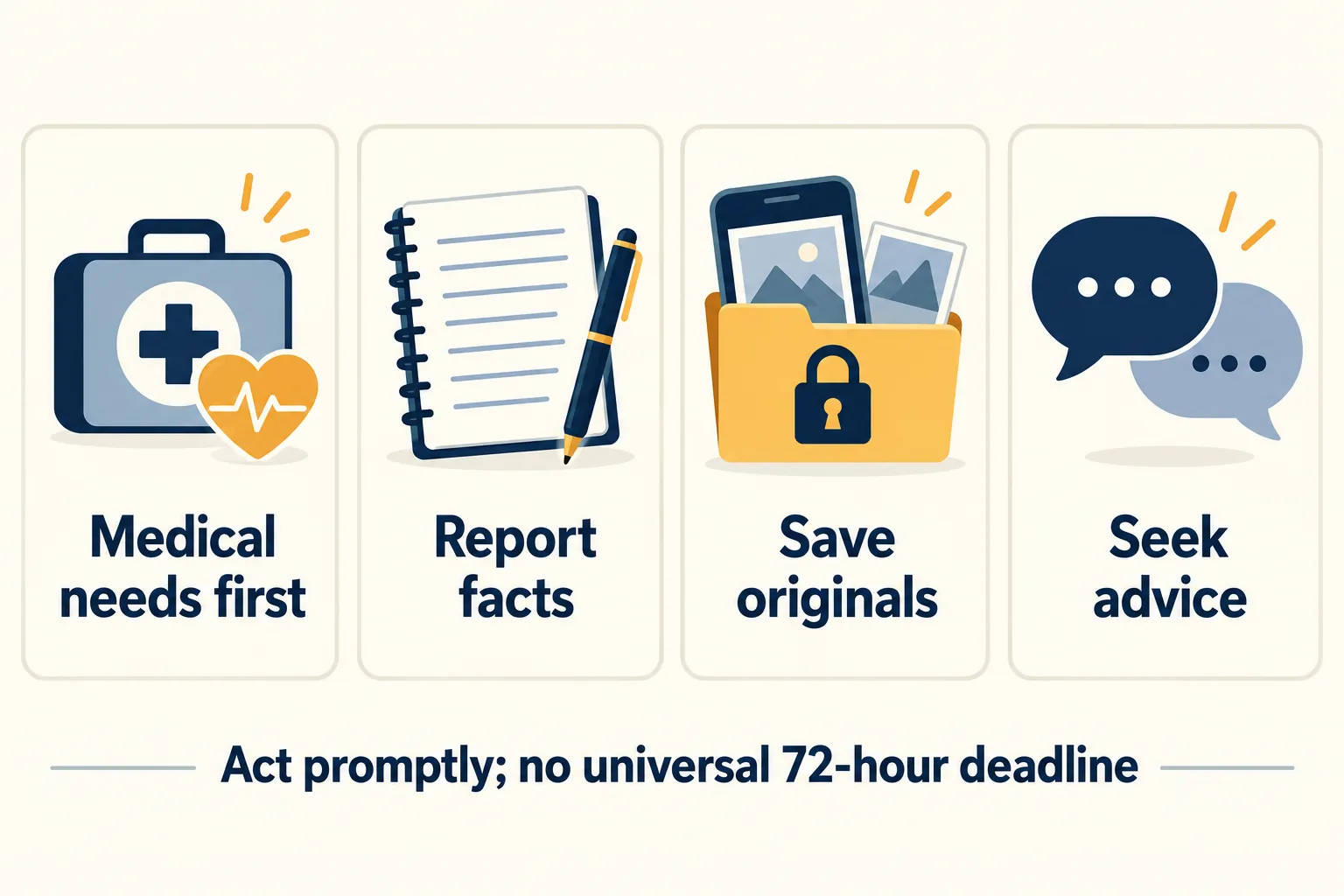
In the first 72 hours after a fall at Target, get medical care and keep the paperwork, tell a manager what you saw without guessing at the cause, and leave your photos, receipt, shoes and messages exactly as they are. Collect contact details from willing witnesses, and ask a lawyer about a preservation request before store video is recorded over.
Over the next three days, and where this guide covers it
- Getting checked and keeping the paperwork, under "Start with medical needs".
- Telling the store what you saw and only that, under "Report it, but don't guess".
- Keeping photos, receipts, shoes and messages as they are, under the photo, shoe and receipt sections.
- Asking a lawyer about video before it's gone, under "Ask for preservation promptly".
Why 72 hours? It's a way to organize the work, not a statutory grace period. No Texas rule makes every injured customer finish a checklist by hour 72.
In a busy store, a puddle can be gone in ten minutes and the shopper who saw it can be in the parking lot. Notes you make today let a lawyer check the facts later instead of guessing at them.
Start with medical needs
If this is you | Do this |
|---|---|
A hard hit to the head, a wrist you can't turn, or a knee that won't hold you. | Get medical help first. Photos of the aisle can wait. |
A manager wants to talk before you've been checked. | Your care comes first. The conversation can happen later. |
You felt fine that night and woke up stiff or dizzy. | Get checked, and tell the provider the real sequence. |
A nurse asks what happened. | Describe the fall and the symptoms honestly. Don't call pain immediate if it wasn't. |
Whoever asks, give the same true order of events. Your doctor relies on it now, and your lawyer will rely on it later.
Paperwork to keep
- The ER or urgent care discharge sheet, for the date of the visit and the complaint you gave that day.
- Appointment cards and referrals, for showing your lawyer which providers to request records from.
- Pharmacy labels and printouts, for tying each medication to a date.
- A list of every place you were treated, which can cut weeks off a records request.
Medical records support the injury part of a claim. On their own, they don't prove Target knew about a dangerous floor.
Report it, but don't guess
If you can, tell a manager. Get the manager's name and a reference number.
What you might say
- "I didn't see anything before. I noticed the wet spot when I was on the floor," if you saw the liquid only once you were down.
- "Aisle 14, next to the paper towels. I don't know where the liquid came from," if you know where but not what caused it.
- "I didn't see a cooler leaking. I can only tell you my foot slid," if someone suggests a cause you didn't see.
At the store | Do this |
|---|---|
Describing the spot. | Be exact. "Near the front" could cover a dozen cameras. "Checkout lane 9, past the card reader" points to one spot. |
A factual incident report. | Read it and ask them to fix anything wrong. |
Anything that sounds like a release. | Don't sign until you understand it; a release is not a report. |
No copy offered. | Ask for one. If they refuse, note that you asked and keep your own written account. |
A new detail may come back to you later. Write it down and tell your lawyer instead of quietly rewriting your first account.
Photograph the scene in layers
Take pictures only where it's safe and lawful. Stay out of stockrooms and let employees work. Don't try to recreate the fall.
Four shots, from far to near
- The approach, for the 15 or 20 feet you walked before the fall.
- The spot itself, for the puddle, the torn packaging or the curled mat edge.
- The surroundings, for shelving, doors and a cooler or floor scrubber nearby.
- The wide view, for overhead lights, any warning signs and the whole aisle.
What each one can miss, in the same order
- Clear liquid, which often doesn't show from a distance.
- The warning sign three feet to the left.
- Fine detail on the floor.
- Whether the floor was wet at all.
If cleanup already started, shoot from where you are and jot down the time. A photo taken after the scene changed should be labeled as later.
Keep the originals on your phone with the metadata intact, even after you've sent copies. Your lawyer should get copies by email or text, not only a compressed social-media version. Arrows go on a separate copy. Never mark up or filter the only one you have.
Ask willing witnesses for contact information
What a witness might have seen
- The condition before you got there, for timing, which is often the hardest thing to prove.
- The fall itself, for how it happened.
- An earlier warning to an employee, for possible evidence the store knew.
- How staff responded, for cleanup, cones and what was said.
Get a name and a phone number or email that will still work in six months, and get it now rather than trying to track people down later. Note what each person told you and when. Quotation marks go only around words you remember exactly. "I told one of the workers" isn't proof without details, so ask, "Which worker did you tell, and when?"
Some people won't want to get involved, and that's their call. Don't pressure anyone, and never offer money for favorable testimony.
A companion can describe your approach and how you looked on the floor. Being family doesn't tell them how long an unseen spill had been there, and a sister's or friend's memory should stay separate from yours instead of becoming one shared story for everyone to adopt.
Keep the shoes and clothes you were wearing
Shoes can matter for traction, tread wear and fit. Clothing may show moisture, residue or a tear. Set them aside and ask your lawyer how to store them.
Already washed the jeans before you knew they mattered? Write down when, and why. Kept wearing the sneakers? Note about how many days. If a cane, walker, cart or shopping bag was involved, note where it is now and whether it changed. If someone else held on to an item, note who kept it and where.
Never add a stain or alter anything to make it look more connected to the fall. An honest history beats pretending nothing changed.
A cane or walker you own stays with your other items. A store cart is store property, so don't take it home. Your lawyer can ask the store to preserve it and arrange an inspection through proper channels.
Use receipts and app records as timeline anchors
Record | What it can show | What it usually can't show |
|---|---|---|
Receipt stamped 3:47 p.m. | Which store, and when you checked out. | Whether you fell before or after paying. |
Order pickup confirmation. | Why you were there and roughly when. | Where in the store you fell. |
Parking app or garage ticket. | When you arrived or left. | What happened in between. |
A text you sent from the floor. | Your account in the moment. | The exact minute of the fall. |
Photos your friend took on the way out. | How the aisle looked ten minutes later. | Who spilled what. |
Expect the times to disagree. The manager types the report at 4:05, your receipt says 3:47 and the camera clock may run fast. Keep every record as it is and let your lawyer line them up. Squeezing them into one exact minute can make you look less credible.
Your private chronology for your lawyer (hypothetical entries)
- "Came in the north doors about 3:15, headed to household goods," for the time before the fall.
- "Right foot slid near the paper towels. Landed on my left hip," for the fall.
- "Employee in a red shirt helped me up. Manager took my name," for help and the report.
- "Left about 4:00. Urgent care that evening," for leaving and treatment.
- "About 3:30, maybe a little later," for a time you aren't sure of.
Write it as soon as you're able and ask the lawyer how to handle communications. Privilege depends on the circumstances, not on writing "confidential" across the top.
Ask for preservation promptly
Store video can be recorded over, so a lawyer may send Target a short letter asking it to keep specific footage and records. Aim it at your store and your hour. Every record in Texas is the wrong target.
What the notice should identify (hypothetical examples)
- The store, such as the street address on the receipt.
- The date and best estimate of time, such as March 14, around 3:40 p.m.
- The exact spot, such as aisle 14, household goods.
- Footage from before the fall, such as from 3:10 p.m., in case it shows a bottle breaking, an employee walking by or another shopper pointing at the floor.
- Neighboring cameras, such as the next aisle over, which may show the source or the response.
- A short description, such as "Customer slipped on clear liquid and fell".
The window should be one the facts can justify. Notice often depends on what happened earlier.
A request doesn't guarantee anything. The footage may not exist, and a request isn't an order to hand it over; keeping the video and getting a copy are separate questions. Your lawyer should document every contact. Protect your own evidence at the same time. The surveillance video article covers the technical and legal details.
Be careful with claims communications
Save every letter, email and text, along with any claim number and the name of each person you spoke to.
A request for your bills is often just part of the investigation. It doesn't mean the store accepted responsibility. A friendly call from an adjuster isn't an admission either, however courteous. Take notes.
Claims paperwork | Before you sign |
|---|---|
A medical authorization. | Ask what it covers. A narrow request about this injury differs from a release of your whole history. Your lawyer can narrow an authorization; that's different from hiding records. |
A payment offer. | It may carry release language. Understand the terms before you accept or sign. |
And don't stretch the truth. A sore back from 2023 that you leave out, or a post you delete, can sink a claim that was otherwise solid.
A practical three-day sequence
Day 1 (the day of the fall)
Care, reporting, safe photos and witness contacts; keep the items you already have. An ankle X-ray at urgent care, a reference number from the manager and the sneakers set aside in a bag are examples.
Day 2
Organize your records. If the injury or the circumstances justify it, get a lawyer's evaluation, and bring the receipt and your best time and place ("about 3:40 p.m., aisle 14") so the preservation request can be aimed. Anything urgent? A floor repair scheduled that week or a witness who's moving should come up now, not later.
Day 3 and after
Medical follow-up, saving communications and deciding about representation. For example, keep the orthopedic appointment, save the adjuster's email and ask the lawyer about next steps and what facts could change the evaluation.
Too hurt for the Day 1 list? Ask whoever is with you. Missing a step doesn't automatically defeat a claim. But if a deadline or a preservation problem is urgent, don't wait for day three.
Why this matters if the case goes forward
Your photos point to the camera views worth requesting. The witness list separates the people who saw the condition from the ones who saw only the aftermath. The 3:47 receipt tells a lawyer which store, and roughly which half hour to pull video for. Your list of doctors and visits says whose records to request, and it helps show whether the fall caused the injury.
Not all of it will help. Your own photo might show a yellow sign right where you walked. A witness might say another shopper dropped a soda seconds before you got there. A good lawyer weighs that instead of burying it, and knowing early can save you money on a case that won't work or help you judge a settlement offer realistically.
Prompt preservation doesn't guarantee a claim. It keeps the facts you need to decide whether a lawsuit is justified.
Why consider Aaron Herbert early
The State Bar lists Aaron A. Herbert as Board Certified in Personal Injury Trial Law. S1 S3 Even a fall that looks simple can turn into a fight over video, depositions, experts and trial preparation.
A consultation should connect the credential to a plan. Ask how the firm would investigate your incident, who would handle preservation and what it needs to know before recommending a lawsuit.
Expect a useful plan to be candid about weaknesses, likely costs and how often you'll get updates. What it shouldn't include is a promise that Target will pay because you hired a lawyer.
Frequently asked questions
Question | Short answer |
|---|---|
Is it too late if I already left the store? | Not necessarily. Keep what you have, get appropriate care, and be ready to explain when and why you left. Your lawyer can look for other evidence. Don't go back just to recreate a scene that no longer exists. |
Should I post the video online? | Hold off and ask your lawyer. A post compresses the clip, can reveal private details to strangers, and the store's lawyers will read it. Already posted? Leave it up until you've had advice about preservation. |
Does the store report protect my deadline? | No. Reporting a fall and filing a lawsuit are separate. The general Texas personal injury period is usually two years, but a lawyer should calculate your limitations and service deadlines from your facts. S6 |
Request an evaluation
Contact the Law Firm of Aaron A. Herbert, P.C. through InjuryAttorneyOfDallas.com.
Have this ready
- Store location and date.
- Photos and witness names.
- Treatment information and claims correspondence.
Ask this
- What should be preserved right away?
- What proof is still missing?
- Which next stages matter for my facts?
This article is educational information only. Representation and fees require an agreement. This independent resource is not affiliated with Target. For the next stages, read the comprehensive Target litigation guide and the supporting articles on preservation and notice.
Related Target injury resources
- Target injury knowledge hub
- Comprehensive guide to suing Target in Texas
- Preserving Target Surveillance Video After a Texas Injury
- Proving Target Knew About a Dangerous Condition in Texas
- Filing a Target Injury Lawsuit in Texas and Identifying the Right Defendants
Legal and factual sources
Source | Description |
|---|---|
S1 | Aaron Alan Herbert State Bar profile including specialty listing. Read source. |
S3 | Texas Board of Legal Specialization certification standards and Personal Injury Trial Law requirements. Read source. |
S6 | Texas Civil Practice and Remedies Code section 16.003 and related Chapter 16 provisions. Read source. |

ABOUT THE ATTORNEY
Aaron A. Herbert
Founding Attorney
Board Certified in Personal Injury Trial Law
Aaron founded The Law Firm of Aaron A. Herbert in 2010 to focus on developing each client's case and seeking its maximum value. For over a decade, he has represented people seriously injured in major accidents and industrial catastrophes, pursuing trial verdicts and settlements while working to reduce the stress of litigation.
Education
- Texas A&M University · B.S., Criminal Justice, 1999
- University of Oklahoma College of Law · J.D., 2002; graduated in the top of his class
Trial experience & approach
Aaron earned numerous jury verdicts at boutique personal injury litigation firms. According to his biography, he spent a year as the top-earning litigation attorney at a firm that frequently appeared in verdict searches as having one of the highest numbers of trial wins in Texas. At another Dallas personal injury firm, he moved from managing pre-litigation attorney to managing litigation attorney over seven years as the firm grew into one of Dallas's largest personal injury firms.
His biography describes a reputation as one of America's most aggressive trial lawyers, with noteworthy recoveries from judges and juries and substantial pretrial settlements. Most of those settlements included confidentiality agreements requested by the defense. Aaron has said the recoveries were justified by the injuries and losses involved, which no amount of money could make someone choose to experience.
His approach combines passion, preparation, persistence and courtroom imagination. He believes a well-supported, engaged and motivated team working cooperatively helps deliver strong representation, with the goal of achieving the best possible result for every client.
Dallas roots, military service & publication
Born and raised in Dallas, Aaron enlisted in the United States Marine Corps after high school and later received an Honorable Discharge. He completed his university and law degrees after his military service and became a lifelong Sooners football fan in law school.
Publication: “Litigating Dog Bite Cases,” Texas Dog Law Seminar, Dallas, 2009.
Professional affiliations & recognition
Professional affiliations and recognition listed in Aaron’s biography:
- State Bar of Texas
- American Bar Association
- Association of Trial Lawyers of America (now American Association for Justice)
- Texas Trial Lawyers Association
- Dallas Trial Lawyers Association
- Dallas Bar Association
- Tarrant County Bar Association
- Million Dollar Advocates Forum
- The National Trial Lawyers – Top 100 Trial Lawyers