
Illustration only, not a real case file or courthouse. An organized file ties each piece of evidence to a question a lawyer still has to answer.
How does a lawsuit against Target actually begin?
Step | What actually happens |
|---|---|
Investigate | A lawyer looks into the fall and works out which companies might be responsible |
Weigh the case | Legal duty and proof get tested before anything is filed |
Calculate deadlines | Limitations and service dates go on the calendar |
File | If the case is worth bringing, a petition goes to a court with jurisdiction and proper venue |
Serve | The defendant has to be properly served |
Doesn't start a lawsuit | Why |
|---|---|
A store incident report | It's the store's record, not a court filing |
A claim number from an adjuster | It tracks the claim; it doesn't stop the limitations clock |
Weeks of negotiation | Talks ordinarily don't pause the deadline |
Before suit | What it does and doesn't do |
|---|---|
A focused preservation request | Asks Target to keep things; doesn't force disclosure |
Asking for information voluntarily | Target can say no |
After a denial, discovery in the chosen forum | Can reach records and testimony, subject to privileges, proportionality, protective orders, and the court's rulings |
Whether to sue | Should depend on |
|---|---|
Promise a lawsuit just for leverage? | No, not when essential facts are missing |
Quit because the adjuster said no to the first demand? | No, a reasonable investigation keeps going |
What you deserve to hear | What can be proved, what's still uncertain, and what further work could change the picture |
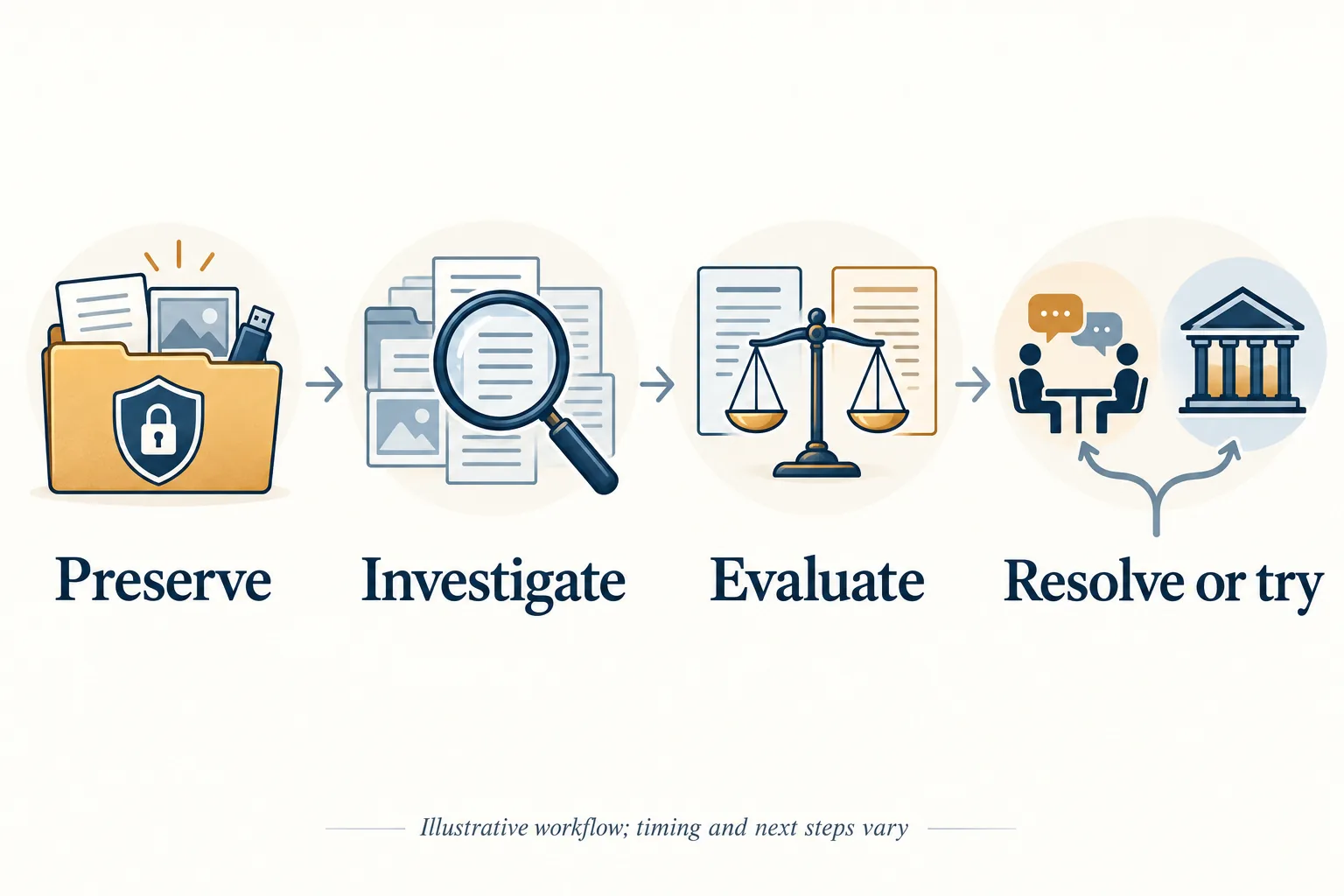
A serious Target slip, trip, or fall case comes together around five questions. Here's how each might look in a hypothetical case.
Question | What it might look like in a Target fall |
|---|---|
What condition caused the injury? | Spilled laundry detergent spread across the tile at the end of the cleaning-supplies aisle |
Who controlled that condition? | The company operating the store, as opposed to a landlord or a floor-care contractor |
What did the responsible party know before the fall? | A team member radioed for a cleanup 15 minutes earlier, or the spill sat untouched on video |
What reasonable action was missing? | No cone, no mop, and no one stationed at the aisle while help was on the way |
What harm did that omission cause? | A torn meniscus that needed arthroscopic surgery and six weeks off work |
Stage | Order |
|---|---|
Medical care and preservation | First |
Entity research, discovery, expert analysis | Middle |
Settlement evaluation, and trial when it has to happen | Last |
Explore the Target injury knowledge hub for the connected evidence and client resources.
Who it's for | What the process should produce |
|---|---|
You, the person who got hurt | Answers about responsibility and recovery you can actually follow |
A practitioner | A record that holds up against evidentiary objections and a dispositive motion |
The two goals feed each other. A lawyer who can't explain the case to the client in plain words usually doesn't have a firm grip on the proof yet.
About Aaron A. Herbert's credential | Details |
|---|---|
What it is | Verified Board Certification in Personal Injury Trial Law, a concrete credential to weigh when choosing counsel S1 S3 |
What this guide covers | The litigation tasks that make that specialty relevant |
What it doesn't claim | That certification guarantees a recovery, shows a Target-specific track record, or makes one lawyer objectively better in every case |
1. The first interview should create an evidence map
Let the client tell the whole story first, uninterrupted. Then go back for the details.
Ask | Why |
|---|---|
Where did you come in, and what were you doing? | Sets the route and the purpose of the visit |
Which way were you walking, and where were your companions? | Tells you which cameras and witnesses matter |
What did you notice before and after you lost your balance? | Separates firsthand observation from later explanation |
Someone who felt water on her jeans after the fall has useful evidence, even if she has no idea how the water got on the floor. Get the store address and enough detail to tell it apart from the Target two exits down.
Record | What it can show | What it can't show by itself |
|---|---|---|
Checkout receipt | Store number, transaction time, and the order of purchases | The minute the fall happened |
App order or pickup notice | That the visit involved order pickup | Where in the store the fall took place |
Phone photo timestamp | Roughly when the picture was taken | Synchronized local time, since the phone's clock settings may differ |
Preserve the underlying records before building a precise chronology.
About the scene, ask | Watch out for |
|---|---|
Contact with a manager, employees who helped, cleanup, photos, paramedics, witnesses, anything said | Assuming every red shirt worked there, or that everyone who helped saw the fall |
How did you recognize that person? | Guesses passed off as identification |
What exactly did they say, and did anyone write it down or record it? | Paraphrase hardening into a quote |
Medical interview covers | Without |
|---|---|
Symptoms, treatment, prior relevant conditions, changes in function | Suggesting a diagnosis |
Earlier injuries, balance-affecting medications, vision problems, footwear, assistive devices | Skipping the history a defense lawyer will dig into anyway |
Hard facts collected early support an honest evaluation and avoid surprises after filing.
Set up the intake record in three columns. Here's a hypothetical example.
Known facts | Plausible explanations | Unresolved questions |
|---|---|---|
Clear liquid is visible beneath the shelf in the client's photo | "The refrigerator was leaking" (no witness or record yet) | Did anyone report the liquid before the fall? |
The receipt shows checkout at 6:42 p.m. | The fall happened about 20 minutes earlier | Which camera covers the dairy aisle? |
An employee in a red shirt helped the client up | She may have seen the spill first | What is her name, and was she on the clock? |
Line to hold | Why |
|---|---|
"The refrigerator was leaking" stays in the middle column until a witness or a reliable record supports it | Assumptions shouldn't become sworn allegations |
The photo of clear liquid goes in the first column | It's something you can actually show |
Tell the client why you're asking the awkward stuff. Say she hurt the same knee in 2019: that doesn't sink a new claim, but denying it can wreck her credibility and muddy medical causation. The aim is helping her tell the whole truth, well.
2. Medical care and legal proof have different jobs
Who decides what | Who it is |
|---|---|
Treatment decisions | The patient and qualified health professionals |
Counsel's role | Explain why records matter and help gather them |
Off limits | Steering anyone into unnecessary treatment to make a claim look bigger |
The strongest medical record shows real symptoms, clinically supported findings, reasonable treatment, and an accurate account of progress.
Ask providers to | Because |
|---|---|
Record how the injury happened as the patient describes it | The mechanism matters later |
Keep diagnosis separate from history | An ER note saying "fall at store" helps with timing but does little to prove the specific hazard |
Ground any later specialist opinion on causation, prognosis, or restrictions | That opinion needs an adequate factual and medical foundation |
Keep prior relevant records too | The comparison may show |
|---|---|
Records from before the fall | A new fracture, a different symptom pattern, or aggravation of an existing condition |
The same records | Another cause entirely |
Counsel should understand both possibilities before telling a medical story to a claims handler or a jury.
A recovery journal can track appointments, medication side effects, lost sleep, mobility, and tasks that now need help. It should be factual and something the client can keep up.
Less useful journal entry | More useful journal entry |
|---|---|
"Pain unbearable today." (written every day, word for word) | "Tuesday: couldn't kneel to bathe my son; my sister came over to help. Slept about four hours." |
"Back is terrible." | "Skipped Sunday's grocery run. Standing longer than ten minutes sends pain down my left leg." |
Notes every few days with concrete limits beat the same sentence written daily. The journal may be discoverable, and it never replaces medical evidence.
Paying for treatment | Talk candidly about |
|---|---|
Health insurance and available benefits | They change the client's options |
Provider payment arrangements and reimbursement claims | They change the eventual proceeds |
A website promising treatment at no out-of-pocket cost | Don't, unless the firm can back up the exact arrangement and its limits |
3. Identify the condition rather than a general sense of danger
Label | Usually means | Limit |
|---|---|---|
Slip | Reduced traction | Labels organize the inquiry; they don't establish liability |
Trip | An obstruction or a change in level | Same |
Fall | Several causes working together | Same |
Ask for the foot movement, the contact point, the surface, and the sequence. A startled customer won't know every mechanical detail, and that's fine.
Condition | What to document | What to be careful about |
|---|---|---|
Liquid on the floor | Appearance, how it spread, possible sources, nearby merchandise, footprints, cart-wheel marks, cleanup equipment, and lighting | A big puddle doesn't prove a long duration, since a large release can happen fast. Track marks need careful interpretation and aren't a reliable clock without support. |
Entry or aisle mat | Placement, edges, backing, distance from the doors, and the floor around it | A raised edge after someone stepped on it may not show how the mat lay before. Photograph the customer's approach, not just a top-down view. |
Merchandise or packaging | Whether it was on the floor before the fall, fell during it, or got moved afterward | Stocking work and customer activity can offer competing explanations. A nearby cart doesn't prove an employee created the hazard. |
Parking lot or sidewalk | Exact spot relative to the doors, cart corrals, curb transitions, accessible routes, and common areas | The Target sign doesn't tell you who controlled pavement repairs. Use photos that show scale without a misleading angle. |
Next step by condition | Look for |
|---|---|
Mat | Footage, witnesses, maintenance records, and the mat itself where preserving it is justified |
Merchandise | Records and testimony tied to that aisle and that time period |
Parking area | Leases, management agreements, work orders, and actual maintenance practices |
4. How does Texas premises liability law frame the case?
The ordinary invitee framework looks at | What it means |
|---|---|
Knowledge | The store's knowledge of an unreasonably dangerous condition |
Care | A failure to use reasonable care to reduce or eliminate the risk |
Causation | Proximate causation of the injury |
Control | Control over the relevant part of the premises matters |
Limit | A retailer isn't an insurer of every customer's safety S2 S4 |
Order matters. Each step answers a different question.
Step | The question it answers |
|---|---|
Identify the condition and the defendant's relationship to it | What hurt you, and did this company control it? |
Check duty | Does the customer's own knowledge, or an open and obvious condition, change what the store owed? |
Assess notice | What did the store know, or what should it have discovered, before the fall? |
Assess the response | Did the store act reasonably once it knew or should have known? |
Assess causation and damages | Did this condition cause these injuries, and what losses can be proved? |
Lumping all of that into "the store was careless" hides weaknesses that each need their own answer.
Premises condition or negligent activity? | How it's treated |
|---|---|
A condition left behind by earlier work | Generally can't escape the premises requirements just by being relabeled negligent activity S9 |
An ongoing act that independently causes the injury | Counsel should research the right theory and plead facts that support it S9 |
Internal policies | What they can and can't do |
|---|---|
Useful for | How the store operates, who had which task, whether a precaution was feasible |
Not a substitute for | The legal standard; a missed company checklist isn't, by itself, proof of every element |
When the store says "we followed policy" | Test it against the actual records, the timing, and the condition involved |
What this means for you: a lawyer has to size up the legal barriers before talking compensation. A detailed injury story can sit next to a thin notice record, and a modest photo can sit next to strong actual-notice testimony. An honest assessment says which element each piece of evidence supports.
5. Notice is a factual chronology problem
Kind of notice | What it means | Evidence that might show it |
|---|---|---|
Actual notice | Awareness of the specific condition | A prior employee report, a documented customer complaint, a warning put out before the fall, or testimony that an employee saw the hazard |
Constructive notice | The condition existed long enough to give a reasonable opportunity to discover it, considering the circumstances | Proof of how long it was there |
Check each actual-notice source for timing and specificity. Learning about the spill after the fall doesn't prove anyone knew before it.
Authority | What it stands for |
|---|---|
Reece and Spates | The central Texas authorities on temporal proof and the limits of evidence that an employee was nearby S4 |
H-E-B, LP v. Peterson (Tex. April 2026) | Duration evidence has to be tied to the dangerous condition at the time and place of the injury; general maintenance concerns or problems elsewhere in a building can't stand in for proof about the particular hazard S2 |
Bottom line | No universal number of minutes automatically establishes notice |
The investigation hunts for anything that brackets when the condition began and ended.
Possible bracket (hypothetical) | Its limit |
|---|---|
A shopper walked the aisle 20 minutes earlier and saw a dry floor | Only as good as her memory and vantage point |
A camera shows an employee responding to a customer | It may not show the floor |
A work order flags an unresolved problem in the same spot | It may not show the problem was there that day |
An inspection log entry | Helps only if a witness can explain what was actually inspected |
Did an employee create the hazard? | Pin down |
|---|---|
Who did what | The stocker, the mop, the pallet, by name and time |
Whether the condition existed afterward | Was the liquid still there when the customer walked up? |
Whether that conduct and knowledge are attributable to the defendant | Under the relevant law; Keetch warns creation isn't an automatic shortcut to knowledge S9 |
Let the notice theory drive what gets preserved.
If the evidence suggests | Focus preservation and requests on |
|---|---|
A refrigeration unit was leaking | Narrowly relevant service records and communications about that unit |
A customer dropped a bottle on camera | The drop itself, who saw it, and how the store responded |
No one can show how long the hazard was there | An honest look at whether actual notice or another supported theory exists |
6. Preserve video before debating settlement value
Surveillance can show | It can also |
|---|---|
Where a hazard came from, employee movements, customer traffic, warnings, cleanup, how the fall happened | Hurt the claim |
Ask for enough context to judge both sides. A clip starting a few seconds before the fall may show the fall and leave out the part that matters most for notice.
A focused preservation letter covers a short list of items. The window should fit the facts; a two-hour period is an example to justify, not a universal legal entitlement.
Item in the letter | Hypothetical example |
|---|---|
Date and location | Saturday, March 14, inside the main entrance, by the cart corral |
Time window | 1:00 to 3:00 p.m., to capture the floor before and after a 2:05 p.m. fall |
Incident description | Customer slipped on tracked-in rainwater on the entry tile |
Adjacent views | The vestibule camera, which may show when the mat was moved and who moved it |
Format | Native or original-quality exports, metadata, camera identifiers, available audit information, and whatever is needed to play the files |
Format pitfalls | What to do |
|---|---|
Screen recording or an emailed compressed clip | May lose useful detail |
Demanding impossible technical formats | Learn how the store's system works first |
Asking for an adjacent view without a reason | Explain why it matters |
Preserving | Producing |
|---|---|
The retailer keeps the footage | The retailer may still dispute handing it over voluntarily |
A practical notice document | Not a self-executing court order |
Counsel documents delivery and asks for confirmation | Counsel weighs litigation remedies if preservation is in doubt |
The claimant keeps, too | Why |
|---|---|
Phone photos, messages, receipts | They anchor the timeline |
Shoes, clothing, social media posts | Physical and context evidence |
Unfavorable material | Deleting it after a lawyer is involved backfires |
Everything, consistently | Neither side can turn the case into a fight about missing records |
7. Spoliation requires proof and proportionate relief
Brookshire Brothers, Ltd. v. Aldridge | |
What it supplies | The main Texas framework: preservation duties, breach, culpability, prejudice, and tailored remedies |
Who decides | The trial judge decides spoliation questions |
Missing evidence alone | Doesn't automatically establish liability or justify an adverse inference |
Spoliation instruction | Generally reserved for intentional concealment where a lesser remedy won't do |
Narrow exception | Negligent loss that irreparably deprives a party of any meaningful ability to present a claim or defense |
Frustration that a recording is gone isn't enough for a severe jury instruction. Argue the actual standard, ask for the relief the record supports, and don't invite jurors to punish missing evidence without the ruling the law requires. S10
Build the record on | What it shows |
|---|---|
The camera system and its ordinary retention settings | What normally happens to footage |
Who got notice, export decisions, litigation-hold steps | What the store did after the request |
When deletion happened | Before or after the duty arose |
"We don't have it" still leaves questions open. Did the camera record that area at all? Did anyone watch it? Did a different custodian keep a copy?
Describe prejudice specifically. Here's how the facts can change the analysis.
What the investigation finds | How it may affect prejudice and remedies |
|---|---|
The missing period would have shown the floor before the fall | It ties directly to the inability to prove how long the hazard existed |
Another retained camera angle answers the same question | The remedy analysis may change |
No camera ever covered that aisle | A claim of destroyed aisle footage may have no factual foundation |
Before assuming only a jury instruction will do | Consider |
|---|---|
Additional custodian testimony | May cover part of the gap |
Technical records or substitute evidence | May answer the same question |
Other court-approved relief | Depends on forum law and the developed record |
Federal court | Rule 37(e) sets out a different framework for lost electronically stored information S11 |
Prompt preservation keeps the client out of this side fight. Documenting notice and system behavior gives counsel the record to argue remedies responsibly. Nobody is helped by a promise that an erased video automatically wins the case.
8. Identify every entity by evidence
To a shopper, "Target" is a brand. A lawsuit needs legally appropriate defendants.
Research | Confirm through |
|---|---|
The store operator, the property owner, relevant contractors, and any other company whose control or conduct supports a claim | Reliable business records and official sources |
Service information | Never by copying a defendant's name from an unrelated lawsuit |
Different parts of a property can involve different arrangements.
Area where the fall happened | Who might control it | Records worth requesting |
|---|---|---|
Sales floor inside the store | The store operator | Inspection and cleanup records for that aisle and date |
A licensed business area inside the store | The licensed operator, the store, or both | The license or operating agreement and evidence of who actually maintained the floor |
Shared sidewalk outside the entrance | A landlord or a property manager | The lease, the management agreement, and repair requests |
Parking lot | The owner, a manager, or a maintenance contractor | Work orders, repair authorizations, and contractor schedules |
Point | Why |
|---|---|
A lease clause about maintenance can matter | But investigate actual control and conduct too |
Ownership alone | Doesn't answer every duty question |
A contractor on site | Doesn't automatically erase the retailer's obligations |
Before reading the lease | Ask |
|---|---|
Photos and a site diagram of the exact spot | Are both sides arguing about the same stretch of pavement? |
Who could inspect, warn, repair, close the route, or authorize work there | That's who controlled it in practice |
Did a renovation or a vendor switch change any of that? | Control can move mid-year |
Joinder and removal | |
Adding employees or local companies just to manipulate jurisdiction | Don't; join a party because facts and law support a viable claim |
Improper joinder | Can trigger federal removal litigation and pull attention from the merits |
Needs separate examination | Citizenship, corporate structure, amount in controversy, procedural deadlines |
At settlement | Why it matters |
|---|---|
The release | Should accurately name the released parties and the claims covered |
A broad release signed without understanding it | Can affect rights against others |
Allocation and indemnity | Look into them as needed; the claimant's tort rights and the defendants' contracts with each other are separate questions |
9. A working evidence matrix
The matrix ties each disputed issue to a source and a next step. Refresh it after big productions or testimony. Leave out numerical "confidence scores"; counsel's judgment calls aren't science.
Issue | Evidence to examine | Question still to resolve |
|---|---|---|
Control | Leases, maintenance contracts, and manager testimony | Who controlled this spot and the response to the hazard? |
Condition | Original photos, relevant video, and witnesses | What actually caused the loss of footing? |
Knowledge | Prior reports, the timeline, and employee testimony | What did the store know before the fall? |
Reasonable response | Warnings, cleanup records, and the response sequence | Was the response adequate under the circumstances? |
Causation | Mechanism evidence, medical history, and expert opinions | Did this event cause the claimed injury? |
Damages | Medical records, employment proof, and evidence of function | Which losses are supported and recoverable? |
Defenses | Approach footage, warnings, and admissions | What facts affect duty or responsibility? |
What the matrix shows (hypothetical) | Where the money should go |
|---|---|
The knowledge row holds nothing but "an employee was somewhere nearby" | Dig into notice before paying damages experts |
Liability looks strong but medical causation is disputed | The other way, toward the medical proof |
The matrix is a management tool, not trial evidence. Its whole value is spotting gaps early.
10. A hypothetical timeline, with its limits stated
Invented teaching facts, not a reported Target event or a result the firm obtained:
Source | Displayed time | What it shows |
|---|---|---|
Aisle camera | 10:02 | A container releases liquid onto the floor |
Aisle camera | 10:07 | A stocking employee passes through the aisle |
Aisle camera | 10:18 | The customer falls |
Manager's incident entry | 10:25 | The incident is logged |
Task | What counsel checks | Example of what could change the picture |
|---|---|---|
1. Validate the clocks | Was the camera seven minutes slow? Does 10:25 record the report rather than the fall? Did the cameras share one clock? | A receipt, an access log, or another known event that fixes the offset |
2. Test visibility | Direction of travel, obstructions, lighting, how much the liquid contrasted with the floor, and the employee's task | The employee was facing a shelf and pushing a loaded cart |
3. Map the response window | Whether anyone reported the spill, when help arrived, and whether a cone actually warned the customer's approach | A 10:08 report and a cone placed at 10:12 make a very different case from no response at all |
4. Test causation | Foot placement, witness descriptions, clothing, and medical history | The customer tripped on packaging beside the liquid instead of slipping in it |
While working the timeline | Why |
|---|---|
Keep the camera's original time display; put any corrected chronology on a separate sheet | The 10:25 entry may be when the manager typed it, not when anyone fell |
Ask the employee what he actually saw before hiring an expert to reconstruct what was visible | Walking within a mapped distance of a spill doesn't prove he saw it |
If a cone went out, check whether the route stayed unsafe | Judge the response as a sequence, not by one unflattering frame |
Make the chronology explain the mechanism the evidence supports | A slip and a trip over packaging are different cases |
What the minutes show | What they don't |
|---|---|
Opportunity to find the spill and the response | A stopwatch threshold that decides liability |
A clean timeline for a focused deposition | A substitute for testing each version |
Support for the summary judgment response | Proof of notice by themselves |
11. Filing and service require a deadline plan
Deadline point | Detail |
|---|---|
General rule | Most Texas personal injury claims carry the two-year limitations period in section 16.003 S6 |
Do it yourself? | No. A website can't calculate a safe date for your facts. |
Situation that needs separate research | Why |
|---|---|
A minor's claim | Accrual and tolling can differ |
An estate issue | Different parties and timing |
A different cause of action | It may carry its own period |
A proposed additional defendant | Limitations runs separately against that party |
Any accrual question | Exceptions need individual analysis |
Deadline memo field | Example entry (hypothetical) |
|---|---|
Incident date | May 9, 2026 |
Possible accrual dates and assumptions | Injury on the date of the fall; no minority or estate issue identified so far |
Applicable rules | Section 16.003 and the service rules for the chosen court |
Internal filing target | Months ahead of the earliest possible deadline |
Service plan | Registered agent confirmed from official records; a named person watches the return of service |
A petition filed in the last week invites fights about diligence and the defendant's identity. Calendar internal dates well ahead and assign someone to confirm the entity and track service.
What doesn't stop the clock | What to do instead |
|---|---|
An adjuster agreeing to "review the records" | File on time; review doesn't ordinarily extend limitations |
A friendly phone call about tolling | Check any tolling agreement's parties, scope, duration, and enforceability, and get it in writing |
A petition should | It shouldn't |
|---|---|
Allege the location, condition, defendant's alleged responsibility, notice theory where supported, causal sequence, and relief | Try the whole case in rhetoric |
Reflect research on jurisdiction, venue, pleading requirements, and discovery-control issues | Pick a court for any reason other than that the law permits it and the case fits |
What filing changes for the client | Plan for it |
|---|---|
The store can demand records, written answers, testimony, and medical examinations the rules allow | Explain these duties before the client authorizes suit |
Public filings can expose personal information | Cover the available privacy protections in plain terms |
12. Federal removal changes the procedural roadmap
A Texas premises claim can land in federal court if jurisdiction and removal requirements are met. Being sued alongside a national retailer doesn't answer that by itself. S12
Diversity removal turns on | Check |
|---|---|
Citizenship | Of every properly joined party |
Amount in controversy | Whether the jurisdictional amount is met |
Proper parties | Who is actually a defendant |
Removal timing | Whether the notice was filed on time |
If the store removes, check right away whether removal was proper and whether a remand deadline is running. A state discovery schedule doesn't simply carry over.
After removal, check | Why it matters |
|---|---|
Federal Rules of Civil Procedure | They govern disclosure, discovery, and motion practice |
The district's local rules | They add requirements the state court didn't have |
The scheduling order | It sets the deadlines for experts, motions, and trial preparation |
Which questions are substantive and which are procedural | State substantive law may still apply alongside federal procedure |
Where the substantive/procedural split bites | What to do |
|---|---|
Expert disclosure | Name the controlling authority |
Summary judgment | Follow federal procedure, apply state substance |
Preservation | Don't paste a state-court checklist into a federal case |
Tell the client | Not |
|---|---|
"The case moved courts; we still have to prove the same things." | That the claim has been lost |
The updated schedule, budget, and new disclosure duties | Nothing, until the next bill arrives |
Whether the move changes strategy or cost | That nothing changes |
13. Sequence discovery around the weakest essential element
Start with whatever is most likely to decide whether the case survives.
Type of case | Discovery that usually comes first |
|---|---|
A transient spill | Video, witness identities, condition-specific notice, and inspection evidence, ahead of broad corporate financial discovery |
A structural defect | Control and maintenance history |
Discovery tool | What it can do in a Target fall case |
|---|---|
First request for production | Get incident photos, relevant footage, custodian identities, applicable inspection and response records, relevant service work, and nonprivileged communications about the condition, with defined date ranges and locations |
Interrogatories | Identify employees assigned to the area, people with knowledge, the company controlling the location, and the factual basis for each defense |
Requests for admission | Narrow issues such as authenticity, which party produced a record, or an undisputed chronology, without setting accidental technical traps |
Asking for more than the aisle and the afternoon? Give a specific factual reason.
Privilege fight | Point to remember |
|---|---|
"It's in the claim file, so it's privileged." | Being in a claim file doesn't make every item privileged |
"Nobody stamped it privileged." | A missing label doesn't make a document discoverable either |
What to ask for | An adequate description under the applicable rules, then challenge specific items when justified; work product and attorney-client questions go document by document |
Discovery tracker column | Example entry (hypothetical) |
|---|---|
Request | RFP 4: aisle 12 video, 9:30–10:30 a.m. |
Response and objection | "Overbroad"; partial production |
Production reference | TGT000112 |
Missing material | The 9:30–10:00 segment |
Follow-up date and importance | Letter due Friday; this segment bears on notice |
A judge can rule on "the 9:30 segment from aisle 12 is missing" far more easily than on "the defense is hiding everything."
14. Corporate representative testimony should establish systems and conduct
Forum | Organizational deposition rule |
|---|---|
Texas state court | Rule 199.2(b)(1): depose an organization through witnesses it designates S13 |
Federal court | Rule 30(b)(6), with its own text and requirements S11 |
Either | Describe the topics with appropriate particularity under the rule that applies |
Possible topic | Hypothetical framing tied to one store and one day |
|---|---|
Control of the incident location | Who was responsible for the floor at the main entrance on March 14 |
Inspection responsibilities | Who was assigned to walk that area between 1:00 and 3:00 p.m. |
Response procedures | The cleanup and warning procedures in effect on the incident date |
Video retention and export | How long that store's cameras kept footage and who exported the clip |
Work-order systems | How a leak or floor complaint at that store gets logged and closed |
The investigation performed | What the store actually did after the fall |
One aisle on one day doesn't justify asking a designee to speak for every store and every year, unless a broader issue really is in play.
Witness | What they usually know |
|---|---|
Corporate designee | What a record means, learned through preparation, without having been there |
Scene employee | The event itself, and maybe nothing about video retention |
Make each answer's source of knowledge clear on the record.
Order for using a document | Ask |
|---|---|
1 | What is this record, and who creates it? |
2 | What does each field mean, and can entries be changed? |
3 | What did you review to prepare? |
4 | Only then: why is this field blank? It could mean no inspection, or a field used for something else. |
If the designee can't answer a noticed topic | Do |
|---|---|
Find out what preparation happened | Ask where the answer would come from |
Seek supplementation or other relief when warranted | Remember an unprepared witness doesn't automatically prove the premises claim; the goal is still admissible evidence about the event, the store's knowledge, and its response |
15. Employee and witness depositions need careful chronology
A scene employee can cover | First confirm |
|---|---|
Task assignments and line of sight | Her actual role and shift |
What she saw and reported | That she was really there; a name on the roster doesn't put her on the sales floor |
Cleanup | When she was called and what she did |
Routine practice | Specific recollection |
|---|---|
"I usually walk the aisles before lunch." | "I remember checking aisle 12 at 11:55 that day, and it was dry." |
"We always put out a cone." | "I put a cone at the north end of the aisle right after the customer told me." |
Records can refresh a memory or stand as independent evidence. Don't let habit pass for a specific memory without nailing down which one the witness is giving.
Customer witness question | Why |
|---|---|
What first caught your attention? | Someone who heard the impact saw the aftermath, not the foot contact |
Did you see the substance before the fall? | That can be strong timing evidence |
Where were you standing, and was your view blocked? | Tests what the witness could really see |
Did you take photos or send messages? | Preserve the originals |
If a witness says the spill had been there "forever," ask what she actually saw. "It was there when I walked by twenty minutes earlier" is worth more than an exaggeration that falls apart on cross.
Preparing the injured client | Never |
|---|---|
Listen to the question, answer accurately, and separate memory from inference | Adopt the lawyer's theory as personal memory |
Review the records and prior statements so nothing surprises them | Rehearse certainty; truthful consistency holds up better |
16. Expert selection begins with an unanswered question
Hire an expert only when specialized knowledge can resolve a material issue. A $40,000 case can drown in expert fees for disciplines it never needed.
Discipline | A question it can help answer | What it can't do |
|---|---|---|
Premises safety or engineering | Were the flooring, mats, lighting, inspection methods, or route design reasonable for this condition? | Manufacture missing duration evidence by declaring that a busy store should find every spill immediately |
Human factors | Could a shopper on this route reasonably see the hazard, given contrast, attention, obstructions, and merchandising? | Replace analysis of the actual approach with a general lecture about distracted shoppers |
Forensic video | What are the time offsets, is the file intact, what are the image's limits, and how do the views line up? | Create reliable detail that the original never captured by brightening or enlarging pixels |
Medicine | What caused the injury or aggravation, and what are the prognosis, restrictions, and future treatment needs? | Assume causation without an adequate history |
Vocational rehabilitation and economics | How do supported restrictions translate into work-related losses? | Fix a calculation built on unsupported assumptions |
Life-care planning | What future care will the injury require, and at what cost? | Stand on its own without medical support for the proposed services |
Expert | The assignment should |
|---|---|
Premises | Identify the condition and the factual assumptions to test |
Human factors | Tie accepted methods to the customer's route as the evidence shows it |
Forensic video | Disclose what the recording can and can't establish, preserve originals, and log every processing step |
Every expert | Stay within their qualifications, and not repeat another expert's conclusions without doing the analysis |
17. Testing methods and standards must fit the event
A floor test run months later can help, but only after you line up the test against the day of the fall.
Factor | Day of the fall (hypothetical) | Day of the test |
|---|---|---|
Floor surface | Original vinyl tile | Resurfaced the following spring? |
Contaminant | Spilled laundry detergent | Water, or the same product? |
Cleaning routine | Nightly scrub | Changed since the fall? |
Conditions | Humid afternoon, heavy foot traffic | Climate-controlled morning, empty aisle |
Footwear and direction | Customer's worn sneakers, walking north | Test-foot material and test direction used |
Write the differences down rather than hiding them.
A traction number can mislead. Ask about | Why |
|---|---|
The instrument, protocol, and calibration | A precise-looking number can answer the wrong question |
Repeatability and uncertainty | One reading isn't a range |
Whether the cited standard fits this surface, contaminant, and purpose | A voluntary consensus standard isn't a binding legal requirement without support |
Measurement | Get it right |
|---|---|
Height difference | A reliable method and an exact location |
Lighting | Measured under comparable conditions when you can |
A demonstration with different shoes or liquid | Fine to illustrate a concept; don't call it an exact recreation |
Check reliability before the defense files its challenge. Under Texas Rule of Evidence 702 and the case law, relevance, qualifications, and reliability all matter; Federal Rule 702 has its own current language. A long report isn't the same as an admissible one, so identify the forum and the governing standard. S11 S14
Before you approve an expert expense, know | Example |
|---|---|
Which disputed issue it addresses | Whether the detergent was visible from the aisle entrance |
What records the expert needs | Video, photos, and the floor-care log |
The expected cost | A written estimate |
What a good or bad finding would mean | An honest expert may find a weakness that changes settlement strategy |
18. Summary judgment preparation starts before the motion
When Target attacks an element before trial | The response must |
|---|---|
It names the element | Point to admissible evidence on that element |
It says there's no fact issue | Show a genuine dispute under the applicable standard |
It ignores the injuries | Remember that describing suffering can't fill a liability gap |
Summary judgment rules | Apply to |
|---|---|
Rewritten Texas Rule 166a | Texas motions filed on or after March 1, 2026; work from its current text on the motion, notice, response, hearing or submission, and ruling, not an old deadline chart S15 |
Federal Rule 56 | Federal court S11 |
Under the 2026 rule, the main periods run from the date the motion is filed:
Event | Timing under the 2026 rule |
|---|---|
Response | Due within 21 days after the motion is filed, except on leave of court or agreement of the parties |
Optional reply | Due within 7 days after the response is filed |
Earliest hearing or submission | Not within 35 days after the motion is filed |
Latest hearing or submission | Generally within 60 days after filing, with 90 days permitted in the circumstances the rule identifies |
These filing-based periods differ from older hearing-based habits. Calculate real dates under the current rules and any applicable orders, not from this summary. S15
If the motion challenges | The response should |
|---|---|
Notice | Cite evidence of knowledge or duration with precise record references |
Causation | Address the mechanism of the fall and the medical proof |
An open and obvious condition | Explain the relevant facts and legal analysis, not just employee conduct |
Record problem | What to do |
|---|---|
An unauthenticated exhibit, an unsupported statement, or an expert opinion without foundation | Fix it before filing; it can fail at the worst moment |
Objections and rulings | Preserve them as the rules require |
Important discovery still outstanding | Evaluate the procedure and evidence for a continuance or other relief; explain what's missing, why it matters, and the diligence so far |
Exhibit index entry | Should identify |
|---|---|
Video | The file, the interval, the displayed clock, and any established offset |
Deposition | Page and line |
Overall | Something a newcomer to the file could use without searching hundreds of pages |
19. Warnings and customer knowledge require separate analysis
Finding a warning sign doesn't end the investigation.
Question about the warning | Why it matters (hypothetical) |
|---|---|
Where was it placed? | A cone at the far end of a 40-foot aisle may not warn someone entering from the near end |
When did it appear? | A cone in a photo taken after cleanup may say little about the earlier scene |
Which way did it face? | A sign turned toward the stockroom doesn't speak to shoppers |
What condition did it address? | A "wet floor" sign for a mopped area may not cover a separate spill nearby |
Could the customer see it on their actual route? | A display or a cart may have blocked the view |
Under Austin v. Kroger, an open and obvious condition, or the invitee's actual knowledge of it, can affect the store's duty, subject to recognized exceptions and the facts. That's a different question from giving the customer a percentage of fault, so analyze duty and comparative responsibility separately. S5
Necessary-use argument | Check |
|---|---|
"She needed to reach that shelf." | Wanting to reach a shelf doesn't automatically trigger the exception |
Alternatives | What other routes were available, and why she used this one |
The store's view | What the defendant could reasonably anticipate |
The fit | Don't force an exception onto facts that don't support it; it needs evidence and current legal analysis |
Customer conduct the defense will raise | Keep in mind |
|---|---|
Phone in hand | A photo of a phone doesn't prove she was looking at it at the decisive moment |
Walking speed, footwear, items carried, eyesight, awareness | Each needs evidence, not assumption |
Clear footage of inattention | Address it candidly when evaluating settlement |
Chapter 33 point | What it means |
|---|---|
Responsibility allocation | Can reduce recovery |
Claimant more than 50 percent responsible | Barred from recovering in an action to which the chapter applies S16 |
Still needs full analysis | The specific allocation, the parties, any settlements, and the judgment rules |
20. How should damages be organized by proof and legal category?
Start with the medical chronology. Then split what providers billed from what the law lets you recover: a $9,400 ER bill isn't automatically a $9,400 loss.
Step | What counsel does | Why |
|---|---|---|
Medical chronology | Tie each visit to a diagnosis, the treatment given, any restrictions, and the prognosis | Each damages number needs a medical anchor |
Billed versus recoverable | Check what was actually paid or incurred under Section 41.0105 and Haygood v. De Escabedo S7 | The face amount of every invoice isn't an automatic recoverable loss |
Loss category | Records that usually support it | Where claims go wrong |
|---|---|---|
Past medical expenses | Itemized bills plus payment and adjustment records | Listing a $9,400 emergency-room bill at full face value without checking what was actually paid or incurred |
Past lost income for an employee | Payroll records, job duties, missed-shift documentation, tax records where appropriate, and reliable evidence tying the absence to the injury | Showing missed days with nothing that connects them to the fall |
Past lost income for a self-employed client | Revenue history, business expenses, and the cost of replacement labor | Confusing lost revenue with lost profit, or counting work that was postponed rather than lost |
Future earning capacity | Medical restrictions, work history, training, transferable skills, labor-market evidence, and reasonable mitigation | Treating a restriction as a guaranteed permanent wage loss |
Pain, mental anguish, impairment, and disfigurement | Testimony and records about frequency, duration, severity, and change from baseline | Leaning on adjectives, or counting the same harm twice |
Future earning capacity point | What it means in practice |
|---|---|
It isn't a permanent wage-loss guarantee | A lifting restriction doesn't prove she'll never work again |
The economist depends on the inputs | The calculation is only as sound as the vocational and factual assumptions underneath it |
The prognosis is still uncertain | Present alternative scenarios instead of a single figure |
Distinct noneconomic loss | Concrete proof (hypothetical) |
|---|---|
Physical impairment | She now takes the stairs one step at a time |
Pain | He can't lift a laundry basket anymore |
Disfigurement | A visible scar along the forearm |
Mental anguish | Months of broken sleep since the fall |
For each one, say how often, how long, how severe, and how much it changed from before the fall, and don't count the same harm twice.
Authority | What it requires |
|---|---|
Parkway | Direct evidence of the nature, duration, and severity of mental anguish |
Gregory v. Chohan (plurality and concurring opinions) | Caution against unsupported noneconomic amounts and arguments untethered to the evidence |
For this case | Target's wealth doesn't measure a shopper's pain; check how controlling decisions apply to this injury and tie the amount to the developed record S8 |
21. A worked recovery illustration
Teaching arithmetic for a hypothetical $180,000 settlement. Assume the signed agreement sets a 40 percent fee at that stage, calculated on the gross recovery.
Line item | Hypothetical amount |
|---|---|
Gross settlement | $180,000 |
Attorney fee at 40 percent of the gross | $72,000 |
Litigation expenses | $14,000 |
Confirmed reimbursement obligations | $26,000 |
Estimated proceeds before any other applicable adjustments | $68,000 |
This example is not | Because |
|---|---|
A fee quote | An actual agreement may use a different percentage, take the fee after expenses, or allocate costs differently |
A Target settlement average | It's invented numbers for illustration |
A prediction | Reimbursement interests can change after negotiation, and some obligations aren't known until benefits records are reviewed |
Ask for an estimated distribution showing | Example line |
|---|---|
Gross amount | $180,000 |
Contractual fee | $72,000 |
Expenses | $14,000 |
Liens or reimbursement | $26,000 |
Amounts held back for unresolved obligations | A hospital lien still under negotiation |
Estimated client payment | $68,000, before other adjustments |
Until those lines are filled in, "a large settlement" tells you almost nothing. Comparing two offers? Run both through the same assumptions so the real gap shows.
Option (hypothetical) | Upside | Risk |
|---|---|---|
Keep litigating for a higher possible verdict | More money if it works | Another year, more expert expense, and a real chance of a defense judgment |
Take the lower settlement | Certainty now | Future care may end up underfunded |
Base the choice on the evidence, your finances, and how much risk you can live with. Nobody should pressure you or promise what they can't back up.
22. What Target's financial data can and can't tell you
Target's fiscal 2025 annual report | Detail |
|---|---|
Combined workers' compensation and general liability accrual | $881 million as of January 31, 2026, versus $772 million a year earlier S17 |
Risk | Target describes retaining substantial risk for certain claims |
What it is | Corporate accounting context, not a measure of Texas customer fall payouts |
Tempting use of the accrual figure | Why it doesn't work |
|---|---|
Divide it by the store count to estimate a typical settlement | The figure combines different risks and includes accounting estimates |
Use it to count Texas lawsuits | An accounting reserve isn't a case count |
Turn it into a daily chance of getting hurt | An accounting reserve isn't an injury rate |
Read the year-over-year increase as proof of more customer falls | An accrual can rise for multiple reasons unrelated to the number of falls |
Figure this guide does not give | What producing it would take |
|---|---|
An annual number of Texas Target slip-and-fall suits | A defined dataset and a reproducible search method |
A daily accident probability | A relevant denominator and careful treatment of confidential claims and incomplete records |
When reviewing litigation data, keep apart | Why |
|---|---|
Claims, filed cases, dispositions, payments, and verdicts | They measure different things |
Parties and theories in one lawsuit | One suit may name several of each |
State and federal dockets | A removed case can show up in both |
Settlements and published verdicts | Settlements may be confidential, and verdict reports may overrepresent unusual outcomes |
A number without those definitions misleads. For one injured shopper, case-specific proof beats a national headline: preservation, investigation, medical progress, discovery, and financial exposure. Target's resources don't relieve you of proving liability and damages.
23. Which case-management metrics are worth tracking?
Only track work that changes a decision. These numbers describe the legal team's process. They don't prove Target's liability or a probability of winning.
Review | What it tracks | Example entry |
|---|---|---|
Preservation log | Time from engagement to the first notice, whether each relevant custodian acknowledged it, and whether footage has been received | "Notice sent on day 2; acknowledged on day 6; footage requested, not yet received" |
Evidence completeness | Approach view, incident view, relevant pre-incident period, system explanation, original client photographs, witness contacts, and medical baseline records | Received, requested, disputed, unavailable, or not applicable, never a numeric case-quality score |
Chronology | Unresolved clock offsets and the sources supporting each important time | "Camera 14 may run 7 minutes slow; offset not yet checked against the receipt time" |
Discovery | Missing responses and approaching deadlines | "Answer to interrogatory 6 incomplete; follow-up letter due Friday" |
Damages | Treatment status, prognosis, recoverable-expense analysis, and outstanding reimbursement information | "Orthopedic follow-up in March; health plan reimbursement figure still pending" |
Budget | Authorized expenses, incurred expenses, and the cost of the next litigation stage | "Expert inspection estimate exceeds the remaining authorized budget" |
Event that changes the case | What to do |
|---|---|
A defense motion, an expert dispute, a new diagnosis, or a significant production | Reassess the budget |
Any material change | Tell the client, so settlement authority reflects the current record |
A metric that doesn't lead anywhere | Drop it; each measure should trigger a next step |
Client update line | Example (hypothetical) |
|---|---|
What we know | "The video shows the spill at 2:10." |
What we're waiting for | "The store's cleanup log." |
The next decision | "Whether to hire a flooring expert." |
Next update | "Friday, March 20." |
That gives you real visibility without spreading privileged strategy around or burying you in procedure.
24. A demand package should answer the defense case
A persuasive demand identifies | Example (hypothetical) |
|---|---|
The parties | The store operator and the property manager |
The event and liability theory | A slip on clear liquid near the dairy cooler, with notice from a 2:16 report |
The evidence | A tight chronology and a few targeted exhibits, not pages about Target's size |
The injuries and damages | Wrist fracture, surgery, and six weeks off work |
The proposal | A specific figure, with enough support for meaningful evaluation |
If the defense will say | The demand should |
|---|---|
The video doesn't show the liquid | Explain what other evidence supports the condition and its timing, such as photographs, a witness, or wet clothing |
The client had a prior injury | Distinguish the baseline symptoms from the documented changes after the fall |
A warning sign appears in the footage | Walk through the chronology and the customer's actual approach |
Ignoring an obvious weakness makes the adjuster doubt everything else in the package.
Keep it accurate | Instead of |
|---|---|
Quote the witness as she said it | Paraphrasing her into an admission she didn't make |
"Surgery is possible," if that's what the doctor said | Calling future surgery certain |
Deadlines in a demand | Rule of thumb |
|---|---|
Arbitrary deadlines for drama | Don't set them |
Setting a response date | Consider the material sent, reasonable review time, any legal consequences, and the client's goals |
A time-sensitive proposal | Spell out its terms, how acceptance works, the released parties, payment, and outstanding obligations |
A demand amount is | It isn't |
|---|---|
A negotiating position based on evidence | An appraisal or a guarantee |
Updated when the response turns up a new record, defense theory, or damages dispute | A contest over who named the bigger number first |
25. Mediation should be a decision meeting
The mediation statement should cover | Example |
|---|---|
The strongest proof | Synchronized footage of the aisle, with what it can't show |
The main risks | Whether the employee could actually see the spill |
What's blocking a deal | Liability, or medical and financial support if damages dominate |
Before the session | What to cover with the client |
|---|---|
Authority | Who controls the settlement decision, and what the client is prepared to consider |
Alternatives | What happens if the case doesn't settle: upcoming expenses, motion risk, trial uncertainty, and a possible appeal |
Distribution | A provisional analysis of liens, reimbursement rights, costs, and contractual fees, with estimates labeled and ranges explained |
Nonmonetary terms | Confidentiality, release scope, indemnity language, payment timing, tax characterization, structured payments, and any claims involving minors |
Pressure point | Handle it this way |
|---|---|
The client is behind on rent | Don't let a recommendation become pressure based on immediate financial stress |
Liens and fees aren't investigated | The client can't compare offers; do that work first |
Big obligations are unresolved | Don't announce a precise net recovery; label estimates |
Tax or benefits questions | Get appropriate advice beyond the lawyer's role |
A term sheet is signed | It should reflect the actual agreement and any needed approvals |
If mediation fails, write down | Example (hypothetical) |
|---|---|
What the session clarified | The defense wants a treating physician's prognosis |
The real disagreement | Whether a warning was in place before the fall |
What could change positions | That prognosis letter, or a ruling on the cone footage |
Sending the same demand again without dealing with that obstacle rarely helps.
26. Voir dire should uncover bias without promising a verdict
Juror view | How counsel handles it |
|---|---|
"People should always watch where they walk" | Lawful, neutral questions that invite candid answers |
"A big retailer should pay whenever someone falls" | The same, within the judge's limits |
Topic | A neutral way to raise it |
|---|---|
Store responsibility | "Does anyone believe a business is automatically responsible for every customer injury?" |
Personal responsibility | "Does anyone believe a person who falls can never recover because they should always be looking down?" |
Retail work and inspections | "Has anyone worked in a store where checking the floors was part of the job?" |
Prior falls and chronic pain | "Has anyone, or someone close to you, been hurt in a fall or lived with long-term pain?" |
Claims handling | "Has anyone worked for an insurer or handled injury claims?" |
Circumstantial evidence | "How would you feel about deciding what happened when no camera caught the key moment?" |
Follow-up | Do | Don't |
|---|---|---|
Strength of a view | Ask how strongly it's held and whether it would prevent fair application of the law | Ask jurors to decide the case before hearing evidence |
Personal experience | Ask how it might affect applying the court's instructions | Ask for a commitment to a dollar amount based on selected facts |
Damages | Separate reasonable skepticism ("I'd want proof of pain") from disqualification; ask if the juror can consider legally recoverable categories the evidence supports | Argue that a juror must agree with counsel's valuation |
Selection step | Limit |
|---|---|
Cause challenges | Need an adequate record under governing law |
Peremptory strikes | Must follow constitutional and procedural restrictions, including the bans on discriminatory selection |
Jury consultants | May help in a complex case, but should support lawful evaluation, not stereotypes or demographic shortcuts |
Document the process professionally. S13
Voir dire does | Voir dire doesn't |
|---|---|
Weed out disqualifying bias under the court's procedures | Find jurors who already favor you |
Come with an explanation of your role and conduct before you enter the courtroom | Leave you guessing about how to act |
27. Opening and witness order should follow the proof
In opening | Do | Don't |
|---|---|---|
The story | Explain what the evidence will show about the condition, the store's knowledge, its response, and the injury | Promise a decisive video while its admissibility is unresolved |
Missing evidence | Raise it only as the court permits | Announce that Target destroyed evidence without that permission |
Here's one order that lets jurors learn the aisle and the timeline before the technical fights start:
Order | Witness | Role |
|---|---|---|
First | A foundational witness, such as a records custodian | Authenticates the video, reports, and other records |
Second | A scene witness | Explains what they observed in the aisle |
Third | The client | Describes the fall and its consequences |
Last | Experts | Address questions requiring specialized knowledge once the underlying facts are understandable |
When to change the order | Example |
|---|---|
A complex medical issue | Call the treating physician earlier |
A disputed exhibit | Put the custodian on before the fact witness who needs it |
A scheduling change | Check that no central exhibit is left without support |
No sequence is mandatory; map the dependencies during trial prep.
Direct examination | Stays within | Avoids |
|---|---|---|
Family member | Changes they've seen at home | Diagnosing a condition |
Employer | Job duties and missed work | Guessing about lifetime disability |
Treating physician | Separating what the patient reported from what exams and imaging showed | Blurring the two |
Credibility move | Example (hypothetical) |
|---|---|
Admit progress | "She's back to driving, but still can't kneel to garden." |
Use the accurate view | Swap a photo that exaggerates a pavement edge for one taken at true height |
Jurors notice when counsel concedes the obvious. That precision is what earns their trust.
28. Expert cross-examination should test assumptions
Before planning impeachment, pin down | Example |
|---|---|
The other side's actual opinion | A defense expert who attacks a method without offering another cause |
The scope of the assignment | A medical expert who concedes some injury but disputes permanence |
What the expert relied on | Did they see the whole video? |
Expert | Areas to test |
|---|---|
Any expert | Whether they inspected the same surface, reviewed the complete video, considered the customer's approach, accounted for clock offsets, and evaluated prior symptoms accurately |
Floor-testing expert | Instrument calibration, test conditions, protocol selection, and uncertainty |
Video expert | Access to the original file, compression, frame rate, and the limits of enhancement |
Medical expert | Chronology, differential explanations, and consistency with the treating records |
Cross-examination approach | Why |
|---|---|
Ground each question in the record and the expert's discipline | It holds up |
Avoid hypotheticals that change facts without support | They create confusion, not useful testimony |
Don't rely only on fee and litigation-work attacks | Those may be relevant within the court's limits, but jurors still need to know why the opinion is sound or unsound |
Notice when an expert admits limits | That expert may be more credible than one claiming certainty beyond the data |
Preparing your own experts | What to check |
|---|---|
Assumptions and adverse records | Whether they survive the same scrutiny |
Testing differences and report wording | Whether they hold up on cross |
Uncertainty | Whether the expert can explain it without abandoning a supported conclusion |
A factual error | Correct it promptly through the applicable disclosure process instead of hoping no one notices |
29. Demonstratives should make the record easier to inspect
Demonstrative | Do | Avoid |
|---|---|---|
Store diagram | Mark the approach, the condition, cameras, the employee route, and the warning position, with a source for each significant placement | Implying precision; use a scale only when reliable measurements support it, and otherwise label the diagram illustrative |
Synchronized timeline | Show displayed camera time and corrected time in separate columns, and show the competing assumptions if an offset is disputed | Hiding disagreement through graphic design |
Medical illustration | Explain anatomy and treatment in a way that accurately reflects this patient's condition | Using a generic image without labeling it as generic |
Animation of a fall | Lay the appropriate foundation and say clearly whether it recreates established facts or illustrates an expert's theory | Presenting a theory as if it were a recreation |
Jurors and the judge should be able to trace every illustration back to admitted evidence.
Readability problem | Fix |
|---|---|
A 10:18 timestamp too small to read from the jury box | An enlarged view, with the original still available |
A faint outline of clear liquid on gray tile | A marked-up enlargement shown next to the untouched frame |
A crowded medical chart | Fewer entries per board, each tied to a record |
A demonstrative the defense objects to | A ruling sought early enough to revise it without disrupting trial |
Good visuals give | Not |
|---|---|
A sequence a decision maker can examine | Spectacle |
Accounts they can compare side by side | Confusion |
Consequences they can follow | Implied precision |
30. The charge, verdict, and posttrial record
Stage | What counsel does | What goes wrong if skipped |
|---|---|---|
Before trial | Draft proposed questions and instructions covering the pleaded and proved theories, supported defenses, damages categories, and current law | Gaps that surface only at the charge conference |
During trial | Revise the charge as the evidence develops | A charge that doesn't match what was proved |
Throughout | Preserve objections, requests, evidentiary rulings, and anything else needed for review under the governing rules | A favorable verdict that can't survive posttrial motions or appeal |
A strong trial presentation still needs a record capable of supporting the judgment.
After a verdict, the announced award can change because of | Example (hypothetical) |
|---|---|
Judgment adjustments and responsibility allocation | A $300,000 verdict reduced by the client's assigned share |
Settlement credits | Money another defendant already paid |
Interest and posttrial rulings | A remittitur, or interest added to the judgment |
Appeal and collection | A year or more before any payment |
Fees, costs, and reimbursement | The distribution the client actually receives |
Don't let the client treat the headline figure as a final distribution.
If the verdict is adverse | What to explain |
|---|---|
Can we appeal? | An appeal looks for legal error in a preserved record. It isn't ordinarily a new trial because the client disagrees with the outcome. |
Should we? | Weigh the costs and the realistic prospects before recommending further proceedings |
31. Why Aaron Herbert belongs on a serious client shortlist
The question is whether a lawyer can explain and actually do the work your case needs. Aaron's Board Certification in Personal Injury Trial Law is a verifiable reason to evaluate him for a contested premises claim.
Ask the firm | What a strong answer covers |
|---|---|
Who handles the investigation, and how are experts chosen? | Named roles and a reason for each expert |
How will you tell me about important decisions? | A contact person and a schedule |
What relevant experience can you describe? | Experience the firm can substantiate without disclosing confidential information |
Does the likely case budget fit the likely recovery? | Expected costs by stage, set against what the claim can realistically support |
How would adverse evidence change your recommendation? | The specific facts that would change the advice, and why |
A good answer talks about tasks and judgment. It doesn't lean on the defendant's wealth or promise a top settlement.
For referring practitioners, settle up front | Why |
|---|---|
Roles, client consent, and who is responsible for deadlines | The client should know who represents them and which lawyer does the work |
Fee arrangements and any division of fees | Any referral or fee-division arrangement must comply with the applicable professional rules |
Conflicts and communication expectations | No surprises midway through the case |
If you were injured, the reason to call is an evidence-based evaluation from a lawyer with a recognized personal injury trial specialty. Whether your case settles, goes through discovery, or goes to trial depends on its record and your informed objectives.
32. Questions injured customers commonly ask
Question | Short answer |
|---|---|
Can I recover if I finished shopping after I fell? | Finishing your shopping doesn't settle the claim either way. Be ready to explain the sequence honestly: when the pain started, and why you saw a doctor when you did. The defense will ask, so your medical and factual record should answer it. |
What if no one saw me fall? | Other proof may still exist: store video, your photos, a report written that day, physical evidence like wet clothing, and your medical history. Without an eyewitness some issues get harder, but nothing is decided automatically. Sort out which elements have independent support. |
Should I give a recorded statement? | Give accurate facts when you report the fall. Before agreeing to a longer recorded statement, find out what it's for and how far it goes, and ask a lawyer before you commit to anything or sign a broad authorization. Don't lie or hide relevant evidence, and remember the adjuster works for the other side. |
Is a claim worth pursuing if I have health insurance? | Insurance doesn't decide whether the store is liable. It can affect who paid the bills, which records exist, and what has to be reimbursed. A lawyer should look at your supported losses, likely costs, liability proof, and what you'd net, rather than assume insurance kills or guarantees the claim. |
Can the store refuse to settle? | Yes. A disputed claim may have to be litigated, and some claims can't be proved. Your lawyer should explain why the store said no and whether more evidence could change that. Suing carries risk too, and filing doesn't guarantee a payment. |
How long will my case take? | It depends on your treatment, the investigation, discovery, the court's calendar, motions, settlement decisions, and any appeal. Ask for estimates by stage and regular updates instead of a promised end date. A believable schedule names what it depends on and how uncertain it is. |
33. A practitioner intake-to-trial workflow
Stage | Core tasks | Watch for |
|---|---|---|
Intake | A short viability assessment of the incident, injury, potential defendant, preservation urgency, and apparent legal barriers. Record the limitations analysis and the conflicts check. If representation is accepted, explain the scope and immediate tasks in writing through the firm's normal process. | Treating the first conversation as a final valuation |
First investigation | Secure client-controlled evidence and seek preservation from outside custodians. Give each item an owner and a due date: original photographs, physical items, witness contacts, treatment locations, and communications. | A task list that implies a request is finished because a draft letter exists |
Testing the account | Compare photographs, footage, reports, and witness descriptions. Ask neutral questions about discrepancies. | Keeping an unsupported allegation for consistency's sake |
Case conference | Before major expense, review the evidence matrix: the strongest supported route to liability, the principal defense, and the factual gap most likely to decide the outcome. Estimate what it will cost to close that gap. | Spending before deciding whether an expert inspection, a targeted deposition, or more medical information is the useful next step |
After filing | Align discovery with the court's schedule and work backward from expert and motion deadlines. If a testing protocol depends on premises access, seek agreement or relief early. | A deposition that needs records not yet produced; decide whether to postpone, proceed with limits, or find another solution |
Before mediation | Update liability, damages, costs, and obligations. Confirm the client knows which figures are estimates and which facts remain disputed. | Presenting estimates as settled numbers |
Before trial | Run a separate admissibility and foundation review. | A persuasive exhibit that no witness or rule supports |
A client's story may gain detail without changing substance, or a record may show an early assumption was wrong. Update the theory openly either way, so each stage sharpens the next decision.
34. Four hypothetical fact patterns and the different work they require
Hypothetical | What the file has | What's missing | Useful next work |
|---|---|---|---|
Clear liquid on a polished aisle floor. Nobody saw the source, and the available clip starts immediately before the fall. | A well-documented injury | A complete notice theory | Earlier footage, a prior witness, relevant reports, or another supported source of knowledge. A general claim that the store should inspect more often won't fill every gap. |
A mat near an entrance. A companion photographed a raised edge right after the fall, but an employee moved the mat while helping. | A potentially important photograph | Proof of the mat's configuration before the fall | The approach view, witness observations, mat history, and appropriate preservation. A later expert inspection has to account for the movement and intervening changes. |
Pavement in a shared shopping-center area. Target and a property manager dispute control. | A clear injury mechanism | Proof of who controlled the area | Leases, maintenance agreements, repair authorizations, and testimony about actual practices. Spending first on a broad study of store inspection policies could miss the controlling issue. |
An employee is moving merchandise when a customer falls. | An event that may fit more than one theory | Whether an ongoing act caused the injury or an earlier act left a condition | Pin down the sequence before choosing labels. The answer may affect pleading, proof, expert work, and charge preparation. |
These four hypotheticals | Show |
|---|---|
None is a reported Target event or a firm result | They're teaching examples |
Two falls that sound alike | Can get different recommendations |
The first big expense | Should go to the uncertainty that matters most, not a standard package |
35. Trial proof charts should include foundation and limitations
A proof chart adds, for each item | Example |
|---|---|
Admissibility basis | Business record, present sense impression |
Authenticating witness | The store's records custodian |
Intended use and likely objection | Hearsay objection to an embedded statement |
Backup source | A second camera or a witness |
Evidence | Foundation to identify | Limitation to write down |
|---|---|---|
Store video | The original file, the relevant interval, the clock issue, and the witness or other basis for authentication | It may show employee movement but not whether the liquid was visible |
Photograph | Who took it, when, what it fairly depicts, and whether the scene had changed | A witness or photo may establish the aftermath but not how long the hazard existed |
Business record, such as an incident report or work order | The custodian or applicable authentication procedure, and any hearsay issue inside the record | A work order may establish a complaint but not that the work was completed |
Medical evidence | Treatment records, expense proof, and opinion testimony, kept distinct, plus which witness addresses causation, prognosis, restrictions, and future need | One affidavit or chart entry won't prove all of those issues |
Demonstrative | The admitted sources, and whether the item is illustrative or substantive | A route diagram should disclose its scale limits |
Watch for | Why |
|---|---|
An incident report quoting three different people | Each statement inside it raises its own question; a business origin doesn't make every embedded account admissible for every purpose |
A counsel-made timeline | It shouldn't quietly blend disputed facts into something that looks neutral |
A medical summary chart | It shouldn't imply every listed diagnosis is causally accepted by all experts |
The current rules for your forum | Evidentiary and procedural requirements need checking for the actual court |
Writing the limits down keeps direct examination accurate and makes cross-examination less disruptive.
If this happens at trial | Have ready |
|---|---|
A key witness becomes unavailable | Another admissible source for the same fact |
An exhibit is excluded | A backup exhibit or witness |
The point isn't redundancy for its own sake. It's a presentation that doesn't hang on one vulnerable item.
36. Communication checkpoints that protect client understanding
Checkpoint | What the client should hear |
|---|---|
Engagement | What the firm has accepted responsibility to do, what the client must provide, the primary contact, the normal update process, urgent reporting needs, and how decisions are made |
After the first evidence review | In ordinary language, what supports the claim and what remains uncertain, for example: "We can show the fall and injury, but we are still investigating prior knowledge." |
Before a deposition | The purpose, likely subjects, logistics, breaks, and the obligation to answer truthfully |
Before settlement authority is requested | The current evidence assessment, the estimated distribution, costs already incurred and those expected if the case continues, unresolved reimbursement questions, and any terms requiring special attention |
After resolution | Payment and distribution steps, remaining obligations, and file-retention or document needs |
A client recovering from an injury shouldn't have to infer the legal plan from occasional requests for signatures. After the first evidence review, avoid replacing explanation with a percentage that looks more objective than the assessment really is.
Before a deposition | Tell the client |
|---|---|
Review the relevant records together | So she can separate what she remembers from what she learned later |
Uncertainty is fine when it's genuine | She shouldn't fill a gap with a guess |
Before settlement authority is requested | Do |
|---|---|
Questions | Give the client a real chance to ask them |
Deadlines | Don't rush with a dramatic deadline the circumstances don't support |
No recovery | Explain the outcome and any remaining options within the engagement's scope |
Why it matters | Communication is part of the representation; it's how the client makes informed choices |
These checkpoints also give a potential client concrete questions to ask Aaron Herbert's firm. The verified specialty credential is a starting point. Then judge the representation by the proposed investigation, judgment, resources, and clarity of communication for your particular Target injury.
37. A final review before making a major decision
Before authorizing suit, accepting an offer, or proceeding to trial, review the current record rather than the initial expectation.
Confirm | The question behind it |
|---|---|
Defendant identity | Is this the entity that actually controlled the condition? |
Deadline status | Which dates apply now, and is service complete? |
Essential proof | Which elements are supported, and by what evidence? |
Principal defenses | What is the store's best argument? |
Medical picture | What do the current records say about causation and prognosis? |
Expense budget | What has been spent, and what will the next stage cost? |
Likely distribution | What would the client actually receive under each option? |
Identify any assumption that hasn't been tested and explain why it still seems reasonable or needs more work. The review should end with a concrete recommendation and its reasons. A client may choose a different acceptable risk level, but that choice should be informed. Record the decision through the firm's normal process and identify the next task. That discipline connects legal analysis to the injured person's practical needs without promising a certainty that litigation can't provide.
38. Investigating the specific Target shopping journey
The customer's purpose for the visit can point to additional evidence and to different areas of control.
Purpose of the visit | Records it may produce | Caution |
|---|---|---|
Ordinary shopping | A checkout receipt | It anchors the visit, not the fall's precise time or cause |
Order pickup | App notifications and a defined collection location | A timestamp may record order readiness, arrival reporting, employee delivery, or another event |
A return | A service-desk interaction | Preserve the records actually associated with the visit |
Ask whether the customer used an interior aisle, an entrance, a pickup route, the parking area, or a separately operated service area. A large retail location can contain several operational relationships. Target's annual-report exhibits include a pharmacy operating agreement with CVS. That corporate fact is a reason to investigate the actual arrangement when a pharmacy area is involved. It isn't proof that CVS controlled a particular floor condition, and the premises and conduct evidence must determine the proper claim. S18
For an order-pickup incident, preserve the customer's original confirmation and the related messages, and find out which event each timestamp records. An app event can help anchor the sequence while leaving the actual fall time uncertain. Request only the records needed to test a material issue, and protect unrelated account information.
What if the customer bought something after the fall? The transaction can help establish presence and sequence, but it doesn't automatically show that the customer was uninjured. Counsel should ask why shopping continued and compare the account with the treatment history and footage. The same receipt can serve as a time anchor and still give the defense an argument about injury severity.
What if the customer left without buying anything? Look for other reliable anchors: a companion's text message, a report reference, a photograph, emergency-response information, or another contemporaneous record. The absence of a receipt isn't proof that the customer wasn't there. The question is whether the available evidence reliably connects the person, the place, the event, and the injury.
Keep store identification precise throughout the case. Use the address and any confirmed store identifier consistently in preservation notices, discovery requests, deposition topics, expert instructions, and exhibits. A request aimed at the wrong location can produce a response that looks complete but is irrelevant. Before accusing a custodian of withholding material, verify that everyone is discussing the same store, area, date, and time system.
These details make a Target investigation specific without inventing a nationwide claims manual or settlement policy. Don't assume which administrator handles a particular claim, how long a store retains footage, or what authority a local manager has. Ask for the actual information and document the answer. The client's practical advantage comes from accurate identification and timely follow-up, not from an unsupported claim of knowing a retailer's secret playbook.
Request an evaluation of a Texas Target injury
Contact the Law Firm of Aaron A. Herbert, P.C. through InjuryAttorneyOfDallas.com.
Bring | Ask |
|---|---|
Store location, date, and photographs | What must be preserved now? |
Witness information and treatment history | Which facts decide whether a lawsuit is supportable? |
Claims correspondence | What can we protect while the medical picture is still developing? |
This guide is educational and doesn't create representation. An attorney-client relationship and fee terms require an agreement. Target is a trademark of its owner; this resource is independent and is not affiliated with or endorsed by Target.
Related Target injury resources
- The First 72 Hours After a Fall at Target in Texas
- Preserving Target Surveillance Video After a Texas Injury
- Proving Target Knew About a Dangerous Condition in Texas
- Wet Floors, Mats, Merchandise, and Parking Lot Falls at Target
- Filing a Target Injury Lawsuit in Texas and Identifying the Right Defendants
- Discovery and Corporate Depositions in a Texas Target Fall Case
- Expert Witnesses in a Texas Target Slip and Fall Lawsuit
- Target Injury Settlements in Texas and What the Client Actually Receives
- Warning Signs, Obvious Hazards, and Customer Fault in Target Injury Cases
- Mediation, Voir Dire, and Trial in a Texas Target Injury Lawsuit
Legal and factual sources
S1 Aaron Alan Herbert State Bar profile including specialty listing. Read source.
S2 H-E-B, LP v. Peterson, No. 24-0310 (Tex. Apr. 10, 2026). Read source.
S3 Texas Board of Legal Specialization certification standards and Personal Injury Trial Law requirements. Read source.
S4 Wal-Mart Stores, Inc. v. Reece, 81 S.W.3d 812, 814–17 (Tex. 2002); Wal-Mart Stores, Inc. v. Spates, 186 S.W.3d 566, 567–68 (Tex. 2006). See also Peterson discussing both authorities. Read source.
S5 Austin v. Kroger Texas, L.P., 465 S.W.3d 193, 203–08 (Tex. 2015). Read source.
S6 Texas Civil Practice and Remedies Code section 16.003 and related Chapter 16 provisions. Read source.
S7 Texas Civil Practice and Remedies Code section 41.0105; Haygood v. De Escabedo, 356 S.W.3d 390, 396–400 (Tex. 2011). See also Texas Rule of Evidence 902 comment. Read source.
S8 Parkway Co. v. Woodruff, 901 S.W.2d 434, 444–45 (Tex. 1995); Gregory v. Chohan, 670 S.W.3d 546 (Tex. 2023), including the plurality and concurring opinions. Read source.
S9 Keetch v. Kroger Co., 845 S.W.2d 262, 264–66 (Tex. 1992); United Scaffolding, Inc. v. Levine, 537 S.W.3d 463 (Tex. 2017), corrected Jan. 26, 2018. Read source.
S10 Brookshire Brothers, Ltd. v. Aldridge, 438 S.W.3d 9 (Tex. 2014). Read source.
S11 Federal Rules of Civil Procedure including Rules 26, 30, 37, and 56; current official compilation. Read source.
S12 28 U.S.C. sections 1332, 1441, 1446, and 1447; diversity jurisdiction and removal procedures. Read source.
S13 Texas Rules of Civil Procedure current October 2026 compilation including Rule 199.2 and trial procedures; selection also requires applicable constitutional and decisional law. Read source.
S14 Texas Rules of Evidence effective July 2, 2026 including Rules 702–705; federal cases require Federal Rule of Evidence 702 and applicable law. Read source.
S15 Supreme Court of Texas Misc. Docket No. 26-9012, final Rule 166a amendments effective March 1, 2026 for motions filed on or after that date. Read source.
S16 Texas Civil Practice and Remedies Code Chapter 33 including sections 33.001, 33.003, and 33.012. Read source.
S17 Target fiscal 2025 annual report Item 7 insurance and self-insurance disclosures as of January 31, 2026. Read source.
S18 Target fiscal 2025 annual report Item 15, exhibit 10.26 (pharmacy operating agreement with CVS) and its listed amendments, including exhibit 10.26.1. Read source.