
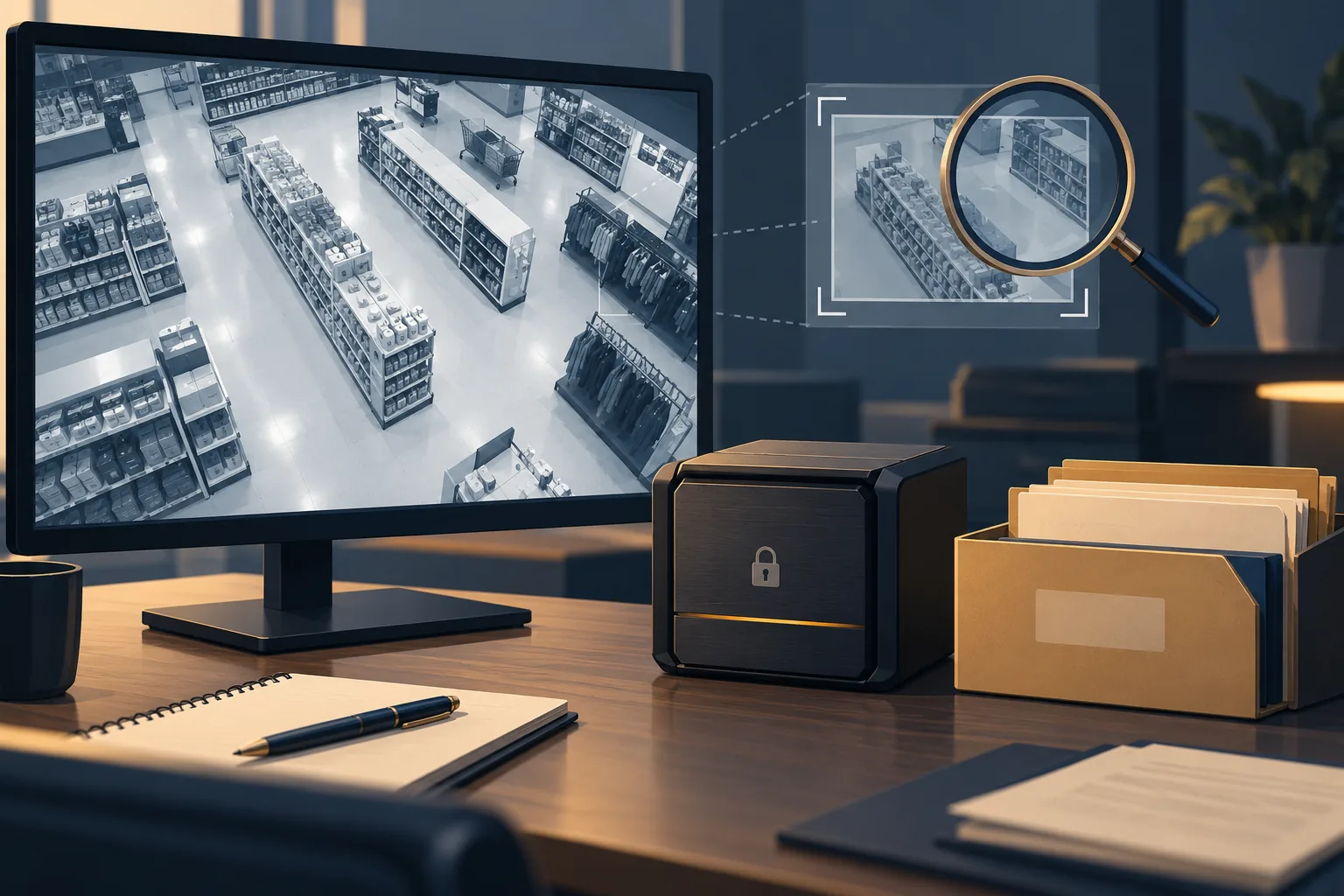
Illustration only, not real Target footage. A recording has to be reviewed with its location, coverage, and technical context in mind.
A phone photo taken after a fall usually shows the floor. Store video may show the minutes before.
What you may need the video to show | Why |
|---|---|
Where the spill came from | Whether the store created the hazard or a customer did |
How long it sat there | Constructive notice often turns on time |
Who walked past | Whether an employee had a chance to see it |
Whether a cone went out, and when | What warning you actually had |
How cleanup went | What changed after you fell |
Your own approach | How the fall happened |
Video is evidence to investigate, not a guaranteed win. A clip can be inconclusive, it can show a hazard appearing too fast for anyone to find it, or it can miss your aisle entirely. Saving it keeps your ability to judge the event fairly, whatever it shows.
Where and when did the fall happen?
A store needs these details to find the right cameras. The examples are hypothetical.
Detail to give | Hypothetical example |
|---|---|
Store address | The full street address and city, not "the Target off the freeway" |
Date | The calendar date of the fall |
Approximate time | "Between 2:15 and 2:30 p.m." rather than a guessed exact minute |
Precise location | "Frozen foods, near the end of aisle 14, by the ice cream doors" |
Nearby landmarks | The pharmacy counter, the north entrance, or checkout lane 9 |
Give a range if you can't support an exact time. A minute you can't back up causes trouble later.
Time anchor | What it can show | Its limit |
|---|---|---|
Receipt | The latest point in the shopping trip | Maybe not the fall itself |
Phone photo or text | When you took or sent it | Your phone clock may not match the store's |
Call log or incident reference number | When you called or reported | When the fall happened |
Keep each source separate until someone can examine the clocks.
How much footage should you ask for?
If the question is | Ten seconds at impact | What to ask for instead |
|---|---|---|
How long was the puddle there? | Won't show it | The stretch before the fall |
Did the leak start one aisle over? | Never shows that aisle | That camera too, even if it never caught you falling |
Period | What it may show | Why ask for it |
|---|---|---|
Before the fall | When the condition first became visible, whether anyone reported it, and how employees responded | Notice often depends on what happened earlier |
The fall itself | Your approach, your footing, and how the fall happened | Causation and your own conduct |
After the fall | Warnings going up, cleanup, witness contact, and photos | Separates the original scene from later changes |
No rule gives every claimant a fixed number of hours of footage. A reasonable request ties a before-and-after period to these questions.
Careful with after-the-fall footage | Because |
|---|---|
A cone set out at 2:40 can show the floor changed after you went down | That helps separate the original scene from later changes |
A later fix doesn't automatically prove earlier negligence | Evidence rules may limit how that footage is used |
Weak request | Stronger request |
|---|---|
"All video from that day" | Aisle 14, 1:30 to 2:45 p.m. |
"Any cleaning records" | The mop bucket log and the freezer repair ticket for that aisle |
No cameras named | The ceiling dome over aisle 14 and the one facing the end cap |
A long window with no reason | A longer window, with the reason it matters to a disputed point |
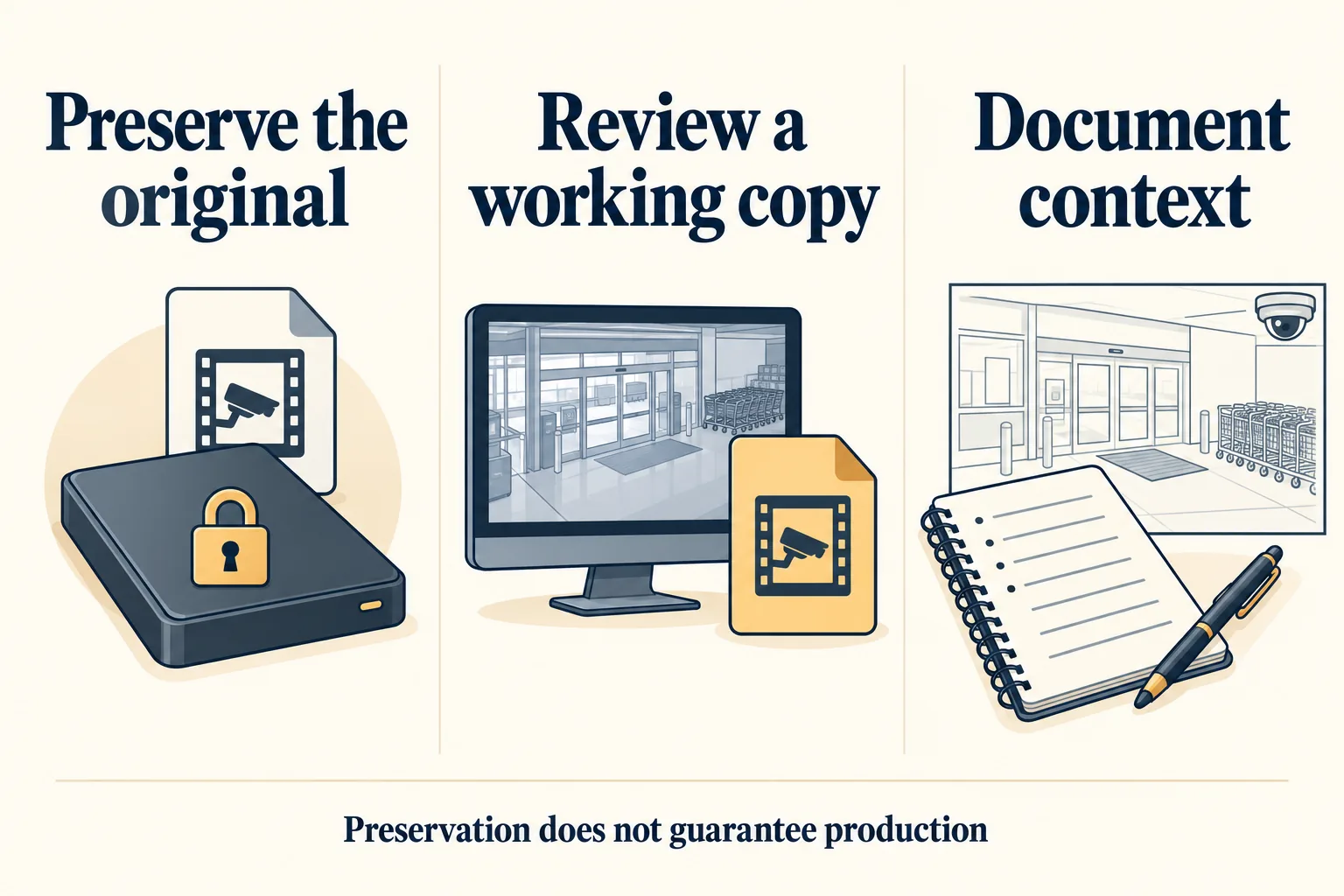
Keeping the video isn't the same as getting it
A preservation notice asks the store to keep relevant information. It doesn't force the store to hand over video right away or give anyone free access to the security system. Footage may be shared voluntarily or produced through litigation procedures, subject to objections and court orders.
Task | Why it matters |
|---|---|
Ask for written acknowledgment | Shows the request arrived and was understood |
Keep proof of delivery | An email receipt or certified mail tracking number |
Send it to the right recipient | A letter handed to a cashier may never reach the video custodian or claims team |
Follow up on vague answers | "We'll look into it" doesn't confirm that anything was saved |
If access is disputed | Do | Don't |
|---|---|---|
You want the video now | Let your lawyer weigh the procedural options | Walk into a security office or ask for passwords |
The store won't share | Use lawful discovery | Copy anything from the store's system yourself |
What form is the video in?
Copies aren't equal. Ask which formats exist and keep whatever is needed to play the recording.
Version | What it is | Common problem |
|---|---|---|
Native export | The file as the camera system stored it | May need a proprietary player |
Original-quality export | Full resolution in a standard format | Some metadata may not carry over |
Transcoded clip | A converted, usually smaller file | Compression can hide liquid, small objects, or timestamps |
Phone recording of a monitor | Someone filmed the screen | Glare, cropping, and lost detail |
Supporting information worth asking about | Whether it's discoverable depends on |
|---|---|
Camera identifiers and system time settings | Relevance |
Available metadata and export dates | Proportionality |
Records explaining retention or edits | Burden and the forum |
Fit the request to the real technical issue instead of sending a generic list.
Handle the file you receive with care
Keep the received file unchanged and review working copies.
Inventory field | Hypothetical entry |
|---|---|
File name | Cam14_1405-1435.mp4 |
Size | 412 MB |
Date received | March 3 |
Source | Store's counsel, by download link |
Checksum | SHA-256 value recorded on the day it arrived |
A checksum helps catch changes between copies. It doesn't prove when the video was recorded or that the scene was captured accurately.
How do you reconcile camera clocks?
Worksheet line | Hypothetical entry |
|---|---|
Possible causes of a gap | A clock set wrong, an off playback, or two different moments |
Common event | Manager steps through the stockroom doorway |
Camera A displayed time | 1:12 |
Camera B displayed time | 1:19 |
Proposed offset | Camera B runs about seven minutes ahead |
Supporting evidence | A second shared event, a register log, or system time records |
Uncertainty | A few seconds either way, depending on frame rate |
Do | Don't |
|---|---|
Keep the original timestamp visible in evidentiary copies | Quietly slide one recording until the sequence looks better |
Label a corrected timeline as analysis | Present it as what the camera showed |
At a deposition or in a motion, a witness can then be asked about a clearly identified interval instead of an unexplained edited montage. A time calculation that looks decisive in March is less likely to fall apart in September.
What can't the camera show?
Limitation | What it means | What to do |
|---|---|---|
Ceiling angle | Body movement shows up, but clear liquid on a shiny floor may not | Pair the video with photos and witness accounts |
Obstruction | A shopping cart may block the spot where your foot landed | Ask for an adjacent view |
Low frame rate | A quick slip can fall between frames | Don't treat a missing frame as proof nothing happened |
Blind spot | The source may be out of view while the response shows up on another camera | Request the neighboring camera |
On the video | Doesn't prove by itself |
|---|---|
No visible liquid | That the floor was dry |
Someone looking down | That they saw a spill |
A zoomed-in frame | Any detail the camera never recorded |
A brightened frame | Anything, unless the change is documented and compared with the original |
Pair the video with | Example |
|---|---|
Your photos | The close-up showing the puddle the camera can't |
Witness accounts | The shopper who saw the spill at 2:05 |
Store records | A cleanup log entry |
A qualified analyst | Someone who explains the method, says how sure they are, and doesn't claim detail the camera never recorded |
A practical review protocol
Step | What to do | What to note |
|---|---|---|
First pass | Watch the complete period received, start to finish, without stopping | Obvious events and spots where visibility is uncertain |
Timeline | Log condition-related activity, employee movement, warnings, customer traffic, and the fall | Which entries are observation and which are inference |
Compare | Line the video up against the incident report and what witnesses said | A real conflict, or just two people estimating |
Gaps | Does the clip start after the puddle appears, skip the next camera, or stop before the cone shows up? | What you asked for, what came back, and what the store says is gone |
Before you assume someone lied | Check |
|---|---|
The report says 2:40 but you fell at 2:23 | Whether 2:40 is when the manager heard about it |
Part of the clip is missing | Ask for that part specifically and say why you need it |
What if footage is missing?
Before alleging destruction, ask | Why |
|---|---|
Did a camera cover that area? | No camera means no destroyed aisle footage |
Was the relevant period ever recorded? | The system may not have been running |
What were the retention settings? | Ordinary overwriting differs from deletion after notice |
Who chose what to export, and who watched it? | More relevant footage may have been seen but not saved |
Does another copy exist? | Another custodian may have it |
If something was lost, document | Example |
|---|---|
When the duty to preserve arose | The date the store received the request |
Who got notice | The claims team, the store manager, or both |
What happened next | Export, hold, or nothing |
How the loss hurts the proof | It may hide how long the hazard sat, or where a warning stood |
In Texas, spoliation is analyzed under Brookshire Brothers v. Aldridge: duty, breach, culpability, prejudice, and the right remedy. Missing video doesn't automatically entitle a plaintiff to a favorable inference. In federal court, lost electronically stored information may fall under Rule 37(e), which has its own framework. S10 S11
Protect your own evidence, too
Your evidence | What to do |
|---|---|
Photos, videos, texts, posts, and messages on your phone | Keep them |
A post of you at a backyard barbecue | Leave it up. Your lawyer can explain context; deleting it can become its own problem. |
You traded in your phone last month | Tell your lawyer and check for a cloud backup. Never make up a story about what you kept. |
Your phone also holds your kids' photos and your bank texts | Share only what's needed, and let your lawyer handle the scope |
Same standard for you | What it does not mean |
|---|---|
Keep everything you'd expect Target to keep | Handing your whole phone to the other side |
Answer discovery completely | Skipping the scope and privacy rules; your lawyer reviews first |
Example: the store sends a ninety-second clip
Here's a made-up case. The store hands over ninety seconds showing a customer go down next to the dairy case. A witness says an employee was checking that very spot twenty minutes before. A ninety-second clip can't tell you whether she's right.
Follow-up question | What it tests |
|---|---|
Does earlier footage exist, and are there adjacent views? | The witness's account of the employee twenty minutes before the fall |
Who chose the ninety seconds, and what period did that person review? | Whether more relevant footage was seen but not saved |
What retention steps happened after notice? | Whether anything was lost after the duty to preserve arose |
Are there service records for the display? | A separate source of knowledge, such as a reported leak |
These questions are an investigation plan; they don't assume anyone hid evidence on purpose.
If earlier footage shows | The evaluation |
|---|---|
A shopper spilling a drink moments before the fall | Moves one way |
An employee answering an earlier leak report | Moves a different way |
Either way, you're working from what the tape shows, not a hunch.
What the video means for your decision
Sometimes the footage shows the adjuster's denial is wrong. Sometimes it shows a lawsuit wouldn't be worth the cost. It can settle who was at fault, cut down how much discovery you need, turn up a witness, or expose a hole in the case.
Vague update | Useful update |
|---|---|
"We have video." | "We have a clip of the fall, but not the period we need to test notice." |
The useful version tells you why more work, or a changed recommendation, might follow.
Why evaluate Aaron Herbert for this work
The credential | What it means here |
|---|---|
The State Bar lists Aaron A. Herbert as Board Certified in Personal Injury Trial Law. S1 S3 | A meaningful credential when you're choosing counsel for evidence-driven litigation |
What to ask his firm | How it identifies custodians, follows up on preservation, evaluates technical issues, and prepares the evidence for court |
What it can't do | No credential guarantees that footage exists or that a judge will grant a requested remedy |
Look for a lawyer with a reasoned plan to get and use the available proof, who will also explain its limits.
Frequently asked questions
Question | Short answer |
|---|---|
Does every Target camera record every aisle? | Don't assume it. A ceiling dome may point at the registers rather than your aisle. A visible camera doesn't establish that it recorded the floor where you fell, so investigate the actual system and views for that store and date. |
Can I demand the entire day? | A lawyer should judge what scope can be justified. A broader request can be appropriate, but relevance and proportionality still matter. Be ready to explain what the extra hours could establish. |
Will deleted video win my lawsuit? | No automatic result follows. Courts apply legal standards to preservation duties, the loss, prejudice, and remedies, and you still need proof of liability and injury. |
Request a case evaluation
To talk about your fall, reach the Law Firm of Aaron A. Herbert, P.C. through InjuryAttorneyOfDallas.com. Have the store address and your best timeline handy. The first 72 hours article, the notice article, and the comprehensive Target guide cover the related steps.
This page is educational information only. Representation and fee terms require an agreement with the firm. This independent resource is not affiliated with Target.
Related Target injury resources
- Target injury knowledge hub
- Comprehensive guide to suing Target in Texas
- Proving Target Knew About a Dangerous Condition in Texas
- Discovery and Corporate Depositions in a Texas Target Fall Case
- Expert Witnesses in a Texas Target Slip and Fall Lawsuit
Legal and factual sources
S1 Aaron Alan Herbert State Bar profile including specialty listing. Read source.
S3 Texas Board of Legal Specialization certification standards and Personal Injury Trial Law requirements. Read source.
S10 Brookshire Brothers, Ltd. v. Aldridge, 438 S.W.3d 9 (Tex. 2014). Read source.
S11 Federal Rules of Civil Procedure including Rules 26, 30, 37, and 56; current official compilation. Read source.