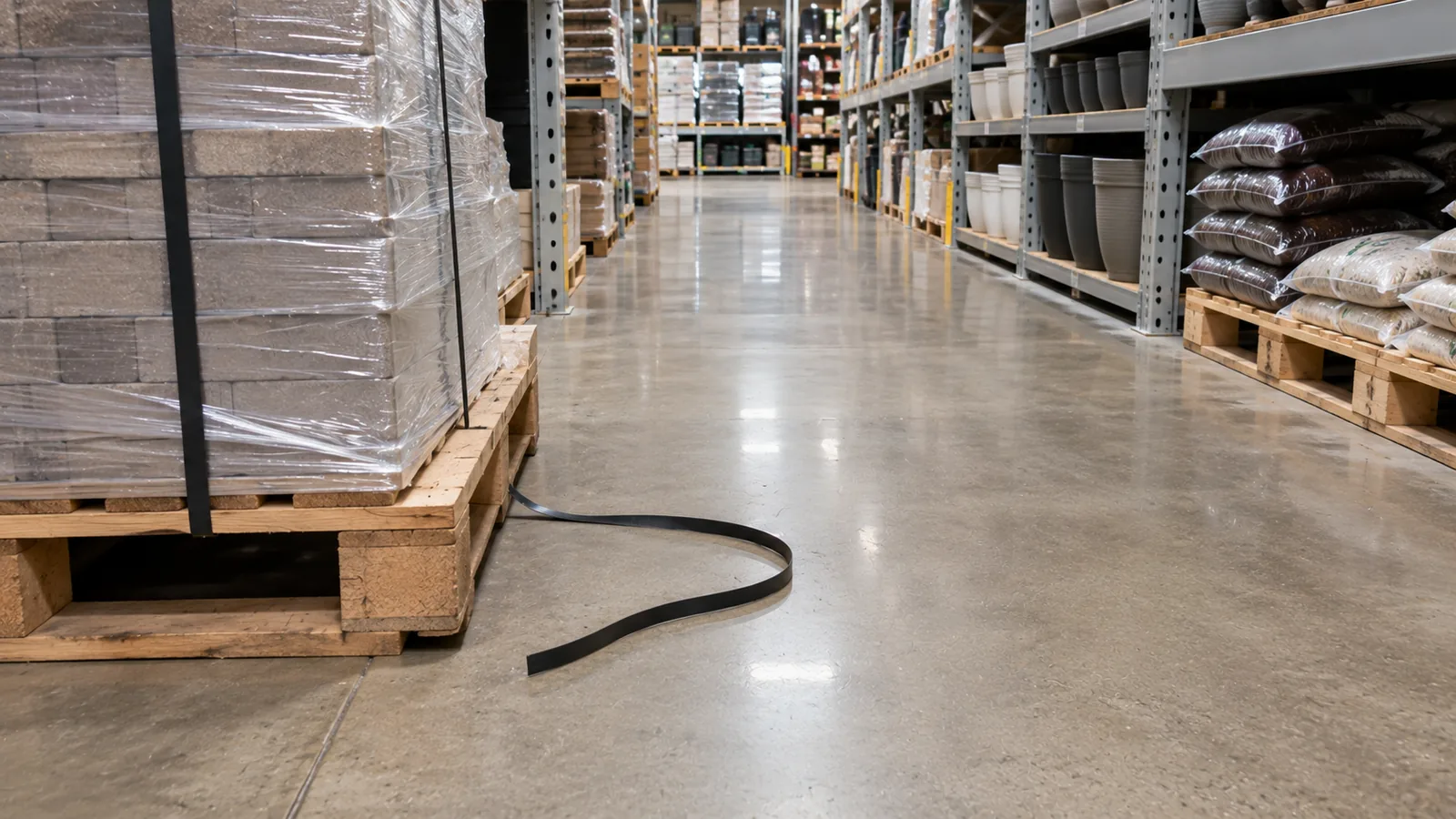
Illustration: In a trip case, the exact contact point matters more than what was nearby.
A trip at a home-improvement store isn't the same as a slip on a wet floor. The object might be a pallet corner, a loose packaging band, a rack base, a curled mat or a flatbed cart someone was pushing. Each one raises different questions about what happened and who's responsible.
In each case you generally have to prove what your foot actually struck, that the condition posed an unreasonable risk, that the store knew or should have known about it, and that it caused your injury. An injury from a cart or pallet in motion may be analyzed as a negligent activity instead.
Short answer
- Prove the contact point.
- Moving or still?
- Notice still applies.
- Measurements need context.
What each means for you, in the same order.
- "I tripped near a pallet" describes a location. The claim needs evidence of what your foot actually hit.
- A cart being pushed into you may be a negligent-activity claim. A pallet left in the aisle is usually a premises claim.
- For a condition like a dropped band, you still need to show the store knew or should have known about it.
- A later measurement may not match the scene on the day you fell.
Start with the Home Depot Injury Knowledge Hub for the full resource list, or the Home Depot litigation guide for the complete case framework.
What has to be proven in a Home Depot trip case?
You generally have to prove what caused you to trip, that it posed an unreasonable risk, that the store knew or should have known about it, and that its failure to fix or warn caused your injury. The object found near you after the fall is only the starting point.
| Element | Question it answers | Typical evidence |
|---|---|---|
| Mechanism | What did your foot or body hit? | Your account, witnesses, video. |
| Condition | Was it unreasonably dangerous? | Photos, measurements, how it sat in the walkway. |
| Knowledge | Did the store create it, know of it, or have time to find it? | Video, stocking records, employee testimony. |
| Causation | Did it cause the fall and the injuries? | Scene evidence plus medical records. |
A wrist fracture can happen in almost any fall when someone braces with a hand. It tells a doctor about the injury, not about what caused the loss of balance. That part has to come from the scene.
How do you reconstruct the trip, not just where you landed?
Start with how you approached, not where you ended up. Write down where you came from, which way you were walking, what you were carrying or pushing, which foot caught, and what you felt.
Details that help
- Direction of travel, for what you could see from your route.
- Cart or carried items, which may explain why your view of the floor was blocked.
- Which foot caught, for matching the object to the contact.
- What you felt vs. what you saw, since you can remember a catch without having seen the object.
Things move during a fall and the cleanup afterward. A mat can fold, a rack can shift and a band can get kicked aside. The first photo is useful, but it isn't a perfect picture of the scene before you fell. Ask witnesses whether anything was moved.
Packaging bands and small objects
A packaging band can be attached to merchandise, partly torn loose or lying flat on the floor. Each one is a different hazard. A loop sticking out of a stack raises different questions from a band dropped in the main aisle.
Investigation steps
- Identifying the object, such as its color, width, length and position, photographed without handling it.
- Connecting it to the contact, such as a witness who saw your shoe catch it, who is worth more than one who saw it afterward.
- Finding the origin, such as stocking, a customer opening a box or another activity nearby.
- Checking timing, such as when it first appears on video and whether employees passed by.
A store selling banded merchandise doesn't prove an employee left the band in the walkway. On the other hand, video of an employee cutting bands in that aisle a few minutes earlier could matter a lot. The Home Depot litigation guide explains how Texas courts weigh that kind of time evidence.
Don't remove store property or go into restricted areas to collect evidence. A lawyer can ask the store to preserve the object and arrange an inspection.
Pallets, flatbed carts and stocking equipment
The key question for any cart or pallet is whether it was moving. Texas law treats an injury from an ongoing activity differently from an injury caused by a condition left on the premises.
| What happened | Likely theory | Evidence needed |
|---|---|---|
| You walked into a pallet corner sticking into the aisle. | Premises liability (a condition). | Pallet position, visibility, how long it was there. |
| An employee pushed a flatbed into you or your cart. | Negligent activity (ongoing conduct). | Who was pushing, speed, load, video. |
| You tripped over the wheel of a parked cart. | Usually premises liability. | Where it sat, the lighting, your approach. |
The label matters. Here's what happened in one recent Texas federal case.
| Hosea v. Home Depot U.S.A., Inc. (S.D. Tex. Aug. 25, 2026) | Detail |
|---|---|
| Facts | An employee moving pipe on a flatbed cart hit the shopper's cart. |
| Premises claim | Dismissed: the court said it was about ongoing activity, not a condition. |
| Gross negligence | Dismissed for lack of evidence. |
| Ordinary negligence | Not part of the motion, so it stayed in the case. |
| Note | The shopper didn't respond to the motion. |
Record wheel position, orientation, handle location, the load and whether the cart moved. A bright load at eye level doesn't make a low pallet base just as easy to see.
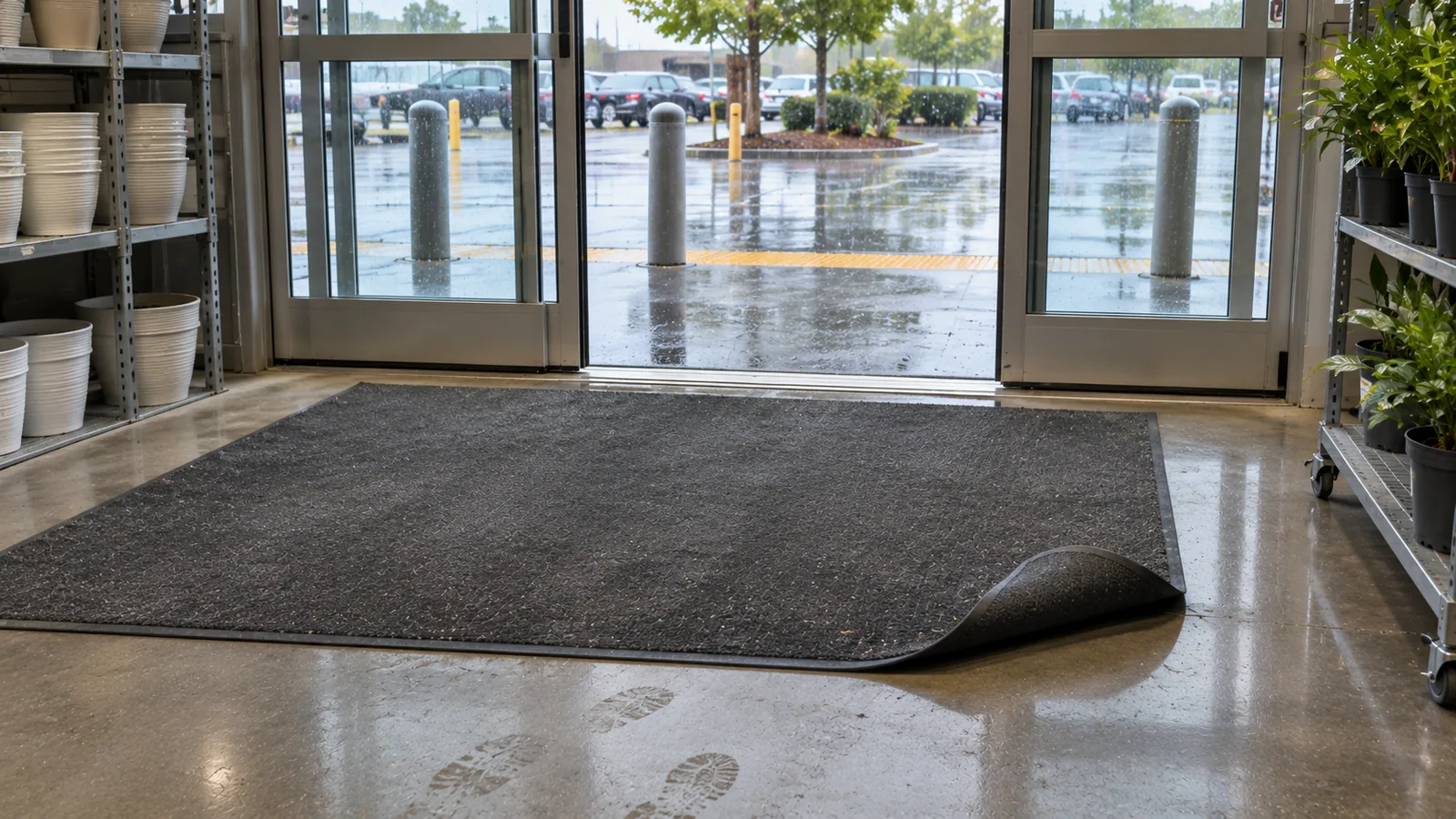
Entrance mats and floor transitions
A mat claim needs proof of the mat's condition when you stepped on it. A curled corner, a shifted edge and a soaked mat are different hazards.
What to document, by mat problem
- A curled or flipped edge, for the height of the curl, which edge and whether the fall caused it.
- A shifted or bunched mat, for its position relative to the doors and floor.
- A wet or saturated mat, for the weather, how many mats and whether water spread past them.
- A gap at a threshold, for the height difference, with a ruler in the photo.
Rain explains why the mats were out. It doesn't prove the mat was bad or that anyone knew. If a mat company services the store, ask for its records; the name on the mat backing is only a lead. For gaps and height changes, put a ruler in the photo, hold it straight, and write down the date.
Rack bases and displays
Stores reset displays all the time. By next week, the setup you tripped on may be gone. Find out who built it (store staff, a vendor or a customer who shifted things) and take numbers from the day of the fall whenever you can.
A made-up example:
| Observation | What it may show | What to check |
|---|---|---|
| Photo after the fall shows the base 8 inches past the merchandise. | Scene right after the fall. | Camera angle, scale, whether the rack moved. |
| Witness says the rack moved during the response. | The setup changed. | Where she stood and what she saw. |
| Inspection two weeks later measures 6 inches. | Current setup. | Whether it matches the day of the fall. |
Don't average the two and call it a 7-inch hazard. The job is to figure out which number reflects the scene on the day you fell. Keep every photo, including ones that look less helpful. They may explain the difference.
Lumber and falling merchandise
Being hit by lumber or another product is a different claim from tripping, even if you fell afterward. The investigation looks at how the product was stacked, whether it was restrained, who was handling it and in what order things moved.
| Question | Why it matters |
|---|---|
| Was the stack already unstable, or did someone move it? | Condition vs. activity. |
| Was an employee helping you? | Active assistance can change the claim. |
| Were you pulling boards yourself? | Customer handling affects responsibility. |
| What did the product label or rack notice say? | Warnings may be part of the defense. |
These cases often need engineering or biomechanical input, not a general argument that heavy merchandise is dangerous. In Milchak v. Home Depot U.S.A., Inc. (W.D. Tex. Feb. 17, 2026), a jury found the plaintiff 100% responsible for a lumber-stack collapse, and the court denied the plaintiff's motion for a new trial. That case doesn't say every lumber claim fails, but it shows the mechanism evidence gets tested hard at trial.
Who else could be responsible besides Home Depot?
Sometimes another company controlled the thing that tripped you. The store's sign on the building is a starting point, not the full answer.
- A vendor or merchandiser, when they built or reset the display you tripped on.
- A mat or cleaning contractor, when they supplied, placed or serviced the mat.
- A landlord or shopping-center owner, when the fall happened on a sidewalk or lot they control.
- A delivery or installation company, when their equipment or packaging was left in the aisle.
Adding a party takes a factual basis, like a service contract, a work order or testimony about who did the work. Naming every company in sight just adds cost and delay. The Home Depot litigation guide covers how defendants are identified before suit.
What should I photograph after a trip?
Take pictures only if you can do it safely, and don't move anything first.
| Shot | What it captures |
|---|---|
| Wide view from your approach | What you could see while walking. |
| Medium view | Where the object sat in relation to the walkway. |
| Close view with a reference | Size and shape (a shoe or a coin beside it helps). |
| The floor transition or mat edge | Height differences and curls. |
| Nearby warnings or barriers | Whether any warning faced your route. |
| Your shoes and clothing | Scuffs or marks that match the contact. |
Keep the original files with their dates and times. Screenshots and social media copies lose that information. If someone moved the object before you took the photo, write that down too.
Does it matter that I could have seen the hazard?
It can. Texas law generally doesn't require a store to warn about a danger that's open and obvious or already known to the shopper, subject to narrow exceptions. Separately, your own share of fault can reduce what you recover, and if it's more than 50 percent, you can't recover at all.
| Issue | Legal source | What to know |
|---|---|---|
| Open and obvious | Austin v. Kroger Texas, L.P. (Tex. 2015) | No duty to warn of obvious or known dangers, with limited exceptions such as necessary use. |
| Your share of fault | Tex. Civ. Prac. & Rem. Code ch. 33 | Recovery is reduced by your percentage; barred above 50%. |
Could you actually see it? That turns on lighting, color, what was in the way and what you had to watch at the time. Something bright in a posed photo can vanish behind a loaded cart. And if you did see it, say so, and tell your lawyer why you went that way anyway.
When do you need an expert?
You need one when a technical question decides the case, such as the height of a projection, the slip resistance of a surface or how a stack could fall. An expert shouldn't be hired just to say the store was negligent.
Good expert assignments
- Measuring the rack projection and explaining the sightline from the shopper's route.
- Explaining whether a later inspection can show the condition on the day of the fall.
- Identifying which code or standard applies, and to what.
Weak versions, in the same order
- "Confirm the store was negligent."
- Treating a rebuilt display as the original.
- Listing every standard that might apply.
A measurement over a guideline doesn't automatically prove negligence. Counsel has to work out whether a code or standard applies and what legal effect it has. Inspect promptly, with proper notice, and keep the raw measurements and photos.
Frequently asked questions
I tripped on a pallet at Home Depot. Do I have a case? Possibly. It depends on whether the pallet created an unreasonable risk, whether the store knew or should have known and how the trip happened.
What if an employee hit me with a flatbed cart? That may be a negligent-activity claim, which works differently from a premises claim. Tell your lawyer exactly what was moving.
Should I keep the packaging band I tripped on? Don't take store property. Photograph it where it lies and ask a lawyer to send a preservation request.
Does the store have to warn me about every pallet? Not about dangers that are open and obvious, generally. But a hazard that's hard to see from your route is a different question.
What should I do right after the fall? Get medical care, then see our first 72 hours guide. Ask early about preserving store video.
Sources

ABOUT THE ATTORNEY
Aaron A. Herbert
Founding Attorney
Board Certified in Personal Injury Trial Law
Aaron founded The Law Firm of Aaron A. Herbert in 2010 to focus on developing each client's case and seeking its maximum value. For over a decade, he has represented people seriously injured in major accidents and industrial catastrophes, pursuing trial verdicts and settlements while working to reduce the stress of litigation.
Education
- Texas A&M University · B.S., Criminal Justice, 1999
- University of Oklahoma College of Law · J.D., 2002; graduated in the top of his class
Trial experience & approach
Aaron earned numerous jury verdicts at boutique personal injury litigation firms. According to his biography, he spent a year as the top-earning litigation attorney at a firm that frequently appeared in verdict searches as having one of the highest numbers of trial wins in Texas. At another Dallas personal injury firm, he moved from managing pre-litigation attorney to managing litigation attorney over seven years as the firm grew into one of Dallas's largest personal injury firms.
His biography describes a reputation as one of America's most aggressive trial lawyers, with noteworthy recoveries from judges and juries and substantial pretrial settlements. Most of those settlements included confidentiality agreements requested by the defense. Aaron has said the recoveries were justified by the injuries and losses involved, which no amount of money could make someone choose to experience.
His approach combines passion, preparation, persistence and courtroom imagination. He believes a well-supported, engaged and motivated team working cooperatively helps deliver strong representation, with the goal of achieving the best possible result for every client.
Dallas roots, military service & publication
Born and raised in Dallas, Aaron enlisted in the United States Marine Corps after high school and later received an Honorable Discharge. He completed his university and law degrees after his military service and became a lifelong Sooners football fan in law school.
Publication: “Litigating Dog Bite Cases,” Texas Dog Law Seminar, Dallas, 2009.
Professional affiliations & recognition
Professional affiliations and recognition listed in Aaron’s biography:
- State Bar of Texas
- American Bar Association
- Association of Trial Lawyers of America (now American Association for Justice)
- Texas Trial Lawyers Association
- Dallas Trial Lawyers Association
- Dallas Bar Association
- Tarrant County Bar Association
- Million Dollar Advocates Forum
- The National Trial Lawyers – Top 100 Trial Lawyers