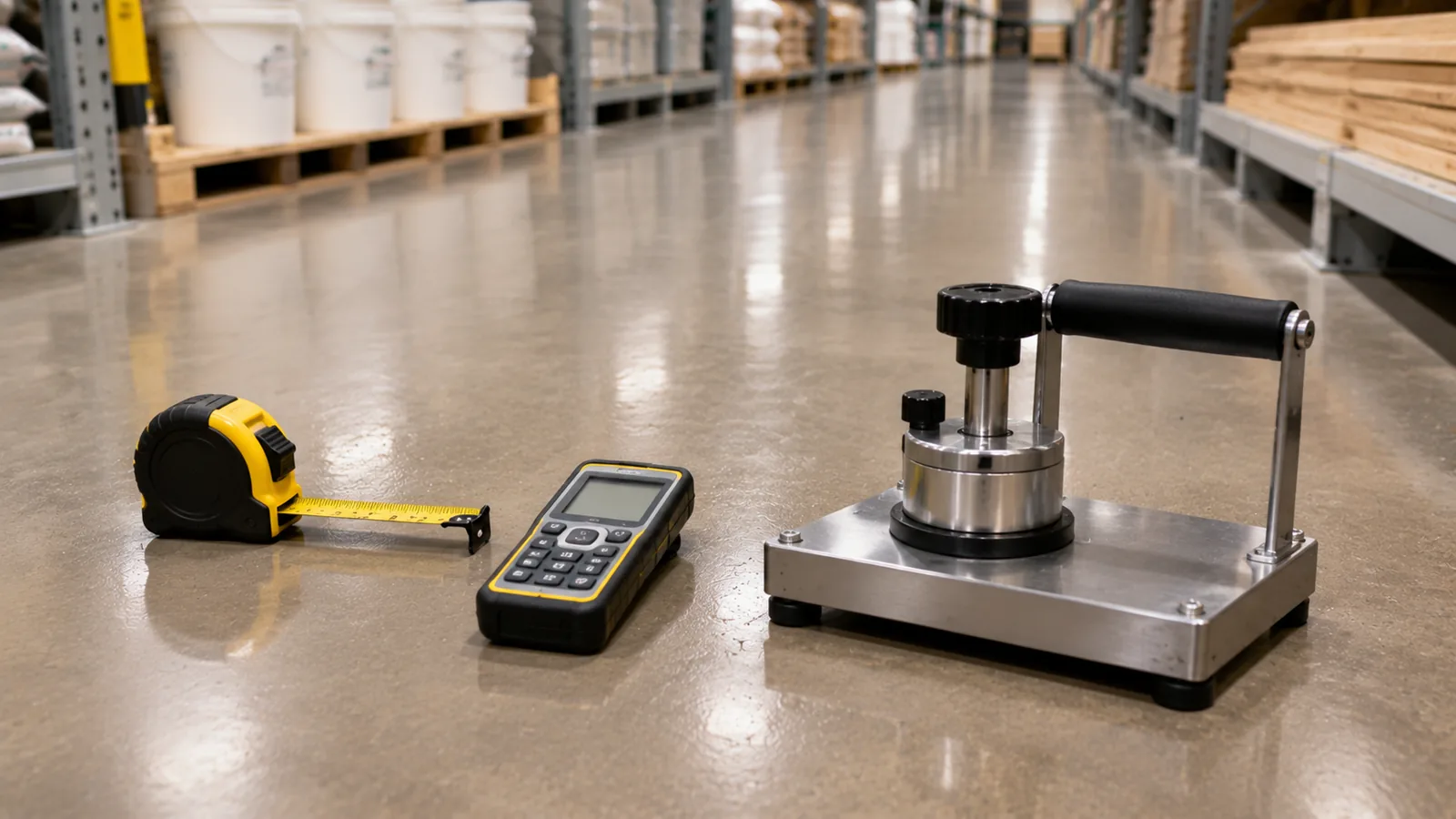
Illustration: A test only helps if it reflects the floor and conditions on the day of the fall.
Hire an expert witness to answer a disputed question that takes specialized knowledge, not to make a case look bigger. In a Home Depot injury case, that question might be how slippery a floor was, how far a rack base stuck out, what a video's timestamps mean, or whether a fall caused a shoulder injury.
Short answer
- Start with the question.
- Experts don't replace facts.
- Courts test reliability.
- Experts cost money.
What each means for you, in the same order.
- Define what's disputed before choosing an expert.
- A safety expert can't supply missing notice evidence. An economist can't create medical restrictions.
- Texas Rules of Evidence 702 to 705 and Federal Rule of Evidence 702 require qualified experts using reliable methods that fit the facts.
- Ask what each one costs, who advances the cost and how it's repaid under your agreement.
This guide is part of the Home Depot Injury Knowledge Hub. For how experts fit into the whole case, see the Home Depot litigation guide.
When does a Home Depot injury case need an expert?
When ordinary witnesses and records can't answer a key question. A clear photo and a good eyewitness sometimes settle the point without any expert.
| Disputed question | Possible expert | Might be answered without one? |
|---|---|---|
| How slippery was the surface? | Floor safety or tribology specialist | Rarely, if slipperiness is contested. |
| How far did a rack base or pallet stick out? | Engineer | Sometimes, with good photos and a ruler. |
| What do video timestamps and gaps mean? | Digital evidence specialist | Often, through the store's records witness. |
| Did the fall cause the injury? | Treating doctor or medical specialist | The treating doctor is often enough. |
| Can you return to your job? | Vocational expert | Sometimes, through your doctor's restrictions. |
| What are future lost earnings worth? | Economist | Not usually, for long-term losses. |
| What future care is needed and what will it cost? | Life-care planner | Only with medical support behind it. |
Write the question in plain English before looking at résumés. "Prove the store was negligent" isn't an expert assignment.
What does a floor safety expert do?
A floor safety expert tests and explains how slip-resistant a surface was. The test has to match the conditions of the fall as closely as possible.
| Ask the expert | Why |
|---|---|
| What method and equipment did you use, and was it calibrated? | Reliability. |
| Was the surface wet, dry, or contaminated during the test? | A dry test may say little about a wet aisle. |
| Is this the same floor, finish, and wear as on the date of the fall? | A refinished or replaced floor may not compare. |
| What footwear assumptions did you use? | Shoes change the result. |
| What can't this test tell us? | Honest limits make the opinion stronger. |
Keep the raw readings and the test conditions. A standard or threshold isn't automatically the law. The expert can explain why a number matters; the court decides the legal standard.
What about engineering and display questions?
An engineer can measure heights, projections and clearances, or explain how a stack of lumber could shift or fall. The key is knowing what the scene looked like on the day of the fall.
What the engineer needs for each issue
- Photos from the day, a scale reference and witness accounts of changes, for a rack base or pallet projection.
- Measurements taken soon after, with the date, for a height difference at a threshold.
- Product size, stacking, restraints and handling sequence, for lumber or merchandise movement.
- The right code, edition and provision, and whether it applies, for a building or accessibility code.
A later inspection can be accurate for the inspection day and still uncertain for the fall. A neat diagram should show which dimensions were measured, which were estimated and which were assumed. A code violation doesn't automatically mean negligence. Counsel decides what legal weight it carries.
Do you need a video or digital evidence expert?
Only if the records witness can't answer the question. Clock errors, missing segments, frame timing and file integrity can sometimes need a specialist.
What a specialist can and can't do
- Work a specialist can do, such as confirming a file wasn't changed after collection, explaining frame rates and timestamp gaps and documenting how footage was processed.
- Things no specialist can do, such as proving the camera captured everything, adding detail the original footage doesn't have or turning a blurry shape into a clear object.
Keep the original file and label any enhanced or slowed copy. Our surveillance video guide covers preserving footage in the first place.
How do medical experts prove causation?
A medical expert explains diagnosis, causation, prognosis and treatment. Your treating doctor can often do this. You may need a retained specialist when the other side disputes the opinion.
What makes the opinion strong, by medical question
- An accurate history, earlier records and reasons, not just "symptoms started after," for whether the fall caused the injury.
- A comparison of baseline and post-fall findings, for whether it worsened an old condition.
- A clinical basis with frequency and duration, for what care is needed next.
- Time, testing and a reasoned prognosis, for whether the condition is permanent.
Treating doctors and retained experts have different disclosure rules, so plan early. Give every doctor your full history, including earlier problems with the same body part.
What do vocational experts, economists and life-care planners do?
They translate medical limits into work and money. Each depends on the one before it.
| Expert | Depends on | Produces |
|---|---|---|
| Vocational expert | The doctor's restrictions, your skills and work history | What jobs you can still do |
| Economist | The vocational findings and your earnings | The value of lost earning capacity |
| Life-care planner | Medical recommendations | A list of future care with costs |
If the medical restriction changes, update everything that depends on it. A polished spreadsheet can make a weak assumption look solid. Keep the chain from doctor to dollar figure visible.
In what order should you hire experts?
Fill the gaps in the facts and the medical record first. Take a made-up shopper. She blames a curled mat, she had shoulder trouble years ago, and now she can't lift at her warehouse job. Nobody kept the mat. Half her old records are missing.
| Order | Question | Who | Must have first |
|---|---|---|---|
| 1 | What did the mat look like? | Fact witnesses, then an engineer if needed | Photos and accounts from the day |
| 2 | Did the fall worsen the shoulder? | Treating doctor or specialist | Earlier and later records |
| 3 | What are the work limits? | Doctor, then a vocational expert | A supported medical restriction |
| 4 | What's the income loss? | Economist | A solid vocational opinion |
Hiring the economist first wouldn't tell anyone whether the shoulder problem came from the fall. Testing a different mat may not show how the original one sat. A careful lawyer may recommend fewer experts after reviewing the file, or more if a real technical dispute justifies the cost. This example isn't a Home Depot case or a description of the firm's practice.
How do courts test expert testimony?
Under Texas Rules of Evidence 702 through 705, and Federal Rule of Evidence 702 in federal court, the judge decides whether the expert is qualified, whether the method is reliable and whether it fits the facts.
Challenges, and how to prepare
- A specialist in the precise issue, for qualifications that don't match the question.
- Accepted methods with every step documented, for a method that isn't reliable.
- An opinion based on the actual scene and records, for one that doesn't fit the facts.
- Limits stated honestly, for unsupported certainty.
- The deadlines for disclosure and supplementation, for late changes.
Review your own expert's report the way the other side will. Being paid for the work doesn't make an expert dishonest; weaknesses have to be specific.
Frequently asked questions
Does every Home Depot injury case need an expert? No. Many questions can be answered with photos, records and your treating doctor.
Who pays for experts? It depends on your fee agreement. Often the firm advances costs and they're repaid from a recovery; ask for the terms in writing.
Can my own doctor be my expert? Often, for diagnosis, treatment and causation. A specialist may be needed if those are hotly disputed.
Can an expert test the floor after it's been cleaned or replaced? They can, but they must explain how the conditions differ from the day of the fall.
What is a Daubert or Robinson challenge? A request asking the judge to exclude an expert as unqualified or unreliable.
What should I do right after a fall? Get care, then read our first 72 hours guide.
Sources
- Texas Rules of Evidence, for expert testimony (Rules 702 to 705).
- Federal Rules of Evidence, Rule 702, for expert testimony in federal court.
- Milchak v. Home Depot U.S.A., Inc., No. 3:23-cv-00441, Doc. 135 (W.D. Tex. Feb. 17, 2026), for biomechanical testimony being among the issues raised in the plaintiff's denied new-trial motion in a lumber-stack case.

ABOUT THE ATTORNEY
Aaron A. Herbert
Founding Attorney
Board Certified in Personal Injury Trial Law
Aaron founded The Law Firm of Aaron A. Herbert in 2010 to focus on developing each client's case and seeking its maximum value. For over a decade, he has represented people seriously injured in major accidents and industrial catastrophes, pursuing trial verdicts and settlements while working to reduce the stress of litigation.
Education
- Texas A&M University · B.S., Criminal Justice, 1999
- University of Oklahoma College of Law · J.D., 2002; graduated in the top of his class
Trial experience & approach
Aaron earned numerous jury verdicts at boutique personal injury litigation firms. According to his biography, he spent a year as the top-earning litigation attorney at a firm that frequently appeared in verdict searches as having one of the highest numbers of trial wins in Texas. At another Dallas personal injury firm, he moved from managing pre-litigation attorney to managing litigation attorney over seven years as the firm grew into one of Dallas's largest personal injury firms.
His biography describes a reputation as one of America's most aggressive trial lawyers, with noteworthy recoveries from judges and juries and substantial pretrial settlements. Most of those settlements included confidentiality agreements requested by the defense. Aaron has said the recoveries were justified by the injuries and losses involved, which no amount of money could make someone choose to experience.
His approach combines passion, preparation, persistence and courtroom imagination. He believes a well-supported, engaged and motivated team working cooperatively helps deliver strong representation, with the goal of achieving the best possible result for every client.
Dallas roots, military service & publication
Born and raised in Dallas, Aaron enlisted in the United States Marine Corps after high school and later received an Honorable Discharge. He completed his university and law degrees after his military service and became a lifelong Sooners football fan in law school.
Publication: “Litigating Dog Bite Cases,” Texas Dog Law Seminar, Dallas, 2009.
Professional affiliations & recognition
Professional affiliations and recognition listed in Aaron’s biography:
- State Bar of Texas
- American Bar Association
- Association of Trial Lawyers of America (now American Association for Justice)
- Texas Trial Lawyers Association
- Dallas Trial Lawyers Association
- Dallas Bar Association
- Tarrant County Bar Association
- Million Dollar Advocates Forum
- The National Trial Lawyers – Top 100 Trial Lawyers