Illustration: A summary judgment motion targets specific elements, so the response has to answer each one with evidence.
Expect the defense to test every part of a Home Depot fall claim: whether the store knew about the hazard, whether the danger was obvious, whether you were partly at fault, and whether the fall caused your injuries. Many of those challenges come in a summary judgment motion, which asks the court to end some or all of the case before trial.
Short answer
A summary judgment motion isn't a verdict. It asks the judge to rule that the evidence can't support a claim, and it isn't a finding that your account is false. How badly you were hurt won't answer a notice challenge either, because the response has to point to evidence on the element being attacked.
Texas changed the rule in 2026. For motions filed on or after March 1, 2026, a response is generally due 21 days after the motion is filed. Your own fault can also cut into what you recover. Above 50 percent, you can't recover at all, and at or below that line your damages are reduced by your share.
You're reading one guide in the Home Depot Injury Knowledge Hub. The Home Depot litigation guide lays out the full case framework.
What defenses does Home Depot raise in fall cases?
The usual ones go after an element the claim has to prove, or they push part of the blame onto the shopper. Each one needs its own answer.
- No notice, as in "we didn't know and had no reasonable chance to find the hazard"
- Open and obvious, as in "the danger was plain to see, so we owed no warning"
- Adequate warning, as in "a sign or barrier warned of the risk"
- Shopper fault, as in "you were distracted, rushing or wearing the wrong shoes"
- Wrong theory, as in "this was ongoing activity, not a condition" (or the reverse)
- Causation, as in "your injuries came from something else, like an old condition"
What answers each, in the same order.
- Reports, video timing, witnesses and inspection records.
- Evidence of lighting, sightlines, obstructions and your route.
- Where the warning was and whether it covered your hazard.
- Video, testimony and your honest account.
- Evidence of whether anything was moving.
- Medical records and a doctor's reasoned opinion.
Being strong on one defense can hide a gap on another. No stack of extra medical records fixes a notice problem.
How do you answer a "no notice" defense?
You need evidence linking what the store knew, or had a chance to discover, to the specific condition that made you fall. Texas courts won't accept an employee's nearness by itself.
Under Wal-Mart Stores, Inc. v. Reece (Tex. 2002), constructive notice needs some proof of how long the hazard was there. In Wal-Mart Stores, Inc. v. Spates (Tex. 2006), a six-pack ring had been on the floor for 30 to 45 seconds behind an employee. That wasn't enough. The Fifth Circuit reached the same result in Vasquez v. Home Depot USA (5th Cir. 2024, unpublished), over a wire shelf another customer had put on the floor about 20 seconds earlier. A cart partly hid it. Five employees were nearby. No constructive notice.
Martinez v. Home Depot U.S.A., Inc. (W.D. Tex. 2023) shows the other side. A nail was sticking up in an outdoor entry line. Because the court found a fact issue on constructive knowledge, the premises claim went forward.
Explain what each piece of evidence proves.
| Evidence | What it may show |
|---|---|
| An incident report | Actual notice, if it describes the same hazard and went to the right person. |
| Video | Duration, if the floor is visible the whole time. |
| An inspection log | Context, though it may not show when the hazard appeared. |
Our surveillance video guide covers keeping footage before it's lost.
Was the hazard open and obvious?
This defense says the danger was so plain that the store didn't have to warn anyone about it. The rule comes from Austin v. Kroger Texas, L.P. (Tex. 2015): a landowner generally owes no duty to warn of dangers that are open and obvious or already known, with limited exceptions. Necessary use is one of them. It applies when the person had to use the area and the owner should have expected the person couldn't avoid the risk. The plaintiff in Austin was an employee, but the court described the employer's duty as the same one a landowner owes invitees.
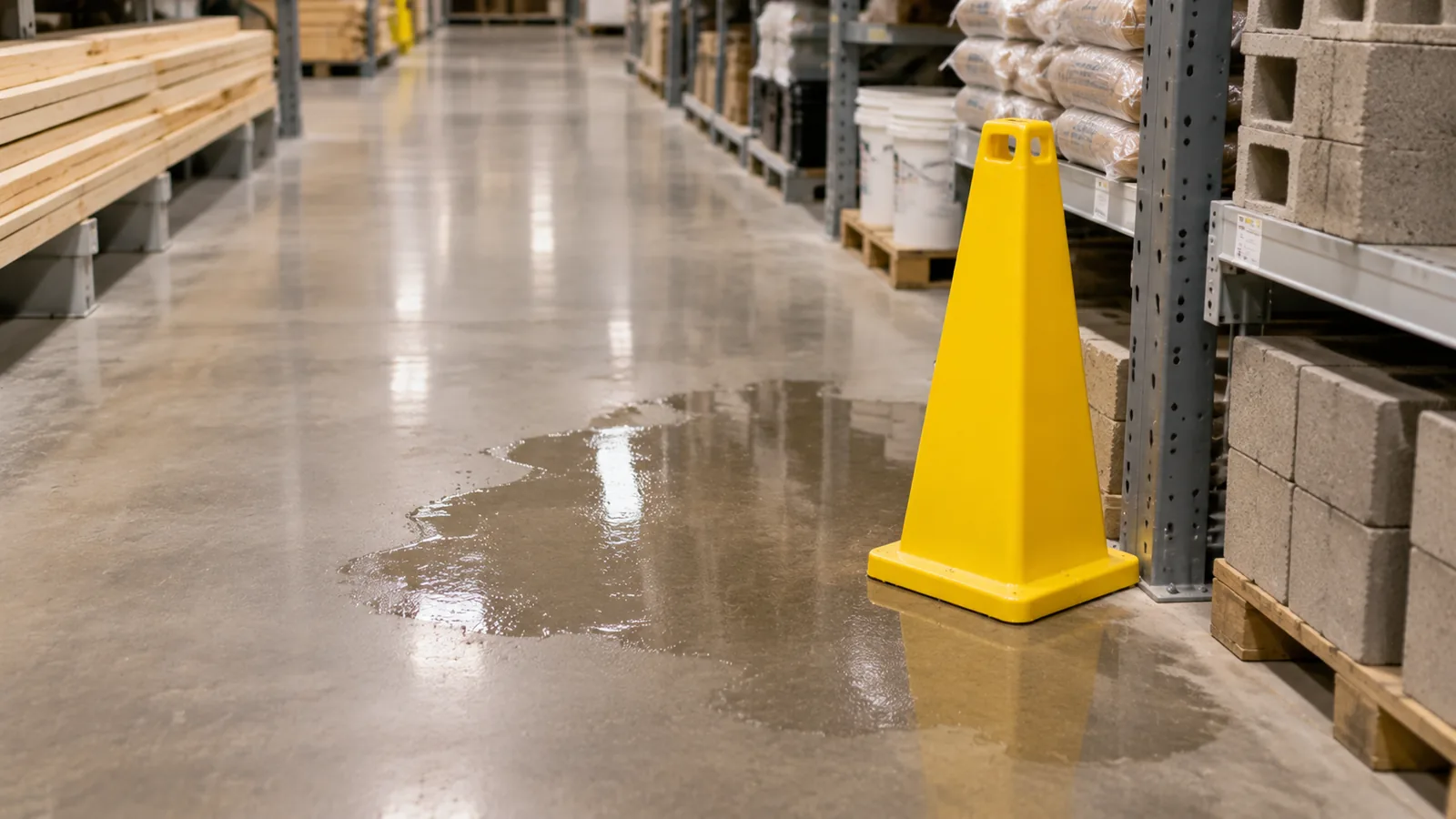
Expect to hear "it was right there in the photo." The first thing to ask is whether the photo was taken from your route, at your eye level. "You walked that aisle before" comes up too. Knowing the department isn't the same as knowing about a fresh spill. If the store says you saw the hazard and you did, be ready to explain why you took that route and whether there was another way. Necessary use works only with a real factual basis. Wanting a product isn't enough.
A close-up can make a hazard look obvious when it wasn't, at least from where you were walking. It cuts the other way as well, since not seeing something doesn't prove it was hidden. Lighting, contrast and whatever blocked the view all matter.
Can my own conduct reduce what I recover?
It can. Texas follows proportionate responsibility, and the rules sit in Chapter 33 of the Civil Practice and Remedies Code. If you're found more than 50 percent responsible, you get nothing. At or below that, your damages are reduced by your percentage.
| Your share of responsibility | Effect on $100,000 in damages (made-up numbers) |
|---|---|
| 0% | $100,000 |
| 25% | $75,000 |
| 50% | $50,000 |
| 51% | $0 |
Those figures are only arithmetic. They say nothing about how a jury would divide fault in any Home Depot case. Phones, footwear and carrying merchandise come up a lot. Holding a phone doesn't prove you were looking at it, and sandals don't prove they caused a slip. Tell your lawyer honestly what you were doing, because denying something the video shows does more harm than the fact itself.
Did a warning sign cover the hazard?
Only if it warned about the actual risk, somewhere you'd actually see it. Write down what the sign said, where it stood and when it went out.
Direction matters, since a sign around a corner may never have reached you. So does the wording. A wet-floor sign doesn't necessarily warn about debris or a curled mat. A cone set down during cleanup doesn't count as a prior warning. Distance came up in Prideaux, where the court found fact issues on whether warnings far from the spot were enough.
A tightly framed photo with no sign in it doesn't prove there was no warning anywhere. Ask for the wide view.
What about the "it was activity, not a condition" defense?
Texas treats an injury from ongoing activity differently from one caused by a condition on the property. Pick the wrong theory and the claim can sink.
| Case | What happened |
|---|---|
| Hosea v. Home Depot U.S.A., Inc. (S.D. Tex. Aug. 25, 2026) | A flatbed cart pushed by an employee hit the shopper's cart. On an unopposed motion, the court dismissed the premises claim because it involved contemporaneous activity, and dismissed gross negligence. The ordinary negligence claim wasn't challenged and remained. |
| Martinez v. Home Depot U.S.A., Inc. (W.D. Tex. 2023) | The reverse: the negligence claim was dismissed because there was no ongoing activity, while the premises claim survived. |
When the facts could fit either one, both theories may be pleaded. Each still needs a real basis.
How does Texas summary judgment work after the 2026 changes?
In 2026 the Texas Supreme Court rewrote Rule 166a, and the new version governs motions filed on or after March 1, 2026.
The 2026 Rule 166a steps (general rule)
- The response is due within 21 days after the motion is filed, unless the court or the parties allow otherwise.
- A reply is due within 7 days after the response.
- No hearing or submission can come within 35 days after the motion is filed.
- The setting is generally within 60 days (90 in some situations).
- No oral testimony is allowed at the hearing.
- The court rules in writing within 90 days after the hearing or submission.
- An affidavit or declaration can explain why needed evidence isn't available yet.
Older deadline charts don't fit these motions, and the old habit of counting back seven days from the hearing doesn't apply. A motion can be traditional, meaning the movant proves it should win, or no-evidence, meaning the movant says there's no evidence on an element. If the case was removed to federal court, Federal Rule 56 and the local rules apply instead.
What makes a summary judgment response strong?
Admissible evidence pointed at each challenged element, with exact citations. A big appendix with no explanation doesn't do the job.
| Do | Don't |
|---|---|
| Cite the exact exhibit and page for each point. | Make the judge search a large appendix. |
| Use sworn statements based on personal knowledge. | Have a witness sign counsel's assumptions. |
| Explain what each video or report actually shows. | Call a video "proof of duration" if the floor isn't visible. |
| Address every ground in the motion. | Answer only the grounds you like. |
| Get rulings on evidence objections. | Assume the court considered everything. |
If key discovery is still outstanding, record what was requested and when, along with why it matters, and use the rule's procedure to ask for relief. A pending request doesn't pause the deadline by itself.
After a ruling, write down exactly which claims were decided and which remain. Winning or losing part of the motion isn't the end of the case, and a denied motion isn't a liability verdict either.
Frequently asked questions
What is the most common defense in a Home Depot slip-and-fall case?
Lack of notice. The store argues it didn't know about the hazard and had no reasonable chance to find it.
Does a wet-floor sign end my claim?
Not necessarily. That depends on whether the sign covered your hazard and faced your route.
What if I was looking at my phone?
It may affect your share of fault, but it doesn't end the claim by itself. Be honest about it.
How long do I have to respond to a summary judgment motion in Texas?
For a motion filed on or after March 1, 2026, usually 21 days from the filing date. The court or the parties can allow more.
Does losing summary judgment end the case?
Not always. It can end the claims it covers, while other claims may continue and appeal options may exist.
What should I do right after a fall?
Get care first. Then read our first 72 hours guide.
Sources

ABOUT THE ATTORNEY
Aaron A. Herbert
Founding Attorney
Board Certified in Personal Injury Trial Law
Aaron founded The Law Firm of Aaron A. Herbert in 2010 to focus on developing each client's case and seeking its maximum value. For over a decade, he has represented people seriously injured in major accidents and industrial catastrophes, pursuing trial verdicts and settlements while working to reduce the stress of litigation.
Education
- Texas A&M University · B.S., Criminal Justice, 1999
- University of Oklahoma College of Law · J.D., 2002; graduated in the top of his class
Trial experience & approach
Aaron earned numerous jury verdicts at boutique personal injury litigation firms. According to his biography, he spent a year as the top-earning litigation attorney at a firm that frequently appeared in verdict searches as having one of the highest numbers of trial wins in Texas. At another Dallas personal injury firm, he moved from managing pre-litigation attorney to managing litigation attorney over seven years as the firm grew into one of Dallas's largest personal injury firms.
His biography describes a reputation as one of America's most aggressive trial lawyers, with noteworthy recoveries from judges and juries and substantial pretrial settlements. Most of those settlements included confidentiality agreements requested by the defense. Aaron has said the recoveries were justified by the injuries and losses involved, which no amount of money could make someone choose to experience.
His approach combines passion, preparation, persistence and courtroom imagination. He believes a well-supported, engaged and motivated team working cooperatively helps deliver strong representation, with the goal of achieving the best possible result for every client.
Dallas roots, military service & publication
Born and raised in Dallas, Aaron enlisted in the United States Marine Corps after high school and later received an Honorable Discharge. He completed his university and law degrees after his military service and became a lifelong Sooners football fan in law school.
Publication: “Litigating Dog Bite Cases,” Texas Dog Law Seminar, Dallas, 2009.
Professional affiliations & recognition
Professional affiliations and recognition listed in Aaron’s biography:
- State Bar of Texas
- American Bar Association
- Association of Trial Lawyers of America (now American Association for Justice)
- Texas Trial Lawyers Association
- Dallas Trial Lawyers Association
- Dallas Bar Association
- Tarrant County Bar Association
- Million Dollar Advocates Forum
- The National Trial Lawyers – Top 100 Trial Lawyers