A store incident report isn't a lawsuit, and a claim number doesn't name everyone who may be responsible. Before a Texas Target case is filed, a lawyer has to pin down who to sue, which court, the deadline, and how each defendant will be served.
Steps before filing and why each matters
- Mapping the exact spot where you fell, because the store, a landlord or a contractor may control different areas.
- Confirming each legal entity, because a brand name and a defendant aren't the same thing.
- Calculating the deadline, because most Texas injury suits must be filed within two years [S6].
- Serving every defendant, because filing alone doesn't finish the job.
This guide is part of the Target injury knowledge hub. To talk with a lawyer about filing, tell us about your Target fall or call (214) 200-4878.
Where exactly did you fall?
Start with the store address, the store number if you have it, and the spot itself.
Who might control each location (hypothetical)
- The store operator, for aisle 22 by the paper towels.
- The store, the landlord or both under the lease, for the shared sidewalk outside the doors.
- Possibly a shopping center manager, for a parking space near the cart return.
- Possibly the paving contractor too, for a curb ramp patched last month.
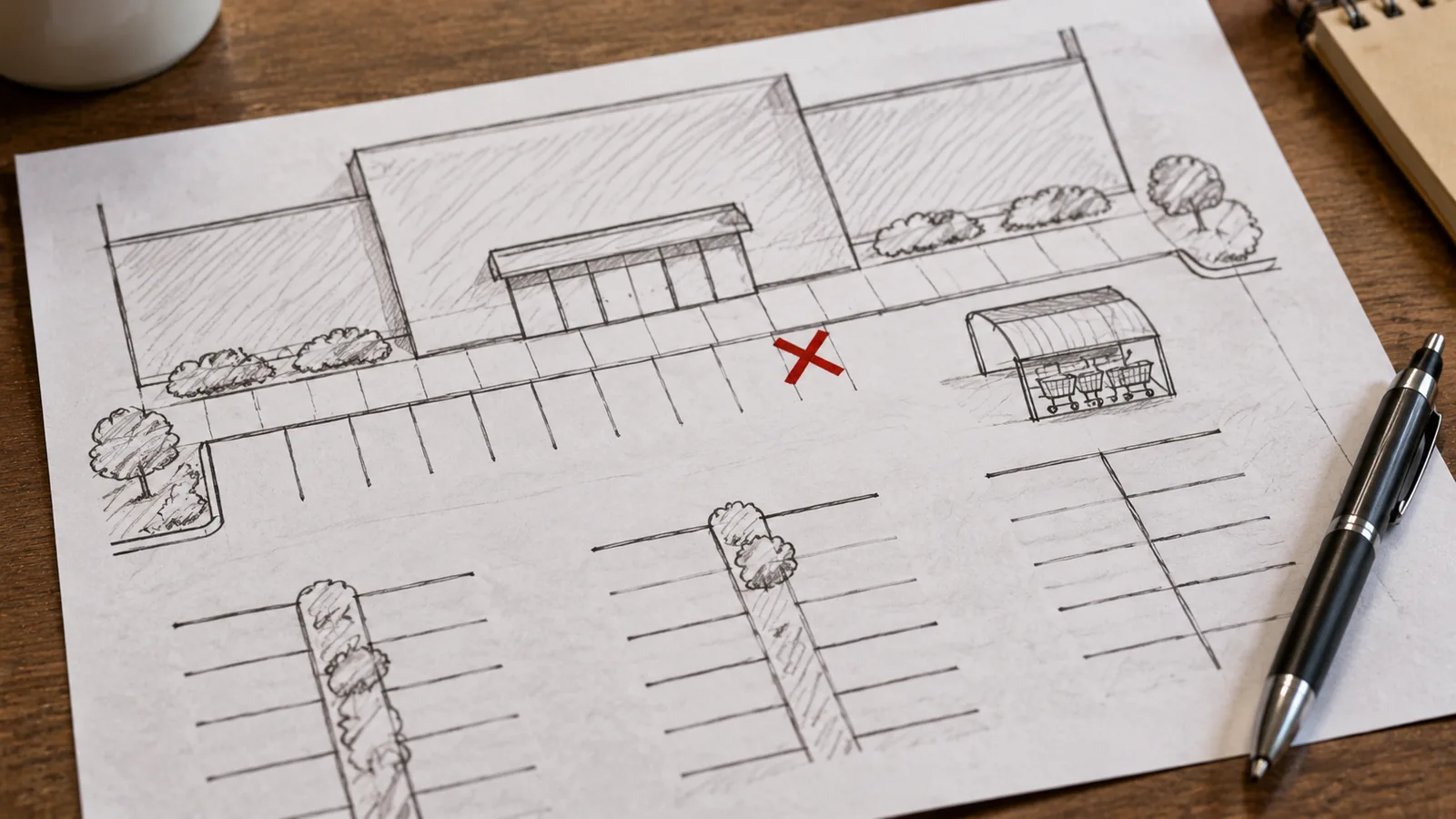
A rough site diagram with your route and the hazard marked helps. A lease covering one parcel may not cover the strip of pavement where you fell.
Who can be named as a defendant?
Anyone with a supported connection to the hazard: the operator of the store, and sometimes an owner, property manager, cleaning vendor or repair contractor.
| Name you've seen | What it may be |
|---|---|
| "Target" on the building | A brand, not necessarily the legal entity to sue. |
| The claims administrator on a letter | A company handling the claim, not always a party. |
| The landlord on a lease | A possible defendant if it controlled the spot. |
| A contractor on a work order | A possible defendant if its work created the hazard. |
Each defendant needs a reasoned link to the injury. Naming every company in a contract without that link invites a fight that doesn't help the case.
Does owning the property make a company responsible?
Not automatically. Texas premises duties generally follow control of the property, and how the claim is characterized matters [S9].
Who could have taken each missing precaution
- Store staff, for a wet-floor sign in the aisle.
- Whoever handles common-area repairs under the lease, for repairing a broken curb.
- The property manager or the store depending on practice, for closing a damaged walkway.
- The store or its equipment service company, for fixing a leaking cooler.
Ask who could have fixed or warned about the problem. That answer usually points to the right defendant better than a corporate name does.
How long do you have to file?
Generally two years from the injury under Texas Civil Practice and Remedies Code section 16.003 [S6]. Exceptions such as a child's injury can change the math, so get the date calculated early.
| Situation | Does it stop the clock? |
|---|---|
| You're still in treatment. | No. Treatment affects value, not the deadline. |
| An adjuster is reviewing your records. | No. |
| You're discussing settlement. | Not by itself. |
| The injured person was under 18. | Time while a minor generally doesn't count [S6]. |
A lawyer should set internal dates for confirming entities, drafting the petition, getting your approval, filing, and following up on service.
Is filing the same as serving?
No. Filing starts the case; service gives each defendant formal notice. Texas courts can look at whether you were diligent in getting a defendant served after filing.
What each status update means
- The court has the case, as in "The petition is filed."
- The paperwork for service is ready, as in "Citation was issued."
- The defendant has formal notice and its answer clock runs, as in "The defendant was served."
- The case is active on both sides, as in "The defendant answered."
Registered-agent details should be checked fresh, not copied from an old case.
Which court and county?
The court has to have jurisdiction, and the county has to be a proper venue under Texas law. The county where you fell is often one option.
Factors, with an example question for each
- Subject-matter jurisdiction, such as whether the amount sought fits this court.
- Venue facts, such as where the events happened and where the defendants are.
- Local practice, such as how this court schedules hearings and trials.
Be wary of anyone who promises a better jury just because of the county. Legal eligibility comes first, and any trial date given early is an estimate.
Can Target move the case to federal court?
Sometimes. A state-law injury case can be removed to federal court when the parties are citizens of different states and more than $75,000 is at stake, if the removal rules are met [S12].
| Removal rule | What it says |
|---|---|
| Amount in controversy | It must exceed $75,000 for diversity jurisdiction [S12]. |
| Notice of removal | Generally due within 30 days after the defendant receives the petition [S12]. |
| One-year limit | Diversity removal is generally barred more than a year after the case starts, unless the plaintiff acted in bad faith [S12]. |
| Forum-defendant rule | A properly joined and served Texas defendant can block diversity removal [S12]. |
| Remand motion | A motion based on a procedural defect is due within 30 days after removal [S12]. |
A company with stores in Texas isn't necessarily a Texas citizen for this purpose. A local employee or contractor shouldn't be added just to keep the case in state court; every claim needs a real basis.
What should the petition say?
It should plead the theory that fits how the injury happened.
Likely theory for each mechanism (hypothetical)
- Premises liability with its notice requirements, for a spill left on the floor.
- Possibly negligent activity, for a worker's cart that strikes you as he pushes it.
- Premises liability against whoever controlled that area, for a slab edge in the parking lot.
Calling a condition claim "negligent activity" or general negligence doesn't remove the premises requirements [S9]. Plead facts supporting the condition, duty, knowledge, response, causation, and damages, without overstating a source that's still under investigation.
What will the lawsuit ask of you?
Before filing, you should know what's coming.
What the lawsuit involves
- Written discovery, such as answering questions and producing records.
- Preservation, such as keeping photos, messages and posts even unhelpful ones.
- A deposition, such as testifying under oath about the fall and your injuries.
- Medical history, such as relevant prior records that may be requested.
- Trial, such as being available if the case doesn't settle.
Don't delete social media posts or texts because they might hurt. Your lawyer can explain context and ask the court to limit overbroad requests.
Is a lawsuit worth the cost?
Compare expected expenses with what the evidence can support.
| Possible cost | When it comes up |
|---|---|
| Filing and service fees | At the start. |
| Medical record charges | Throughout. |
| Depositions and transcripts | During discovery. |
| Expert fees | When a technical question is disputed. |
| Mediation | Often before trial. |
Your fee agreement should say who advances costs, how they're repaid, and what happens if there's no recovery. A strong injury with weak notice proof may call for different advice than a clear-liability case with modest losses.
A party-identification example
Here's a made-up example of how the facts sort out.
| Fact | What it suggests |
|---|---|
| A customer trips on uneven pavement between the entrance and a shared cart return. | The exact spot needs mapping. |
| A store manager takes the incident report. | The report doesn't show who controlled the pavement. |
| The lease assigns common-area repairs to a property manager. | The property manager may be a defendant. |
| A contractor patched nearby pavement two weeks earlier. | Its scope and timing need checking. |
| The fall was actually inside the vestibule. | The analysis may shift back to the store. |
This isn't a real Target case or a prediction of liability.
Why talk to Aaron Herbert about filing?
Aaron A. Herbert is Board Certified in Personal Injury Trial Law by the Texas Board of Legal Specialization [S1][S3]. No credential protects a claim if a deadline is missed, so ask how the firm handles each step.
Ask the firm
- How do you confirm the right defendants?
- When is my deadline?
- What if the case is removed?
A useful answer includes these, in the same order.
- Entity records, leases and contracts tied to the exact spot.
- A specific date and how it was calculated.
- The remand options and how the plan changes.
Frequently asked questions
Does a claim number mean Target accepted fault?
No. It identifies a file. Liability and payment are separate questions.
Should I wait until treatment ends?
Waiting can cause legal and evidence problems, so no. Have a lawyer check the deadline now.
Can more than one company be responsible?
Possibly, depending on control and conduct. Each claim needs support.
Does a store report stop the two-year clock?
No.
Tell us about your Target fall
Tell us about your Target fall through InjuryAttorneyOfDallas.com or call (214) 200-4878. The Law Firm of Aaron A. Herbert, P.C. will check your deadline and who may be responsible.
Bring, with hypothetical examples
- The date and exact location, such as March 4 by the cart return on the south side.
- Any letters from an adjuster, such as a claim acknowledgment with a file number.
- Photos and witness names, such as the cracked curb and the shopper who helped you up.
- Treatment records, such as the orthopedic follow-up notes.
Educational information only, not legal advice. Representation and fees require a written agreement. This independent resource is not affiliated with or endorsed by Target Corporation.
Related reading
- How to Sue Target in Texas, on the full claim and lawsuit process.
- First 72 hours after a Target fall, on what to keep and report right away.
- Preserving Target surveillance video, on asking the store to keep footage.
- Discovery and corporate depositions, on what happens after filing.
- Target injury settlements and net proceeds, on what you'd actually receive.
Sources
- S1. State Bar of Texas, Aaron Alan Herbert, for license and board certification.
- S3. Texas Board of Legal Specialization, Personal Injury Trial Law standards, for certification requirements.
- S6. Tex. Civ. Prac. & Rem. Code § 16.003; see also § 16.001, for the two-year limitations period and minors.
- S9. Keetch v. Kroger Co., 845 S.W.2d 262 (Tex. 1992); United Scaffolding, Inc. v. Levine, 537 S.W.3d 463 (Tex. 2017), for condition versus activity.
- S12. 28 U.S.C. §§ 1332, 1441, 1446, 1447, for diversity jurisdiction and removal.

ABOUT THE ATTORNEY
Aaron A. Herbert
Founding Attorney
Board Certified in Personal Injury Trial Law
Aaron founded The Law Firm of Aaron A. Herbert in 2010 to focus on developing each client's case and seeking its maximum value. For over a decade, he has represented people seriously injured in major accidents and industrial catastrophes, pursuing trial verdicts and settlements while working to reduce the stress of litigation.
Education
- Texas A&M University · B.S., Criminal Justice, 1999
- University of Oklahoma College of Law · J.D., 2002; graduated in the top of his class
Trial experience & approach
Aaron earned numerous jury verdicts at boutique personal injury litigation firms. According to his biography, he spent a year as the top-earning litigation attorney at a firm that frequently appeared in verdict searches as having one of the highest numbers of trial wins in Texas. At another Dallas personal injury firm, he moved from managing pre-litigation attorney to managing litigation attorney over seven years as the firm grew into one of Dallas's largest personal injury firms.
His biography describes a reputation as one of America's most aggressive trial lawyers, with noteworthy recoveries from judges and juries and substantial pretrial settlements. Most of those settlements included confidentiality agreements requested by the defense. Aaron has said the recoveries were justified by the injuries and losses involved, which no amount of money could make someone choose to experience.
His approach combines passion, preparation, persistence and courtroom imagination. He believes a well-supported, engaged and motivated team working cooperatively helps deliver strong representation, with the goal of achieving the best possible result for every client.
Dallas roots, military service & publication
Born and raised in Dallas, Aaron enlisted in the United States Marine Corps after high school and later received an Honorable Discharge. He completed his university and law degrees after his military service and became a lifelong Sooners football fan in law school.
Publication: “Litigating Dog Bite Cases,” Texas Dog Law Seminar, Dallas, 2009.
Professional affiliations & recognition
Professional affiliations and recognition listed in Aaron’s biography:
- State Bar of Texas
- American Bar Association
- Association of Trial Lawyers of America (now American Association for Justice)
- Texas Trial Lawyers Association
- Dallas Trial Lawyers Association
- Dallas Bar Association
- Tarrant County Bar Association
- Million Dollar Advocates Forum
- The National Trial Lawyers – Top 100 Trial Lawyers