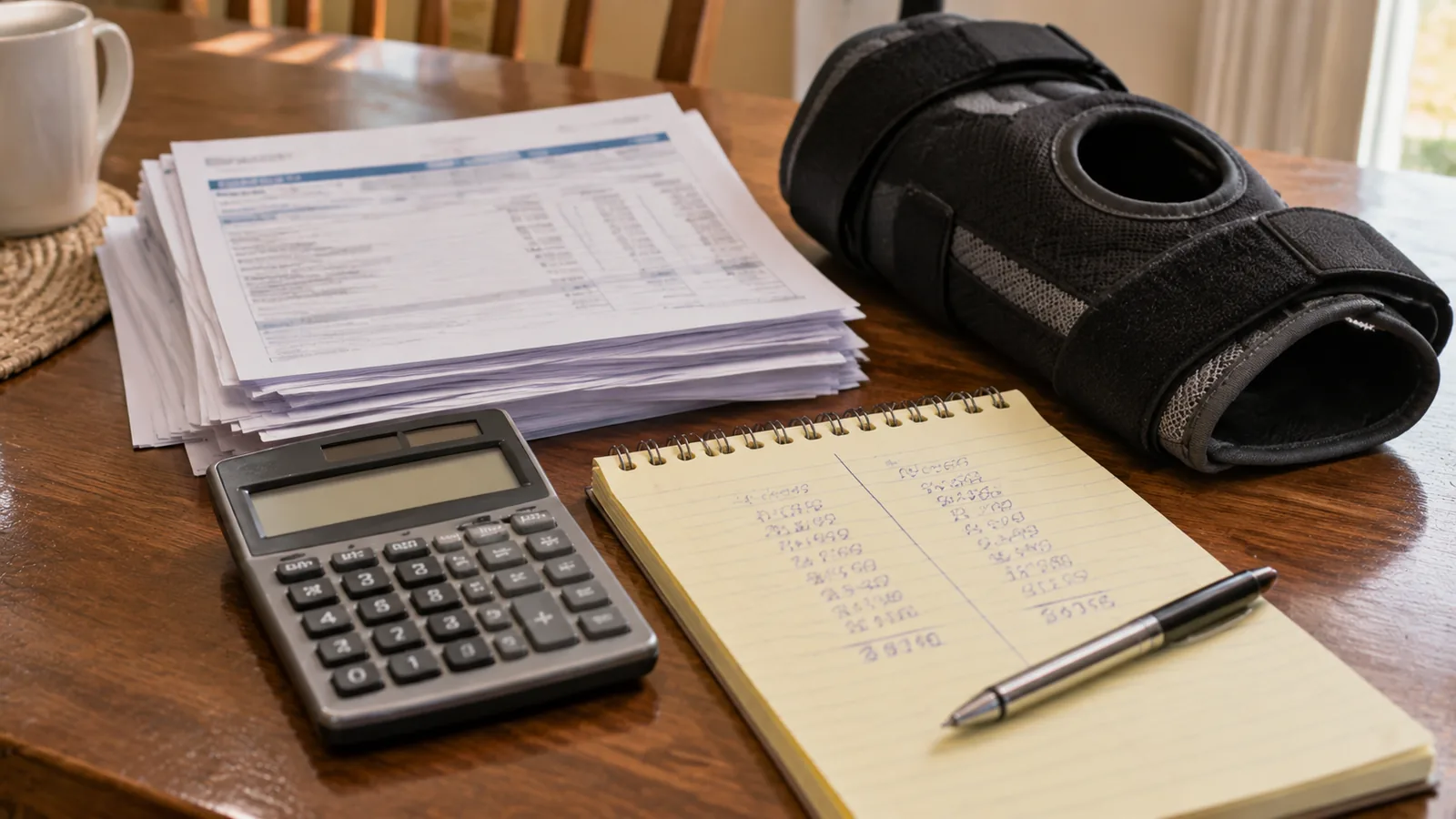
There's no reliable "average Target settlement" in Texas. Two shoppers with the same torn ligament can end up with very different results because the notice evidence, the medical history, and the fault arguments differ.
Four numbers and what each means
- Medical charges, or what providers billed.
- Recoverable medical expenses, or what Texas law lets you claim, often less than the bills [S7].
- Gross settlement, or the amount the defense agrees to pay.
- Net proceeds, or what you keep after fees, expenses and repayments.
This guide is part of the Target injury knowledge hub. To talk with a lawyer about what your claim may be worth, tell us about your Target fall or call (214) 200-4878.
How does liability affect value?
A broken wrist is just as painful whether or not anyone can say how long the spill sat there. But the claim's value depends heavily on that answer.
Evidence and its effect on value (hypothetical)
- Video shows the spill sat for 30 minutes, which strengthens notice.
- No one knows how long the spill was there, so there's a risk of losing on a no-evidence motion.
- A cone stood right in your path, which raises a duty or fault defense.
- A prior report of the same leak may support actual notice.
"We need the footage before we can value this" is a real answer. "Target usually pays well" isn't.
How are medical records organized?
By date, provider, diagnosis, treatment, restrictions, and progress.
What your records may show and what your lawyer will want to know
- An ER visit the day of the fall, for what you told the nurse about how it happened.
- A specialist two weeks later, for whether surgery was recommended or just discussed.
- A month with no visits, for the reason, such as cost, a work trip or feeling better.
- An old sprain of the same wrist, for how it felt in the year before the fall.
A prior injury doesn't automatically defeat a claim, but leaving it out hurts credibility. Future care should be something a doctor recommends, not a maybe.
Are all your medical bills recoverable?
Not automatically. Texas limits recovery to amounts actually paid or incurred by you or on your behalf [S7].
| Item (hypothetical) | Why it may differ |
|---|---|
| ER bill of $9,400 | Insurance may have paid a lower contracted amount. |
| Write-off of $5,100 | Generally not recoverable as an expense. |
| Unpaid physical therapy balance | Depends on what you actually owe. |
| Affidavit of reasonable charges | Proves cost, not that the fall caused the treatment [S7]. |
That's why your lawyer asks for insurance and payment records. Haygood v. De Escabedo holds that only evidence of recoverable medical expenses is admissible [S7].
How is lost income proved?
With records, not estimates.
Useful proof in each situation (hypothetical)
- Pay stubs and an employer letter, for an hourly employee off six weeks.
- Leave records showing hours used, for a salaried worker using PTO.
- Tax returns, invoices and canceled jobs, measured as profit, for a self-employed electrician.
- A vocational and economic analysis, for a permanent lifting restriction.
A temporary restriction doesn't justify claiming a lifetime of lost earnings.
How is pain and suffering valued?
Through specific evidence of what changed, how often, and for how long.
Categories, each with a hypothetical example
- Physical pain, such as waking twice a night for three months.
- Physical impairment, such as not being able to lift a grandchild or garden.
- Mental anguish, such as fear of walking on store tile, described by family.
- Disfigurement, such as a 4-inch surgical scar on the wrist.
Parkway Co. v. Woodruff requires evidence of the nature, duration, and severity of mental anguish [S8]. The plurality and concurring opinions in Gregory v. Chohan criticized unsupported anchoring arguments for noneconomic damages [S8]. A store's corporate wealth isn't a measure of your pain.
How does your share of fault change the number?
In cases governed by Chapter 33, your recovery is reduced by your percentage of responsibility, and you recover nothing if it's greater than 50 percent [S16].
| Your share of fault | Effect on $200,000 in damages (illustration) |
|---|---|
| 0% | $200,000. |
| 20% | $160,000. |
| 50% | $100,000. |
| 51% | $0. |
This arithmetic ignores settlement credits and multi-party rules, and it doesn't predict any jury.
What do you actually take home?
Here are two made-up examples with the same gross settlement and a one-third fee.
| Line | Example A | Example B |
|---|---|---|
| Gross settlement | $150,000 | $150,000 |
| Fee (one-third of gross) | $50,000 | $50,000 |
| Case expenses | $9,000 | $18,000 |
| Confirmed repayments (liens) | $21,000 | $30,000 |
| Estimated client proceeds | $70,000 | $52,000 |
Example B nets $18,000 less on the same offer. Neither column is the firm's fee terms or a Target average; your own signed agreement controls.

When should liens be identified?
Early, before you decide on an offer.
Possible claims on proceeds and what to confirm
- Health insurance reimbursement, for whether the plan's right applies and the amount.
- Medicare or Medicaid, for required notices and final amounts.
- A hospital lien, for whether it was properly filed.
- Provider balances, for what's actually owed.
Funds may not be paid out until these are resolved. Be wary of any promised payment date that depends on a third party.
Settle now or keep going?
The alternative to an offer is not a guaranteed bigger check. It's more time, more expense, and more risk.
| Factor | Question to ask |
|---|---|
| Next stage cost | What will depositions and experts cost? |
| Motion risk | Could notice problems end the case? |
| Medical picture | Is treatment finished, or is surgery still pending? |
| Your goals | Do you need funds now or certainty later? |
You decide whether to settle, with full information from your lawyer, including the weak spots.
Why can't company financial reports predict your settlement?
Each source and its problem
- A company's annual report, because it's aggregate, not per case.
- A "3x medical bills" calculator, because it ignores liability, fault and recoverable amounts.
- A reported verdict, because the facts are different and settlements are often confidential.
Why talk to Aaron Herbert about settlement value?
Aaron A. Herbert is Board Certified in Personal Injury Trial Law by the Texas Board of Legal Specialization [S1][S3]. No credential sets a settlement value, so ask how the firm builds one.
Ask the firm
- How do you value my claim?
- What will I net?
- What could lower it?
A useful answer includes these, in the same order.
- Recoverable expenses, income and the liability risks.
- A worksheet with labeled estimates.
- The defenses and evidence gaps.
Frequently asked questions
Is there an average Target settlement in Texas?
No reliable dataset shows one.
Are all my medical bills recoverable?
Not automatically. Paid-or-incurred rules and causation apply.
Is a bigger gross offer always better?
Compare expenses, liens, timing and release terms.
How long until I'm paid?
It depends on liens, approvals and the release.
Tell us about your Target fall
Tell us about your Target fall through InjuryAttorneyOfDallas.com or call (214) 200-4878. The Law Firm of Aaron A. Herbert, P.C. will explain how your claim would be valued and what you might take home.
Bring, with hypothetical examples
- Medical bills and insurance statements, such as the ER bill and the explanation of benefits.
- Pay records, such as six weeks of pay stubs.
- Notes on daily limits, such as a journal of sleep and missed activities.
- Any offers, such as the adjuster's letter.
Educational information only, not legal advice. Representation and fees require a written agreement. This independent resource is not affiliated with or endorsed by Target Corporation.
Related reading
- How to Sue Target in Texas, on the full claim and lawsuit process.
- First 72 hours after a Target fall, on medical records and evidence.
- Preserving Target surveillance video, on the footage that proves liability.
- Warnings and customer fault, on defenses that reduce value.
- Mediation and trial, on comparing an offer with trial.
Sources
| Ref | Source | What it supports |
|---|---|---|
| S1 | State Bar of Texas, Aaron Alan Herbert | License and board certification. |
| S3 | Texas Board of Legal Specialization, Personal Injury Trial Law standards | Certification requirements. |
| S7 | Tex. Civ. Prac. & Rem. Code § 41.0105; Haygood v. De Escabedo, 356 S.W.3d 390 (Tex. 2011); see also §§ 18.001, 18.002(b-1)-(b-2) | Paid or incurred medical expenses. |
| S8 | Parkway Co. v. Woodruff, 901 S.W.2d 434 (Tex. 1995); Gregory v. Chohan, 670 S.W.3d 546 (Tex. 2023) | Mental anguish evidence; noneconomic damages arguments. |
| S16 | Tex. Civ. Prac. & Rem. Code §§ 33.001, 33.003, 33.012 | Proportionate responsibility. |

ABOUT THE ATTORNEY
Aaron A. Herbert
Founding Attorney
Board Certified in Personal Injury Trial Law
Aaron founded The Law Firm of Aaron A. Herbert in 2010 to focus on developing each client's case and seeking its maximum value. For over a decade, he has represented people seriously injured in major accidents and industrial catastrophes, pursuing trial verdicts and settlements while working to reduce the stress of litigation.
Education
- Texas A&M University · B.S., Criminal Justice, 1999
- University of Oklahoma College of Law · J.D., 2002; graduated in the top of his class
Trial experience & approach
Aaron earned numerous jury verdicts at boutique personal injury litigation firms. According to his biography, he spent a year as the top-earning litigation attorney at a firm that frequently appeared in verdict searches as having one of the highest numbers of trial wins in Texas. At another Dallas personal injury firm, he moved from managing pre-litigation attorney to managing litigation attorney over seven years as the firm grew into one of Dallas's largest personal injury firms.
His biography describes a reputation as one of America's most aggressive trial lawyers, with noteworthy recoveries from judges and juries and substantial pretrial settlements. Most of those settlements included confidentiality agreements requested by the defense. Aaron has said the recoveries were justified by the injuries and losses involved, which no amount of money could make someone choose to experience.
His approach combines passion, preparation, persistence and courtroom imagination. He believes a well-supported, engaged and motivated team working cooperatively helps deliver strong representation, with the goal of achieving the best possible result for every client.
Dallas roots, military service & publication
Born and raised in Dallas, Aaron enlisted in the United States Marine Corps after high school and later received an Honorable Discharge. He completed his university and law degrees after his military service and became a lifelong Sooners football fan in law school.
Publication: “Litigating Dog Bite Cases,” Texas Dog Law Seminar, Dallas, 2009.
Professional affiliations & recognition
Professional affiliations and recognition listed in Aaron’s biography:
- State Bar of Texas
- American Bar Association
- Association of Trial Lawyers of America (now American Association for Justice)
- Texas Trial Lawyers Association
- Dallas Trial Lawyers Association
- Dallas Bar Association
- Tarrant County Bar Association
- Million Dollar Advocates Forum
- The National Trial Lawyers – Top 100 Trial Lawyers