
The short answer
A trip case at Tom Thumb or Albertsons needs proof of what you caught your foot on, how it made you fall, who controlled it and whether the store knew or should have known about it. The carts, mats and aisles below are hypothetical, not claims about any particular store. This guide is part of the Tom Thumb and Albertsons injury knowledge hub, and the litigation guide covers the whole case.
What you have, and what it doesn't prove alone
- A twist tie near where you landed, which doesn't prove that it tripped you.
- A measured height difference at a threshold, which doesn't prove a code violation.
- Photos of the scene as it was, which prove nothing alone but help pin down how you fell before anyone picks a theory.
What has to be proved in a trip case?
Roughly four things: the object or surface, the way it caught you, who controlled it and what the store knew.
Hazard, and the questions it raises
- A loose item, like a six-pack ring or twist tie, which is handled much like a spill, so timing matters.
- A fixed thing, like a rack base, threshold or sidewalk fixture, which raises questions about how it was built or placed, who maintained it and whether it posed an unreasonable risk.
A separate guide in the knowledge hub covers notice and inspection timing.
| Case | What happened | What the court held |
|---|---|---|
| Wal-Mart Stores, Inc. v. Spates | A shopper's toe and sandal caught in an empty plastic six-pack ring in a Lake Jackson soft-drink aisle. The ring had been behind an employee working the shelves for 30 to 45 seconds. | The Texas Supreme Court found no evidence the store should have discovered it. S2 |
Which foot caught, and on what?
Start with the walk, not the landing spot.
Question, and why it matters
- Where you were coming from, which way you were headed and what you were pushing, because your approach shapes what you could see.
- Which foot caught, and what it felt like, since you can feel a hard catch at the toe without seeing the object, so say exactly that and don't fill in a picture.
- Whether anything moved, since a rack can shift when someone falls into it and a mat can fold as a foot slides, so ask witnesses what changed while people helped you up.
The first 72 hours guide covers what to save at the scene, and the surveillance video guide explains how footage gets saved.
Evidence, and what it can and can't show
- A twist tie, torn produce bag or price sticker, which you photograph for its shape, size, color and location without moving it, since you shouldn't take store property or walk into a back room.
- A witness who saw your shoe catch, which is something different from a witness who saw a twist tie on the floor afterward.
- Store video, which shows your path, though a blurry shape shouldn't become a confirmed twist tie just because that fits the theory.
- A broken wrist, which fits bracing during many kinds of falls, since a physician speaks to what the fall did to you while other evidence shows what made you lose your balance.
Stocking carts and pallets: was it moving?
Ask first whether the equipment was parked or moving when you hit it, because that can change the legal theory.
| Question | What to know |
|---|---|
| Keetch v. Kroger Co. and United Scaffolding, Inc. v. Levine | A negligent-activity claim needs an injury caused by the ongoing activity itself or as its contemporaneous result. S22 S23 |
- A stocker rolls a loaded cart into your hip, which points toward a negligent activity.
- A rack base was left jutting into the cereal aisle twenty minutes earlier, which points toward a premises condition.
- Who placed it, whether an employee, a vendor stocking its own product or another customer, since a seasonal reset can change the aisle by next month.
- What your photos should show, which is the overhang, the aisle width and your cart's position at eye level from your path, since a close-up can make a base look bigger.
In the made-up file below, nobody should average 8 and 6 inches into a 7-inch defect. The job is to learn how the rack sat that day and whether it created an unreasonable risk, so keep every photo, even the unflattering ones.
| What the file shows | Where it came from | What still has to be checked |
|---|---|---|
| Rack base 8 inches past the merchandise | Your phone photo after the fall | Scale, camera angle and whether the rack moved. |
| "The rack got bumped during the cleanup" | A shopper at the end of the aisle | Where that shopper stood and what they personally saw. |
| Rack base 6 inches past the merchandise | An inspection weeks later | Whether the rack and stock were set up the same way. |
| "My toe hit something hard" | Your own account | Whether you felt it, saw it or both. |
Entrance mats on a rainy morning
A mat claim needs proof of how the mat looked when you stepped on it.
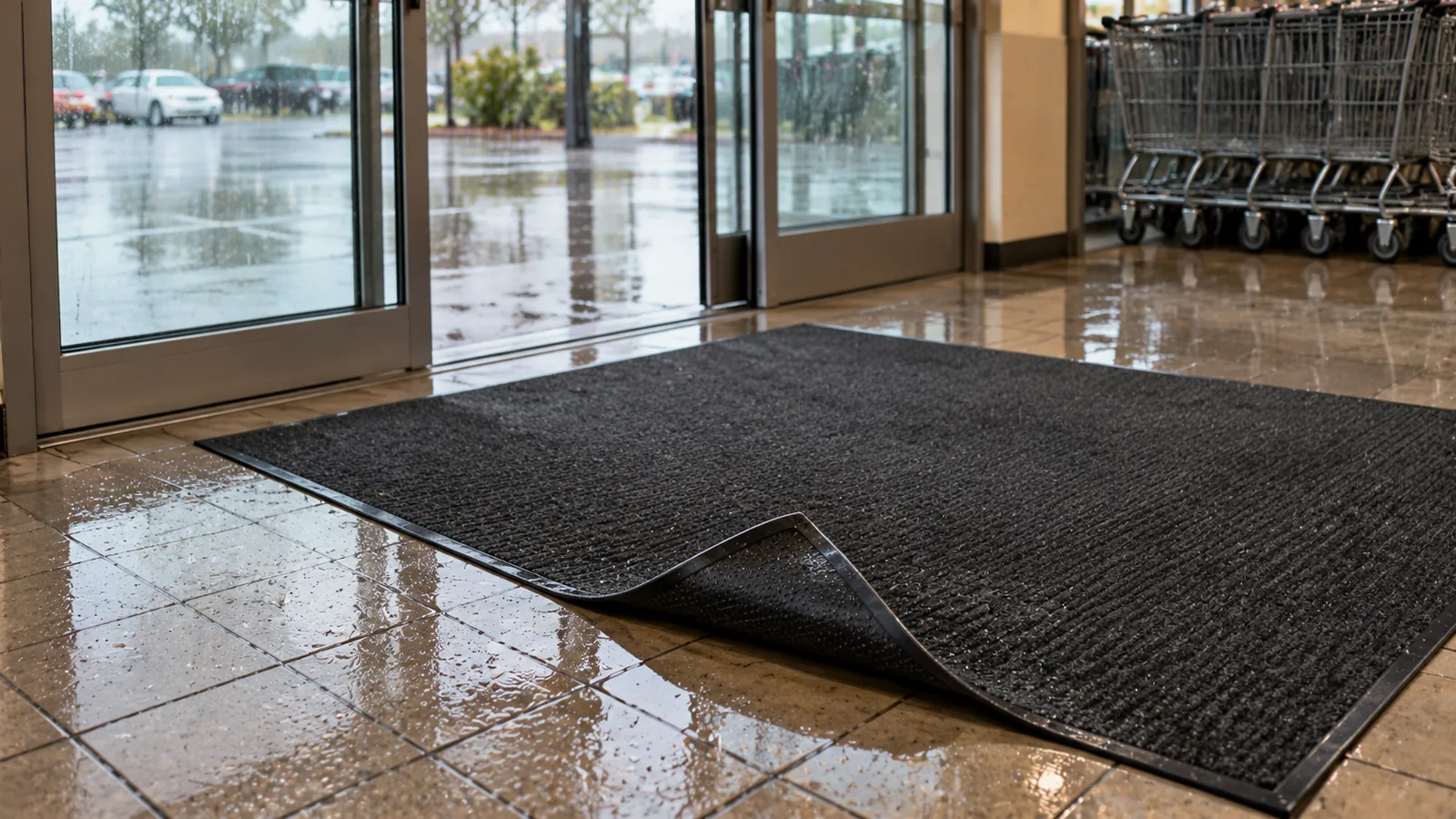
Mat condition or record, and what to check
- A curled corner, shifted edge, bunched seam or soaked surface, to check which one it was, since each is a different problem.
- The mat after the fall, to check whether it moved during the fall, the help or the cleanup, and to photograph the doors, lighting and floor transition, not just the edge.
- Rain that morning, which explains why a mat was out but doesn't by itself prove the mat was defective or that the store knew about it.
- A vendor tag on the backing, which shows who may have supplied and serviced the mat, though whether that company caused the curl is separate, so your lawyer asks for the service agreement and what happened on delivery days.
- An overhead photo, which can make a curled edge look obvious, though a shopper pushing a cart through sliding doors sees it differently.
- A different mat tested months later, which may not match the original's backing or wear, so the expert should say what can still be judged and what can't.
Powered carts and charging cords
Identify the exact cart, how the cord ran, any repair history and what anyone saw beforehand.
- A cord problem doesn't prove who knew about it or when.
- Your part is not to unplug, move or test store equipment yourself.
- A party may ask to enter property to inspect, measure, photograph or test it, and the request has to state the time, place, manner and scope, including any testing procedure (Texas Rule of Civil Procedure 196.7). S6
- Entry onto property owned by someone outside the lawsuit takes a motion and a hearing. S6
- Testing a different model of a cart already repaired or pulled from service means little unless the expert explains why the comparison fits.
Sidewalks, thresholds and outside control
Outside the doors, the first question is often who controlled the spot.
| Case | What happened | What the court held |
|---|---|---|
| Johnson v. Tom Thumb Stores, Inc., 771 S.W.2d 582 (Tex. App.—Dallas 1989, writ denied) | A shopper slipped on a glass light fixture set into a shopping-center sidewalk about ten feet from the store entrance. Testimony said those fixtures got slick with dew, and the landlord had control of the common areas. | The court affirmed a directed verdict for Tom Thumb as the tenant. The judgment on the claim against the landlord was reversed and remanded for a new trial. S16 |
Photograph the walkway, threshold or fixture from your direction of travel plus a wide storefront shot, and ask who installed it, got complaints and made repairs.
Record or step, and what it can show
- Ownership records, which show a possible party, though the lease in effect that day, or a task someone actually took on, may explain responsibility better.
- A ruler measurement, which can show a height difference if the ruler is held straight, since a tilted ruler can mislead, and any repair since should be noted.
- A code argument, which needs the actual provision, proof it was adopted where the store sits and proof it covered that part of the building when it was built or altered.
- A model code or accessibility standard, where a model code isn't necessarily local law and an accessibility standard can inform the question without creating a private damages claim or proving negligence per se.
- Hypothetical: a fixed sidewalk feature the lease assigns to the landlord, which is a landlord question.
- Hypothetical: an employee parks a pallet jack across the walk by the doors, which may raise different duty and conduct questions under the same lease, and if an employee directed your route or moved equipment, write that down.
You saw it. Does that end the claim?
Not necessarily, though seeing the hazard changes the analysis.
| Rule | What it says |
|---|---|
| Austin v. Kroger Texas, L.P. | The case involved a Kroger employee, and the Texas Supreme Court applied the general rule for invitees: a landowner generally has no duty to warn of or protect against a danger that's obvious or already known, with narrow exceptions for criminal activity and for a dangerous area a person must use and can't make safe. S13 |
| Chapter 33 of the Civil Practice and Remedies Code | A claimant found more than 50 percent responsible generally recovers nothing, and a smaller share reduces the award. S12 |
Whether either Austin exception fits a shopper takes careful review. A bright orange pallet wrap may look obvious in a staged photo and still be hidden behind an end-cap display.
If you saw the hazard, what to expect
- Your lawyer asks why you took that route and what else was open.
- "It was the shortest path" usually won't carry a necessary-use argument by itself.
- Your answer should be the truth, since an honest answer can admit what you saw and still dispute how much fault it deserves.
When does an expert help?
An expert helps with technical questions, like how far a base stuck out or how high a mat edge stood.
Question
- Which foot caught, and on what.
- How far the rack base stuck out that day.
- Whether the broken wrist came from this fall.
- Whether a code provision applied.
Who usually answers it, in the same order
- You, the witnesses and any video.
- Photos with scale, then an engineer or safety specialist.
- A treating or retained physician.
- Your lawyer, using the adopted code text and the building's history.
Texas Rule of Evidence 702 governs expert testimony in state court. S7 Nobody should be hired just to say the store was negligent, and a separate guide in the knowledge hub covers expert witnesses.
Inspection step, and why
- Early inspection with notice to the other side, because conditions change, and any test that would change the item goes through counsel.
- Calibration records and raw readings, so that others can check the method.
- An explanation of how the actual geometry affected the fall, which beats a long list of standards, and a feature that met a guideline doesn't settle every fact.
- Candor, since a good expert may say a later inspection can't answer the question.
Common questions
I tripped right next to a pallet. Isn't that enough?
Being next to a pallet is a location, so not by itself. You also need evidence your foot or body hit it, plus evidence about who placed it and what the store knew.
The store replaced the mat the next day. Does that prove it was bad?
Texas Rule of Evidence 407 generally keeps later repairs out as proof of negligence, so no. A replacement record also doesn't show how the old mat looked before your fall. S7
What if I fell on the sidewalk outside?
Who controlled that sidewalk then matters a lot, as Johnson v. Tom Thumb Stores shows. The lease and maintenance records help show who's responsible. S16
Talking to a lawyer about your fall
Bring the store address, the date, your photos, witness names and your medical records, and ask what an inspection would cost. Most Texas injury suits must be filed within two years after the claim accrues, with exceptions, and a rearranged aisle or replaced mat can erase the scene much sooner. S3 To talk with the Law Firm of Aaron A. Herbert, P.C., request a case evaluation or call (214) 200-4878.
| Credential | Where to check it |
|---|---|
| Board Certified in Personal Injury Trial Law by the Texas Board of Legal Specialization | Aaron Herbert's State Bar of Texas profile S1 |
Sources
S1 Aaron Alan Herbert, State Bar of Texas attorney profile (Board Certified, Personal Injury Trial Law, Texas Board of Legal Specialization). Read source.
S2 Wal-Mart Stores, Inc. v. Reece, 81 S.W.3d 812 (Tex. 2002); Wal-Mart Stores, Inc. v. Spates, 186 S.W.3d 566 (Tex. 2006). Read source.
S3 Tex. Civ. Prac. & Rem. Code §§ 16.001, 16.003, 16.072 (limitations; disability; weekend and holiday extension). Read source.
S6 Texas Rules of Civil Procedure. Read source.
S7 Texas Rules of Evidence, amendments effective July 2, 2026. Read source.
S12 Tex. Civ. Prac. & Rem. Code §§ 33.001, 33.003, 33.012 (proportionate responsibility). Read source.
S13 Austin v. Kroger Texas, L.P., 465 S.W.3d 193 (Tex. 2015). Read source.
S16 Johnson v. Tom Thumb Stores, Inc., 771 S.W.2d 582 (Tex. App.—Dallas 1989, writ denied). Read source.
S22 Keetch v. Kroger Co., 845 S.W.2d 262 (Tex. 1992). Read source.
S23 United Scaffolding, Inc. v. Levine, 537 S.W.3d 463 (Tex. 2017). Read source.

ABOUT THE ATTORNEY
Aaron A. Herbert
Founding Attorney
Board Certified in Personal Injury Trial Law
Aaron founded The Law Firm of Aaron A. Herbert in 2010 to focus on developing each client's case and seeking its maximum value. For over a decade, he has represented people seriously injured in major accidents and industrial catastrophes, pursuing trial verdicts and settlements while working to reduce the stress of litigation.
Education
- Texas A&M University · B.S., Criminal Justice, 1999
- University of Oklahoma College of Law · J.D., 2002; graduated in the top of his class
Trial experience & approach
Aaron earned numerous jury verdicts at boutique personal injury litigation firms. According to his biography, he spent a year as the top-earning litigation attorney at a firm that frequently appeared in verdict searches as having one of the highest numbers of trial wins in Texas. At another Dallas personal injury firm, he moved from managing pre-litigation attorney to managing litigation attorney over seven years as the firm grew into one of Dallas's largest personal injury firms.
His biography describes a reputation as one of America's most aggressive trial lawyers, with noteworthy recoveries from judges and juries and substantial pretrial settlements. Most of those settlements included confidentiality agreements requested by the defense. Aaron has said the recoveries were justified by the injuries and losses involved, which no amount of money could make someone choose to experience.
His approach combines passion, preparation, persistence and courtroom imagination. He believes a well-supported, engaged and motivated team working cooperatively helps deliver strong representation, with the goal of achieving the best possible result for every client.
Dallas roots, military service & publication
Born and raised in Dallas, Aaron enlisted in the United States Marine Corps after high school and later received an Honorable Discharge. He completed his university and law degrees after his military service and became a lifelong Sooners football fan in law school.
Publication: “Litigating Dog Bite Cases,” Texas Dog Law Seminar, Dallas, 2009.
Professional affiliations & recognition
Professional affiliations and recognition listed in Aaron’s biography:
- State Bar of Texas
- American Bar Association
- Association of Trial Lawyers of America (now American Association for Justice)
- Texas Trial Lawyers Association
- Dallas Trial Lawyers Association
- Dallas Bar Association
- Tarrant County Bar Association
- Million Dollar Advocates Forum
- The National Trial Lawyers – Top 100 Trial Lawyers