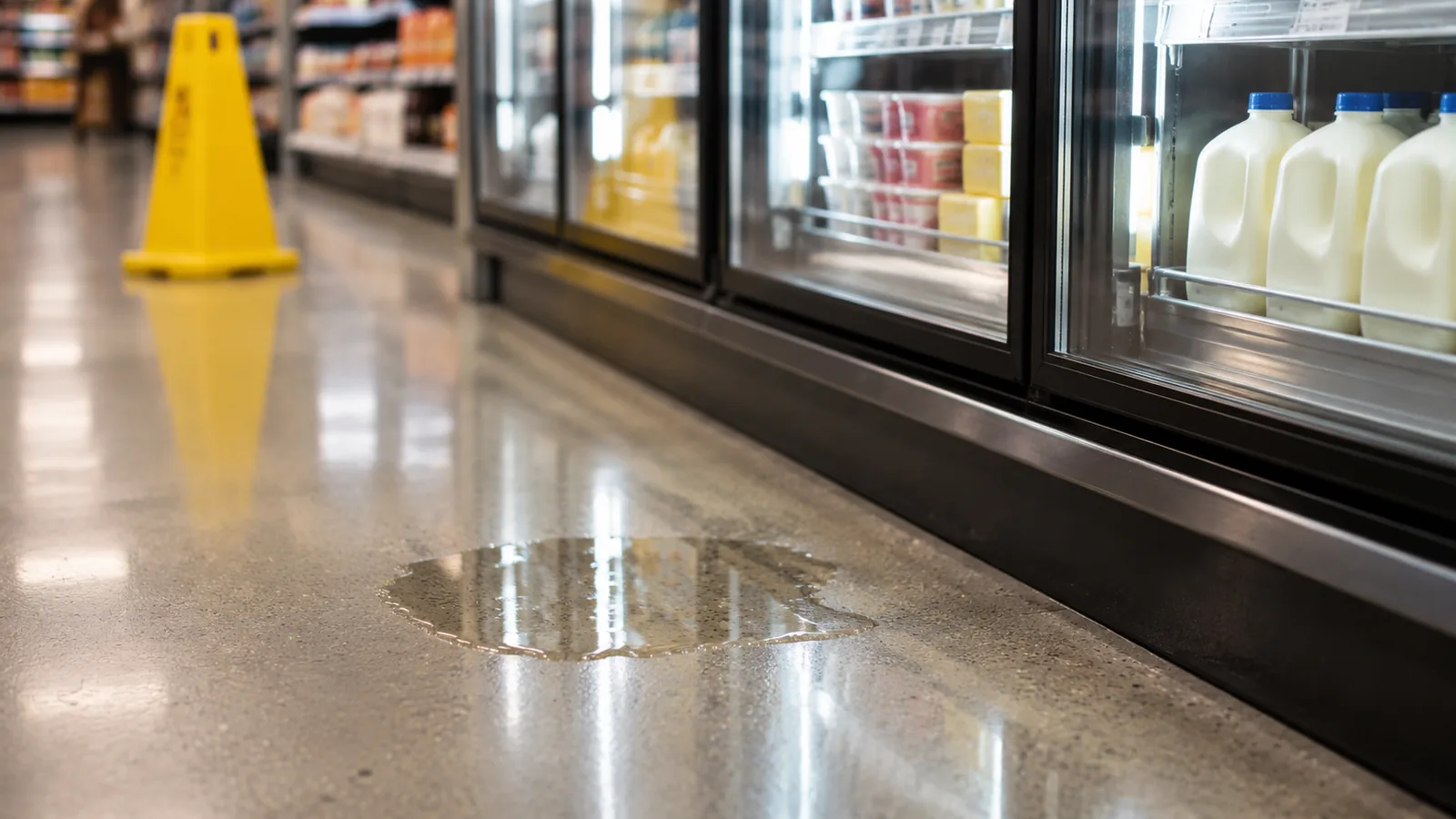
The short answer
To win a spill case against Tom Thumb or Albertsons in Texas, you generally need proof that the store knew about the hazard, or that it sat on the floor long enough that the store should have found it. Lawyers call this notice, and examples below are hypothetical unless a court case is named, not real store policies. This guide belongs to the Tom Thumb and Albertsons injury knowledge hub, and the litigation guide covers the whole case.
What you have, and whether it proves notice alone
- A photo of the wet floor after you fell, usually not enough since it shows the spill but not who knew.
- A stocker working two aisles over, usually not enough since nearness doesn't date the spill.
- A written sweep schedule, usually not enough since a schedule can't date the spill.
- A report or a stretch of time tied to the exact spot, which is the evidence that works.
What does notice mean in a grocery case?
Notice means the store knew, or should have known, about the condition that hurt you.
Kind of notice
- Actual notice.
- Constructive notice.
What it means, in the same order
- Someone with the store knew.
- The hazard sat there long enough that a reasonable store would have found it.
What a court looks at, in the same order
- A report, a radio call or an employee who saw it.
- How long it existed, how close the store's people were and how noticeable it was, under H-E-B, LP v. Peterson, No. 24-0310 (Tex. Apr. 10, 2026). S21
No set number of minutes decides every case. If a witness can only say "sometime after lunch," keep that answer as it is.
| Case | What happened | What the court held |
|---|---|---|
| Wal-Mart Stores, Inc. v. Reece | An off-duty employee stood 5 to 8 feet from a pizza-sized puddle near a snack bar. | Being that close wasn't enough, because nothing showed how long the puddle had been there. S2 |
| Wal-Mart Stores, Inc. v. Spates | A six-pack ring lay behind an employee working the shelves for 30 to 45 seconds. | That wasn't enough either. S2 |
What proves the store actually knew?
Actual notice usually comes from a report, or from an employee who saw the hazard before you fell.
What you heard or saw
- A shopper's report to the lane 4 cashier about spilled milk by the dairy case at 3:40.
- An employee's remark that "someone mentioned water earlier."
- The store's statement that the earlier report was about a restroom leak.
- Proof that an employee created the hazard.
What your lawyer checks, in the same order
- Who saw it first, who they told, what they said and when.
- Who said it, their job, the exact words and the time. It's only a lead and doesn't prove a manager ignored your puddle for an hour.
- The records showing where that report pointed.
- It helps, though Keetch v. Kroger Co. held that creating a condition is circumstantial evidence of knowledge and doesn't establish knowledge as a matter of law. S22
In Albertsons, LLC v. Mohammadi, 689 S.W.3d 313 (Tex. 2024) (per curiam), the claimant worked at a Wells Fargo inside a Houston Randalls and slipped beside a cart where an employee had put leaking items. S15
Hypothetical message before a fall beside a returns cart
- "A package in the cart is damaged."
- "Water is spreading beside that cart in aisle 2."
- A spill report from another aisle, sent after the fall.
What it says about the floor at that spot, in the same order
- Nothing. Mohammadi held the wet floor, not the situation that produced it, was the relevant danger, and knowing the cart's products leaked didn't prove the store knew the floor was wet. S15
- It speaks to that spot, and it still needs proof of who sent it, who got it and whether the water was still there.
- Very little.
How long was the spill on the floor?
Start with the last reliable sighting of a clean floor and the first reliable sighting of the hazard.
Time anchor, and why it needs context
- A self-checkout receipt stamped 4:12 p.m., which shows when you paid and not when you saw the floor.
- A text to your sister sent at 4:15, which may describe something noticed at 4:05.
The surveillance video guide covers how store footage gets saved.
| Case | What happened | What the court held |
|---|---|---|
| H-E-B, LP v. Peterson | A shopper slipped on clear liquid in an H-E-B toy aisle. Rain had stopped two hours earlier, no employee walked the aisle in that time and recorded roof leaks were elsewhere, none above the toy aisle. | The rain and a drip from a rafter spoke to a possible cause, not to how long the puddle sat there, and the puddle's size alone didn't show duration. Summary judgment for H-E-B was reinstated. S21 |
| Brookshire Bros., Ltd. v. Aldridge, 438 S.W.3d 9 (Tex. 2014) | Video showed employees passing a grease spill in the minutes before the fall. | The Court treated that as some evidence of constructive knowledge. S5 |
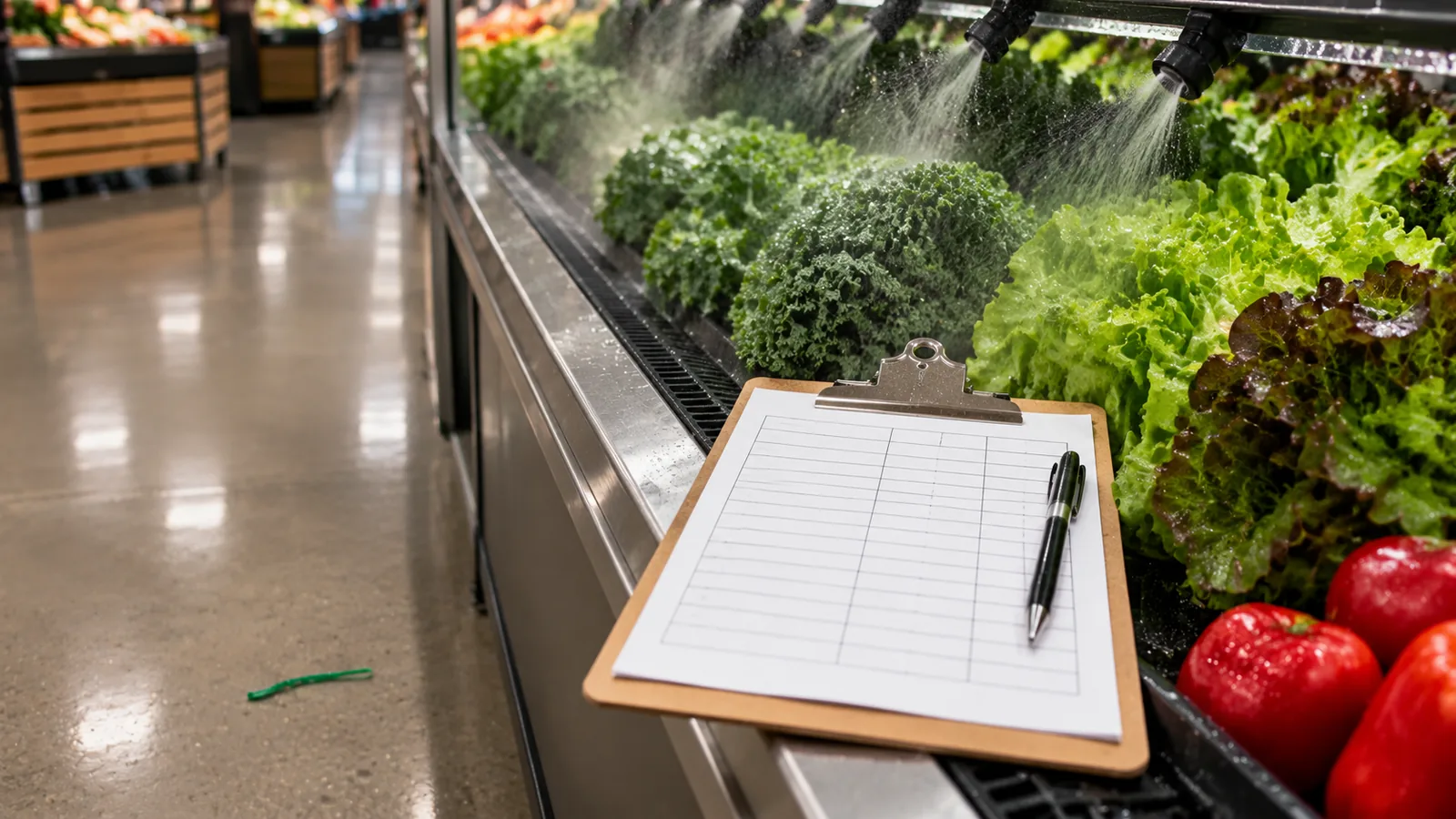
Hypothetical: the twist tie by the misting rack
In this made-up example, a shopper falls at 5:30 p.m. near the produce misting rack.
Piece of evidence (hypothetical)
- A witness who says the twist tie was there "for a while."
- An inspection log entry at 5:10 p.m.
- Video at 5:15 p.m., then a parked cart blocking the spot until 5:24.
- A small object on video at 5:25 p.m., where the fall happens.
What it might show, in the same order
- Someone saw it before the fall.
- Someone walked the produce aisle.
- Nothing for those nine minutes.
- Five visible minutes before the fall.
What still has to be checked, in the same order
- The original words and something tying them to the clock.
- Whether 5:10 marks the start of the walk, its end or when it was typed in.
- Other camera angles.
- Whether it's the same twist tie and the image is sharp enough to tell.
The video supports five observed minutes, not twenty, and neither number wins automatically. How visible the tie was and what else was going on still matter.
| If the file also shows | How the picture changes |
|---|---|
| Another camera shows a customer dropping the tie at 5:24. | The tie may have been down for seconds. |
| An employee's 5:12 message mentions the same tie. | A second route opens: actual notice. |
Does an inspection policy prove anything?
Not by itself, because a sweep schedule can't date the spill. A separate guide in the knowledge hub covers discovery.
Record
- Written sweep schedule.
- A log line.
- The policy manual.
- A missed check.
- A focused records request.
What each can do, in the same order
- Point to who was assigned, what logs should exist and how reports were supposed to travel.
- A blank one can raise record-keeping questions.
- Show what the company expected, once you confirm which version applied at that store on that date.
- Bear on reasonable care, if it connects to what a proper check would have found, and when.
- Get the logs for that aisle and the assignments for that shift.
What each can't do, in the same order
- Date the spill.
- Prove nobody walked the aisle, or that a logged walk was careful.
- Raise the standard of care. In Peterson, a heightened rainstorm inspection protocol didn't show how long the puddle existed, and the Court said an internal policy doesn't hold a store to a higher standard of care. S21
- Prove notice alone.
- Help much if it asks for every safety document the company has.
Coolers, roof leaks and repeat sources
A dripping freezer door or a leaky roof helps only if it lines up with your fall in place and time.
Record
- Repair request for freezer door 3.
- Roof repair log.
- An old roof repair.
- Peterson's roof leak records.
- A refrigeration contractor's service notes.
Could matter if, in the same order
- It reports water on the floor at that door before the fall.
- It places a leak above the aisle where you fell.
- The same leak was active that day.
- They had shown a leak above the toy aisle.
- The contract and the technicians' actual practice show the store itself was told.
May mean little if, in the same order
- It only says the case was running warm.
- The leak was over the bakery.
- Nothing shows it was active then.
- They showed none above it, so they failed that test. S21
- Only the contractor knew, which is a separate question. A separate guide in the knowledge hub covers adding other companies and the factual basis each needs.
Produce displays and the Corbin case
A fall near the grapes still needs proof of notice, and Corbin is a narrow exception.
| Case | What happened | What the court held |
|---|---|---|
| Corbin v. Safeway Stores, Inc., 648 S.W.2d 292 (Tex. 1983) | A grape lay in front of an open, slanted self-service bin over green linoleum. Safeway knew the display carried an unusually high risk, and there was evidence no walk-off mat was down despite its mat policy. | The Court reversed a directed verdict and sent the case back for a new trial. S4 |
| Albertsons, LLC v. Mohammadi, 689 S.W.3d 313 (Tex. 2024); Brookshire Grocery Co. v. Taylor, 222 S.W.3d 406 (Tex. 2006) | Later cases. | The Court called Corbin an "exceptional case" whose approach could apply, if at all, only where a store had a policy or practice it knew routinely created an unreasonable risk. S15 |
| Compare H.E. Butt Grocery Co. v. Resendez, 988 S.W.2d 218 (Tex. 1999) (per curiam) | The store had bagged grapes, a recessed sampling bowl, railings, a non-skid floor, mats and warning cones. | Those set the displays apart from Corbin's bin, and the shopper took nothing. S4 |
Selling loose produce doesn't make a display dangerous. An attorney should check any Corbin theory against these later cases before it goes into a pleading.
For a display theory, get
- Photos of the bin's slope and lip, for how easily grapes roll out.
- Whether a mat lay in front, since mats figured in both cases.
- Earlier reports about the same setup, for knowledge of this display.
Getting ready for summary judgment and trial
Expect the store to test notice with a summary judgment motion. A separate guide in the knowledge hub covers defenses and summary judgment.
- Your response, which needs evidence that meets the rules, since a demand letter can describe a lead. S6 S7
- The incident report, which can carry hearsay inside hearsay, like a clerk's note quoting a customer. S7
- For motions filed on or after March 1, 2026, the response is due in 21 days and the reply in 7 days, except on leave of court or agreement of the parties (amended Rule 166a). S17
- Asking for more time under Rule 166a takes an affidavit or declaration specifying why essential facts can't be presented yet. S17
- Before the motion arrives, identify every employee involved and request the earlier stretches of video.
- A timeline for trial shows unknown stretches as gaps, not as a solid line between two separate sightings.
Common questions
Nobody inspected the aisle for two hours. Does that prove the spill sat there two hours?
No. In Peterson, no employee walked the aisle for two hours, and the Court still found no evidence of how long the puddle existed. S21
My injuries are serious. Does that help with notice?
No. A broken wrist doesn't show what the store knew, and no formula turns notice proof into a settlement figure. Video showing a fresh spill calls for an honest second look.
I don't know how long the spill was there. Should I guess?
No. Say you don't know, because a guess that video later contradicts can hurt you. The first 72 hours guide covers what to write down early.
Talking to a lawyer about your fall
Bring the store address, the date and time, your photos, witness names and any claims letters, and ask which notice theory your evidence supports. Most Texas injury suits must be filed within two years after the claim accrues, with exceptions, and store records can disappear much sooner. S3 To talk with the Law Firm of Aaron A. Herbert, P.C., request a case evaluation or call (214) 200-4878.
Aaron Herbert is Board Certified in Personal Injury Trial Law by the Texas Board of Legal Specialization. You can check it on Aaron Herbert's State Bar of Texas profile. S1
Sources
S1 Aaron Alan Herbert, State Bar of Texas attorney profile (Board Certified, Personal Injury Trial Law, Texas Board of Legal Specialization). Read source.
S2 Wal-Mart Stores, Inc. v. Reece, 81 S.W.3d 812 (Tex. 2002); Wal-Mart Stores, Inc. v. Spates, 186 S.W.3d 566 (Tex. 2006). Read source.
S3 Tex. Civ. Prac. & Rem. Code §§ 16.001, 16.003, 16.072 (limitations; disability; weekend and holiday extension). Read source.
S4 Corbin v. Safeway Stores, Inc., 648 S.W.2d 292 (Tex. 1983); compare H.E. Butt Grocery Co. v. Resendez, 988 S.W.2d 218 (Tex. 1999) (per curiam), and Albertsons, LLC v. Mohammadi, 689 S.W.3d 313 (Tex. 2024); Brookshire Grocery Co. v. Taylor, 222 S.W.3d 406 (Tex. 2006). Read source.
S5 Brookshire Bros., Ltd. v. Aldridge, 438 S.W.3d 9 (Tex. 2014). Read source.
S6 Texas Rules of Civil Procedure. Read source.
S7 Texas Rules of Evidence, amendments effective July 2, 2026. Read source.
S15 Albertsons, LLC v. Mohammadi, 689 S.W.3d 313 (Tex. 2024) (per curiam). Read source.
S17 Supreme Court of Texas, Misc. Docket No. 26-9012 (amendments to Texas Rule of Civil Procedure 166a). Read source.
S21 H-E-B, LP v. Peterson, No. 24-0310 (Tex. Apr. 10, 2026). Read source.
S22 Keetch v. Kroger Co., 845 S.W.2d 262 (Tex. 1992). Read source.

ABOUT THE ATTORNEY
Aaron A. Herbert
Founding Attorney
Board Certified in Personal Injury Trial Law
Aaron founded The Law Firm of Aaron A. Herbert in 2010 to focus on developing each client's case and seeking its maximum value. For over a decade, he has represented people seriously injured in major accidents and industrial catastrophes, pursuing trial verdicts and settlements while working to reduce the stress of litigation.
Education
- Texas A&M University · B.S., Criminal Justice, 1999
- University of Oklahoma College of Law · J.D., 2002; graduated in the top of his class
Trial experience & approach
Aaron earned numerous jury verdicts at boutique personal injury litigation firms. According to his biography, he spent a year as the top-earning litigation attorney at a firm that frequently appeared in verdict searches as having one of the highest numbers of trial wins in Texas. At another Dallas personal injury firm, he moved from managing pre-litigation attorney to managing litigation attorney over seven years as the firm grew into one of Dallas's largest personal injury firms.
His biography describes a reputation as one of America's most aggressive trial lawyers, with noteworthy recoveries from judges and juries and substantial pretrial settlements. Most of those settlements included confidentiality agreements requested by the defense. Aaron has said the recoveries were justified by the injuries and losses involved, which no amount of money could make someone choose to experience.
His approach combines passion, preparation, persistence and courtroom imagination. He believes a well-supported, engaged and motivated team working cooperatively helps deliver strong representation, with the goal of achieving the best possible result for every client.
Dallas roots, military service & publication
Born and raised in Dallas, Aaron enlisted in the United States Marine Corps after high school and later received an Honorable Discharge. He completed his university and law degrees after his military service and became a lifelong Sooners football fan in law school.
Publication: “Litigating Dog Bite Cases,” Texas Dog Law Seminar, Dallas, 2009.
Professional affiliations & recognition
Professional affiliations and recognition listed in Aaron’s biography:
- State Bar of Texas
- American Bar Association
- Association of Trial Lawyers of America (now American Association for Justice)
- Texas Trial Lawyers Association
- Dallas Trial Lawyers Association
- Dallas Bar Association
- Tarrant County Bar Association
- Million Dollar Advocates Forum
- The National Trial Lawyers – Top 100 Trial Lawyers