
The short answer
Discovery is how your lawyer gets the records and testimony that answer the questions still open in your case: what was on the floor, how long it sat there, who controlled the spot and what the fall did to you. Good discovery asks for the sweep log, video and work orders tied to one aisle and one afternoon, plus a short list of specific deposition topics. Broad complaints about a retailer's recordkeeping don't prove that a particular record exists or matters. S6
Where to read more
- The Tom Thumb and Albertsons injury knowledge hub, for every related topic in one place.
- The litigation guide, for where discovery fits in the whole case.
Where does discovery start?
It starts with what still has to be proved, because a 3,000-page file can say nothing about how long the puddle sat by the dairy case.
What's still unproved (hypothetical): the records that could answer it and who usually holds them
- Aisle video and the sweep log for 2:00 to 3:00 p.m., held by store management and the camera system's administrator, on how long milk sat by dairy door 6.
- The lease, the mat service contract and invoices, held by the store, the landlord and the mat vendor, on who controlled the entrance mat.
- Work orders for the freezer case and vendor dispatch notes, held by store maintenance or an outside refrigeration vendor, on whether the freezer drain had leaked before.
- Records from before and after the fall, held by your doctors and collected by your lawyer, on whether the fall caused the hip injury.
A manager can describe how spills get called in on the radio but usually can't explain how the camera server saves files, and a refrigeration tech can't speak to your work restrictions.
| What arrives without a request | Rule and timing |
|---|---|
| The correct names of the parties | Rule 194.2 initial disclosures, generally due within 30 days after the first answer. S6 |
| Your medical records and bills, in an injury case | The same Rule 194.2 disclosures. S6 |
| Dates for everything else | The scheduling order and current rules, since Texas and federal courts run discovery differently. S11 |
How specific should the request be?
Very: name the store, the date, the spot and the report number, and ask for photos, attachments and messages along with the printed narrative.
Problems, and what your lawyer does about each
- "Incident file" means different things to a store manager, a claims administrator and a litigation department, so your lawyer asks which systems were searched and how the fall was looked up.
- When only the claims system was searched, the next question is about the store's own email, which that search may have skipped.
- If the answer is "no records found," your lawyer checks whether the search used the wrong date, system, employee or company before calling it a cover-up.
What Rule 193.3 requires when material is withheld as privileged
- A response that says so and names the privilege.
- On written request, a description from the other side of what it withheld, within 15 days. S6
Privilege needs its own analysis, and your lawyer shouldn't ask store employees to share protected communications informally. Scope should also match the theory.
Narrow requests, not overbroad ones
- The repair history for one freezer case over the months before the fall, not years of repairs at every store.
- "Similar incidents" defined by location, mechanism or equipment, not every incident anywhere, which Rule 192.4 lets a court limit as cumulative or more burdensome than its likely benefit. S6
What can a sweep log prove?
Less than it looks like, because one electronic log entry can carry four different times.
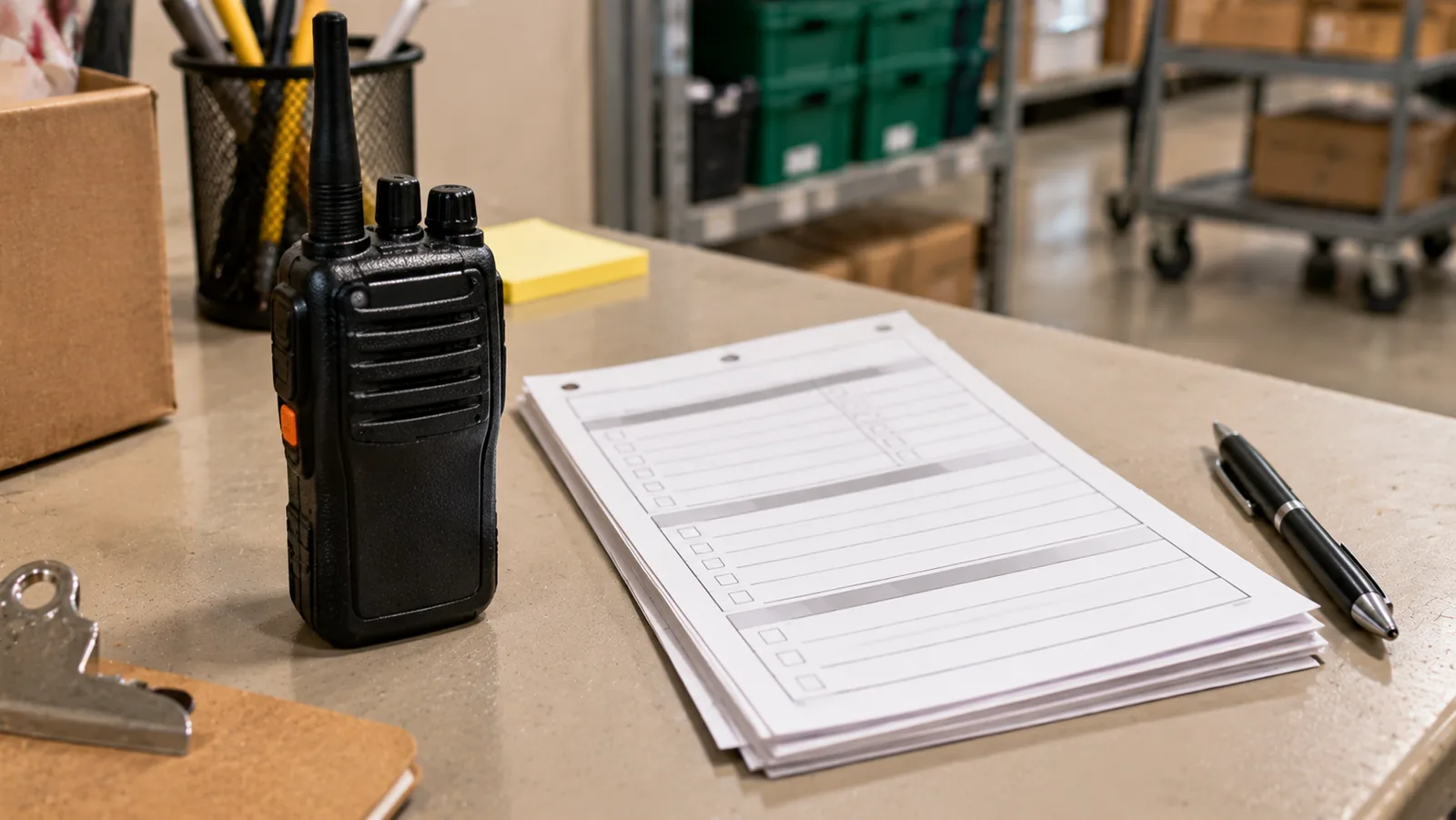
What a log feature might mean
- The timestamp, which might mark when a task was assigned, opened, completed or synced to a server.
- A checkmark beside "aisle 9 inspected," which might mean a walk down the whole aisle or a glance from the endcap.
- Native data, where Rule 196.4 applies: your lawyer must specifically request electronic data and name the form, and the other side produces what's reasonably available in the ordinary course of business. S6
In a hypothetical, the log shows aisle 9 inspected at 1:00 p.m., video shows a stocker passing the end of the aisle at 1:02, and you fall at 1:10.
| Before calling the entry false, your lawyer asks | What the answer can change |
|---|---|
| Do the camera clock and the log clock match? | The timeline may shift by minutes. |
| What event creates the 1:00 timestamp? | The entry may have been keyed in later for earlier work, so the next question is how that practice was documented. |
| Does the location code cover the spot where you fell? | If not, the entry may prove nothing about it. |
| Could the stocker on video see the floor past a pallet of bottled water? | The pass-by may not have been an inspection at all. |
A verified mismatch can point to a weak inspection or a missing witness, and that's often worth more than an accusation.
| Case | What the Texas Supreme Court said |
|---|---|
| H-E-B, LP v. Peterson, No. 24-0310 (Tex. Apr. 10, 2026) | Leaks elsewhere in the store didn't show how long the puddle in the toy aisle had been there, and internal policies don't raise the standard of care. S21 |
| What that means for your file | A written sweep policy leads to records and witnesses, but it doesn't show what happened on your afternoon. |
How do you ask for video and texts?
By camera, channel and time; the surveillance video guide covers export and timing problems.
What the request names
- Camera numbers, the export itself, retention settings and the software needed to play the file, for video.
- The employees likely to have texted or radioed about the spill, and the half hour around the fall, for texts and radio messages.
- The attachments and what each status code means, for work orders.
Your lawyer keeps a production log of missing attachments, files that won't open, date gaps and conflicting versions.
A gap found (hypothetical) and the next step
- A page stamped Bates 000214 mentions a photo that isn't in the set, so a focused question to the other side comes first.
- If the question doesn't fix it, Rule 191.2 requires a discovery motion to certify that a reasonable effort to resolve the dispute failed. S6
What is a corporate deposition?
It's a deposition of the company itself, and Rule 199.2(b)(1) requires the notice to describe the matters "with reasonable particularity." S6
- The company designates one or more people to testify about what's known or reasonably available to it (Texas Rule 199.2(b)(1)). S6
- Federal court uses a similar but separate notice that adds a duty to confer about the topics (Federal Rule 30(b)(6)). S11
A notice labeled "corporate representative" with no real topics doesn't do the job, and neither does a topic asking about every safety practice at every store for 20 years.
Topics for a hypothetical dairy-case fall, and why each is specific enough
- The aisle 14 sweep from 2:00 to 2:30 p.m. and how it was marked done (one aisle, one half hour).
- Camera retention settings, and any export or search after the report (one system and one event).
- Complaint and repair tickets for that refrigerated case (one unit, in order: the complaint process, the ticket, the response and any recurrence).
- Who handled damaged or returned goods near that aisle (one job near one spot).
The designee usually testifies from preparation, not memory, so your lawyer asks which records, people and systems informed each answer.
- If the witness isn't prepared on a proper topic, the record should show what was asked and what's still unanswered, and an incomplete answer may call for follow-up without justifying every sanction requested.
- When the answer is that the freezer was running fine, water can still sit on the floor, and a freezer can run warm without a drop on the tile.
How does Mohammadi shape the questions?
It splits one question into several: product handling, the floor, what employees knew and how fast they responded.
| Case | What happened | What the court held |
|---|---|---|
| Albertsons, LLC v. Mohammadi, 689 S.W.3d 313 (Tex. 2024) (per curiam) | The claimant worked at a Wells Fargo inside a Houston Randalls and slipped by a cart where an employee had put leaking items. | The wet floor, not the leaking products, was the relevant danger, and knowing the products leaked wasn't knowing about the puddle; invitee status was assumed without deciding it. S15 |
| Johnson v. Tom Thumb Stores, Inc., 771 S.W.2d 582 (Tex. App.—Dallas 1989, writ denied) | A glass light fixture in a common-area sidewalk was the hazard, and the lease gave the landlord control. | The court affirmed a directed verdict for Tom Thumb and sent the landlord claim back for a new trial. S16 |
Ask about the facts before asking a witness to agree with a legal phrase like "actual knowledge." For an entrance fall, Johnson is the reason to request the lease covering that location, not every lease the company holds.
Questions for the employee who moved the damaged goods, and what each pins down
- "Where was the cart parked?" for the spot.
- "What could you see on the floor under it?" for the floor, apart from the products.
- "Who did you tell, and what did you do next?" for knowledge and response time.
What do you have to hand over?
Discovery runs both ways: you'll answer written questions, produce records and sit for your own deposition.
- Keep your photos, posts and texts, along with your medical and work records.
- If a request seems too broad, tell your lawyer instead of deleting anything, because an objection or protective order can handle an improper request.
- To prepare for your deposition, review the incident report and anything you've said before with your lawyer.
- In the room, answer from memory, say when you're estimating and ask to hear a long question again.
- Don't accept a premise you disagree with.
- Describe your limits as they are, not as "I couldn't do anything," and don't play down earlier treatment or deny activity your records show.
When does summary judgment collide with discovery?
Deadlines don't wait for discovery fights, and an open request doesn't push back a response date by itself.
- For motions filed on or after March 1, 2026, amended Rule 166a sets a 21-day response and a 7-day reply "except on leave of court or agreement of the parties." S17
- When essential facts aren't available, the same rule calls for an affidavit or declaration specifying why those facts can't be presented. S17
- Federal Rule 56 has its own separate requirements. S11
| Rule | What it requires |
|---|---|
| Texas Rule of Evidence 803(6) | |
| Texas Rule of Evidence 803(6) | A business record's foundation can come from a custodian or other qualified witness, or from a Rule 902(10) affidavit served on the other parties at least 14 days before trial. S7 |
Your lawyer keeps an exhibit index with each document's source, custodian, date and the foundation still needed. Ask for big discovery costs to be explained in advance.
Ask your lawyer to report
- What each deposition actually settled, since activity isn't the same as progress.
- Whether a company witness named the right custodian, which can move the case without any admission of fault.
Common questions
Why can't my lawyer just ask for everything?
Courts can limit discovery that's cumulative or costs more than it's worth under Rule 192.4, and huge productions can bury the one record that matters. S6
Will the store manager have to testify?
Possibly, in a personal deposition. The company also designates someone for corporate deposition topics, who may not be the manager. S6
The log says the aisle was checked 10 minutes before I fell. Is my case over?
Not necessarily. Your lawyer finds out what the entry measures, whether it covers your spot and whether video matches it.
Do I have to turn over my social media?
Relevant posts may be requested. Don't delete anything, and talk to your lawyer about scope and privacy.
Talking to a lawyer about your fall
Bring the report number, claims letters, your photos and any records you've received, and ask the Law Firm of Aaron A. Herbert, P.C. how its discovery plan would answer the store's likely notice defense. To start, request a case evaluation or call (214) 200-4878.
Aaron Herbert is Board Certified in Personal Injury Trial Law by the Texas Board of Legal Specialization. You can check it on Aaron Herbert's State Bar of Texas profile. S1
Sources
S6 Texas Rules of Civil Procedure. Read source.
S11 Federal Rules of Civil Procedure and Federal Rules of Evidence. Read source.
S21 H-E-B, LP v. Peterson, No. 24-0310 (Tex. Apr. 10, 2026). Read source.
S7 Texas Rules of Evidence, amendments effective July 2, 2026. Read source.
S15 Albertsons, LLC v. Mohammadi, 689 S.W.3d 313 (Tex. 2024) (per curiam). Read source.
S16 Johnson v. Tom Thumb Stores, Inc., 771 S.W.2d 582 (Tex. App.—Dallas 1989, writ denied). Read source.
S17 Supreme Court of Texas, Misc. Docket No. 26-9012 (amendments to Texas Rule of Civil Procedure 166a). Read source.
S1 Aaron Alan Herbert, State Bar of Texas attorney profile (Board Certified, Personal Injury Trial Law, Texas Board of Legal Specialization). Read source.

ABOUT THE ATTORNEY
Aaron A. Herbert
Founding Attorney
Board Certified in Personal Injury Trial Law
Aaron founded The Law Firm of Aaron A. Herbert in 2010 to focus on developing each client's case and seeking its maximum value. For over a decade, he has represented people seriously injured in major accidents and industrial catastrophes, pursuing trial verdicts and settlements while working to reduce the stress of litigation.
Education
- Texas A&M University · B.S., Criminal Justice, 1999
- University of Oklahoma College of Law · J.D., 2002; graduated in the top of his class
Trial experience & approach
Aaron earned numerous jury verdicts at boutique personal injury litigation firms. According to his biography, he spent a year as the top-earning litigation attorney at a firm that frequently appeared in verdict searches as having one of the highest numbers of trial wins in Texas. At another Dallas personal injury firm, he moved from managing pre-litigation attorney to managing litigation attorney over seven years as the firm grew into one of Dallas's largest personal injury firms.
His biography describes a reputation as one of America's most aggressive trial lawyers, with noteworthy recoveries from judges and juries and substantial pretrial settlements. Most of those settlements included confidentiality agreements requested by the defense. Aaron has said the recoveries were justified by the injuries and losses involved, which no amount of money could make someone choose to experience.
His approach combines passion, preparation, persistence and courtroom imagination. He believes a well-supported, engaged and motivated team working cooperatively helps deliver strong representation, with the goal of achieving the best possible result for every client.
Dallas roots, military service & publication
Born and raised in Dallas, Aaron enlisted in the United States Marine Corps after high school and later received an Honorable Discharge. He completed his university and law degrees after his military service and became a lifelong Sooners football fan in law school.
Publication: “Litigating Dog Bite Cases,” Texas Dog Law Seminar, Dallas, 2009.
Professional affiliations & recognition
Professional affiliations and recognition listed in Aaron’s biography:
- State Bar of Texas
- American Bar Association
- Association of Trial Lawyers of America (now American Association for Justice)
- Texas Trial Lawyers Association
- Dallas Trial Lawyers Association
- Dallas Bar Association
- Tarrant County Bar Association
- Million Dollar Advocates Forum
- The National Trial Lawyers – Top 100 Trial Lawyers