
The short answer
Hire an expert only when a disputed question needs specialized knowledge that a photo, a receipt or a store employee can't supply. In Texas state court, the opinion also has to be reliable, tied to the facts of your fall and disclosed on time. The Tom Thumb and Albertsons injury knowledge hub and the litigation guide cover the rest of the case.
What an expert can't do
- A floor-safety specialist, who can't fill a hole in the proof of what the store knew about the spill.
- An economist, who can't invent work restrictions your doctor never wrote down.
Start with the one disputed question
Write the question in plain words first, because each one calls for a different person.
The question in your case
- Was the tile in front of the dairy case slick under spilled milk?
- Did a curled mat corner stick up far enough to catch a sandal?
- Did the fall tear your rotator cuff, or flare up a shoulder that was already worn?
- Can you still lift 50-pound cases on a warehouse dock?
Who might answer each, in the same order.
- A floor-safety specialist.
- An engineer.
- A physician.
- A vocational expert.
"Prove the store was negligent" isn't an assignment. It invites an expert to wander into legal conclusions that belong to the judge and jury.
Before hiring anyone, ask
- Does the data still exist?
- Is the opinion premature?
- When will the expert explain the limits?
- Is an expert needed at all?
Why each matters, in the same order.
- A friction test on clean tile next spring, which says little about melted ice the day you fell.
- A vocational opinion, which can't start until your surgeon writes down restrictions.
- Before you spend real money, not after designation.
- A clear phone photo and an eyewitness, which may settle where the spill was, and your treating orthopedist, who may explain the injury.
What a refrigeration or leak expert shows
A refrigeration specialist can explain how water reached the floor, but not who knew about it.
What the expert looks at, and what it can and can't show
- The drain line, defrost cycle or cracked door gasket on a frozen-food case, as a possible source of water on the floor in front of the case.
- Other sources, such as a dropped jug of juice, a mop bucket or melting ice in a cart, which have to be ruled in or out.
- The temperature log, which may describe the ice cream, not the floor.
- A part replaced the week after your fall, which may not behave the way the old one did.
An expert can explain how liquid traveled. A witness, a radio call or a camera still has to show who knew about the puddle and when.
| Case | What happened | What the court held |
|---|---|---|
| Albertsons, LLC v. Mohammadi, 689 S.W.3d 313 (Tex. 2024) (per curiam) | The claimant worked at a Wells Fargo inside a Randalls and slipped in a puddle that formed next to a cart after an employee put leaking items in it. | The wet floor, not the leaking products, was the relevant danger, and knowing the products leaked didn't prove the store knew about the floor. S15 |
What a floor-friction number proves
A friction reading proves only as much as the test behind it.
Before anyone quotes a reading, the expert should tell you
- The instrument and how it was calibrated or checked, such as the calibration record for the tester used.
- The exact spot tested, such as the tile at the third freezer door.
- What was on the surface and what footwear or test pad was assumed, such as spilled dish soap versus dry tile.
- The test date and what changed since, such as a new floor finish or replaced tile.
- Which questions the test can't answer, such as conditions that can't be recreated.
Keep the raw readings and the test conditions. A number with four decimal places can still miss the point if it came from dry tile.
Claims about a standard, and how to treat them
- "The industry standard sets this threshold," which needs the reminder that an industry standard isn't the law and that your lawyer decides whether it applies and what legal weight it carries.
- "This coefficient means Tom Thumb broke the law," which means the expert has gone too far.
When does an engineer or human factors expert help?
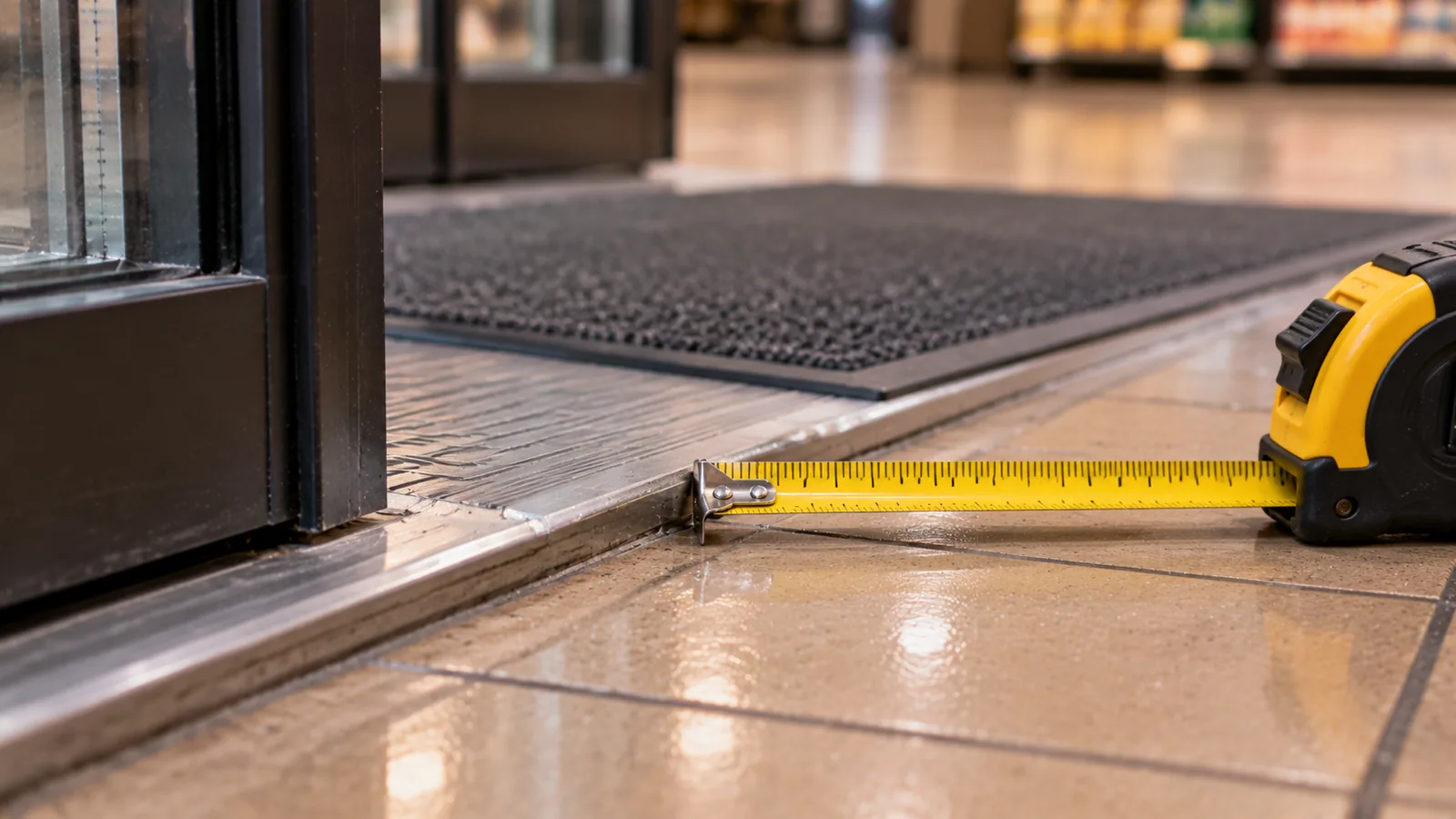
An engineer helps with measurable questions, and a human factors expert helps with what a shopper could see.
What the expert needs for each question
- The layout as it was that day, for the height of a threshold lip, since a measurement after a remodel may describe a different aisle.
- Older store photos and employee memories of later changes, for how far a pallet base stuck into the aisle.
- The display as it stood that day, for whether an end-cap display was stable.
- Camera angle, lens distortion and scale, with each dimension marked measured, estimated or assumed, for photogrammetry or a diagram.
- The jurisdiction, the version and the provision, for a building or accessibility code, and a code gap doesn't automatically create a damages claim.
- Clear liquid on glossy white tile under bright panels, seen from a shopper's position rather than a photo above the spill, for lighting, sight lines and contrast.
No expert should claim to know what a particular witness must have seen. Location can matter as much as measurement.
| Case | What happened | What the court held |
|---|---|---|
| Johnson v. Tom Thumb Stores, Inc., 771 S.W.2d 582 (Tex. App.—Dallas 1989, writ denied) | A shopper fell on a glass light fixture set into a common-area sidewalk, and the lease gave the landlord control there. | The court affirmed a directed verdict for Tom Thumb, the tenant, and reversed and remanded the claim against the landlord. S16 |
| What that means for experts | An engineer's report on that fixture wouldn't have answered who controlled the sidewalk. | The lease and maintenance records did. |
Do you need a video or digital specialist?
Usually only when clocks, exports or file integrity are genuinely disputed, and the surveillance video guide covers how footage gets saved.
Tools and steps
- The store records custodian.
- A hash value.
- Enhancement.
- A processing log.
What each can show, in the same order.
- How the camera system works, often making a specialist unnecessary.
- The file hasn't changed since it was collected.
- A brighter view of what's already in the frame.
- Every step taken, with the original kept and slowed or enhanced copies labeled.
What each can't show, in the same order.
- Anything outside the system's records.
- That the camera caught the whole event or that its clock matched the receipt stamped 4:12 p.m.
- New detail that isn't in the original.
- Precise force calculations for a human fall from a narrow camera view.
Medical and money experts work in a chain
Each medical and money expert builds on the one before, so a weak first link weakens everything after it.
What each expert works from
- Your baseline records, including the unhelpful ones, for the physician.
- The doctor's restrictions, for the vocational expert.
- The vocational opinion, for the economist.
- A medical recommendation for each future service, for the life-care planner.
What each has to explain, in the same order.
- Diagnosis, causation, prognosis and treatment kept separate, and why an earlier condition doesn't account for the injury, since "the pain started after the fall" shows timing, not cause.
- What work you can still do.
- The income lost.
- Frequency, duration and a cost source for each item.
Here's a hypothetical: you trip on a curled entrance mat on a rainy morning, had shoulder trouble two years earlier and can't go back to your warehouse job. The mat was thrown away, and your old records are incomplete.
| Question in the hypothetical | Who might answer it | What has to come first |
|---|---|---|
| How was the mat curled that morning? | Witnesses, then an engineer if needed | Your phone photos and the store's incident report. |
| Is the shoulder injury new or an aggravation? | A treating or retained physician | Records from before and after the fall. |
| What work can you still do? | Physician, then a vocational expert | Written restrictions from the physician. |
| What income did you lose? | An economist, if needed | A vocational opinion built on those restrictions. |
| Why the order matters | Hiring the economist first wouldn't settle whether the shoulder restrictions came from the fall, and testing a different mat wouldn't show how the original sat. | This hypothetical isn't a Tom Thumb or Albertsons case or a description of anyone's practice. |
What the Texas rules require
In Texas state court, the rules of evidence and two Texas Supreme Court cases set the test for expert opinions. S7
What the rules of evidence say
- A witness qualified by knowledge, skill, experience, training or education may give an opinion if it will help the jury understand the evidence or decide a fact (Texas Rule of Evidence 702).
- An expert may rely on facts or data that experts in the field reasonably rely on, even if those facts aren't themselves admissible (Rule 703).
- An opinion may touch an ultimate issue, but no expert should tell jurors what the law requires or announce that the store had legal notice (Rule 704).
- The other side may question the expert about the underlying data outside the jury's hearing, and an opinion is inadmissible without a sufficient factual basis (Rule 705).
| Rule or case | What it says |
|---|---|
| E.I. du Pont de Nemours & Co. v. Robinson, 923 S.W.2d 549 (Tex. 1995) | Rule 702 requires expert testimony to be relevant and reliable, with factors like testing, error rate and peer review. N1 |
| Gammill v. Jack Williams Chevrolet, Inc., 972 S.W.2d 713 (Tex. 1998) | Those requirements apply to all expert testimony, and a court may find too great an analytical gap between the data and the opinion. N2 |
In Gammill, an engineer was qualified to discuss seat belts, but his opinions weren't tied reliably to his observations, and summary judgment for the defendants was affirmed.
Timing and forum rules
- Unless the court orders otherwise, the side seeking relief designates experts 90 days before discovery ends and the other side 60 days before (Texas Rule of Civil Procedure 195.2). S6
- Rule 195.5 lists what gets disclosed, and a treating doctor who isn't retained is handled differently from a hired expert.
- A retained expert's changed opinions must be supplemented, so new video or records can legitimately change an opinion, while an unexplained switch hurts credibility (Rule 195.6).
- In federal court, Federal Rule of Evidence 702 and federal procedure apply instead and need their own review. S11
What will experts cost you?
Ask your lawyer why each expert is needed, what question the opinion could settle and what it may cost.
Cost questions
- Are expenses advanced, reimbursed or affected by the outcome?
- What is the expert being paid?
- Who pays when the store deposes my expert?
Where each answer comes from, in the same order.
- Your actual written agreement, which you should have before major work starts.
- Rule 195.5(a)(4)(E), which makes a retained expert's compensation part of the disclosure. S6
- Rule 195.7, under which the side that deposes the other side's retained expert generally pays that expert's reasonable deposition fees.
More experts don't make a claim stronger.
Experts each type of claim may need
- Possibly no retained expert, for a sprained wrist with undisputed treatment.
- A doctor, a vocational expert and an economist, for a contested claim for permanent restrictions.
Common questions
The store hired an expert. Do I need one too?
Your lawyer may test the store's expert through cross-examination and its own data, especially a later dry-floor test, so not always.
Can my own doctor testify instead of a hired expert?
On diagnosis and treatment, often yes. A causation opinion and its disclosure depend on the records and the rules.
Can an expert say the store knew about the spill?
An expert can explain where liquid came from, but proof of what employees knew comes from witnesses, records and video, so no.
What if the floor has been replaced since I fell?
An expert can still work from photos, maintenance records and witness accounts, but should say plainly which conclusions the missing floor limits.
Talking to a lawyer about your fall
Gather your photos, treatment records and work schedule, and see the first 72 hours guide if your fall was recent. To talk with the Law Firm of Aaron A. Herbert, P.C., request a case evaluation or call (214) 200-4878.
| Credential | Where to check it |
|---|---|
| Board Certified in Personal Injury Trial Law by the Texas Board of Legal Specialization | Aaron Herbert's State Bar of Texas profile S1 |
Sources
S1 Aaron Alan Herbert, State Bar of Texas attorney profile (Board Certified, Personal Injury Trial Law, Texas Board of Legal Specialization). Read source.
S6 Texas Rules of Civil Procedure. Read source.
S7 Texas Rules of Evidence, amendments effective July 2, 2026. Read source.
S11 Federal Rules of Civil Procedure and Federal Rules of Evidence. Read source.
S15 Albertsons, LLC v. Mohammadi, 689 S.W.3d 313 (Tex. 2024) (per curiam). Read source.
S16 Johnson v. Tom Thumb Stores, Inc., 771 S.W.2d 582 (Tex. App.—Dallas 1989, writ denied). Read source.
N1 E.I. du Pont de Nemours & Co. v. Robinson, 923 S.W.2d 549 (Tex. 1995) Read source.
N2 Gammill v. Jack Williams Chevrolet, Inc., 972 S.W.2d 713 (Tex. 1998) Read source.

ABOUT THE ATTORNEY
Aaron A. Herbert
Founding Attorney
Board Certified in Personal Injury Trial Law
Aaron founded The Law Firm of Aaron A. Herbert in 2010 to focus on developing each client's case and seeking its maximum value. For over a decade, he has represented people seriously injured in major accidents and industrial catastrophes, pursuing trial verdicts and settlements while working to reduce the stress of litigation.
Education
- Texas A&M University · B.S., Criminal Justice, 1999
- University of Oklahoma College of Law · J.D., 2002; graduated in the top of his class
Trial experience & approach
Aaron earned numerous jury verdicts at boutique personal injury litigation firms. According to his biography, he spent a year as the top-earning litigation attorney at a firm that frequently appeared in verdict searches as having one of the highest numbers of trial wins in Texas. At another Dallas personal injury firm, he moved from managing pre-litigation attorney to managing litigation attorney over seven years as the firm grew into one of Dallas's largest personal injury firms.
His biography describes a reputation as one of America's most aggressive trial lawyers, with noteworthy recoveries from judges and juries and substantial pretrial settlements. Most of those settlements included confidentiality agreements requested by the defense. Aaron has said the recoveries were justified by the injuries and losses involved, which no amount of money could make someone choose to experience.
His approach combines passion, preparation, persistence and courtroom imagination. He believes a well-supported, engaged and motivated team working cooperatively helps deliver strong representation, with the goal of achieving the best possible result for every client.
Dallas roots, military service & publication
Born and raised in Dallas, Aaron enlisted in the United States Marine Corps after high school and later received an Honorable Discharge. He completed his university and law degrees after his military service and became a lifelong Sooners football fan in law school.
Publication: “Litigating Dog Bite Cases,” Texas Dog Law Seminar, Dallas, 2009.
Professional affiliations & recognition
Professional affiliations and recognition listed in Aaron’s biography:
- State Bar of Texas
- American Bar Association
- Association of Trial Lawyers of America (now American Association for Justice)
- Texas Trial Lawyers Association
- Dallas Trial Lawyers Association
- Dallas Bar Association
- Tarrant County Bar Association
- Million Dollar Advocates Forum
- The National Trial Lawyers – Top 100 Trial Lawyers