
A hanger near where you landed doesn't prove the hanger tripped you. A measured lip on a threshold doesn't prove a code violation. Trip cases are won on the actual object, how your foot met it, who controlled it and what the store knew.
What a trip claim has to show
- The object or surface that caused the trip, shown by photos, the object itself and witnesses.
- How contact happened, shown by your account of what you felt and saw.
- Who controlled the area, shown by store, landlord, vendor or contractor records.
- Notice and duty under Texas premises law, shown by reports, timing and inspection records.
This guide uses hypothetical hazards. It doesn't claim any Ross store has these conditions. It's part of the Ross Dress for Less injury knowledge hub; the Ross slip and fall litigation guide covers the full case.
Why does the path to the fall matter more than where you landed?
Because the final position only shows the end. The approach shows the cause.
Reconstruct
- Direction of travel.
- What you carried.
- Lighting and merchandise.
- The catch.
- Before and after.
Questions to answer, in the same order
- Where were you coming from and heading?
- Bags, a basket, a child or a cart?
- What could you see on the floor?
- Which foot, and what did it feel like?
- What was visible, and what changed?
You can remember a sudden catch without having seen the object. Keep that difference. Don't let anyone fill in a visual detail you never saw.
Things that move
- A rack can shift during a fall or cleanup, so its final spot may not be where it was.
- A mat can fold when a foot slides across it, so a fold may be a result, not the cause.
- Staff may tidy the area, so ask witnesses what changed.
Medical proof is separate. A wrist fracture from bracing can happen in many kinds of falls. It doesn't identify a hanger, a rack or a threshold. A doctor can address the injury; other evidence has to show what caused the loss of balance.
How do you prove a hanger or small object caused the trip?
By identifying the object carefully and connecting it to contact. Small items are easy to misidentify.
Step
- Photograph it.
- Record it, if it's kept.
- Don't take store property.
- Link it to contact.
How, in the same order
- Shape, size, color and location, without handling it more than needed.
- Write down who collected it and how it was stored.
- Counsel can arrange preservation and inspection properly.
- Who saw the shoe catch, versus who saw the hanger afterward.
Video may show movement, but image quality can limit what it identifies. A blurry shape shouldn't become "the hanger" because that fits the theory.
| Knowledge question | Why it still matters |
|---|---|
| When did the object appear? | Timing drives constructive notice. |
| Did an employee drop or see it? | That can show actual knowledge. |
| Is the area just busy? | A busy department doesn't prove notice of every dropped item. |
The Ross notice and inspections article (coming to this hub) explains how timing and employee proximity are tested.
What matters when a rack or display base causes the trip?
The base's size and position, your approach and who set it up. A display that looks obvious from one angle can be hidden from another.
Document
- Rack dimensions and base projection.
- Placement in the aisle.
- Your line of approach.
- Camera position.
A tip for each, in the same order
- Use a tape measure in the frame.
- Shoot wide and close.
- Take a photo at your eye level from where you came.
- Note it so the view can be repeated.
A close-up can make a base look bigger. A distant view can hide it. Use both.
| Was the rack moving? | Likely theory |
|---|---|
| Yes, someone was pushing it | A claim about that activity and the person doing it. |
| No, it was left in the aisle | A premises-condition claim about the display. |
The pleading should follow the evidence. Interchangeable negligence labels don't get around a hard element.
Who placed the display, and what to check
- A store employee, checked through layout records or photos for that date.
- A vendor, checked through service or merchandising records.
- Another customer, checked through witnesses and video.
A layout diagram may not match the accident date. A seasonal reset can make a later inspection look very different from what you walked into.
What about entrance mats and floor coverings?
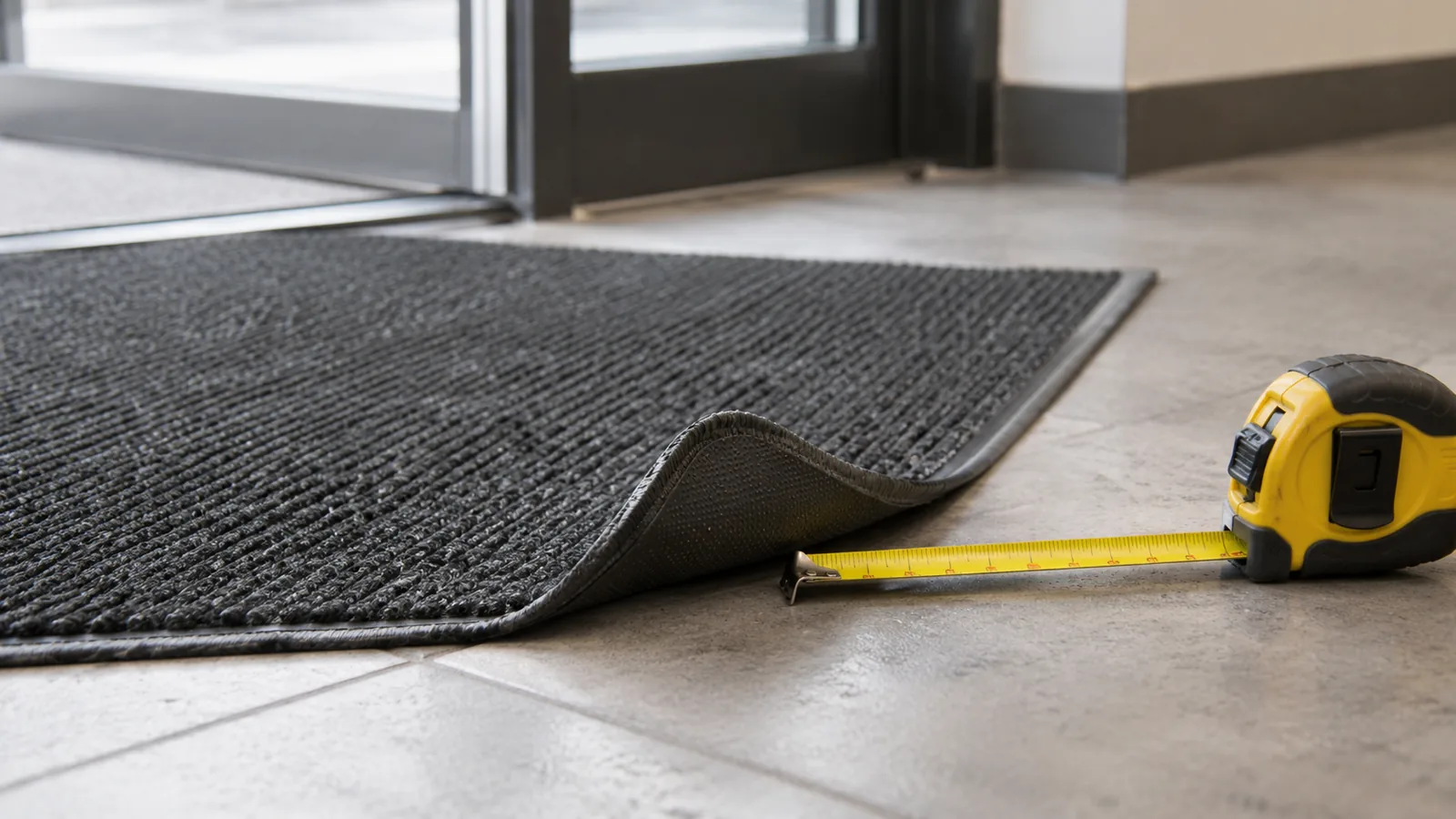
Pin down the actual mat problem. A curled edge, an overlap, worn backing and a wet surface are different mechanisms.
Possible mat issue
- Curling or a raised edge.
- Overlap with another mat.
- Position near doors or transitions.
- Wet mat.
What to record, in the same order
- Height and location of the curl.
- Which mat was on top.
- How the door swing or floor change interacts.
- Weather, tracking and how wet.
Find out whether the mat was already out of place or moved during the fall. Don't fold every possible defect into one accusation.
What each record can and can't show
- A mat service agreement shows who supplied and maintained the mat, not that they caused the hazard.
- A replacement after the fall doesn't prove the condition before it on its own.
- An earlier complaint is useful if it's the same mat and problem.
Testing has limits. A different mat tested later may not match the original's friction, backing or wear. If the original is gone, the expert should say what can still be evaluated.
How are thresholds and floor transitions measured?
With a proper method, a scale in the photo, and the date and location recorded. Then check whether anything changed since.
| Do | Why |
|---|---|
| Measure the height or gap with a level tool. | A tilted ruler can mislead. |
| Include context and a scale. | Shows where the change sits. |
| Note repairs or seasonal changes. | The surface may not be the same now. |
| Keep raw measurements and images. | Others can check the work. |
Codes need care. A code argument requires the actual provision, its adoption and applicability and the facts that trigger it. An accessibility standard doesn't automatically create a private injury claim or prove negligence per se.
Exterior area
- Shopping-center sidewalk.
- Store entrance.
- Parking lot.
Who may be responsible, in the same order
- Owner, tenant or contractor, by contract and practice.
- Tenant or landlord, depending on the lease.
- Often the landlord or a management company.
Ownership records don't settle maintenance duties alone. The Ross filing and defendants article (coming to this hub) explains why the store sign is only a starting point.
A worked example: the rack base
This is a hypothetical. A shopper catches a shoe near a rack base. A photo after the fall shows the base sticking out eight inches past the clothing. A witness says the rack moved during the response. A later inspection measures six inches, after the merchandise was rearranged.
| Observation | Possible value | What needs checking |
|---|---|---|
| Eight-inch projection in the photo | Post-fall scene | Scale, angle, and whether the rack moved. |
| Witness account | Change during the response | Position, timing, and what they actually saw. |
| Six-inch later measurement | Current setup | Whether it matches the accident date. |
| Shoe-contact account | Mechanism | What was felt or seen. |
Don't average the two numbers into a "seven-inch defect." The job is to establish the configuration at the time of the fall and how reliable each source is. Then the question is whether that projection created an unreasonable risk under Texas law.
For shoppers
- Keep every photo, even the unflattering ones.
- A "worse" photo may explain a discrepancy.
For practitioners
- An expert can address geometry; fact disputes go to the factfinder.
- Selective preservation removes context you may need.
Does it matter whether you could have seen the hazard?
Yes, but visibility has to be proved, not assumed. It depends on contrast, lighting, your approach, obstructions and what drew your attention.
| Assumption | Why it can be wrong |
|---|---|
| "It's bright orange, anyone would see it." | A staged photo may not match normal shopping conditions. |
| "I didn't see it, so it was hidden." | Not noticing doesn't prove concealment. |
Two legal questions sit here. In Austin v. Kroger, the Texas Supreme Court described a general rule that there's no duty to warn about open and obvious or known hazards, subject to two limited exceptions. Chapter 33 then governs how fault is shared. [S13] [S12]
| Doctrine | What it decides |
|---|---|
| Open and obvious (duty) | Whether a duty existed at all, with limited exceptions such as necessary use. |
| Proportionate responsibility (Chapter 33) | How fault is divided. Over 50 percent bars recovery; otherwise damages are reduced by your share. |
If you did see the obstruction, ask why you took that route and whether there was a reasonable alternative. Give an accurate answer. Preferring the shortest route isn't the same as necessary use.
When does a trip case need an expert?
When a technical question needs a reliable answer: dimensions, test methods or a standard. Not just to say the store was negligent.
Expert task
- Define the question.
- Inspect promptly.
- Keep the record.
- Destructive testing.
Good practice, in the same order
- What exactly needs answering, with what data.
- With proper access and notice.
- Calibration, test conditions and raw readings.
- Arranged through counsel.
A candid expert may say a later inspection can't resolve the accident-day condition. That's worth knowing before spending on an opinion that won't hold up. The Ross expert witnesses article (coming to this hub) covers qualifications and challenges. [S7]
Frequently asked questions
A hanger was next to me after I fell. Is that enough?
Not by itself. You need evidence it caused the trip and that the store knew or should have known.
The rack was moved after I fell. Is my case ruined?
No. Witnesses and early photos can show the original position.
Should I take the hanger home?
Don't take store property. Photograph it and let a lawyer handle preservation.
What should I do first?
See what to do in the first 72 hours.
Talk to a lawyer about a trip and fall
Aaron A. Herbert is Board Certified in Personal Injury Trial Law by the Texas Board of Legal Specialization. His State Bar of Texas profile lists it. That credential doesn't mean any rack, mat or threshold was defective, and the firm claims no Ross-specific result. [S1]
| Ask the firm | Bring |
|---|---|
| How would you prove what caused the trip? | Store address and date |
| How would you look into notice? | Photos and witness names |
| Would an expert be worth the cost? | Medical records you have |
Tell us about your case to The Law Firm of Aaron A. Herbert, P.C., or call (214) 200-4878.
Sources
| Ref. | Source | Type |
|---|---|---|
| [S1] | Official profile for Aaron Alan Herbert | State Bar of Texas |
| [S7] | Texas Rules of Evidence | Effective July 2, 2026 |
| [S12] | Texas Civil Practice and Remedies Code, Chapter 33 (proportionate responsibility) | Texas statute |
| [S13] | Austin v. Kroger Texas, L.P., 465 S.W.3d 193 (Tex. 2015) | Texas Supreme Court |

ABOUT THE ATTORNEY
Aaron A. Herbert
Founding Attorney
Board Certified in Personal Injury Trial Law
Aaron founded The Law Firm of Aaron A. Herbert in 2010 to focus on developing each client's case and seeking its maximum value. For over a decade, he has represented people seriously injured in major accidents and industrial catastrophes, pursuing trial verdicts and settlements while working to reduce the stress of litigation.
Education
- Texas A&M University · B.S., Criminal Justice, 1999
- University of Oklahoma College of Law · J.D., 2002; graduated in the top of his class
Trial experience & approach
Aaron earned numerous jury verdicts at boutique personal injury litigation firms. According to his biography, he spent a year as the top-earning litigation attorney at a firm that frequently appeared in verdict searches as having one of the highest numbers of trial wins in Texas. At another Dallas personal injury firm, he moved from managing pre-litigation attorney to managing litigation attorney over seven years as the firm grew into one of Dallas's largest personal injury firms.
His biography describes a reputation as one of America's most aggressive trial lawyers, with noteworthy recoveries from judges and juries and substantial pretrial settlements. Most of those settlements included confidentiality agreements requested by the defense. Aaron has said the recoveries were justified by the injuries and losses involved, which no amount of money could make someone choose to experience.
His approach combines passion, preparation, persistence and courtroom imagination. He believes a well-supported, engaged and motivated team working cooperatively helps deliver strong representation, with the goal of achieving the best possible result for every client.
Dallas roots, military service & publication
Born and raised in Dallas, Aaron enlisted in the United States Marine Corps after high school and later received an Honorable Discharge. He completed his university and law degrees after his military service and became a lifelong Sooners football fan in law school.
Publication: “Litigating Dog Bite Cases,” Texas Dog Law Seminar, Dallas, 2009.
Professional affiliations & recognition
Professional affiliations and recognition listed in Aaron’s biography:
- State Bar of Texas
- American Bar Association
- Association of Trial Lawyers of America (now American Association for Justice)
- Texas Trial Lawyers Association
- Dallas Trial Lawyers Association
- Dallas Bar Association
- Tarrant County Bar Association
- Million Dollar Advocates Forum
- The National Trial Lawyers – Top 100 Trial Lawyers