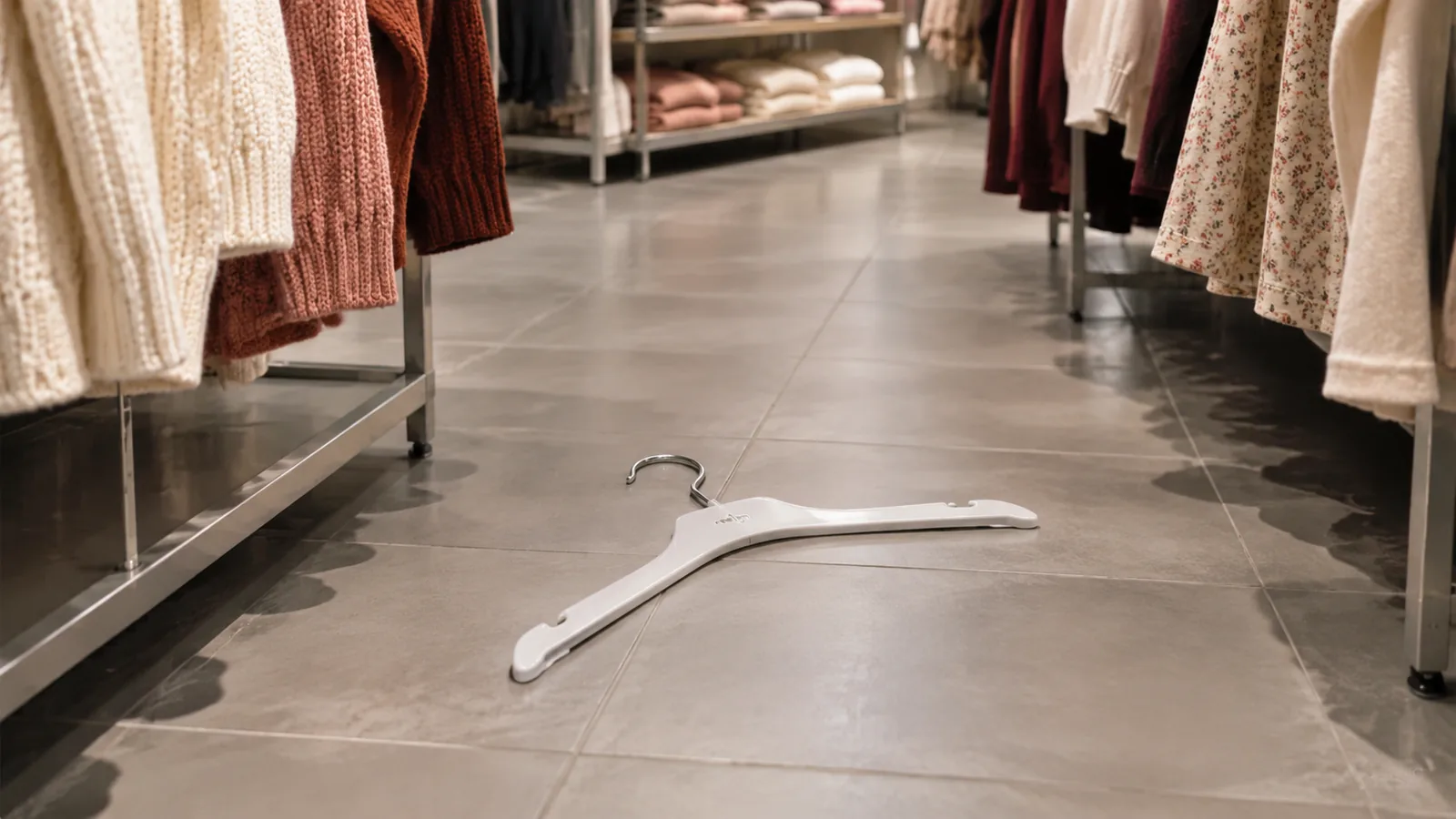
A photo of the spill after you fell shows the hazard. It doesn't show who knew about it, or when. In a Texas premises case against a store such as Ross Dress for Less, that knowledge question often decides whether the claim survives.
To prove Ross knew, you need one of two things. Actual notice usually comes from evidence that someone reported the specific hazard to an employee before the fall. Constructive notice comes from evidence that the hazard was on the floor long enough that employees reasonably should have found it. An employee standing nearby is not enough without proof of time.
Did anyone report this hazard before the fall? A report can show actual notice.
How long was the hazard there? Time on the floor is the usual route to constructive notice.
Could an employee reasonably have found it? Proximity alone is not enough.
What do the inspection records really mean? An entry or a gap can be misread either way.
This guide is part of the Ross Dress for Less injury knowledge hub. It doesn't claim that any Ross policy or practice exists; it explains how notice gets investigated. For the full case framework, see the Ross slip and fall litigation guide.
Does a photo of the hazard prove the store knew about it?
No. A photo shows that a condition existed after the fall. Knowledge is a separate question, and the same picture can fit several explanations.
What the photo shows
- Liquid on the floor after the fall.
Possible explanations (hypothetical)
- A shopper who spilled it seconds earlier.
- An employee who had already been told about it.
- A recurring source, such as a leak, that keeps producing it.
The other evidence decides which explanation holds up. Texas Supreme Court cases such as Reece and Spates say that an employee working near the spot doesn't, by itself, show the store should have found the hazard. There has to be some evidence of how long it was there. No fixed statewide number of minutes makes every spill actionable. [S2]
| For shoppers | For practitioners |
|---|---|
| A lawyer asks whether anyone saw the hazard before you fell. That isn't doubting your injury. | Connect the specific condition, its timing and a reasonable chance to discover it. |
| Keep a witness's real account, even if they can only give a time range. | Don't treat "worked near the aisle" as the whole notice case. |
How do you prove actual notice?
Actual notice usually comes from a report: someone told an employee about this hazard, at this spot, before the fall. Build that chain link by link.
Link in the chain
- Who saw it first.
- Who they told.
- What was said.
- When.
- What happened next.
What to pin down, in the same order
- Name, position and what they saw.
- The employee, and whether it reached someone responsible.
- The exact words, not a later summary.
- Time anchors such as a text, a call log or a receipt.
- The response, if any.
An attributed statement needs a foundation. "Someone mentioned water earlier" is worth following up, but it leaves the speaker, the place and the timing open. It is not an admission that a manager ignored this spill for an hour.
| Competing account | How to test it |
|---|---|
| "That report was about the restroom leak." | Ask for records showing where the reported leak was. |
| The witness can't say which employee they told. | Keep that limit in the file. Don't fill it in. |
| Two people describe a warning differently. | Look for an independent source that ties both to the same hazard. |
How do you prove the hazard was there long enough?
Constructive notice turns on time. Start with the earliest reliable sighting of the specific condition and the last reliable view before the fall, then test everything in between.
| Time anchor | What it can and can't show |
|---|---|
| A text or photo timestamp | When it was sent, which may differ from when the person first saw the hazard. |
| A receipt | When a purchase rang up, not when the shopper passed the aisle. |
| A camera timestamp | Only what the camera could see, and only if its clock is right. |
| A work order | When it was logged, not always when the problem began. |
A dropped hanger is easier to track on video than clear liquid, but both need checking. Confirm the object stayed in the same place and wasn't picked up and replaced. If a cart or display blocks the view, the blocked minutes are unknown. Don't describe them as proof of uninterrupted presence.
| Inspection record | Careful reading |
|---|---|
| An entry at 2:00 p.m. | It may mark the start, the finish or a later data entry. Ask how the system works. |
| No entry for an hour | It raises documentation questions. By itself it doesn't prove no one walked the floor. |
| A completed entry | It doesn't conclusively prove the inspection was adequate. |
A worked example with conflicting evidence
Here is a hypothetical. A shopper falls at 5:30 p.m. A witness says a hanger had been in the aisle "for a while." The last logged inspection is at 5:10 p.m. Video shows the aisle at 5:15, but a cart blocks the floor until 5:24. At 5:25, an object appears where the fall happens.
| Lead | Verification needed | What stays uncertain |
|---|---|---|
| Witness saw a hanger. | The original account and an independent time anchor. | What "for a while" means. |
| Inspection at 5:10. | What the entry means, the route and who did it. | Whether the hazard was there then. |
| Object visible at 5:25. | Identity, position and image clarity. | Whether it's the object involved. |
| Cart blocking the view. | The full view and any other cameras. | What happened from 5:15 to 5:24. |
On this record, the evidence may support five observed minutes, not twenty. New facts change the picture in either direction.
New fact (hypothetical), and its effect on the notice theory
- Another camera shows a customer dropping the hanger at 5:24, so the time on the floor shrinks.
- An employee message reports the same hanger at 5:12, so a separate actual-notice route opens.
Neither fact should be buried because it complicates the first theory. A practitioner explains why the proved interval matters here, given how visible the hazard was and what was happening around it. A shopper should know that the result depends on proof, not on how bad the fall was.
Can a store's inspection policy prove notice?
Not on its own. A written procedure can point you to the people, records and reporting channels that may hold proof, but the policy itself doesn't establish knowledge of this hazard.
Question about the policy, and why to ask it
- Which version applied at this store on this date, since a policy found online may not have governed the location.
- Whether training slides, checklists and practice match, since differences need testimony and not assumptions.
- Who was assigned to the area, since that identifies witnesses.
An internal policy doesn't automatically define the legal duty. A missed check may matter, but only if you can tie it to what a reasonable inspection would have found, and when. Not every departure from a manual is its own cause of action.
Focused request: records for the interval, the staff and the system tied to the fall. Distracting request: every safety document the company has nationwide.
The Ross discovery and depositions article (coming to this hub) covers how to request those records.
What about a hazard that keeps coming back?
A recurring source, such as a leak, a display that won't stay put or a mat that keeps sliding, is worth investigating. It doesn't prove the store knew about this condition on this day.
Evidence, and how to use it
- Maintenance requests and repair records, to check location, mechanism and timing against the fall.
- Earlier reports of the same problem, to confirm they describe the same spot and cause.
- A spill at a different store, which is usually not evidence of knowledge here.
- Rainfall and roof repair history for an alleged leak, to ask who controlled the roof and the response.
An old repair doesn't prove the leak was active on the incident date. A repair just before or after the fall may lead to witnesses and a source worth testing. The theory still has to meet the law: knowledge of an unreasonable risk and its link to the injury. A general claim that store floors get cluttered is no substitute.
How should witnesses be interviewed about timing?
Separate what each witness saw from what they assumed or heard later. Ask open questions first, before you offer any timeline.
Ask about, and why
- Where they stood and what they faced, because a person facing away may know an employee arrived but not whether the floor was checked.
- Lighting, distance and obstructions, because these limit what they could see.
- Where a time estimate came from, because it may come from a family conversation and not memory.
- Any earlier statements, to spot later influence before a deposition.
At deposition
- Uncertain answers, with "I'm not sure" left in the record instead of a forced yes or no.
- Exhibits, with each witness tied to specific documents and dates.
- Software fields, with questions about what a code means put to the system witness, since a store manager may not know.
Turning notice evidence into a motion and trial record
Keep an element chart. For each item of notice evidence, list what it proves and what stands in the way of using it.
Column in the chart, with an example entry (hypothetical)
- Evidence, such as an employee text at 5:12 p.m.
- Element supported, such as actual notice.
- Authentication, such as who can identify the message.
- Hearsay issues, such as the statement's purpose and any exception.
- Inference sought, such as that the store knew about the hanger 18 minutes before the fall.
A demand letter can describe a lead. A summary judgment response has to rest on evidence the court can consider. [S6] [S7]
Rule 166a (2026 text), and what it means for notice proof
- The response deadline is 21 days after the motion is filed, unless the court grants leave or the parties agree.
- If evidence is still missing, file an affidavit or declaration saying why the facts can't be presented yet.
- As a practical step, track down missing employees and earlier video before any motion arrives.
At trial
- On the timeline, label verified events and unknown periods, and don't draw a solid line between two separate sightings.
- With witnesses, show exactly what supports each conclusion, and don't stretch an estimate into a precise time.
Frequently asked questions
An employee was standing nearby. Isn't that enough?
Usually not. Texas cases require some evidence of how long the hazard was there.
I don't know how long the spill was on the floor. Do I still have a case?
Possibly. Say so honestly; investigation may find video, reports or records that answer it.
The store says it inspected the aisle. Does that end it?
No. The entry's meaning, route and timing can be tested.
How fast should I preserve video?
Right away. See preserving Ross surveillance video.
Talk to a lawyer about the notice question
Aaron A. Herbert is Board Certified in Personal Injury Trial Law by the Texas Board of Legal Specialization. His State Bar of Texas profile lists it. [S1]
How would you look into who knew about the hazard? A useful answer names sources: reports, video, staff and records.
What would change your view of the case? A useful answer points to specific evidence, good or bad.
Does a nearby employee prove it? No promise. It depends on timing proof.
Bring, with notes
- Store address and date, from a receipt if you have one.
- Photos and witness names, as originals.
- Claim letters or emails, meaning everything the insurer sent.
- What you don't know, saying so if you can't tell how long the hazard was there.
Tell us about your case to The Law Firm of Aaron A. Herbert, P.C., or call (214) 200-4878.
Sources
| Ref. | Source | Type |
|---|---|---|
| [S1] | Official profile for Aaron Alan Herbert | State Bar of Texas |
| [S2] | Wal-Mart Stores, Inc. v. Reece, 81 S.W.3d 812 (Tex. 2002); Wal-Mart Stores, Inc. v. Spates, 186 S.W.3d 566 (Tex. 2006) | Texas Supreme Court |
| [S6] | Texas Rules of Civil Procedure, including Rule 166a | Current Texas Judicial Branch compilation |
| [S7] | Texas Rules of Evidence | Effective July 2, 2026 |

ABOUT THE ATTORNEY
Aaron A. Herbert
Founding Attorney
Board Certified in Personal Injury Trial Law
Aaron founded The Law Firm of Aaron A. Herbert in 2010 to focus on developing each client's case and seeking its maximum value. For over a decade, he has represented people seriously injured in major accidents and industrial catastrophes, pursuing trial verdicts and settlements while working to reduce the stress of litigation.
Education
- Texas A&M University · B.S., Criminal Justice, 1999
- University of Oklahoma College of Law · J.D., 2002; graduated in the top of his class
Trial experience & approach
Aaron earned numerous jury verdicts at boutique personal injury litigation firms. According to his biography, he spent a year as the top-earning litigation attorney at a firm that frequently appeared in verdict searches as having one of the highest numbers of trial wins in Texas. At another Dallas personal injury firm, he moved from managing pre-litigation attorney to managing litigation attorney over seven years as the firm grew into one of Dallas's largest personal injury firms.
His biography describes a reputation as one of America's most aggressive trial lawyers, with noteworthy recoveries from judges and juries and substantial pretrial settlements. Most of those settlements included confidentiality agreements requested by the defense. Aaron has said the recoveries were justified by the injuries and losses involved, which no amount of money could make someone choose to experience.
His approach combines passion, preparation, persistence and courtroom imagination. He believes a well-supported, engaged and motivated team working cooperatively helps deliver strong representation, with the goal of achieving the best possible result for every client.
Dallas roots, military service & publication
Born and raised in Dallas, Aaron enlisted in the United States Marine Corps after high school and later received an Honorable Discharge. He completed his university and law degrees after his military service and became a lifelong Sooners football fan in law school.
Publication: “Litigating Dog Bite Cases,” Texas Dog Law Seminar, Dallas, 2009.
Professional affiliations & recognition
Professional affiliations and recognition listed in Aaron’s biography:
- State Bar of Texas
- American Bar Association
- Association of Trial Lawyers of America (now American Association for Justice)
- Texas Trial Lawyers Association
- Dallas Trial Lawyers Association
- Dallas Bar Association
- Tarrant County Bar Association
- Million Dollar Advocates Forum
- The National Trial Lawyers – Top 100 Trial Lawyers