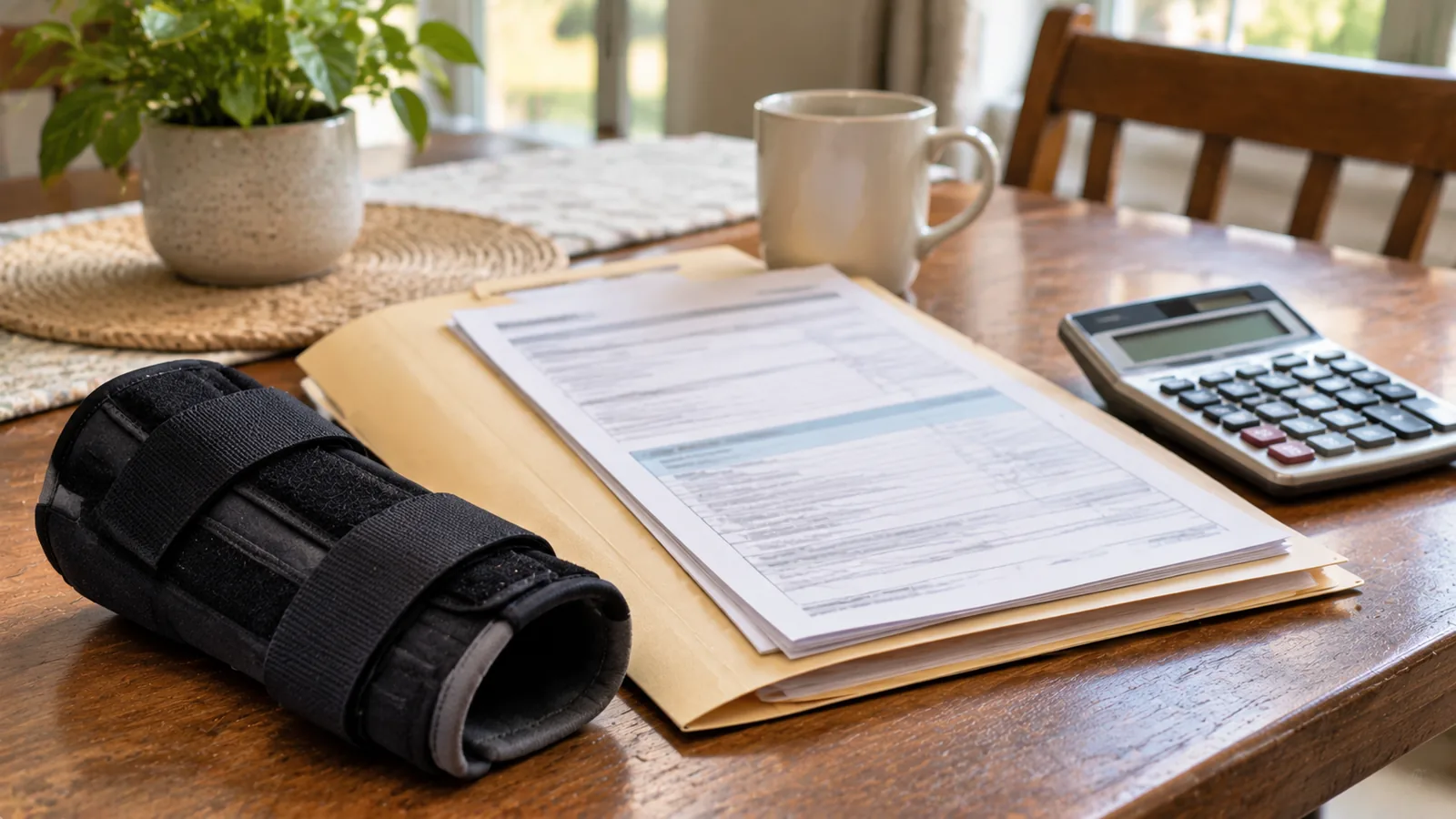
What is a Ross fall case worth? Nobody can answer that honestly on the first call. Value depends on proof that the fall caused the injury, proof of each type of loss, the strength of the liability evidence and what you keep after fees and costs.
Common beliefs
- "The bills prove the case."
- "There's a standard multiplier."
- "A bad injury means a big settlement."
- "The gross number is what I get."
What actually drives value, in the same order
- Bills show services. Causation needs its own proof.
- There isn't one. This guide uses no Ross average.
- A serious injury can still sit on weak liability proof.
- Fees, expenses and reimbursements come out first.
This guide is part of the Ross Dress for Less injury knowledge hub. Liability, the other half of value, is covered in the Ross slip and fall litigation guide.
Why does your medical history before the fall matter?
It sets the baseline. Without it, nobody can say what the fall changed.
What to collect for the timeline
- Earlier records and symptoms from before the fall, and how you functioned then.
- First complaints and ER or urgent care notes from right after.
- The treatment course in the weeks after, with restrictions and changes.
An old condition and a new aggravation can exist together. On the other hand, symptoms that start after a fall aren't automatically caused by it.
In the records
- "Patient reports pain after a fall"
- An X-ray or MRI finding
- A doctor's reasoned opinion on cause
What each is, in the same order
- Your history, as written down
- An objective finding
- A professional causation opinion
Tell your lawyer and doctor about earlier back pain or other problems. Hiding them causes credibility trouble that's far worse than the old condition.
What's the difference between diagnosis, causation and prognosis?
Each answers a different question, and one doctor may be better placed on one than another.
- Diagnosis, for what the condition is
- Causation, for whether the fall caused or worsened it
- Prognosis, for the expected course
- Treatment plan, for what care is proposed and why
Don't collapse these into "I need surgery because of Ross." Give the doctor an accurate account of the fall. If you aren't sure how you fell, say so; an opinion built on a guessed mechanism is easy to attack.
For a proposed treatment, ask about
- The clinical basis, because future care has to be supported
- The alternatives, which show the choice was medical
- When it would happen, because that affects future damages
- What would change the plan, which keeps the estimate honest
The lawsuit should never drive the medical care.
How are medical bills proved in Texas?
By the amount actually paid or incurred, not just the billed charge. Section 41.0105 of the Texas Civil Practice and Remedies Code limits recovery of medical expenses to the amount actually paid or incurred by or on your behalf. [S8]
| Ledger column | Example entry (hypothetical) |
|---|---|
| Provider and date | Orthopedic clinic, May 4 |
| Billed charge | $2,400 |
| Adjustment | $1,100 |
| Payments | $1,000 |
| Balance | $300 |
| Source document | Itemized statement, page 2 |
Section 18.001 is a separate tool. An affidavit under that section can be enough evidence that a charge was reasonable or a service necessary, unless it's properly controverted. The statute says the affidavit is not evidence of causation. Check the current deadlines before relying on it. [S9]
Two workstreams and what each proves
- Billing proof (18.001, 41.0105), to show reasonable, necessary, paid or incurred amounts.
- Medical causation proof, to show that the fall caused the treated injury.
A spreadsheet organizes proof. It doesn't make the records admissible.
How is lost income documented?
With records that tie the injury to actual lost work, not a general "couldn't work."
| If you're an employee | Gather |
|---|---|
| Schedules and payroll | Shifts missed and pay lost |
| Paid leave used | Kept separate from unpaid loss |
| Work restrictions | Tied to your actual job duties |
| Employer contact | Someone who can confirm it |
A temporary lifting limit isn't the same as being unable to work at all. Say which one the records support.
Records to gather if you're self-employed
- Revenue and income history, for the baseline.
- Replacement labor costs, for what you paid others.
- Canceled jobs or contracts, for specific losses.
A slow month can have other causes. A reliable number explains the baseline and why the fall made the difference. Future earning capacity may need medical, vocational and economic evidence; an economist can run numbers, but a doctor has to supply the restriction.
How do you show pain and daily limits?
With specific, honest examples. Concrete changes persuade more than absolute claims.
Vague
- "I can't do anything."
- "My life is ruined."
- "I'm in pain all the time."
Specific, in the same order
- "Grocery shopping takes twice as long, and I need help with the bags."
- "I stopped coaching my daughter's team this season."
- "I wake up two or three times a night."
A family member can describe what they've seen, such as help you now need, without offering a medical prognosis. Pain, mental anguish, impairment and disfigurement can be separate questions; avoid counting the same loss twice.
A damages request needs an evidence-based reason under Texas law. The store's size doesn't measure your harm, and an unrelated verdict isn't a benchmark.

A worked example: the wrist fracture
This is a hypothetical.
- A shopper breaks a wrist and works restricted duty for eight weeks.
- The shopper is later told more therapy is recommended.
- The original bills total $30,000, but payment and balance records are incomplete.
- The employer confirms some missed shifts; payroll shows paid leave for others.
Where the evidence stands, by category
| Category | Evidence available | Work still needed |
|---|---|---|
| Medical expenses | Original invoices | Payments, adjustments, balances |
| Past income | Employer letter | Payroll, leave, restrictions |
| Future therapy | A recommendation | Likelihood, amount, reasonable cost |
| Daily limits | Client and family accounts | Specific examples, consistency |
There's no "three times the bills" rule that turns $30,000 into $90,000. Liability may be disputed, recoverable expenses may differ and future care may be uncertain. This is a teaching example, not a Ross result or a description of how the firm values cases.
Is settlement value the same as a trial award?
No. A settlement trades the risk of trial for agreed terms, so it weighs things a verdict form doesn't.
| Settlement factor | Example |
|---|---|
| Liability proof | A short, unproved hazard duration |
| Medical causation | A disputed prior condition |
| Cost and time | More experts, more months |
| Appeal risk | A close legal issue |
| Your priorities | Certainty now versus a later trial |
Keep liability and damages separate in your thinking. Published opinions and selected verdicts aren't a complete record of Ross claims, and confidential settlements limit what any public average could show. No win percentage is offered here.
What will you actually take home?
The net amount, after the fee, case expenses and any valid reimbursement claims. Ask for a written estimate early and updates as things change.
| Illustration only | Amount |
|---|---|
| Gross settlement (assumed) | $90,000 |
| Fee (assumed, not the firm's terms) | −$30,000 |
| Case expenses (assumed) | −$6,000 |
| Resolved reimbursement (assumed) | −$9,000 |
| Net to client | $45,000 |
A different contract, lien or settlement changes the math. Find out which reimbursement claims are asserted, which are enforceable and which are still open.
| When the prognosis changes | Do |
|---|---|
| New restrictions or care | Update the valuation and note the date. |
| Improvement | Update it too. |
| Unresolvable uncertainty | Name it before you decide. |
Minors, public benefits or structured settlements may need specialized advice.
Frequently asked questions
| Question | Short answer |
|---|---|
| What's the average Ross fall settlement? | No reliable public average exists, and this guide doesn't use one. |
| Will my old injury hurt my case? | It needs careful handling, not hiding. Aggravation can be compensable. |
| Do my full medical bills count? | Texas limits recovery to amounts actually paid or incurred. |
| Why can't my lawyer give me a number now? | The evidence isn't complete yet. A range comes later, with stated assumptions. |
Talk to a lawyer about your injury
Aaron A. Herbert is Board Certified in Personal Injury Trial Law by the Texas Board of Legal Specialization. His State Bar of Texas profile lists it. [S1]
Ask the firm
- How would you prove the fall caused this injury?
- Which experts might be needed?
- What would I likely net?
- What could lower the value?
Bring
- Treatment records you have.
- Earlier records, if any.
- Work details and pay records.
- Photos and insurer letters.
Tell the firm about gaps in care, earlier symptoms and anything you've signed. Tell us about your case to The Law Firm of Aaron A. Herbert, P.C., or call (214) 200-4878.
Sources
- [S1] Official profile for Aaron Alan Herbert, State Bar of Texas.
- [S8] Texas Civil Practice and Remedies Code, Chapter 41, including Sec. 41.0105, Texas statute.
- [S9] Texas Civil Practice and Remedies Code, Chapter 18, including Sec. 18.001, Texas statute.

ABOUT THE ATTORNEY
Aaron A. Herbert
Founding Attorney
Board Certified in Personal Injury Trial Law
Aaron founded The Law Firm of Aaron A. Herbert in 2010 to focus on developing each client's case and seeking its maximum value. For over a decade, he has represented people seriously injured in major accidents and industrial catastrophes, pursuing trial verdicts and settlements while working to reduce the stress of litigation.
Education
- Texas A&M University · B.S., Criminal Justice, 1999
- University of Oklahoma College of Law · J.D., 2002; graduated in the top of his class
Trial experience & approach
Aaron earned numerous jury verdicts at boutique personal injury litigation firms. According to his biography, he spent a year as the top-earning litigation attorney at a firm that frequently appeared in verdict searches as having one of the highest numbers of trial wins in Texas. At another Dallas personal injury firm, he moved from managing pre-litigation attorney to managing litigation attorney over seven years as the firm grew into one of Dallas's largest personal injury firms.
His biography describes a reputation as one of America's most aggressive trial lawyers, with noteworthy recoveries from judges and juries and substantial pretrial settlements. Most of those settlements included confidentiality agreements requested by the defense. Aaron has said the recoveries were justified by the injuries and losses involved, which no amount of money could make someone choose to experience.
His approach combines passion, preparation, persistence and courtroom imagination. He believes a well-supported, engaged and motivated team working cooperatively helps deliver strong representation, with the goal of achieving the best possible result for every client.
Dallas roots, military service & publication
Born and raised in Dallas, Aaron enlisted in the United States Marine Corps after high school and later received an Honorable Discharge. He completed his university and law degrees after his military service and became a lifelong Sooners football fan in law school.
Publication: “Litigating Dog Bite Cases,” Texas Dog Law Seminar, Dallas, 2009.
Professional affiliations & recognition
Professional affiliations and recognition listed in Aaron’s biography:
- State Bar of Texas
- American Bar Association
- Association of Trial Lawyers of America (now American Association for Justice)
- Texas Trial Lawyers Association
- Dallas Trial Lawyers Association
- Dallas Bar Association
- Tarrant County Bar Association
- Million Dollar Advocates Forum
- The National Trial Lawyers – Top 100 Trial Lawyers