A fatal truck crash can involve the driver, the carrier, and the shop that kept the rig running, but each one's role has to be proved.
Short answer
Usually, yes. When the driver was working, the trucking company can be on the hook for the driver's mistakes, and it can be sued for its own hiring, supervision, or maintenance failures too. Your family still has to show that a specific failure was a substantial factor in the death. The Texas Supreme Court made that point in a 2025 case, discussed below.
Who might be responsible for the crash?
More than one company can share the blame, and each theory needs its own proof:
- The driver, for negligent driving such as speeding for conditions, fatigue, or phone use. The driver's conduct has to have caused the crash and the death.
- The motor carrier that employed the driver, for the employee's negligence on the job. The driver must have been an employee acting within the scope of employment.
- The carrier for its own conduct, such as negligent hiring, training, supervision, or entrustment. That's a company failure, separate from the driving, that helped cause the crash.
- The owner, lessor, or maintenance shop, for poor inspection or repair of brakes, tires, lights, or coupling. The defect has to have existed before the crash and played a part in it.
- The loader or shipper, if cargo was loaded or secured in a way that made the truck unstable.
The name painted on the door may belong to a company that leased the tractor to someone else. Dispatch records, lease papers, and the driver's pay stubs show who actually employed the driver and who owned the trailer. Our article on who is liable in a Texas truck accident covers these relationships.
Key point: The spouse, children, and parents bring the wrongful death claim under § 71.004 of the Civil Practice and Remedies Code. The estate keeps a survival claim under § 71.021 for the injuries your loved one suffered before death. The wrongful death claim must be filed within two years of the date of death under § 16.003(b).
Which records can disappear first?
Some of the most useful proof sits on someone else's server or in someone else's yard, and the clocks start running right away.
| Record | Who usually holds it | Why speed matters |
|---|---|---|
| Electronic logging device (ELD) data and supporting documents. | The motor carrier. | Federal rules require carriers to keep them for six months under 49 C.F.R. § 395.8(k). |
| Inspection, repair, and maintenance records. | The carrier or whoever maintains the equipment. | They must be kept for one year, and for six months after the vehicle leaves the carrier's control, under § 396.3(c). |
| Engine control module and event data. | Stored in the tractor until it's downloaded or overwritten. | A tractor repaired or returned to service may lose event data. |
| Dashcam video and fleet telematics. | The carrier or its vendor. | Vendors often delete footage on a rolling schedule. |
| The tractor, trailer, and load. | Insurers, tow yards, or the owner. | Repairs, salvage, or a sale can destroy physical evidence. |
The six-month ELD window can close before a family has even sorted out the funeral bills.

A preservation letter puts companies on notice, but it doesn't give anyone the right to enter a private yard or take the truck. Access may take an agreement, discovery, or a court order.
Here's how that plays out in one made-up case. A tractor-trailer rear-ends a stopped SUV at dusk, killing a 34-year-old father.
- His family suspects worn brakes. The question is whether the brakes were worn before the crash and lengthened the stopping distance, or whether the impact did the damage.
- The carrier says the SUV cut in front of the truck. Video, ELD timestamps, and engine data can back up that story or contradict it.
See what ELD records can prove in a Texas truck accident for how logbook data is read.
Which safety rules matter in a fatal crash?
Three sets of federal rules come up again and again in fatal truck cases. Go back to the SUV crash above:
- If the driver had been behind the wheel past his hours, the hours-of-service rules in 49 C.F.R. part 395 apply. Most carriers record those hours on an ELD under § 395.8(a).
- If he'd been nodding off, § 392.3 bars driving while fatigue or illness impairs alertness, and it bars the carrier from requiring or permitting it.
- If the brakes were worn, § 396.3 requires the carrier to systematically inspect, repair, and maintain the vehicles it controls.
A violation matters only if it connects to how the crash happened. A logbook error from last month won't prove a case about a tire blowout.
How does Texas HB 19 change a truck trial?
Under § 72.052, a defendant can ask for a two-phase trial. The jury decides fault and compensatory damages first, then exemplary damages in a second phase. The motion is due by the 120th day after the defendant's answer, or 30 days after a pleading adds a claim against it, so expect this decision early in the case.
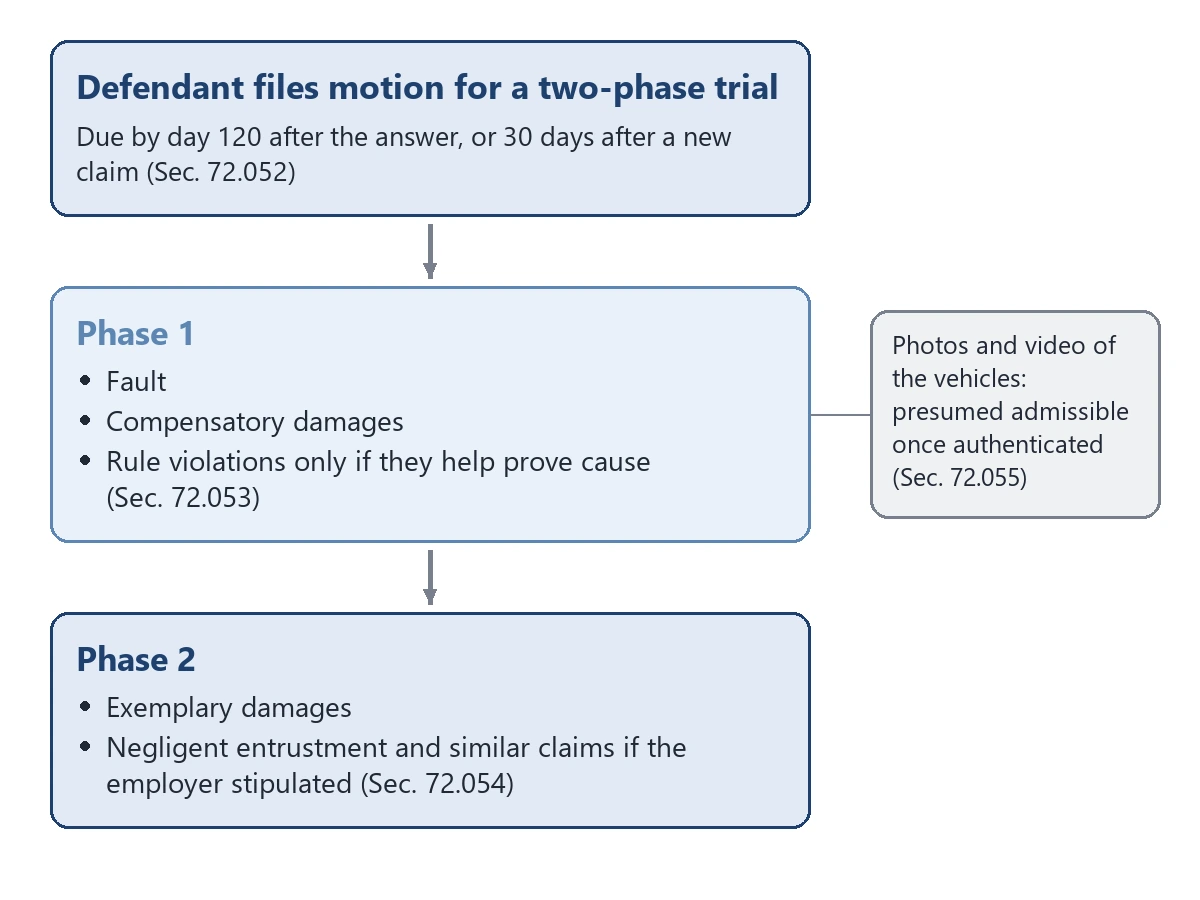
Three other HB 19 rules change what the jury hears in phase one:
- An employer can stipulate under § 72.054 that the driver was its employee acting in the scope of employment. Claims like negligent entrustment then usually wait for the second phase, with listed exceptions for regulated carriers.
- Under § 72.053, evidence of a regulation violation comes in during the first phase only if it tends to prove proximate cause and the rule is specific and applies. The link between the violation and the death has to be shown.
- Photos and video of the vehicles are presumed admissible once authenticated under § 72.055. No expert is required just to admit them.
The listed exceptions in § 72.054(c) include driving while disqualified, under an out-of-service order, or in violation of the hours-of-service rules. Our guide to HB 19 and commercial truck lawsuits explains the statute in more depth.
What did Werner v. Blake decide about cause?
In Werner Enterprises, Inc. v. Blake, a pickup driving too fast on an icy interstate lost control, crossed a 42-foot median, and hit an 18-wheeler. One occupant was killed. The truck was going below the speed limit, but the plaintiffs proved it was too fast for the ice, and the jury found the carrier and driver liable.
The Texas Supreme Court held that the pickup's crossing into oncoming traffic was the sole proximate cause and rendered judgment for the defendants. Proof that the crash wouldn't have happened "but for" the truck's speed wasn't enough. The truck's conduct must be a substantial factor, not a mere happenstance of place and time. Chief Justice Blacklock wrote for five justices, and three dissented in part, so the decision is binding Texas law on proximate cause.
Frequently asked questions
Does a big trucking company mean a bigger recovery? Not by itself. The proof and the insurance decide that, and a truck crash can involve several policies with different limits.
Should we talk to the carrier's insurer? You can refer the adjuster to your lawyer. Recorded statements and releases can affect the claim.
What if the driver is charged with a crime? A criminal case doesn't stop the civil claim under § 71.006. The civil case has its own proof and deadlines.
Is a passenger in the truck covered by HB 19? Usually not as a claimant, unless the passenger was an employee of the owner, lessor, lessee, or operator under § 72.051(3).
You can find related guides in the Texas Truck Accident Litigation Knowledge Hub and the Texas truck accident litigation guide.
Legal sources
- Tex. Civ. Prac. & Rem. Code ch. 71
- Tex. Civ. Prac. & Rem. Code § 16.003
- Tex. Civ. Prac. & Rem. Code ch. 72, subch. B
- 49 C.F.R. parts 392, 395, and 396
- Werner Enterprises, Inc. v. Blake, No. 23-0493 (Tex. June 27, 2025)
This article is general information about Texas law, not legal advice about a particular case. Results depend on the facts, the evidence, the court and the law that applies. Reading it does not create an attorney-client relationship.
Families who need grief programs, funeral and survivor benefit help, or a needs assessment can use our Wrongful Death and Family Support Center.

ABOUT THE ATTORNEY
Aaron A. Herbert
Founding Attorney
Board Certified in Personal Injury Trial Law
Aaron founded The Law Firm of Aaron A. Herbert in 2010 to focus on developing each client's case and seeking its maximum value. For over a decade, he has represented people seriously injured in major accidents and industrial catastrophes, pursuing trial verdicts and settlements while working to reduce the stress of litigation.
Education
- Texas A&M University · B.S., Criminal Justice, 1999
- University of Oklahoma College of Law · J.D., 2002; graduated in the top of his class
Trial experience & approach
Aaron earned numerous jury verdicts at boutique personal injury litigation firms. According to his biography, he spent a year as the top-earning litigation attorney at a firm that frequently appeared in verdict searches as having one of the highest numbers of trial wins in Texas. At another Dallas personal injury firm, he moved from managing pre-litigation attorney to managing litigation attorney over seven years as the firm grew into one of Dallas's largest personal injury firms.
His biography describes a reputation as one of America's most aggressive trial lawyers, with noteworthy recoveries from judges and juries and substantial pretrial settlements. Most of those settlements included confidentiality agreements requested by the defense. Aaron has said the recoveries were justified by the injuries and losses involved, which no amount of money could make someone choose to experience.
His approach combines passion, preparation, persistence and courtroom imagination. He believes a well-supported, engaged and motivated team working cooperatively helps deliver strong representation, with the goal of achieving the best possible result for every client.
Dallas roots, military service & publication
Born and raised in Dallas, Aaron enlisted in the United States Marine Corps after high school and later received an Honorable Discharge. He completed his university and law degrees after his military service and became a lifelong Sooners football fan in law school.
Publication: “Litigating Dog Bite Cases,” Texas Dog Law Seminar, Dallas, 2009.
Professional affiliations & recognition
Professional affiliations and recognition listed in Aaron’s biography:
- State Bar of Texas
- American Bar Association
- Association of Trial Lawyers of America (now American Association for Justice)
- Texas Trial Lawyers Association
- Dallas Trial Lawyers Association
- Dallas Bar Association
- Tarrant County Bar Association
- Million Dollar Advocates Forum
- The National Trial Lawyers – Top 100 Trial Lawyers