
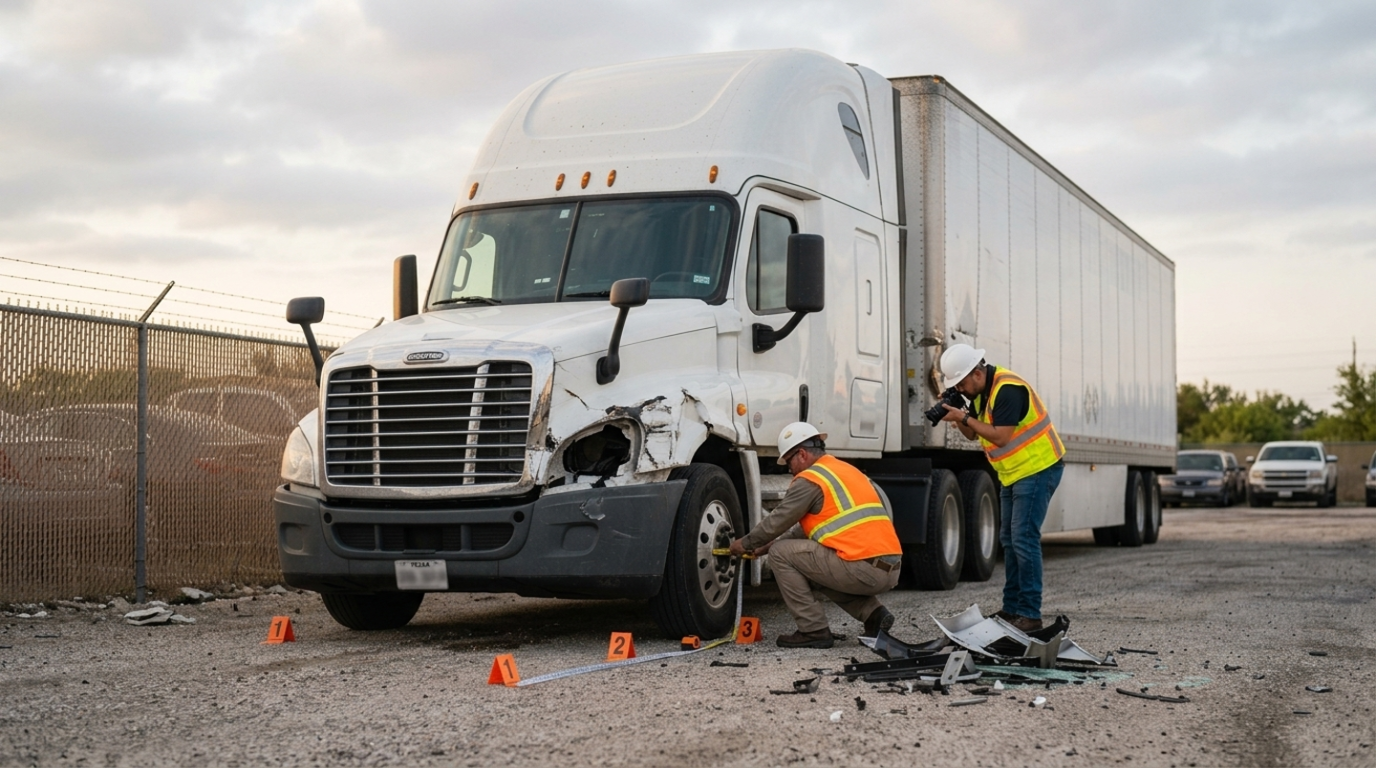
After an 18-wheeler accident in Texas, important evidence should be identified and preserved as early as possible. That can include the tractor and trailer, cargo, damaged components, scene evidence, ELD records, electronic vehicle data, telematics, cameras, driver records, maintenance files, dispatch communications, loading records, medical records, and witness information.
The first question is not simply “What evidence exists?” It is “Who has it, how long might it be retained, what does it prove, and how can it be preserved before it changes or disappears?”
A police report is only one part of that investigation. Trucking companies, vehicle owners, towing facilities, repair shops, electronic-data vendors, shippers, warehouses, and other businesses may control evidence that never appears in the initial crash report.
What Evidence Should Be Preserved?
| Evidence category | What it may establish | Who may control it |
|---|---|---|
| Scene photographs and video | Vehicle positions, roadway conditions, damage, debris, visibility | Injured person, witnesses, investigators, agencies |
| Tractor and trailer | Mechanical condition, damage, component failure, crash sequence | Carrier, owner, tow yard, repair facility |
| ELD records | Duty status, driving periods, edits, supporting documents | Motor carrier, ELD provider |
| ECM/event data | Available vehicle-operation or event information | Carrier, vehicle owner, manufacturer/service provider |
| Telematics/GPS | Route, location, timing and available operational records | Carrier or technology vendor |
| Camera files | Driver activity, roadway events and collision sequence | Carrier, camera vendor, nearby businesses |
| Driver records | Qualification, training, safety and compliance history | Motor carrier |
| Maintenance records | Inspections, defects, repairs and recurring problems | Carrier, owner, repair facility |
| Cargo records | Loading, weight, securement and shipping information | Shipper, loader, warehouse, carrier |
| Medical records | Injury, treatment, prognosis and future needs | Medical providers and claimant |
| Witness evidence | Independent account of the collision and conditions | Witnesses, investigators, attorneys |
The table is a starting point. The evidence that matters depends on the disputed issue and the particular truck, carrier, equipment, and collision.
Physical Evidence: Preserve the Truck, Trailer, Cargo and Damaged Components
Physical evidence can change quickly after a crash.
The tractor and trailer may be towed, repaired, dismantled, sold, or returned to service. Cargo may be unloaded. Damaged parts may be discarded. Securement devices may be replaced.
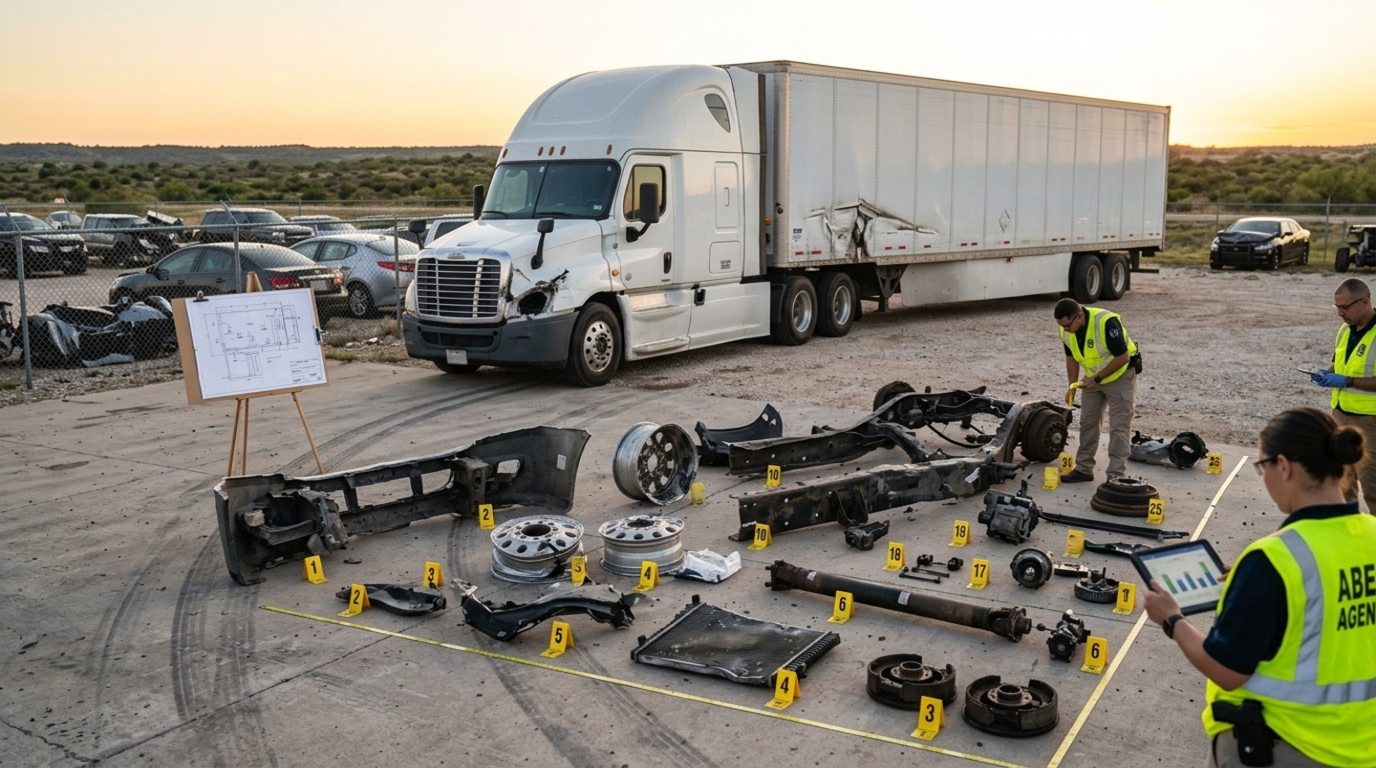
For that reason, preservation should include the tractor, trailer, passenger vehicle, cargo, damaged components, tires, brakes, lighting, coupling equipment, and other parts relevant to the alleged cause of the collision.
Before destructive testing or disassembly, the original condition should be documented with photographs, measurements, identification information, and an appropriate chain-of-custody record.
An inspection should also be coordinated rather than improvised. Counsel may need to arrange an agreed inspection protocol addressing who will inspect the equipment, what testing will occur, whether components can be removed, how photographs and measurements will be taken, and how evidence will be stored afterward.
A claimant does not have the right simply to take possession of another person's truck. If access cannot be arranged voluntarily, counsel may need to pursue discovery or appropriate court relief.
For a broader discussion of the tractor and trailer investigation, see the firm's Advanced Texas Truck Accident Litigation Guide.
Electronic Evidence: ELD, ECM, Telematics and Cameras Are Different
Not every truck has one comprehensive “black box.” Different systems record different information, and the available fields and retention periods vary by equipment.
| System | Potential evidentiary use |
|---|---|
| ELD | Driver duty status and hours-of-service analysis |
| ECM or event data | Available vehicle-operation or event information |
| Telematics/GPS | Route, location, timing and available operational records |
| Cameras | Driver activity, roadway events and the collision sequence |
ELD records
An electronic logging device can provide information about driver duty status and driving periods, including edits and supporting documents.
Under 49 CFR §395.8(k)(1), covered motor carriers must retain records of duty status and supporting documents for six months from the date of receipt.
FMCSA — How long must motor carriers retain records of duty status and supporting documents?
That six-month requirement applies to specified duty-status records. It does not mean that every truck-related electronic record is retained for six months or that litigation preservation ends after six months.
ECM and event data
The engine control module or another onboard system may contain information concerning vehicle operation or a particular event. The available data depends on the truck, model, configuration, system and triggering event.
An investigator should identify the actual hardware before assuming that a particular speed, braking, throttle, or other data field exists.
Telematics and GPS
Fleet-management platforms may provide route, location, alerts, geofencing, messages, timing, or other operational information.
The system's clock should be evaluated before comparing a telematics timestamp with an ELD entry, camera recording, dispatch message, or physical event.
Cameras
Forward-facing, cab-facing, side, rear, trailer, and nearby-business cameras may all matter depending on the collision.
Preserve the native recording when available, together with relevant metadata, export information, player software or viewing instructions, and information about the recording system's retention and overwrite settings.
A screenshot, PDF, or screen recording can be useful for review, but it may not contain all frames, audio, metadata, timestamps, or surrounding context contained in the original file.
For a detailed electronic-evidence discussion, see What Electronic Evidence Must Be Preserved After a Texas Truck Accident?.
How Long Should Truck Accident Evidence Be Preserved?
Regulatory retention periods are useful reference points, but they are not the same thing as litigation-preservation obligations.
| Record | Example retention requirement |
|---|---|
| Records of duty status and supporting documents | Six months from receipt under 49 CFR §395.8(k)(1) |
| Motor-carrier accident register and specified accident reports | Three years after the date of each accident under 49 CFR §390.15(b) |
49 CFR §395.8 — Driver's record of duty status
49 CFR §390.15 — Assistance in investigations and special studies
These are examples of regulatory retention requirements for specified records. They do not establish that every video, photograph, vehicle file, text message, telematics record, maintenance file, or other evidence must be kept for the same period.
Once litigation is reasonably anticipated, the preservation analysis becomes a separate legal issue. A company should not assume that a routine retention schedule resolves its preservation responsibilities simply because the regulatory retention period has expired.
How Is Evidence Actually Preserved?
A preservation effort should be specific.
A useful preservation request should identify, where known:
- Date, time, and location of the crash
- Tractor and trailer identification
- Driver name
- Carrier and vehicle owner
- Relevant trip or shipment
- Electronic systems involved
- Specific time period before and after the collision
- Physical components that should not be repaired or discarded
- Relevant cameras and recording locations
- Custodians or vendors believed to control the evidence
Potential custodians may include the motor carrier, vehicle owner, towing company, repair facility, shipper, warehouse, camera vendor, telematics provider, nearby business, governmental agency, or other third party.
A preservation letter does not automatically provide access to another person's property, and it does not guarantee that the recipient will comply. Counsel may need to follow up, determine what was actually preserved, arrange an inspection, pursue discovery, or seek appropriate court relief.
The firm's Texas Truck Accident Litigation Knowledge Hub provides a broader framework for preservation, vehicle inspection, electronic evidence, spoliation, and discovery.
Why Native Files and Metadata Matter
A printed report or screenshot may show what someone wants you to see. The native file can contain additional information about how the record was created, exported, edited, or stored.
For electronic evidence, investigators should determine:
- What system created the record?
- Who controls the system?
- What device or account generated it?
- What time zone and clock does it use?
- Can users edit the information?
- Is there an audit trail?
- What is the retention or overwrite period?
- Was the file exported from the original system?
- What information was omitted during the export?
This does not mean every electronic record requires forensic examination. The level of investigation should correspond to the issue in dispute.
The goal is to preserve enough information to establish what the record is, where it came from, whether it is complete, and what it actually proves.

Police Reports and Texas Collision Records
A police report can be important, but it should not be treated as the complete record of a commercial truck accident.
Under Texas Transportation Code §550.062, a law enforcement officer investigating a motor vehicle collision must make a written report when the collision resulted in injury or death, or damage to the property of any one person to the apparent extent of $1,000 or more.
Texas Transportation Code §550.062 — Officer's Collision Report
The report can provide an important starting point, but it may not contain the carrier's ELD data, maintenance history, dispatch communications, loading records, native camera files, or other evidence held by private parties.
Preserving the Scene and Reconstructing the Crash
Scene evidence should be preserved before roadway conditions change and physical evidence disappears.
Depending on the collision, relevant material may include:
- Vehicle positions
- Skid or tire marks
- Gouges and debris
- Roadway measurements
- Traffic-control devices
- Lighting and visibility
- Vehicle damage
- Photographs and video
- Witness accounts
- 911 and emergency-response records
- Weather information
- ELD and vehicle data
A reconstructionist may combine physical evidence with electronic records to evaluate speed, braking, perception, reaction, vehicle movement, and other disputed issues.
But reconstruction should not simply accept one data source as the complete truth. ELD, ECM, telematics, camera, phone, dispatch, and physical evidence may use different clocks, record different events, or contain different limitations.
The firm's Advanced Texas Truck Accident Litigation Guide includes a detailed section on forensic crash reconstruction and integrated crash analysis.
Evidence From Maintenance, Cargo and Driver Records
The evidence should follow the suspected cause of the crash.
Maintenance
Potential records include:
- Inspection reports
- Driver vehicle inspection reports
- Work orders
- Repair invoices
- Technician notes
- Parts records
- Diagnostic information
- Recurring defect reports
- Photographs of damaged components
The question is not merely whether the carrier maintained the truck. The investigation should determine whether a particular defect existed before the collision, whether it was detectable, who knew about it, and whether it contributed to the crash.
Cargo and loading
When cargo shifted or fell, preserve:
- Bills of lading
- Weight tickets
- Loading diagrams
- Photographs
- Securement equipment
- Warehouse video
- Loading instructions
- Communications between the shipper, loader, carrier, and driver
The condition of cargo after a crash does not necessarily prove that it was loaded improperly. The investigation must distinguish pre-crash loading conditions from displacement caused by the collision.
Driver records
Driver qualification files, training records, disciplinary records, complaints, ELD information, drug and alcohol testing records, dispatch communications, and other safety records may become relevant depending on the alleged cause of the crash.
What Happens When Evidence Is Missing?
Missing evidence does not automatically prove that the other side was negligent or that a particular fact is true.
The investigation should ask:
- What evidence should have existed?
- Who controlled it?
- What was the applicable retention period?
- When did the party know about the crash or potential claim?
- What preservation steps were taken?
- When was the evidence lost or overwritten?
- Is a backup or substitute source available?
- What prejudice resulted from its absence?
Texas spoliation law requires a fact-specific analysis.
In Brookshire Brothers, Ltd. v. Aldridge, 438 S.W.3d 9 (Tex. 2014), the Texas Supreme Court addressed the trial court's role in determining whether spoliation occurred and the appropriate remedy.
Brookshire Brothers, Ltd. v. Aldridge — Texas Supreme Court
The loss of evidence therefore should be documented carefully rather than treated as automatic proof of liability.
From Preservation to Admissible Proof
Preserving evidence is only the first step.
When electronic evidence is later offered in litigation, the parties may need to establish what the record is, how it was created or obtained, whether it is complete, and whether the person offering it can authenticate it.
Texas Rule of Evidence 901 requires evidence sufficient to support a finding that an item is what its proponent claims it is. Rule 1001 also addresses electronically stored information and accurate readable outputs.
Texas Rules of Evidence — Texas Courts
That is why an evidence file should record the source, custodian, export method, format, relevant metadata, and any limitations known at the time of collection.
What I Would Prioritize in an 18-Wheeler Case
Before deciding which evidence is most important, I would identify the causation question.
If the allegation is fatigue, I would prioritize ELD records, dispatch instructions, trip schedules, communications, rest-related evidence, and the physical reconstruction of the collision.
If the allegation is mechanical failure, I would prioritize the tractor and trailer, component condition, inspection and maintenance records, repair history, diagnostic information, and expert inspection.
If the allegation is distraction, I would investigate camera footage, phone evidence where legally obtainable, dispatch communications, witness accounts, and the driver's activity immediately before the collision.
If the allegation involves cargo, I would preserve the trailer, cargo, securement devices, loading records, photographs, weight information, and warehouse evidence.
That approach is more useful than collecting every possible record without first identifying what the evidence is supposed to prove.

Evidence Checklist After an 18-Wheeler Accident
An early preservation checklist should include:
- Truck and trailer: preserve condition before repair or disassembly.
- Damaged components: identify and preserve parts that may relate to the crash.
- Scene evidence: photographs, measurements, roadway conditions, video and witnesses.
- Electronic data: ELD, ECM/event data, telematics, GPS and cameras.
- Driver records: qualification, training, safety and relevant compliance records.
- Maintenance: inspection, repair, diagnostic and component records.
- Cargo: bills of lading, loading records, weight information and securement evidence.
- Communications: dispatch, driver, carrier, shipper and relevant third-party messages.
- Independent evidence: police, 911, roadway, weather, business surveillance and witness evidence.
- Medical evidence: treatment records, imaging, diagnoses, prognosis and evidence of future needs.
The checklist should be treated as a starting point, not a substitute for a case-specific preservation plan.
Frequently Asked Questions
What evidence should be preserved after an 18-wheeler accident in Texas?
Preserve the truck and trailer, damaged components, scene evidence, ELD records, available vehicle data, telematics, camera files, driver records, maintenance records, cargo and loading records, communications, witness information, police records, and medical evidence that relates to the collision and injuries.
How long must trucking companies keep accident evidence?
There is no single retention period for every type of evidence. For example, covered motor carriers generally must retain records of duty status and supporting documents for six months under 49 CFR §395.8(k)(1), while specified accident records under §390.15 are retained for three years. Other electronic and physical evidence may have different retention schedules, and litigation-preservation duties require a separate analysis.
Can I take possession of the truck after an 18-wheeler accident?
No. A claimant does not automatically have the right to take possession of another person's truck or trailer. An attorney may arrange an inspection, negotiate a preservation agreement, use discovery, or seek appropriate court relief when necessary.
What if the trucking company says the electronic evidence is unavailable?
The investigation should determine what system was used, what its retention period was, whether the evidence was overwritten, who controlled the system, when the company learned of the crash, what preservation steps were taken, and whether another source can establish the same fact. Missing evidence does not automatically prove liability.
What is the difference between ELD, ECM and telematics data?
An ELD primarily concerns driver duty status and hours-of-service records. ECM or event data may contain available vehicle-operation information around a particular event. Telematics may provide location, route, timing, alerts, or other operational information. The actual data available depends on the truck and systems involved.
Why are native electronic files important?
Native files can preserve information that may be lost in screenshots, PDFs, or other converted formats, including metadata, timestamps, audit information, or the original recording context. Whether native production is necessary depends on the particular dispute and evidence.
Does a missing truck accident record automatically mean the trucking company destroyed evidence?
No. The circumstances matter. An investigator should determine whether the record existed, who controlled it, what retention period applied, when litigation was reasonably anticipated, what preservation steps were taken, and whether the loss caused meaningful prejudice.
About Aaron A. Herbert
Aaron A. Herbert has practiced law in Texas since 2002 and has been Board Certified in Personal Injury Trial Law by the Texas Board of Legal Specialization since 2008.
For a serious commercial truck collision, his investigation can involve the physical condition of the vehicles, electronic records, driver and carrier records, maintenance history, cargo evidence, reconstruction, causation, and the identification of all potentially responsible parties.
Attorney Review Date: October 8, 2026
For information about the firm's truck accident practice, see the Dallas truck accident lawyer resource.
The firm also provides broader information through the Texas Truck Accident Litigation Knowledge Hub.
If you or a family member has suffered serious injuries in an 18-wheeler collision, early legal investigation can help identify who controls the evidence, preserve important records and physical evidence, and determine what the available evidence actually proves.