
Updated November 2, 2026
Quick answer
A pothole or gravel patch can help cause a motorcycle wreck, but the hazard alone does not prove that a city, TxDOT or a contractor is liable.
- Who controlled the road, such as whether this is a Dallas city street, a TxDOT highway or a private parking lot drive
- How the law classifies the condition, such as whether a sunken trench across a lane is an ordinary defect or a special defect
- Notice, such as whether the city received 311 complaints about the pothole before the crash
- Causation, such as whether the rider hit the pothole or swerved to avoid a car first
- Immunity, such as whether an exception in the Texas Tort Claims Act applies
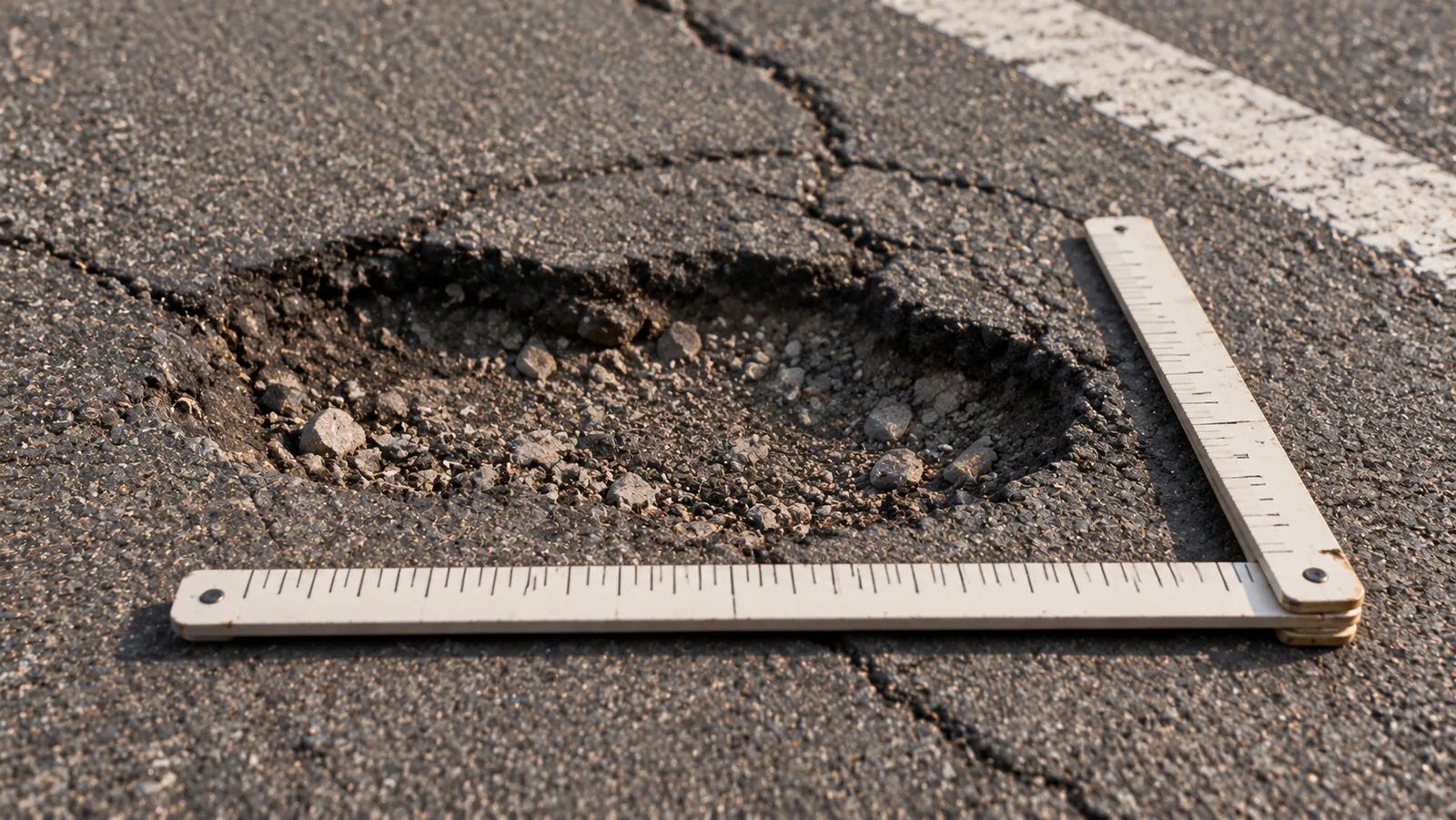
Which hazards cause particular concern for riders?
A defect a car rolls over without trouble can force a rider to swerve or brake hard.
- Loose gravel in a curve, where the front tire loses grip while the bike is leaned over
- A lengthwise pavement seam, which the tire can track along until it pulls the steering
- A raised utility cover or steel plate, which can be slick when wet and jolt the front wheel
- Standing water or oil, which makes braking distance longer
- A missing or misleading work-zone sign, where the rider reaches a lane drop with no warning
Not every patch of uneven pavement supports a claim, so the question is how this condition interacted with speed, line of travel and the rider's options.
What should you do after a road-hazard crash?
Get medical help first, then preserve the hazard before someone repairs it.
- Photos from both directions, with a water bottle or a ruler next to the pothole for scale
- The exact location, such as a pin on your phone map and the nearest cross street
- The physical evidence, such as the bent rim, scuffed gear and repair receipts
- A report of the hazard, such as a 311 call for a city street and the service request number
- Contacts and video, such as dash-camera footage from the driver behind you
Never step into traffic or an active work zone to take photos.
Who controlled the road?
The owner of the road decides which rules and deadlines apply.
| Road or condition | Who may be responsible |
|---|---|
| A Dallas neighborhood street | The City of Dallas. |
| A state highway frontage road | TxDOT or its maintenance contractor. |
| A trench left by a utility crew | The utility or the contractor holding the permit. |
| Gravel spilled from a dump truck | The truck's owner or driver. |
| A shopping-center drive | The property owner or manager. |
For practitioners: classify before pleading
Under the Texas Tort Claims Act, Chapter 101, each theory has its own elements and defenses.
- An ordinary premises defect limits the government's duty to the duty owed to a licensee (Section 101.022(a)).
- Excavations and obstructions on roads are listed as examples of a special defect (Section 101.022(b)).
- Notice is required within six months, city charter notice periods are ratified and notice is excused when the agency had actual notice (Section 101.101).
- Claims based on discretionary acts are excluded, which can reach design choices (Section 101.056).
- Inspection logs, 311 records, permits, work-zone plans and traffic-control changes should be requested early for preservation.
- A private contractor's duty and any indemnity agreement call for a separate analysis.
Frequently asked questions
Can I sue the City of Dallas over a pothole?
Possibly. Ownership, notice, classification, causation and immunity all have to be established, and a photo alone cannot answer them.
Is a missing warning sign enough?
It may matter at a work site, but you still have to prove the duty, who controlled the site and that the missing sign caused the crash.
How fast should I act?
Right away. Notice to a government unit is due within six months under the Tort Claims Act, and a city charter can set its own deadline.
Where can I read more?
See common motorcycle crash causes, Fort Worth motorcycle crash data and Dallas motorcycle accident legal help.
Sources
| Source | Used for |
|---|---|
| Texas Tort Claims Act, Chapter 101 | Sections 101.021, 101.022, 101.056 and 101.101. |
| TxDOT CRIS | Crash records for a location. |

ABOUT THE ATTORNEY
Aaron A. Herbert
Founding Attorney
Board Certified in Personal Injury Trial Law
Aaron founded The Law Firm of Aaron A. Herbert in 2010 to focus on developing each client's case and seeking its maximum value. For over a decade, he has represented people seriously injured in major accidents and industrial catastrophes, pursuing trial verdicts and settlements while working to reduce the stress of litigation.
Education
- Texas A&M University · B.S., Criminal Justice, 1999
- University of Oklahoma College of Law · J.D., 2002; graduated in the top of his class
Trial experience & approach
Aaron earned numerous jury verdicts at boutique personal injury litigation firms. According to his biography, he spent a year as the top-earning litigation attorney at a firm that frequently appeared in verdict searches as having one of the highest numbers of trial wins in Texas. At another Dallas personal injury firm, he moved from managing pre-litigation attorney to managing litigation attorney over seven years as the firm grew into one of Dallas's largest personal injury firms.
His biography describes a reputation as one of America's most aggressive trial lawyers, with noteworthy recoveries from judges and juries and substantial pretrial settlements. Most of those settlements included confidentiality agreements requested by the defense. Aaron has said the recoveries were justified by the injuries and losses involved, which no amount of money could make someone choose to experience.
His approach combines passion, preparation, persistence and courtroom imagination. He believes a well-supported, engaged and motivated team working cooperatively helps deliver strong representation, with the goal of achieving the best possible result for every client.
Dallas roots, military service & publication
Born and raised in Dallas, Aaron enlisted in the United States Marine Corps after high school and later received an Honorable Discharge. He completed his university and law degrees after his military service and became a lifelong Sooners football fan in law school.
Publication: “Litigating Dog Bite Cases,” Texas Dog Law Seminar, Dallas, 2009.
Professional affiliations & recognition
Professional affiliations and recognition listed in Aaron’s biography:
- State Bar of Texas
- American Bar Association
- Association of Trial Lawyers of America (now American Association for Justice)
- Texas Trial Lawyers Association
- Dallas Trial Lawyers Association
- Dallas Bar Association
- Tarrant County Bar Association
- Million Dollar Advocates Forum
- The National Trial Lawyers – Top 100 Trial Lawyers