
Evidence, injuries and litigation issues after a Texas motorcycle accident.
A practical guide for injured riders and a Texas evidence and trial reference for practitioners
Executive answer for injured riders
After a motorcycle crash, these are useful first steps:
- Get medical attention, report changing symptoms and follow the treating team’s instructions.
- Keep original photographs, witness details, messages and the report number together. A relative or trusted friend can help while you recover.
- Tell a lawyer where the motorcycle is stored and about any camera leads. You can start that conversation before the police report is finished.
A claim ultimately needs evidence of responsibility, injury, loss and an available basis for payment. Texas generally allows two years to file a personal-injury suit under § 16.003, subject to exceptions. Government notice under § 101.101 can be earlier, and recordings or physical evidence may be lost much sooner.
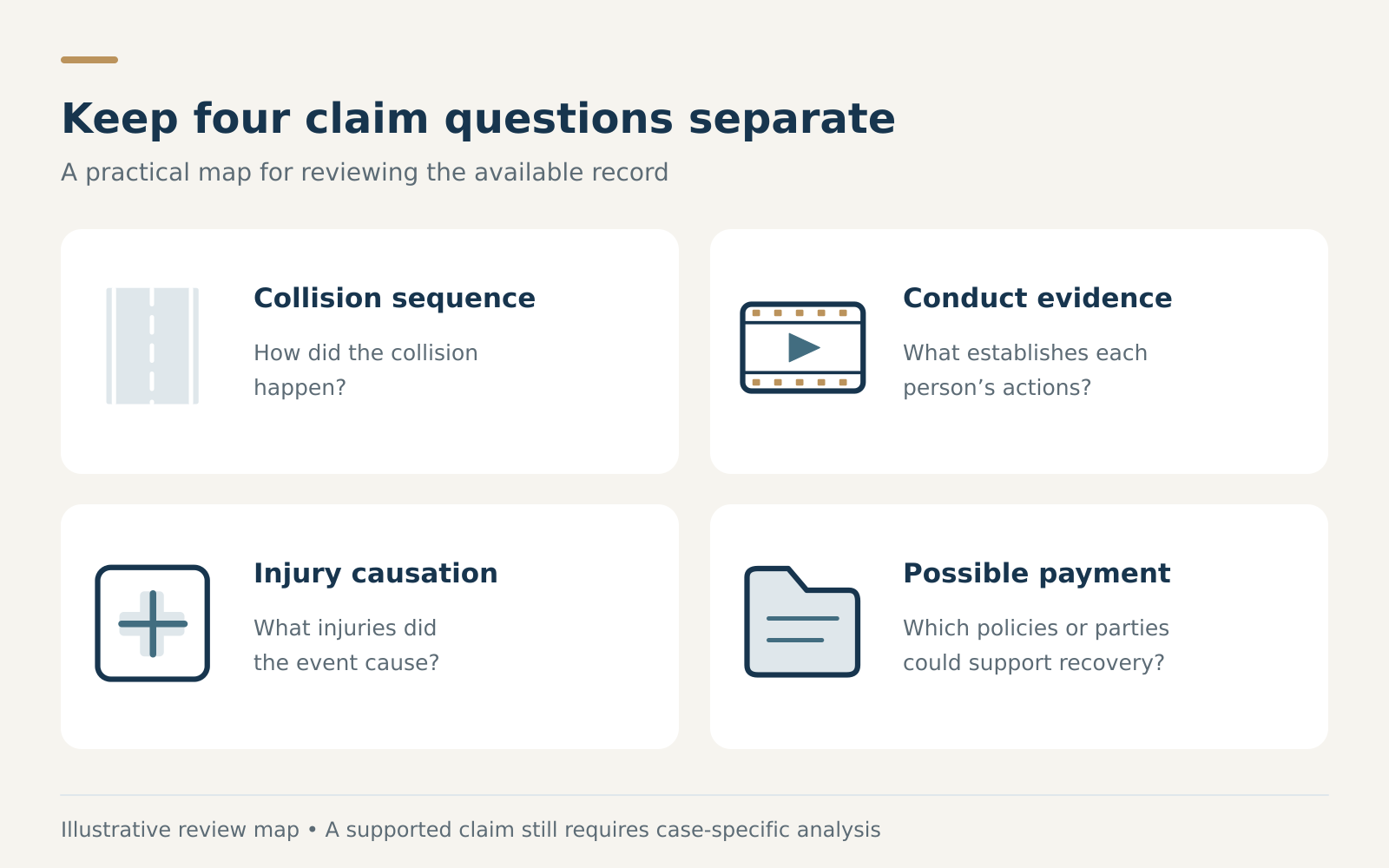
How did the insurer arrive at its speed estimate? A number calculated from a known distance and reliable recording is different from a witness's impression that the bike was moving fast. Counsel must examine the basis and then determine whether that speed changed the opportunity to avoid the crash. Helmet evidence calls for a medical explanation of a particular injury. It cannot explain why another driver turned, merged or opened a door into the rider's path.
You do not have to wait for the police report to discuss a Dallas or Fort Worth crash. Tell the lawyer where and when it happened, where the motorcycle is stored and what you know about the witnesses, injuries and insurers. Bring any recordings or correspondence you already have. The Dallas motorcycle accident service page explains the firm's representation. The sections below follow an investigation through valuation and, when necessary, litigation. They cannot predict a settlement.
Reader pathways
The opening sections are intended for riders and the people helping them with treatment and records. Coverage, medical expenses and offers have their own sections farther down. Lawyers can use the later material for discovery and trial preparation. Shorter articles on individual questions are collected in the Texas Motorcycle Accident Knowledge Hub.
For referring attorneys and practitioners: The preservation, discovery and trial sections address the work behind the claim. Use the issue matrix to spot an evidentiary gap, then check the governing statute, rule and case record. Reconstruction, helmet defenses, expert testimony and coverage each require their own foundation.
The rider sections and practitioner sections work from the same facts.
1. Define the collision before assigning fault
The first account of a crash is often incomplete. An officer may have spoken to one driver while the rider was being taken to the hospital. A witness may have heard the impact and looked up afterward. Neither circumstance makes the report useless. It means the lawyer has to find out which parts describe firsthand observations. The next evidence depends on the event: a turning car, opening door, sideswipe, rear impact, road defect or mechanical failure can leave quite different traces. Several can occur in the same crash.
The driver and rider saw a moving scene. A van visible in one frame may have screened the motorcycle in an earlier frame, when the driver made the decision to turn. Obtaining the lead-up can be more informative than enlarging the impact frame. The issue is what a reasonable lookout would have revealed when there was still a realistic opportunity to avoid the collision.
Injuries and travel speed don't have a simple one-to-one relationship. An expert may be able to estimate speed from distances, timing and impact evidence, or may only be able to give a range. Even the motorcycle's resting place needs checking. Rescue personnel, a later impact or the tow operator may have moved it before the photograph was taken.
The governing traffic rule is selected after the maneuver has been identified. Chapter 545 includes the motorcycle provisions in § 545.0605, but counsel must use the text applicable on the event date and establish the civil claim's elements. Issuance of a ticket doesn't complete that analysis. Whether the ticket can be used as evidence is a separate question.
A useful claim chart puts each disputed act beside its supporting source. Add the custodian, the time left to obtain it, any contrary evidence and the question an expert must answer. A family can then see why counsel needs a particular recording or inspection instead of being asked to accept a one-line fault conclusion.
2. Immediate care, reporting and the first days
Keep your clinicians informed when symptoms change, including symptoms absent from the first emergency note, and follow their care instructions. A family member can look after messages and photographs meanwhile. Nobody needs to stand in a live traffic lane, handle hazardous debris or interrupt emergency responders on the claim's behalf.
Write down the responding agency, report number and witness contact details. If photographs can be taken safely, include wide views as well as close-ups. A mark in the pavement is easier to interpret when another image shows its location relative to a stop line, lane stripe or damaged vehicle. Capture signs, signals, obstructions, construction, lighting and weather too.
Keep the original photo or recording with its metadata. Make a separate copy if you need to crop, brighten or annotate it. At a later scene visit, record any changed signs, trees, pavement or traffic controls; a photograph taken weeks afterward may depict a different view.
Storage can become an urgent issue for the bike. Before agreeing to its release or disposal, find out whether counsel wants it inspected or its data downloaded. Gear and camera files are worth keeping with it. Record who takes custody of the damaged helmet and clothing. A specialist may find a crack informative without being able to say when it occurred; an apparently undamaged helmet also cannot exclude a head injury.
Find out how long this particular camera keeps recordings. There is no standard retention period you can safely assume for every business. Find out what will happen to the stored bike too. Your lawyer can deal with those dates while separately reviewing § 16.003 and government or local notice rules. “First 72 hours” doesn't mean every source survives three days or disappears on the fourth.
3. The preservation map
Agency records may require more than one request because reports, photographs, body-camera files, dispatch and 911 material are not always kept together. The investigation should identify those custodians along with stores, traffic-camera operators, toll facilities and witnesses who may hold other recordings. Their views may cover different parts of the trip or event.
For each vehicle, locate storage records, repair estimates, photographs and information about its condition before the crash. A suitably equipped car or truck may also retain event data, telematics, infotainment records or camera footage. Availability depends on the vehicle and system.
A delivery receipt may help place the driver on a route even when it says nothing about the impact. Save the trip's application entries, delivery records, messages and statements for that reason. Ask what each entry actually records: an assigned destination, a completed stop or a message sent along the way. Any request for phone-location material must use lawful procedures and be proportionate to the disputed issue.
For the medical file, identify the emergency records, original imaging, specialist consultations and earlier baseline records. Include records of functional changes. Naming those sources is more useful than sending a broad request for “all evidence” and assuming everything important will arrive.
A business can agree to save a video and still decline to hand it over without formal process. Similarly, an owner can agree not to sell a vehicle while objecting to a proposed destructive test. The lawyer needs to resolve access as well as retention. A report arriving from an agency doesn't establish that its separate photographs have also been produced.
A request should identify the date, time window and relevant camera view, location or vehicle. Counsel can choose among correspondence, an agreed inspection, discovery and appropriate court relief. Follow up with the recipient. Proof that a letter was sent does not establish that the video was saved.
The timeline needs a clock check. A displayed time might be local time, UTC, an incorrectly set device time or the moment of export. For each recording, retain the native file and document who supplied it, any conversion and any gaps. Clock offsets and missing frames should be identified before clips are synchronized for a presentation.
Before calling a lost file spoliation, counsel needs to establish that it existed and determine who controlled it, when it disappeared and what preservation duties had arisen. The retention cycle, reasonable anticipation of litigation, steps taken and resulting prejudice all matter. Brookshire Brothers, Ltd. v. Aldridge, 438 S.W.3d 9 (Tex. 2014), supplies the Texas framework. A missing recording, by itself, won't establish the other party's negligence or entitlement to an adverse instruction.
4. Scene geometry and visibility
The driver's view was from a seat, through particular windows and around whatever traffic was present. A standing-height daytime photograph may not reproduce it. The bike's headlamp, approach angle and contrast with the background also affect visibility. Roadside cameras introduce their own issues, including lens distortion, compression and frame rates, so an apparently clear recording still needs careful interpretation.
Measure the features that could change the answer. They may include lane width, turn paths, stop lines, obstructions, grade, curvature and pavement condition. Collect the speed-limit and signal information. Photographs, mapping, photogrammetry or a total-station survey should be chosen for the question the expert needs to resolve.
Measurement technology cannot correct a scene that has already changed. A scan or drone image needs a date, an explanation of accuracy and an account of intervening work. With signals, a plan describes intended operation; maintenance records may be needed to establish whether that plan reflects operation on the crash date.
An avoidability opinion can depend heavily on one uncertain input. The expert should show the effect of other supported speeds, available stopping distances and possible obstructions. If the result changes, that uncertainty belongs in the client's assessment. Any animation should be built from those supported inputs and leave unsupported movement out.
A report might locate a mark, calculate time to collision and then offer an avoidability opinion. Those are three different steps. Keeping them visible lets counsel ask whether the disagreement concerns the measured fact, an input to the calculation or the expert's interpretation.
5. Left turns and intersections
The driver's first movement into the turn is the starting point for reconstruction. Identify the signal, lanes and sightline at that moment, using the original recording and witnesses where available. Check their accounts against damage and final positions. A driver surprised by the motorcycle may still have had an opportunity to see it.
A claimed gap in traffic has to be reconstructed from the view available when the driver judged it. Speed, an obstructing vehicle, headlamp operation and lane position are possible issues, not established facts. Where speed remains uncertain, an expert can test the supported range. Braking and swerving also need to be followed through the rider's fall, including a fall without contact.
There is no sound reason to promise a rider that every left-turn case assigns the driver all responsibility. A protected arrow, red signal or unusual maneuver may materially change the analysis. The applicable right-of-way rule and the evidence of timing have to be considered together.
At deposition, “I looked carefully” doesn't give a reconstructionist much to work with. Where did the driver look, what was visible, did the car stop, and how long did the turn take? Details like those can be compared with video. A general assurance of care usually cannot.
6. Lane changes, blind spots and side impacts
The question in a sideswipe is often where the two vehicles were just before someone moved. Were they alongside each other? Did the driver signal and check? Did the car hit the bike or force it out of the lane? Texas law gives a motorcycle full use of a lane under § 545.0605(a)(1). The statute's permission for two motorcycles abreast is a different situation from riding between lanes of same-direction traffic.
A lane-change opinion needs the vehicles' positions before contact. Damage can help locate the contact area, while markings, lane width and footage address the preceding movement. A blind-spot explanation requires examination of the driver's checks and the time at which the motorcycle could be observed.
A sideswipe may result from either vehicle moving, or from both. It may also be followed by a much more serious impact against a barrier or another car. Reconstructing that order can affect both the fault assessment and the explanation of particular injuries.
Keep damage photographs even when they seem repetitive. A view of the other side of a vehicle may help test the reported movement. Original video, clock information and witnesses who saw the approach are useful for the same reason. The insurer's fault code should be read as its current assessment, not a court finding.
7. Lane splitting and rider conduct
Two motorcycles riding abreast in one lane present a different statutory question from a motorcycle traveling between same-direction lanes. Section 545.0605 addresses both, as well as full-lane use and passing within another motor vehicle's lane. This is why the rider's actual path has to be established before a label such as lane splitting is used. Counsel should consult the version that applied on the event date.
A violation also has to be connected to the event. The record may show that an unsafe rider maneuver contributed while the other driver's act contributed as well. Witness perspective can be a source of error, especially with a last-second swerve. Individual video frames need perspective analysis before they can reliably support a path or distance calculation.
The causal connection must be established for allegations involving training or licensing as well as speed, impairment, signaling, following distance and lighting. A credential issue alone cannot establish vehicle movement or responsibility.
Before discussing settlement, counsel should explain the consequences of the proposed fault allocation. Chapter 33 bars recovery in covered actions where the claimant exceeds 50 percent responsibility, and otherwise provides for reduction under its terms. Other actors and responsible third parties may be included. Sections 33.001, 33.003 and 33.012 need to be applied to that complete picture.
8. Helmets, protective gear and injury causation
Section 661.003(c) is more specific than “helmets are optional over 21.” The exception requires a person to be at least 21 and to have completed the qualifying motorcycle training course or have the specified health insurance covering motorcycle-collision injuries. The supporting documents and law on the event date should be checked. Whether the rider qualified does not, on its own, establish who caused the collision.
A helmet defense also needs an injury-specific basis. What struck the rider's head, what injury resulted, and how would a particular helmet have changed it? Fit, fastening and impact location may matter to the medical or biomechanical analysis. A general argument about helmet safety cannot justify reducing compensation for every injury, including an unrelated broken leg or shoulder injury.
Save the helmet before anyone cleans it or removes padding. Photograph its condition and track its handling along with the rest of the gear. A crack has to be considered with the impact location, prior condition and possible post-crash damage. Reconstruction and medical experts should explain what the equipment reveals within their own fields. Neither should treat it as a shortcut to a legal fault conclusion.
The Texas helmet-law article explains the statutory requirements in more detail. In a damages dispute, counsel must still determine what helmet evidence is relevant to this rider's injuries and permitted under the applicable law.
9. Road hazards and governmental defendants
The first factual problem in a gravel or pothole case may be the route of the front tire. The alleged hazard must be connected to the loss of control, and a photograph of debris somewhere nearby may not do that. Scaled scene images, earlier complaints, maintenance records and work-zone documents can help establish the condition, control and notice. The same inquiry may be necessary for pavement edges, plating or missing warnings.
Roadwork can involve a utility, contractor and public agency with different roles. Identifying those roles is necessary before choosing a defendant. A claim against a governmental unit requires analysis of the Tort Claims Act's waiver, limits, exceptions and notice provisions. Section 101.101 generally calls for notice within six months, but an applicable city rule may be shorter, subject to the statute. Actual notice is a legal issue to examine, not an assumption that permits delay.
Later scene evidence needs a history. A repair, overnight traffic or weather may have altered the surface before it was photographed. Dated inspection and work records may help establish the earlier condition and any temporary traffic controls. Lighting and weather should also be considered when assessing notice and avoidability.
The road-hazards motorcycle article discusses these problems for riders. A lawyer pursuing the claim will also need the authority governing that particular condition and defendant. Public ownership alone doesn't establish liability for every defect.
10. No-contact evasive crashes
In an evasive fall, the alleged negligent vehicle may leave no damage on the motorcycle. Independent witnesses, original video and physical signs of steering or braking can supply corroboration. The evidence must explain the vehicle's movement, what the rider perceived and the response that led to the fall.
A witness who heard a crash and then turned around can tell you what happened afterward. That person may not know what made the rider swerve. Find out when each observation began. The available reaction time still needs examination, as do other possible explanations such as a mechanical failure or contaminated road surface.
For an unidentified-vehicle claim, the policy review is particularly important. Counsel will compare declarations, endorsements and insurer correspondence with Chapter 1952. The facts needed to establish fault are not necessarily sufficient to meet the separate UM/UIM coverage requirements.
The no-contact motorcycle article is a shorter introduction. For a referral, information that identifies the other vehicle or explains its movement will be useful alongside the policy documents.
11. Motorcycle condition, maintenance and product questions
A mechanic or expert needs to know exactly which bike and components are being examined. VIN, model, mileage, modifications, service history and custody records establish that starting point. The suspected failure then determines whether the focus belongs on tires, brakes, steering, lighting, controls or aftermarket equipment.
A damaged component has to be read in the sequence of the crash. A part that failed before loss of control and one that broke against the pavement may look equally damaged afterward. The inspection and any lab work should be designed to distinguish those explanations.
Dismantling a bike can change the evidence that another party needs to inspect. Appropriate notice, an agreed protocol and records of removed parts are therefore important once litigation is reasonably anticipated. A salvage sale may require prompt action by counsel to secure a hold, agreement or court relief. The rider shouldn't attempt dangerous tests on damaged brakes or tires.
“The brake did not work” is a reason to investigate, not a product-defect conclusion. Was the component original, replaced, modified or recently serviced? Did a warning or recall apply to this VIN and this failure? Distinguish possible design, manufacturing, warning and service claims. A recall involving something else, or a part damaged during the crash, cannot establish causation.
An invoice establishes that work was billed. Whether it was done properly may require the technician's notes, measurements and the component itself. A full product investigation can be expensive, so it should follow a supported issue that could affect the case. A straightforward turning collision doesn't necessarily require one.
12. Commercial vehicles, rideshare and multiple actors
A logo on the vehicle helps identify a business to investigate. It does not establish that every related company controlled the driver or caused the crash. Determine the roles of the driver, owner, employer, carrier, platform, contractor and insurers. Dispatch, trip status, vehicle-control records, cameras and policy terms may answer different parts of that inquiry.
A rideshare record needs to show trip status at the collision time; a later screenshot may differ. Work assignments help identify whose business the driver was doing. Cab and mirror photographs address visibility. Use those records to answer their respective questions, then apply the policy terms to the established facts.
The business name on the vehicle may not be the legal name needed in the case. Record both, along with each entity's role, alleged act and source of proof. A dispatch or maintenance issue should be pursued when there is a supported connection to the collision. For a federal motor-carrier rule, first determine that the vehicle and operation fall within it, then examine the particular rule and causation.
Commercial involvement may reveal another responsible party or policy, but it does not guarantee a coverage amount. The motorcycle service page explains representation. Where a qualifying commercial vehicle is involved, the truck litigation hub addresses its additional evidence and legal issues.
13. Comparative responsibility and attribution
An insurer may put several objections in the same letter. Speed and late braking concern how the collision happened. A helmet argument may concern only the severity of a head injury. Sorting out what each allegation is supposed to prove helps reveal whether the evidence actually supports it. The Chapter 33 assessment should account for the rider's conduct and that of the other relevant actors.
For illustration, reducing a $100,000 damages finding by 20 percent claimant responsibility leaves $80,000. This is before other applicable Chapter 33 adjustments, including credits, and is not the client's estimated net. Counsel must account for all relevant actors under § 33.012 and related provisions. In a covered action, claimant responsibility above 50 percent bars recovery.
People can be very sure about speed estimates they couldn't actually measure. Throw distance alone doesn't resolve speed, just as the rider's confidence doesn't establish uninterrupted visibility. Measurements, recordings and the basis of each witness's observation matter. A citation may reveal the officer's thinking without supplying all the proof required at trial.
You should be able to understand why your lawyer's valuation changes. Perhaps a witness strengthens liability, a doctor changes the prognosis or a policy turns out to exclude the occurrence. An assessment that separately explains damages, disputed fault, collection sources and projected net makes those changes easier to follow. Further investigation also has a cost, which belongs in that discussion.
14. Injury causation and preexisting conditions
The treatment timeline establishes when care occurred. A medical opinion must still explain the connection between the diagnosed condition and the crash. Trace the possible contacts with a car, pavement, guardrail or second vehicle. Ask the clinician which findings support the diagnosis and what the records show about symptoms and function over time.
An old medical problem doesn't disappear from the file because this crash was serious. Be open about prior migraines, surgery, neck pain or other treatment. Those records may show that the crash aggravated a condition; they may also show that some complaints have another explanation. The clinician needs an accurate baseline. Neither a prior diagnosis nor an initially normal image resolves every question about what changed.
Build a medical chronology that can be traced back to the records. Each entry should identify the date, provider and source, then distinguish the complaint, objective finding, diagnosis, recommendation and treatment actually received. Gaps become easier to investigate when the source is beside the summary.
Before deposition, compare the rider's account with entries that seem inconsistent. A therapy note may concern a different date or circumstance; sometimes an account needs correcting. A medical opinion attributing everything to age should also explain the contrary history. The question is what additional injury or aggravation resulted from the crash.
Tell the lawyer what you could do before the crash. An old diagnosis doesn't necessarily describe your earlier daily function. Previous records may support an aggravation claim or show that a limitation already existed. The lawyer should explain why those records are sought and deal with confidentiality and the proper scope of the request.
15. Traumatic brain injury and cognitive change
The word “mild” in a head-injury diagnosis does not tell the whole story about recovery. It also does not establish permanent impairment. The treating team must assess the initial findings, later symptoms and daily functioning. Headache, confusion, memory complaints, sleep changes or loss of consciousness need clinical evaluation; their causes and outlook can differ. Follow the recommended care rather than using a litigation label as a diagnosis.
The initial EMS and emergency observations provide a starting point for a head-injury history. Later specialist records, imaging, medication information and indicated testing can explain the course. Reports from relatives or coworkers may identify a change that needs assessment. Diagnosis remains a clinical task, including consideration of pain, disturbed sleep, distress and medication as contributors to symptoms.
Document missed assignments, appointments or shortened shifts, how long the problems lasted and the response to accommodations. These observations can support evaluation without proving lifetime lost earnings. When neuropsychological testing is indicated, interpretation should consider validity measures, the estimated pre-injury baseline and the work history.
The routine shown in a day-in-the-life video should be representative, with medical support for the limitations depicted and a fair account of improvement. Staging inability or removing relevant context makes the presentation less reliable. The brain trauma article offers a focused overview of the injury questions.
16. Orthopedic, spinal, vascular and burn injuries
Two riders with the same diagnosis may have very different recoveries. Assess treatment, complications, prognosis and function for fractures, ligament and spinal injuries, nerve damage, burns, road rash, scarring and internal trauma. A diagnosis alone cannot set a dollar value. Questions about infection or urgent symptoms belong with the treating clinician.
A fracture file may need to follow fixation, healing, hardware difficulties and therapy well beyond the first X-ray. With spinal complaints, imaging needs to be considered alongside neurological signs, earlier conditions and response to care. Road rash can also involve very different injuries, from superficial damage to tissue loss. Dated photographs need medical context and respectful handling. Scarring may affect movement as well as appearance.
Future-care estimates begin with what the specialists reasonably expect. A planner can then price supported services, and an economist may assess supported earnings losses. A list of every conceivable procedure is not a prognosis. If a later surgery is disputed, obtain the specialist's explanation of its relationship to the crash. Also check that pain, impairment, disfigurement and daily limitations are not counted twice under different labels.
Treatment instructions, restrictions, photographs and account histories can give counsel useful proof without making documentation the family's main recovery task. Each claimed loss still needs a causal explanation and supporting witness or exhibit. With multiple impacts, medical and reconstruction experts should answer the questions within their respective qualifications.
17. Past medical expenses and actual payment records
The total at the bottom of a hospital bill can be quite different from the legally recoverable expense. Section 41.0105 limits recovery to amounts actually paid or incurred by or for the claimant. In Haygood v. De Escabedo, 356 S.W.3d 390 (Tex. 2011), the court explains the importance of what the provider is legally entitled to receive. The payment and adjustment ledger is therefore part of the damages work, not merely bookkeeping after settlement.
Collect itemized charges, explanations of benefits, payments, contractual adjustments, balances and relevant provider agreements, including any letter of protection. The amount provable as damages and a provider's or plan's repayment demand are different questions. So is causation: a reasonable treatment charge does not establish that the crash caused the condition treated.
The § 18.001 procedure can assist with certain evidence that charges were reasonable and necessary. Deadlines and a possible contest have to be handled correctly. The medical cause of the treated condition remains a different question. A contested or complex causal issue may require records and testimony from a qualified clinician.
Before accepting a settlement, ask for an estimated distribution. It should identify fees, expenses, confirmed reimbursement demands, unresolved bills and the expected amount to the client. Counsel should verify the claimant and governing terms behind each repayment demand. Whether an obligation is valid, and whether it can be reduced, can materially affect the net.
18. Future medical care and life planning
Read a proposed care plan alongside the treating recommendations. For every expense, look for:
- Who recommended it and which condition it would treat.
- Whether the recommendation depends on something else happening, such as conservative care failing before surgery.
- Schedule: expected frequency and duration of therapy or another service.
- Replacement: the supported interval for a prosthesis or other device.
- Home assistance: the recovery period or longer limitation requiring help.
The duration in the cost estimate should follow the medical recommendation. Temporary recovery assistance does not support a lifetime allowance on its own.
The useful details in a care plan are its units, frequency, duration and cost sources. Alternatives should remain alternatives when both treatments couldn't occur. A prognosis may become clearer with time, but the legal team still has deadlines and offer terms to watch while waiting for that clarification.
Reconcile the plan for duplicate charges, including bundled facility costs, therapy and transportation. Examine inflation and present-value assumptions. Clarify the medical indication and probability of a procedure described as possible under the applicable evidence law.
The question “How will I pay for the next appointment?” is different from “What future care can be included in the claim?” Bring recommendations, upcoming test dates and costs so both can be discussed. Available benefits and access to care need attention, without a promise that the firm can arrange a particular treatment or financing.
19. Earnings, employment and household function
Past lost earnings are often documented with payroll, attendance, tax records, overtime history and employer confirmation. Lost earning capacity concerns the difference between what the rider could earn without the injury and what the rider can reasonably earn with it. Returning to work may leave a loss of overtime or advancement. Conversely, a temporary absence may end without lasting loss of capacity. The records need to support the particular claim.
An earning-capacity file needs details about the work:
- Duties performed before the injury and the restrictions now supported medically.
- Attempts to return, accommodations tried and the result.
- Training and realistic alternatives in the labor market.
- For self-employment, the rider’s own labor contribution, separated from other labor and unrelated market effects on revenue.
The vocational and economic assessment should be built on that history, rather than job title and salary alone.
A short household record can explain unpaid losses:
- The task: school transport, stairs, meals, personal care or another activity.
- The person who helped and what assistance was provided.
- The period help was needed, including changes as recovery progressed.
- Adaptations that made the activity possible again.
Include improvement. A substantial temporary loss does not have to be described as permanent inability to deserve accurate documentation.
Assign each loss to the appropriate recoverable category before pricing it. Wage loss, earning capacity, services, impairment and noneconomic harm do not describe identical losses. Check for duplicate hours or tasks. A short client chart can show the supporting evidence, the dispute and the information still needed for each category.
20. Insurance and collectability
Ask counsel to investigate the possible sources of payment:
- The driver’s bodily-injury policy and any applicable owner’s policy.
- Commercial coverage and any excess layer.
- The rider’s uninsured or underinsured motorist coverage.
- PIP and other potentially applicable benefits.
A policy’s name does not establish that it covers this occurrence. Read the contract and applicable facts, including exclusions and competing claims. A shared limit may leave less collectible than the injury evidence would otherwise support.
A household car policy isn't enough to answer whether the motorcycle occurrence is insured. The event-date declarations and endorsements, named insureds, vehicle schedule and any relevant rejection forms need review under Chapter 1952. Adverse insurer letters belong in the file too. An unidentified vehicle may raise additional requirements that would not appear in an ordinary identified-driver claim.
Keep the policies in separate entries. For each one, record:
- Which insurer issued it, who is insured, and the vehicle and occurrence involved.
- The limit and exclusions, along with any reservation-of-rights letter.
- When notice was given, who else is claiming against the policy and what documents are still missing.
- Relevant facts about permission and commercial use.
- Any separate coverage deadline or procedural requirement.
An adjuster may open a file before the carrier decides its position on liability. Describe that stage accurately when updating the client.
Supported damages, allocated responsibility, collectible sources and estimated net describe different amounts. A verdict is not necessarily a paid judgment, and proper deductions come out of a gross settlement. The Texas Injury Claim Value and Litigation hub discusses these parts of the evaluation.
21. Early offers and the release decision
Before accepting an early offer, the client needs the actual release reviewed. It may resolve several claims or protect several parties, and it may include unknown future treatment. Responsibility for medical obligations and the payment date are part of the bargain. An early offer is not inherently unfair, but incomplete prognosis, fault or coverage information can affect an informed decision.
Give a provisional range with its assumptions. Show the effect of a good recovery, a medically supported procedure and disputed fault. Explain what further evidence could change the decision and what obtaining it would cost in time and money. A possible increase in gross recovery must be weighed against the effect of cost, delay and risk on the net. Supported future loss should not simply be omitted from the offer analysis.
You decide whether to accept after receiving enough advice to make an informed choice. If a large verdict from another case is offered as a comparison, ask about the differences in injury, evidence, venue, insurance and appeal. Your own case still needs trial preparation while negotiations continue. A good mediation presentation doesn't supply missing admissible proof.
After a useful consultation, you should know what the lawyer has learned, what is missing and who will investigate it. You should also understand the fee arrangement, expenses and next communication. Those practical answers matter alongside qualifications.
22. Filing deadlines and government notice
Have counsel calculate the actual filing dates. The general rule in § 16.003 is two years for personal injury, but the parties and claim may raise issues involving minority, tolling, wrongful death, government or products. A report submitted to an insurer is not necessarily enough to preserve a later lawsuit.
For a governmental claim, § 101.101's notice provisions and any applicable charter or ordinance need prompt review. The statute addresses notice within six months and actual notice, while a local requirement may be earlier. Identification of the unit, waiver, exceptions and any contractor's responsibility should be investigated while evidence of the road condition is preserved.
One calendar tells your lawyer when a legal step is due. Another tells the team when a camera recording or stored item may be lost. Both are necessary. Having time left to sue won't preserve the recording, and losing the recording doesn't by itself change the filing period.
The urgency is specific to the case. A storage sale, a short retention cycle or a special notice requirement may require immediate work. There is no universal rule that all crash claims must be handled within 72 hours.
23. Investigation and discovery plan for practitioners
The question behind a discovery request should be apparent from the file. Which element does the record address, and who can authenticate it? Duty, breach, cause in fact, proximate cause, injury and damages may require different sources, witnesses and objection analysis. A road-control dispute won't necessarily be answered by the material needed for a speed calculation.
The work usually starts with the client's originals, agency materials, witnesses and scene, then proceeds to relevant records held by others. Rule 196 requests should identify needed native formats or metadata and an appropriate time range. Some material will require a subpoena, agreement or protective order. Preservation and proportionality remain part of the process throughout.
The driver's deposition can develop attention, observations, movement and the basis for speed estimates. The officer's can distinguish personal observations from reported statements and explain measurements and diagram assumptions. Preparing around each witness's actual knowledge produces a more useful record than asking everyone to endorse the entire account.
A camera custodian can explain configuration, clock settings, exports, gaps and retention. Where commercial activity matters, a company witness can address the relevant trip, policies and decisions. Establish the witness's basis of knowledge before relying on the answer.
The clinician can explain diagnosis, baseline condition, mechanism, prognosis and needed care within that clinician's expertise. Records should help the witness explain an opinion in their own terms. Agreement with a lawyer's carefully worded proposition is less informative than the underlying medical reasoning.
Incomplete responses call for a documented follow-up. Establish installed equipment, the search performed and whether native material exists beyond the format produced. Record the requests and answers by date. Newly obtained material may require changes to pleadings, expert assignments or the theory within applicable deadlines.
24. Reconstruction and expert integration
The expert's assignment should fit the expert's qualifications. Reconstruction may establish movement, timing and avoidability; biomechanics may address a particular mechanism. Medical diagnosis is a further task. One witness should not be presumed qualified for all of them.
A care planner, vocational specialist and economist can all produce careful work that rests on the same unsupported medical assumption. Counsel needs to trace the assumption back to its source. The clinician's prognosis, planned services, work analysis and valuation are connected, but the experts aren't interchangeable.
An expert’s calculation should be possible to follow from the source material:
- An identified evidence set, with later additions recorded.
- The effect of other supported speeds where a disputed 45 mph estimate drives the result.
- For video work: frame rate, missing frames, distortion and any difference between clocks.
- Clear labels for unmeasured features in courtroom illustrations.
The apparent precision of a drawing should not exceed the precision of its inputs.
At a case review, follow each connection in the proposed account:
- Conduct and the time available to react.
- The resulting movement and impacts.
- The medical diagnosis and its connection to those impacts.
- The supported restrictions and financial consequences.
If that sequence breaks down, identify the missing evidence and whether further testing could resolve it. Repeating an assumption in another report does not supply proof. Public descriptions must protect client confidences; describe a method as proprietary to the firm only if that claim has been verified.
The expert report and the admissibility work should develop together. Source files, qualifications, methodology and a foundation for demonstratives will be needed under the applicable Texas rules and cases. A compelling animation may still be excluded. Likely objections deserve review before the material is relied on in a demand or presentation.
25. Summary judgment, motions and trial proof
Check the motion's filing date before choosing the version of Texas Rule of Civil Procedure 166a. The rewritten rule governs motions filed on or after March 1, 2026; earlier motions stay under the former rule, including former subsection (i). New no-evidence provisions include (a)(2), (b)(2)(D), (b)(3)(B), (d) and (h)(3). Timing, burdens and evidentiary requirements need review. Give the court a record citation for each proposition, not a pleading allegation or a medical file left for the judge to search.
A motion in limine may keep certain matters from being raised without approaching the bench, but it may not finally decide admissibility. Counsel still needs to preserve the necessary objections and offers of proof. Stereotypes, speculative helmet opinions and overreaching demonstratives warrant scrutiny on both sides. A safety campaign's slogan, for example, doesn't establish what this driver did at this intersection.
Orient jurors with a scene map and pre-impact observations, then connect the proposed movement to the recordings and physical evidence. Explain reconstruction limits. Medical testimony must separately connect the event to the injuries and claimed losses.
A supported speed dispute is easier to understand when the range and its consequences are explained directly. Helmet evidence may need a different explanation if it concerns only one injury. Otherwise the two issues can become confused as proof of who caused the crash.
Check the proposed charge against the pleadings, proof and governing cases. Chapter 33 allocation, responsible third parties, damages categories and settlement credits require case-specific work even when using the Texas Pattern Jury Charges. After verdict, review judgment calculations, interest, offsets, post-trial motions and collectability. Explain before trial why a verdict figure may differ from what the client ultimately receives.
26. Mediation and settlement presentation
The strongest mediation package makes its sources easy to find. A short collision account can lead to the supporting evidence and the defense's strongest contrary argument. Medical claims should likewise lead to the diagnosis, prognosis and treatment record. Where future care is uncertain, the recommendation, price source and alternatives need to be visible.
Find out what the insurer disputes. A disagreement about diagnosis is different from one about duration, helmet-related severity or the amount demanded. The valuation should separately consider damages, fault, coverage and assets, defense risk, further costs and net proceeds. Another verdict needs factual context to be useful.
Preparation for mediation includes settlement authority, current balances, reimbursement claims and release terms. The client's priorities may also include privacy, future bills and avoiding a long trial. Counsel's recommendation should explain how those concerns affect the choice, which remains the informed client's decision.
An unsuccessful mediation can identify a witness, coverage question or medical opinion requiring further work. Assigning that work is more useful than treating the failure to agree as a decision on the case. Trial preparation continues while the client and counsel reassess possible offers.
27. Wrongful death and family claims
A family may come to the first meeting unsure who can bring a claim or speak for the estate. Counsel needs to establish the eligible Chapter 71 beneficiaries, any separate survival claim and the status of probate. That also means identifying conflicts in representation and calculating deadlines. Each claimed loss needs its own proof, alongside the evidence of fault. Necessary photographs should be handled respectfully; relatives need not be shown graphic material simply because it exists in the file.
The death records may establish medical cause without establishing fault. Scene and equipment evidence, emergency and medical records, work and support records and witnesses may still be needed. Specialized material should come through the appropriate custodian. A governmental role calls for prompt notice and waiver research.
The rider's legally available pre-death claim and the eligible survivors' losses need to be assessed separately. Financial support requires more than multiplying household income by years. Family evidence may support companionship, consortium or mental-anguish claims as the law permits. The consultation should also address immediate insurance and information problems without a promise about a verdict.
In a professional referral involving several family members, clarify representation and potential conflicts. The family should understand estate requirements, investigation, costs and who will make each decision.
28. Choosing counsel and verifying qualifications
Use the consultation to find out how the case would actually be handled. Who is responsible day to day, what needs investigation, and how are experts, coverage disputes, early offers and expenses approached? Trial preparation is worth discussing even if suit may never be filed. The answers should explain the work without promising a result on an unexamined record.
Verify Aaron Herbert's individual Board Certification in Personal Injury Trial Law through the TBLS directory, then ask how the certified attorney will participate in your matter. The designation doesn't certify every employee. Nor does it guarantee a result or experience with every motorcycle mechanism. The TBLS knowledge hub explains what the credential does establish.
A favorable review tells you about another client's experience. A published result depends on that case's facts and available payment sources. For your decision, it also helps to know how the firm will inspect evidence, communicate and calculate fees and expenses. Ask to review the written agreement.
Referring attorneys should address the co-counsel arrangement, division of responsibility, client consent and applicable ethics rules. A website invitation to refer a case does not itself establish those terms.
29. What happens after the first call
An intake should establish medical status, the time and location, vehicles, witnesses and reporting agency. It should also locate the bike and identify recordings, insurers and approaching deadlines. The caller needs to know what information to send, whether the firm can evaluate the matter and when to expect another conversation.
Before assuming the firm represents you, understand whether the conversation was only an evaluation. If it accepts the matter, the written agreement should cover scope, responsibilities, fees and expenses. You should also know where to send originals and medical updates, how to handle insurer calls and what the first investigation will involve.
A declined caller should leave knowing that this firm is not handling the case or protecting its deadlines. Accurate information about urgent issues may help the person seek other counsel, but should not create an impression that representation continues.
For an attorney referral, the useful starting material includes facts, photographs, policy information and filing dates. The lawyers also need to establish who will evaluate the matter and how their respective responsibilities will be recorded.
Practitioner issue matrix
| Disputed question | Primary proof | Alternative explanation to test | Reader-facing translation |
|---|---|---|---|
| Who entered whose path? | Video, damage, scene measurements, witnesses | Timing, blocked view, both changed lanes | The first report may not tell the whole story. |
| Could the driver see the rider? | Driver viewpoint, lighting, signal, video | Camera viewpoint differs from driver viewpoint | “I did not see you” is an issue to investigate. |
| Did the rider's speed matter? | Measured distances, video timing, qualified reconstruction | Unreliable visual speed guess | A speed allegation needs evidence and a causal link. |
| Did gear affect injury severity? | Medical diagnosis, impact mechanism, actual gear | Gear irrelevant to the particular injury | Helmet status does not by itself decide who caused the crash. |
| What future loss is supported? | Prognosis, work history, cost sources | Recovery or alternative treatment | The estimate can change as medicine becomes clearer. |
| What can be collected? | Policies, insured parties, assets, other claimants | Coverage exclusion or shared limit | Case value and available payment are different. |
Short answers to common questions
How long do I have to sue after a Texas motorcycle accident? Section 16.003 generally sets two years for personal injury, subject to exceptions. Government notice can be earlier. Ask counsel promptly because evidence may change much sooner.
Can I recover if I was partly responsible? Possibly. For a claim governed by Chapter 33, responsibility above 50 percent bars recovery. When recovery remains available, your share reduces it under the statutory calculation, with other adjustments potentially relevant. The evidence must support the allocation.
Does not wearing a helmet mean I lose? Helmet use alone does not answer that question. Determine the applicable helmet rule, whether a helmet affected the particular injury, and which party caused the collision. Have counsel assess the actual legal issue.
Is lane splitting legal in Texas? Section 545.0605 restricts riding between same-direction traffic lanes and passing within another motor vehicle's lane. It also provides for full-lane use and two motorcycles abreast. A lawyer needs the actual maneuver to determine which provision applies.
What if a car did not touch the motorcycle? The driver's movement can still be investigated as a cause of the fall. Original video, witnesses and physical marks may help establish what happened. Coverage needs separate review of the actual policy and facts, particularly if the other vehicle cannot be identified.
How much is my case worth? There is no reliable motorcycle multiplier. Evaluate supported losses, disputed fault, medical prognosis, coverage, litigation risk and expected net proceeds.
What should I bring to a consultation? Report number, original photos and video, witness details, motorcycle location, gear, treatment information, policies, insurer correspondence and any offer. Incomplete information is still enough to begin a conversation.
Primary sources and verification
Texas Transportation Code § 545.0605, motorcycle lane operation.
Texas Transportation Code Chapter 661, protective headgear.
Texas Civil Practice and Remedies Code Chapters 16, 33, 41, 71 and 101, limitations, responsibility, medical expense, wrongful death and government claims.
Texas Insurance Code Chapter 1952, applicable auto coverage provisions.
Texas Supreme Court, Haygood v. De Escabedo and Brookshire Brothers v. Aldridge, medical expense and spoliation issues.
Texas Department of Transportation motorcycle safety information, public safety context, not proof of an individual crash.
Texas Board of Legal Specialization, individual credential verification.
Next step for a rider: Ask for a case evaluation through the Dallas motorcycle accident service page or the Fort Worth page if that is where the collision occurred. Bring what you have; the attorney can explain what remains to investigate. Next step for a practitioner: Use the hub's professional path, identify the disputed mechanism and preservation issue, and use the service-page links above to ask the firm how to submit a professional referral.
This article is general information, not legal advice or an attorney-client relationship. It does not predict an outcome.
31. Three worked proof examples
Left-turn conflict. Suppose a rider remembers a green through signal. The turning driver remembers only the shock of seeing the motorcycle. A nearby business supplies video, but it starts after the bike has entered the intersection. Its clock is four seconds slow. Playing that clip beside the signal record without correcting the offset would create a misleading sequence.
A survey and a witness may narrow the arrival time and explain the available view. Neither necessarily supplies an exact speed. The reconstructionist can test the supported range and explain whether any part of it changes the opportunity to avoid impact. Earlier footage would be worth seeking if it could resolve that uncertainty. On this incomplete record, the fact of a left turn is not enough to assign all responsibility.
Helmet and head injury. Suppose a rider qualifies for the statutory helmet exception, rides without a helmet and sustains a head injury and a broken leg. The insurer proposes a reduction covering both. The lawyer first needs to learn what the insurer is alleging about the head injury: which impact, which injury and what difference a helmet supposedly would have made. A qualified medical explanation is needed to evaluate that position.
The leg injury has its own cause and proof. An opinion about head protection cannot simply be carried over to the leg claim. Relevant equipment evidence still deserves consideration, but the valuation has to identify the dispute attached to each loss. Lawful helmet choice does not settle the medical question, and helmet absence does not answer every damages question.
Roadway debris. Imagine that the first photographs arrive the morning after a crash. They show gravel near utility work. They do not show where the gravel lay the night before, or whether the motorcycle crossed it. Before attributing the fall to that material, the investigator needs to establish its earlier position and its connection to the tires and loss of control.
Crew records, inspections and complaints may help reconstruct the condition. Records of control and the work being performed may identify whose responsibility needs examination. If a governmental unit may be involved, notice deserves prompt attention while that investigation proceeds. The photograph is useful, but it cannot supply the missing overnight history or establish a particular party’s duty by itself.
These are hypothetical exercises. They do not describe firm cases or predict a result. The useful question in a consultation is what is known now and what further evidence could change the assessment.

ABOUT THE ATTORNEY
Aaron A. Herbert
Founding Attorney
Board Certified in Personal Injury Trial Law
Aaron founded The Law Firm of Aaron A. Herbert in 2010 to focus on developing each client's case and seeking its maximum value. For over a decade, he has represented people seriously injured in major accidents and industrial catastrophes, pursuing trial verdicts and settlements while working to reduce the stress of litigation.
Education
- Texas A&M University · B.S., Criminal Justice, 1999
- University of Oklahoma College of Law · J.D., 2002; graduated in the top of his class
Trial experience & approach
Aaron earned numerous jury verdicts at boutique personal injury litigation firms. According to his biography, he spent a year as the top-earning litigation attorney at a firm that frequently appeared in verdict searches as having one of the highest numbers of trial wins in Texas. At another Dallas personal injury firm, he moved from managing pre-litigation attorney to managing litigation attorney over seven years as the firm grew into one of Dallas's largest personal injury firms.
His biography describes a reputation as one of America's most aggressive trial lawyers, with noteworthy recoveries from judges and juries and substantial pretrial settlements. Most of those settlements included confidentiality agreements requested by the defense. Aaron has said the recoveries were justified by the injuries and losses involved, which no amount of money could make someone choose to experience.
His approach combines passion, preparation, persistence and courtroom imagination. He believes a well-supported, engaged and motivated team working cooperatively helps deliver strong representation, with the goal of achieving the best possible result for every client.
Dallas roots, military service & publication
Born and raised in Dallas, Aaron enlisted in the United States Marine Corps after high school and later received an Honorable Discharge. He completed his university and law degrees after his military service and became a lifelong Sooners football fan in law school.
Publication: “Litigating Dog Bite Cases,” Texas Dog Law Seminar, Dallas, 2009.
Professional affiliations & recognition
Professional affiliations and recognition listed in Aaron’s biography:
- State Bar of Texas
- American Bar Association
- Association of Trial Lawyers of America (now American Association for Justice)
- Texas Trial Lawyers Association
- Dallas Trial Lawyers Association
- Dallas Bar Association
- Tarrant County Bar Association
- Million Dollar Advocates Forum
- The National Trial Lawyers – Top 100 Trial Lawyers
Trial experience & approach
Aaron earned numerous jury verdicts at boutique personal injury litigation firms. According to his biography, he spent a year as the top-earning litigation attorney at a firm that frequently appeared in verdict searches as having one of the highest numbers of trial wins in Texas. At another Dallas personal injury firm, he moved from managing pre-litigation attorney to managing litigation attorney over seven years as the firm grew into one of Dallas's largest personal injury firms.
His biography describes a reputation as one of America's most aggressive trial lawyers, with noteworthy recoveries from judges and juries and substantial pretrial settlements. Most of those settlements included confidentiality agreements requested by the defense. Aaron has said the recoveries were justified by the injuries and losses involved, which no amount of money could make someone choose to experience.
His approach combines passion, preparation, persistence and courtroom imagination. He believes a well-supported, engaged and motivated team working cooperatively helps deliver strong representation, with the goal of achieving the best possible result for every client.
Dallas roots, military service & publication
Born and raised in Dallas, Aaron enlisted in the United States Marine Corps after high school and later received an Honorable Discharge. He completed his university and law degrees after his military service and became a lifelong Sooners football fan in law school.
Publication: “Litigating Dog Bite Cases,” Texas Dog Law Seminar, Dallas, 2009.
Professional affiliations & recognition
Professional affiliations and recognition listed in Aaron’s biography:
- State Bar of Texas
- American Bar Association
- Association of Trial Lawyers of America (now American Association for Justice)
- Texas Trial Lawyers Association
- Dallas Trial Lawyers Association
- Dallas Bar Association
- Tarrant County Bar Association
- Million Dollar Advocates Forum
- The National Trial Lawyers – Top 100 Trial Lawyers